This week in birds - #518

 A roundup of the week's news of birds and the environment

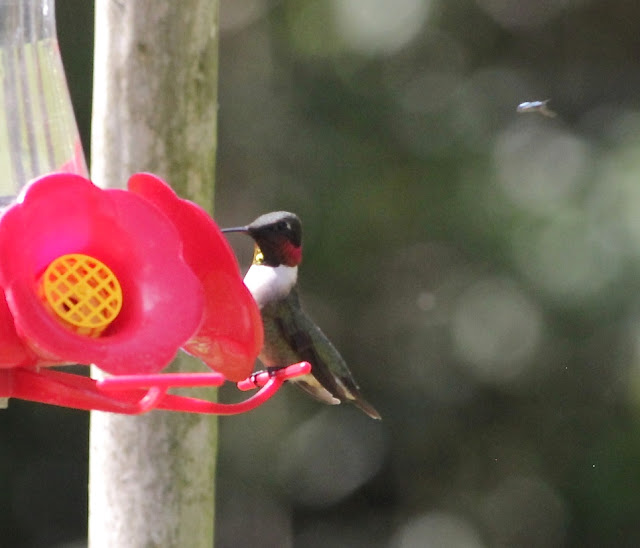
Ruby-throated Hummingbirds are passing through. Some have been with us all summer while others spent the season farther north and are now on their way to their winter homes. If we are lucky, maybe we'll get some of their cousins, the Rufous Hummingbirds, to spend the winter with us.

*~*~*~*

Is our planet the only one in the universe with life on it? That would seem to be an utterly ridiculous assumption. With the unimaginable abundance of planets, surely there are others with life. But how to find and connect with them?

*~*~*~*

Meanwhile, on our planet and our continent, a climate disaster unseen in 1200 years is unfolding. The American Southwest is experiencing a historical drought.

*~*~*~*

How can a study of history help to preserve an endangered species? That is the area of expertise of the "historical ecologist."

*~*~*~*

Coastal landowners in the United States are being urged to let rising sea waters into their property.

*~*~*~*

Once near extinction, the California Condor is making a recovery with a little help from its friends. 

*~*~*~*

Another species near extinction is the Chittenango ovate amber snail. Friends of the species are attempting to stave off that extinction.

*~*~*~*

Wildfires in California, Oregon, and Washington have caused air quality in the area to plummet.

*~*~*~*

Archaeologists in Borneo have discovered the earliest known evidence of surgery. It occurred 31,000 years ago and involved the amputation of the lower left leg. 

*~*~*~*

Not all so-called "marine protected areas" are created equal.

*~*~*~*

In British Columbia, an Indigenous-led project established a carefully guarded pen to protect pregnant caribou and their newborn calves. As a result of their efforts, the herd is flourishing.

*~*~*~*

This is the Mountain Plover, the American Bird Conservancy's Bird of the Week. A bird of the high plains of North America, like many birds of that habitat its numbers are decreasing.

*~*~*~*

The American chestnut tree was virtually wiped out by a blight-causing fungus a century ago, but now there is an attempt to bring it back, or at least to bring a hybrid back to the damaged lands where the trees once stood.

*~*~*~*

In other tree news, here's a story about an ancient ponderosa pine.

*~*~*~*

The Greenland ice sheet has just experienced one of its strongest late-season melts on record. It is September and the sheet is still melting.

*~*~*~*

Here's a link to the winners of the best bird photographs of the year.

*~*~*~*

There's a presidential election in progress in Brazil and the result of that election may well determine the fate of the Brazilian Amazon.

*~*~*~*

The energy crisis has inspired German cities to turn off night lights at landmarks, monuments, and prominent buildings as a way of conserving. It's an idea that we can hope will be emulated in other places.

*~*~*~*

Finally, in Connecticut, a family had an unexpected guest at their birthday party; a black bear showed up to demolish their cupcakes!


Comments

  1. I didn't know that about the American chestnut. My grandmother had a huge tree (in San Mateo, CA) and that was the only one I've ever seen. Those chestnuts were so good roasted over an open fire, just like in the song! I saw that about the bear and the cupcakes! It was probably the highlight of the birthday, seeing a bear might have been more exciting than a party! Or, I guess some children would be upset at not getting the cupcakes.

    ReplyDelete
    Replies
    1. Personally, I'd trade having a bear visit my birthday party for a cupcake anytime!

      Delete
  2. We've had hummingbirds all summer but dont know what kind, as we only get a glimpse of shimmering green and blue before they are gone. They have been at the feeders so we know they're there.

    ReplyDelete
    Replies
    1. I'm not sure where you are located, Harvee, but in the eastern half of this continent, the only one regularly here during summer is the Ruby-throat. In the West, it could also be the Rufous.

      Delete
  3. Hi Dorothy: I am not sure what happened and whether at your end or mine, but the roundup did not appear on my blog yesterday, and just showed up now, when I would normally be looking for your Sunday poem. In any event, thanks for the roundup. Better late than never. Now I am curious when my poetry fix will put in an appearance! All the best - David

    ReplyDelete
  4. That's scary that the Greenland ice sheet is melting so much. Our planet it just falling apart.

    ReplyDelete
    Replies
    1. What's really scary is to realize that the best hope for the planet might be the extinction of our species.

      Delete
    2. I've thought that for a long time, Dorothy, sad to say. And I'm with you-- I'd trade a bunch of cupcakes for a bear at my birthday party, too.

      Delete
    3. I would be honored to have an ursine guest.

      Delete
  5. I love the bird photos. They are astonishingly fresh and remarkable.

    It's good news for the California Condor and chestnut trees.

    We have had a lot of hummingbirds at our feeders lately. I would love to have some overwinter here with us.

    ReplyDelete
    Replies
    1. In recent years, we've had Rufous Hummingbirds overwinter with us, although not last winter for some reason. I'll keep my feeders stocked and ready just in case.

      Delete

Post a Comment

Popular posts from this blog

Poetry Sunday: Don't Hesitate by Mary Oliver

How about we share another Mary Oliver poem? After all, you can never have too many of those. In this one, the poet seems to acknowledge that it is often hard to simply live in and enjoy the moment, perhaps because we are afraid it can't last. She urges us to give in to that moment and fully experience the joy. Although "much can never be redeemed, still, life has some possibility left." Don't Hesitate by Mary Oliver If you suddenly and unexpectedly feel joy, don’t hesitate. Give in to it. There are plenty of lives and whole towns destroyed or about to be. We are not wise, and not very often kind. And much can never be redeemed. Still, life has some possibility left. Perhaps this is its way of fighting back, that sometimes something happens better than all the riches or power in the world. It could be anything, but very likely you notice it in the instant when love begins. Anyway, that’s often the case. Anyway, whatever it is, don’t be afraid of its plenty. Joy is no...

Poetry Sunday: Blackberry-Picking by Seamus Heaney

My mother was a farm wife and a prodigious canner. She canned fruit and vegetables from the garden, even occasionally meat. But the best thing that she canned, in my opinion, was blackberry jam. Even as I type those words my mouth waters!  Of course, before she could make that jam, somebody had to pick the blackberries. And that somebody was quite often named Dorothy. I think Seamus Heaney might have spent some time among the briars plucking those delicious black fruits as well, so he would have known that "Once off the bush the fruit fermented, the sweet flesh would turn sour." They don't keep; you have to get that jam made in a hurry! Blackberry-Picking by Seamus Heaney Late August, given heavy rain and sun For a full week, the blackberries would ripen. At first, just one, a glossy purple clot Among others, red, green, hard as a knot. You ate that first one and its flesh was sweet Like thickened wine: summer's blood was in it Leaving stains upon the tongue and lust ...

Poetry Sunday: Hymn for the Hurting by Amanda Gorman

You probably remember poet Amanda Gorman from her appearance at the inauguration of President Biden. She read her poem "The Hill We Climb" on that occasion. After the senseless slaughter in Uvalde this week, she was inspired to write another poem which was published in The New York Times. It seemed perfect for the occasion and so I stole it in order to feature it here, just in case you didn't get a chance to read it in the Times . Hymn for the Hurting by Amanda Gorman Everything hurts, Our hearts shadowed and strange, Minds made muddied and mute. We carry tragedy, terrifying and true. And yet none of it is new; We knew it as home, As horror, As heritage. Even our children Cannot be children, Cannot be. Everything hurts. It’s a hard time to be alive, And even harder to stay that way. We’re burdened to live out these days, While at the same time, blessed to outlive them. This alarm is how we know We must be altered — That we must differ or die, That we must triumph or try. ...