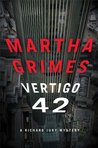
I had thought that Martha Grimes was finished with her Richard Jury mysteries. Then I ran across a note in one of the book review sections that I read about this book that was published this year. It is the twenty-fifth in a series that has been running since 1981. Since I had read all the previous twenty-four, it seemed incumbent on me to read this one, too.
The thing about Richard Jury and all his posse of fellow characters that readers have come to know over the years is that they never age. When the series started way back in the prehistorical days of the '80s, Jury and his sidekick and best friend Lord Ardry, aka Melrose Plant, were dashing, devastatingly attractive, upper class, 40ish Englishmen. Now, almost forty years later, they still appear to be dashing, devastatingly attractive, upper class, 40ish Englishmen. If only I knew where to find their fountain of youth!
All of Grimes' well-loved characters appear in this tale. It starts when the murdered body of a Frenchwoman is washed up on the wild Cornish coast and Brian Macalvie, divisional commander of the Devon-Cornwall police is called to the scene. Macalvie, who is famous for his implacable pursuit of malevolent perpetrators and never giving up on a case, finds the scene perplexing and calls on his friend, Richard Jury, now apparently a superintendent with New Scotland Yard, for assistance. His call interrupts Jury having a drink with a retired legendary CID detective, Tom Brownell, who had a 100% clearance rate for his cases.
Jury goes to Cornwall to assist Macalvie, but in the days following the discovery of the first body, two more murders occur. The events are widely separated and appear to have no connection and yet superdetective Brownell intuits that there is a connection. And that there may also be a further connection to an earlier supposed suicide - that of Brownell's own daughter.
There are, of course, Grimes' iconic characters of cute and precocious children and animals involved, and, as always, Jury calls on his friend, Melrose Plant, who he deems a children/animal whisperer, to help him out in extracting information from the kids.
Frankly, the plot here grows a bit confused and hard to follow. I suppose it wasn't helped by the fact that I was distracted by preparations for Thanksgiving while I was reading. The book would probably best be read by sitting down with it, concentrating fully, and finishing it in one sitting. That never happens to me.
In addition to the regular characters mentioned here, there are many, many others in this book that mostly play cameo roles, but they serve only to increase the confusion rather than illuminating the plot. So, on the whole, this was not one of the stronger entries in this long-running series, but for her truly avid fans, I'm sure it feels like the gift of a visit from an old friend.
My rating: 3 of 5 stars
Books, gardens, birds, the environment, politics, or whatever happens to be grabbing my attention today.
Translate
Showing posts with label Martha Grimes. Show all posts
Friday, November 29, 2019
Tuesday, July 26, 2016
Vertigo 42 by Martha Grimes: A review
Vertigo 42: A Richard Jury Mystery by Martha GrimesMy rating: 4 of 5 stars
The books in Martha Grimes' Richard Jury series often are rich in literary and film references and this one is no exception. The homage to Alfred Hitchcock's film Vertigo is perhaps obvious from the title, but there are also overt references to Thomas Hardy and William Butler Yeats, as well as more subtle nods to Oscar Wilde and even the Bard himself, Shakespeare. It all makes for a fun game for the reader, a kind of hide-and-go-seek, which is an actual game that plays a part in one of the mysterious deaths of the plot.
Once again, Jury is called upon to investigate a cold case, this time as a favor to a friend. Seventeen years before, Tess Williamson died in a fall down stone steps in the garden of her house in Devon. The verdict on the death was left open, as no definitive conclusion could be reached, but the inspector in charge of the investigation at the time leaned toward an accidental death due to the victim's known problems with vertigo. Her husband, Tom, is convinced that her death was murder, and, in that conclusion, he has an ally in another detective who was involved in the original investigation, Jury's friend, Brian Macalvie.
Tom is also friends with Sir Oscar Maples, another in Jury's circle of friends, and it is Maples who suggests to him that Jury might be willing to investigate the death, and it is he who delivers the request to Jury. Jury meets with Williamson at Vertigo 42, a bar in a City of London tower, hears his story, and agrees to look into the case.
One curious aspect of Tess's death is that five years before, a nine-year-old girl had also died in a fall at the Devon home, during a children's party that Tess was hosting. The victim was a particularly nasty child who was not liked by any of the other children, or, for that matter, any adults. There was suspicion that she was pushed and Tess was a suspect, but, again, there was no conclusive evidence and the verdict was left open.
So, two suspicious deaths seventeen and twenty-two years earlier, but before Jury can get very far into his investigation, another death occurs near the village where his friend Melrose Plant lives. A woman dressed in an expensive red silk dress and four-inch-high red heels dies in a fall from a tower. Did she jump? Was she pushed? How did she climb to the top of that tower in those four-inch heels? When it turns out that this woman was one of the children who were present at that party in Devon long ago when the little girl died, Jury sees a pattern and suspects that there may have been three murders.
Then, the woman's husband also turns up dead of gunshot wounds with his dog Stanley standing guard over his body. Four deaths - two in the past and two in the present - dot this intricate and compelling plot. How will Jury ever sort this puzzle out?
This is the latest entry in the Richard Jury series, number 23, and it isn't clear if there will be any more. If indeed it does turn out to be the last one, then Grimes will have ended on a fairly high note. This was a strong effort, more so than some of the recent books in which she seemed to be just phoning it in.
As usual, the plot meandered all over the countryside between Devon and London and it encompassed visits with most of the recurring characters that we've come to know and love (or hate) over the years. It had the usual quirky animals, but at least this time we didn't spend time inside the animals' heads watching their nonverbal reaction to events. There were no charming children this time around, which made for a bit of a change. But, all in all, particularly with the literary allusions, it hit all the notes that we've come to expect from Martha Grimes and it was a fun summer read.
View all my reviews
Wednesday, July 6, 2016
The Black Cat by Martha Grimes: A review
The Black Cat by Martha GrimesMy rating: 3 of 5 stars
After the disappointment of Dust, I found Martha Grimes to be a bit more back to form with this penultimate entry in her Richard Jury series. It had dogs and cats and children and the recurring characters that we've come to expect in the series. The plot was pretty well done and there were plenty of red herrings as well as foreshadowing of clues to send us toward the solution.
Moreover, in this one, the Long Piddleton contingent made only a very brief and mostly unannoying appearance. That was a plus.
On the other hand, there was a bit too much of the non-verbal communication between the dog, Mungo, and the cat, Morris (a female cat, by the way), as they tried to make the stupid humans see the truth. There were a few chapters that were seen through the eyes of the animals and which we spent inside their heads. Just a bit too precious, but Grimes really can't seem to control herself when it comes to her animal characters; they are always extremely intelligent and anthropomorphized.
The mystery here involves the murder of three beautiful women, all dressed to the nines in designer clothes and shoes. The first woman is killed in Chesham on the patio of a pub called The Black Cat. Subsequently, two more women are killed in a similar manner in London. It turns out that all three were leading double lives. They had their ordinary lives and jobs and then their second secret lives which involved jobs with escort services, although each one worked for a different service.
The police make the natural assumption that since all three worked for escort services, their deaths must somehow be connected to that work. But, at length, Superintendent Richard Jury begins to suspect that there may be something else in the women's background that connects them. He's unconvinced that this is the work of a serial killer and starts looking for another explanation.
Throughout the novel, there is a virtual plethora of black cats and red herrings. There are multiple references to old movies such as Vertigo, Strangers on a Train, and Now, Voyager and the reader begins to wonder, are these movies supposed to be a clue? Since Jury spends a lot of time on trains and does some of his best thinking on them, perhaps that narrows it down a bit. Hmm...I remember the plot of that movie - strangers meet on a train and agree to commit murder for each other. Could it be...? Has Grimes lifted her plot from the Hitchcock movie?
In addition to the main plot, there is a subplot involving Jury's paramour from the last book, the Inspector Lu Aguilar, who was knocked down and seriously injured by an automobile at the end of that book. We discover that she is paralyzed and will likely never walk again and, as the story progresses and Grimes doesn't appear to have any further use for her, she slips into a coma and doesn't seem to be long for this world.
Meanwhile, Jury, though feeling guilty about Aguilar, is apparently ready to resume his relationship with Dr. Phyllis Nancy, while simultaneously still being mesmerized by his upstairs neighbor, Carole-Anne. He just can't seem to resist those redheads.
View all my reviews
Monday, May 30, 2016
Dust by Martha Grimes: A review
Dust by Martha GrimesMy rating: 3 of 5 stars
Back to one of my guilty reading pleasures as a break from some of the more serious reading I've done lately. Martha Grimes' Richard Jury series fits the bill for that. I must say though that this time the reading was more guilt than pleasure. Guilt, as in "Why am I wasting my time reading this?"
This is the 21st entry in this series. We are nearing the end. I believe there are a couple left, although Grimes may write more. In such a long series, one expects hits and misses. I would put this one more on the "miss" side. In the end, I gave it a VERY generous three stars, mostly for old time's sake; in actuality, it probably deserved two-and-a-half at best.
The first problem with the book is its plot. A young man is shot to death on the balcony of his room at a trendy Clerkenwell hotel. The body is discovered by young Benny Keegan who is working at the hotel. Benny and his dog Sparky once saved Richard Jury's life and Jury is a friend so Benny calls him. So, even though it's not technically a Scotland Yard case, Jury comes to the scene and gets involved.
And, boy, does he get involved! We learn before he goes to the scene that he is having an affair with Dr. Phyllis Nancy, the pathologist, but when he arrives at the murder scene, he meets Inspector Lu Aguilar of the Islington police who is in charge. Inspector Aguilar is a looker. Moreover, she is originally from Brazil and is a hot-blooded, passionate, Latin woman, whom Jury takes to his apartment and has raucous, furniture-destroying, neighbor-disturbing sex with, straight from the crime scene. And his bed is not even yet cool from his night with Dr. Nancy! This is not the Richard Jury I've come to know over the past 20 books and I did not like him very much.
Neither did I like the portrait of the hot-blooded Brazilian inspector painted by Grimes. Really, Martha? Stereotype much?
Anyway, back to the murder victim who seemed to have been an inoffensive and quite generous rich guy, patron of the arts, who had no enemies. Who could possibly want him dead?
The convoluted plot which Grimes spins reaches back to World War II and long smoldering hatreds, but it seems to take forever to develop and it is only close to the end that we begin to get a glimmer of an inkling as to what might have precipitated the murder. Even then, it seems most unlikely.
There is a secondary plot line involving the works of Henry James. The murder victim had recently been the resident caretaker of the National Trust's James property in Rye, Sussex, a place called Lamb House where James lived and wrote what are considered his three best books. Jury, as per usual, enlists the aid of his friend, millionaire Melrose Plant, to go to Lamb House and take over the caretaker's post until a new one can be selected, and to keep his eyes and ears open and see what can be learned. In that capacity, Plant finally supplies the key that opens up the solution to the case.
Speaking of Plant naturally brings up the little village of Long Piddleton where he lives and which is where we first encounter him in this story. Long Piddleton and the louche group of Long Piddletonians, Plant's friends, who gather at the Jack and Hammer at 11:00 and 6:00 every day to drink copious amounts of booze and speak ill of all their neighbors. I confess I used to find them amusing but now I am thoroughly bored with them and irritated by them. Do they serve any purpose in life other than getting drunk and making fun of people? It doesn't seem so.
So, what did I like about the book? Well, the children and the animals. Grimes is always at her best when writing about them. Cyril the Cat is still a star and I still like Melrose Plant even though I'm annoyed by his entourage. And Sgt. Wiggins, who has grown on me over the years. I enjoyed the Henry James references that I was able to understand. Unfortunately, I'm not that familiar with his work, having only read a couple of his books, and perhaps if I were better read in the oeuvre, I might have enjoyed this book more.
Nah. Probably not.
View all my reviews
Thursday, March 17, 2016
The Old Wine Shades by Martha Grimes: A review
The Old Wine Shades by Martha GrimesMy rating: 4 of 5 stars
A man walks into a pub and starts telling a story to a stranger. The stranger is Superintendent Richard Jury of New Scotland Yard and the storyteller allegedly has no idea who he is. Over the next three nights, he returns to the bar to meet with Jury and continue telling him his baffling story.
The story concerns a woman who has disappeared, along with her nine-year-old son and their dog. The man claims the woman is (was?) the wife of a friend of his, a physicist who is now in a psychiatric hospital, having suffered a breakdown because of the unexplained disappearances.
The disappearance occurred some nine months before. The woman, child, and dog had gone to Surrey to look at some property. The couple was considering moving there. They looked at one house and had tea with the residents and then went on to a second property. The woman was seen there but neither she nor her son have been seen since, seemingly having vanished into thin air.
But then the dog came back.
The Surrey police allegedly investigated but found nothing and concluded that the woman, for reasons of her own, had chosen to disappear. But friends like the storyteller, Harry Johnson, are still trying to find answers.
Is telling the story to Richard Jury part of that effort to find an answer? Or is he trying to involve him in some greater mystery? But Harry doesn't know that Jury is a policeman. Or does he? Jury's picture has recently been all over the news after he broke up a pedophile ring. Has Harry been stalking him and did he seek him out because of his notoriety?
Jury didn't follow the rules in breaking into the house where the child sex slaves were being held and so, even though he's not exactly suspended, (That would be a PR nightmare since the public considers him a hero.) he's not really being allowed to work either. So he has time on his hands. Time to explore this mystery that has been presented to him.
This is the twentieth book in Martha Grimes' long Richard Jury series. There are only three more (so far) left, and as we near the end, her mysteries are getting more complicated and ambiguous. The quirky little village of Long Piddleton and its annoying residents play less and less of a role in them.
We still have Melrose Plant of Long Piddleton, of course. He's Jury's good friend, a fabulously rich dilettante who enjoys playing roles and being sent undercover by Jury to help him solve his cases. In this one, he plays the long-dead physicist Niels Bohr!
The mystery here hinges on theories in physics. We get discussions of string theory, quantum mechanics, the uncertainty principle, and Schrodinger's Cat - that famous cat that can be either alive or dead until you open the box. Is the woman in this case alive or dead? Will Jury be able to open the box?
Although this was a different kind of mystery for Grimes, some things are always true. Her penchant for weird pub names in her titles, for example. The Old Wine Shades is the name of the pub where Jury and Harry meet. Another point we can absolutely depend on is that there will be at least one precocious, oddball child and a lovable cat or dog that is usually more intelligent and noble than many of the humans in the story. In this case, it is the dog named Mungo - the one who came back - and he is the real hero of the piece.
Some of the reviews that I've read of this book found it a bit too precious with some of the viewpoints presented through the eyes of the dog and just too irritating with all of physics theories floating around and the fact that there is no satisfying denouement at the end. (Spoiler alert!) Jury knows what happened but he can't prove it and the culprit walks free.
Trust Grimes though. Even though the bad guy isn't nabbed, she gets the children out of danger before the epilogue.
View all my reviews
Thursday, February 11, 2016
The Winds of Change by Martha Grimes: A review
The Winds of Change by Martha GrimesMy rating: 4 of 5 stars
Child abduction. Human trafficking. Pedophilia. Child murder. Martha Grimes' series of so-called "cozy" mysteries has certainly taken a turn to the dark side with the last two or three entries that I've read. None has been darker than this one, number 19, The Winds of Change.
It starts with the inexplicable murder of a tiny girl. Found cast aside like garbage on a London street, she's five or six years old and nameless. No one immediately comes forward to claim her. She has been shot in the back. Who would want to murder a small child?
Superintendent Richard Jury begins his investigation and soon learns that there is a pedophilia ring operating in the area. A number of small girls are kept prisoner in a house to serve the sick desires of some of the local upstanding businessmen, but police have been unable to gather the evidence needed for probable cause to raid the house and break up the ring. (This began to remind me of one of Anne Perry's Victorian mysteries revolving around the victimization of women and children.)
In the middle of his investigation, Jury is called by his friend, Commander Brian Macalvie, to come and help him with another mystery. It's the murder of a young woman, killed on the grounds of a country estate. She, too, is anonymous, as her body was found with no identification.
It soon emerges that the man who owns the estate where she was killed has been dogged by tragedy. His stepdaughter, whom he adored, had apparently been kidnapped three years before, although no ransom demand was ever received. Moreover, several months after that happened, the child's mother, his wife, died from a heart condition. And who do you think is the child's father? Well, it is none other than the chief pedophile of that odious ring in London. Surely, all of this must be connected.
Once again, Jury deploys his friend Melrose Plant as an undercover agent on the county estate. This time he poses as a "turf specialist" to assist in the renovation of the gardens of the estate. And once again, Melrose encounters an odd and charming child, a little girl, and her equally odd and charming dog, both of whom live on the estate. Some things never change in a Grimes mystery. Although some readers might find this tiresome after a while, I actually enjoy these quirky child and animal characters of hers. They bring a touch of lightness and reality to her plots.
And this plot certainly needed a little lightness. There's not much time spent drinking and trading quips with the Long Piddleton crew at the old Jack and Hammer in this one, and there's precious little Cyril the Cat, nemesis of Jury's boss, Chief Superintendent Racer, and therefore loved by Jury and Racer's secretary, Fiona. No, it definitely leans toward the dark side. But it was an intriguing read, even though the plot had a few holes and the solution to the central mystery actually became pretty evident by about two-thirds of the way through. It proved to be another satisfying chapter in the Richard Jury saga.
View all my reviews
Monday, January 4, 2016
The Grave Maurice by Martha Grimes: A review
The Grave Maurice by Martha GrimesMy rating: 4 of 5 stars
This book started out as a sort of homage to Josephine Tey's The Daughter of Time, sometimes referred to as the best mystery ever written. Like the protagonist in that book, we find Superintendent Richard Jury laid up in a hospital bed and unable to pursue his usual occupation. He needs distraction. Sergeant Wiggins brings him Tey's book to read and his doctor provides him with a much more current mystery.
When last we saw Jury (in The Blue Last) he was lying grievously wounded on a dock. He was found there by a dog and his boy and by his friend Melrose Plant. His life was saved and now he's in recovery, soon to be released. But in the meantime, his mind needs something to occupy it.
His surgeon catches his interest with a mystery from his own life. Two years earlier, his fifteen-year-old daughter had vanished without a trace along with a champion thoroughbred that she was tending at her grandfather's stud farm. Both the horse and the girl disappeared from the barn one night and no one has seen them since.
Jury reviews the known facts of the case and determines to investigate. He's not cleared to return to duty and so he will have some time to look into the matter unofficially.
While still in the hospital, he sends his friend Plant to the stud farm to reconnoiter the place and find out what he can. Melrose arrives to find the local police already there. The body of a woman has been found on one of the training tracks. Everyone at the farm claims not to recognize the woman. How did she happen to end up on that track?
Plant's excuse for going to the farm in the first place is to pretend that he's interested in buying a horse. As these things usually turn out when Melrose Plant is involved, he winds up actually buying a horse. A very expensive stallion.
Once Jury is released from the hospital, he heads to Northampton to convalesce at Plant's home and then he begins his own investigation into the girl's disappearance. Could it somehow be related to the murder of the woman who was found on the training track? There are few clues and Jury finds that he must attempt to piece together tiny bits of information and connections in order to try to get a clear picture of what has happened.
Martha Grimes is up to one of her usual twisting and turning plots in this book. It becomes a rather dark story as we get further into it, involving the abuse of the abducted girl and the abuse of pregnant mares kept for the production of their urine that is used in making the hormone replacement therapy drug Premarin. Grimes paints an all too vivid picture of the lives of the poor mares that are kept tied up and without a chance to exercise, their every drop of urine collected. The reader intuits that this is not going to end happily. And it doesn't.
But (spoiler alert) at least the mares survive and move on to green pastures.
View all my reviews
Tuesday, November 24, 2015
The Blue Last by Martha Grimes: A review
The Blue Last by Martha GrimesMy rating: 4 of 5 stars
All the usual Martha Grimes ingredients are here: precocious and charming children; clever cats and dogs; quirky villages and villagers; memories of World War II; quaintly named pubs, of course; in London, Richard Jury, Wiggins, Cyril the Cat, Carole-Ann, and Mrs. Wasserman, and in Long Piddleton, Melrose Plant, Marshall Trueblood, Aunt Agatha, and all the other villagers we've come to know and expect. And, naturally, there is the typical convoluted Grimes plot that bobs and weaves and circles back on itself. In Grimes books, it is always the journey itself that is most satisfying; often, the conclusion is less so. That is the case with this book.
A friend of Jury's in the City of London police asks his assistance in solving a mystery. Some bones have recently been uncovered on the site of a pub, "The Blue Last," that was destroyed in the blitz during World War II. They are the bones of a woman and child. Ostensibly, they are the bones of the daughter of a wealthy family and a child who was the daughter of that family's nanny. Jury's friend, however, believes that the child was actually the daughter of the woman who died there. The nanny, who survived, he believes, substituted her own baby for the baby of the wealthy woman who died. That baby, now grown up, stands to inherit millions upon the death of the family patriarch.
An additional mystery is added to the plot when a man who is close to the family, and who is researching a book about the period in which the pub was destroyed, is murdered. Jury's policeman friend was also a friend of this family and he often visited the man who was murdered. Jury suspects that his murder was somehow related to the book that he was planning to write, but his manuscript and all his notes as well as his laptop were all taken at the time that he was killed. No one seems to know just what was in the book.
Adding even more confusion, the nine-year-old girl who is a ward of the family patriarch believes that someone is trying to kill her, and, indeed, there was a shot fired into the greenhouse while she was there. It's all a real muddle and there don't seem to be any obvious suspects.
Once again, Jury calls upon his friend Melrose Plant to go undercover to help with the investigation. This time he is to pose as the undergardener on the family's estate and gather information as to what's really going on with these people. As usual, Melrose has several scenes with the precocious child on the estate, as well as her friend and his dog, and, as usual, these scenes are a delight.
We also have a subplot with Marshall Trueblood, the Long Piddleton antiques dealer, who believes he may have an authentic Renaissance masterpiece, and persuades Melrose Plant to accompany him to Italy to consult experts who may be able to confirm the artwork's authenticity. Their trip is a lark worthy of Grimes.
One reads Grimes' novels for their settings and their characters and her use of language in describing them. The intricate plots are sometimes difficult to follow, and, as in The Blue Last, the endings are not always satisfying. But her characters have such winning personalities that one keeps coming back for the pleasure of interacting with them once again.
Overall, this was a fun read. I debated about whether I should award it three stars or four stars. In the end, I decided to be generous, even though the cliff-hanging ending truly left me hanging and unsatisfied. I guess I'll just have to read the next book in the series to find out what happened.
View all my reviews
Tuesday, October 27, 2015
The Lamorna Wink by Martha Grimes: A review
The Lamorna Wink by Martha GrimesMy rating: 4 of 5 stars
This sixteenth entry in the "Richard Jury Mysteries" is actually a Melrose Plant mystery. Richard Jury only makes a brief appearance in the story at the end of the book during the wrapping up phase.
The hook of the story is that Jury is in Ireland on Scotland Yard business and his friend Melrose, bored with his existence in Northumberland and hoping to get away from Aunt Agatha, decides to rent a house for three months in Cornwall. Of course, there is no easy escape from Agatha and soon she is ensconced in Cornwall as well, staying at a B-and-B and learning the real estate trade from her new friend there.
The house which Melrose has chosen to rent is right out of Rebecca or Jamaica Inn or some other Daphne du Maurier tale. It exudes an air of tragedy, even in the harsh beauty of its surroundings. Melrose wonders from where the feeling of sadness and mystery which surrounds the house emanates. He doesn't have to wonder long.
He soon learns that four years previously two children who lived in the house drowned in the nearby sea. After the horror of this event, their parents moved away, never to return and the house was put up for rent. Even though Commander Brian Macalvie was on the case of the drowned children, it was never really solved. Was it simply an inexplicable accident or was it something more sinister? As we've learned previously, Macalvie never closes a case that he hasn't solved, so he is still looking for answers.
Melrose Plant settles into the Cornwall community for his three-month vacation and begins visiting the pubs and pastry shops and talking with the locals. He is soon engrossed in the tales that he hears of the place and particularly of the family which occupied the house where he is now living and the tragedy that befell them. His avocation as an amateur detective leads him to snoop further.
But soon there are more and newer mysteries to ponder. The half-owner of the local pastry shop, and aunt of a young man who works several jobs around the town and whom Melrose meets and likes, has disappeared without leaving any word for her nephew as to where she was going. At the same time, the murdered body of a woman is found in a nearby village and Melrose fears at first that it is the missing aunt, but it turns out to be someone else altogether. However, the victim is someone who had had public disagreements with the aunt. Suddenly, the missing person becomes a possible suspect in the murder.
Melrose visits a local hospice where his landlord is presently living. It turns out to be more like an upscale retirement home. The old man, his landlord, is the grandfather of the two children who died. Also, living at the home is the man's long-time chauffeur, who is suffering from AIDS and whose survival prospects are dim. (This book was published in 1999.) But soon even those prospects are ended when the man is shot dead while sitting in his employer's wheelchair. Was the shot to the back truly intended for him or was it a case of mistaken identity?
Well, the bodies continue to drop while Melrose and Macalvie puzzle through the clues and try to determine if there is a connection among all these deaths or are they merely coincidences?
We do get a bit of respite from the doom and gloom of Cornwall when Melrose takes a trip to London and there meets with the artist Bea Slocum with whom he's having a bit of a romance. And I say "Bravo!" to Martha Grimes for actually finally giving him an adult emotional experience. More, please.
Grimes' plots are very loosely constructed and tend to wander here and there. Once again, we get to spend ample time in Long Piddleton, and once again Vivian Rivington is threatening to marry her Italian count. Therefore, it follows as the night does the day that the usual Piddletonian suspects are engaged in their juvenile shenanigans meant to thwart the nuptials. Contrast their silly antics with the grotesque explanation of the two children's deaths which Macalvie finally uncovers. It's enough to make a reader queasy, but that's Grimes for you - from shock to comedy routines to intrigue all within the covers of one book.
View all my reviews
Friday, October 16, 2015
The Stargazey by Martha Grimes: A review
The Stargazey by Martha GrimesMy rating: 4 of 5 stars
Well into Martha Grimes' Richard Jury series, one finds the quality of each individual book sometimes a bit hit or miss. This one was definitely a hit for me. I enjoyed it quite a lot, even though I suspected pretty early on who the culprit(s) was(were). Or maybe it was because I figured it out pretty early and was able to watch Jury and his friend Melrose Plant struggle to the same conclusion.
It's a somewhat complicated plot with definite noir tendencies. It involves art forgery and theft, the consequences of political murder, the activities of a professional assassin, a couple of murders, and has the usual characters from Northants that we have come to expect and enjoy, as well as the London contingent of Scotland Yard, cats and dogs, Jury's neighbors, and the quirky Cripps family. Yes, all the essential elements are here and Grimes concocts a very tasty dish of them.
Jury, as always, is inexplicably lonely on a Saturday night. Such a handsome, intelligent, lovable man with a killer smile and yet, in Grimes' world, he just can't find anyone to love. Or to love him. Well, fiction is all about the suspension of disbelief, I suppose.
On a Saturday night, Jury takes a ride on a bus and notices a striking blonde woman in a sable coat. She gets on the bus, rides for a while, gets off for a while, then gets on again. When she gets off the second time, Jury decides to follow her. He follows her to an ecclesiastical palace and gardens, but does not follow her into the grounds of the place. The next day he reads in the paper that the murdered body of a blonde woman in a fur coat was found on one of the herb beds in the garden and reproaches himself that he did not continue to follow her.
The murder victim is unidentified and Jury contacts the local policeman in charge to tell him what he observed. He is asked to look at the body to see if it is the woman he saw. She is superficially like that person, but when he looks closer, he is able to see differences. It is not the same person. So, were there two blonde women in fur coats in those gardens the night before?
As usual, even though it isn't technically his case, Superintendent Richard Jury gets involved, and, as usual, he calls on his friend Melrose Plant to do some private investigating for him.
Melrose goes to London and checks into his father's old club where he meets several interesting if ossified old codgers. One of them turns out to be a former art critic. A very famous art critic. Since one of Melrose's assignments from Jury is to buy a painting at a local gallery owned by a family that had its origins in the Soviet Union, where it suffered the murder of the family patriarch, he cultivates a relationship with the critic and asks his help and advice.
It is unclear at first just what this art gallery and the family might have to do with the murdered woman, the theft of a famous Chagall painting from a museum in St. Petersburg, or an eventual second murder that takes place. The plot is made more perplexing because a second blonde woman in sable does turn up and, even though she denies it, Jury knows that she is actually the person that he saw on the bus and followed.
Well, this does all get quite intricate and confusing at times, but Grimes does a good job of blending it together and making sense of it in the end.
My only real qualm with the book was its ending. I found it unsatisfactory, but I wondered if perhaps we were left hanging because this plot is to be picked up in later books. Guess I'll just have to read them to find out.
View all my reviews
Thursday, August 13, 2015
The Case Has Altered by Martha Grimes: A review
The Case Has Altered by Martha GrimesMy rating: 4 of 5 stars
When it comes to light summer reading, perfect for sweltering days spent in air-conditioned comfort in one's favorite chair, it's hard to beat one of Martha Grimes' Richard Jury mysteries. She's up to her usual standard in The Case Has Altered although there were one or two things that annoyed me. But I'll get to those in a moment.
In this fourteenth entry in the series, the mystery involves the murder of two women. One was a guest at a country home of local gentry in the isolated fens. She was the ex-wife of the owner of the estate and a thoroughly self-centered and evil person who was disliked by everyone who knew her. Plenty of possible suspects for her murder.
The second victim, killed a few days after the first, was a barmaid at the pub called "The Case Has Altered" who also worked part time in the kitchen and as a sometimes maid at the estate. She seemed to be a thoroughly inoffensive person, one who would go unnoticed in a crowd, and there doesn't seem to be any obvious motive for her to have been killed.
It turns out that another guest at the estate at the time that the ex-wife was killed was Lady Jennifer Kennington, whom Richard Jury has long carried a torch for, but, being Richard Jury, he's never mentioned it to the object of his affection. Through a convoluted set of circumstances, Lady Kennington becomes the prime suspect in the murders. Superintendent Jury and his friend Melrose Plant begin their independent investigation to try to clear her.
Things do not go well with the investigation. They are unable to come up with any other plausible suspects and eventually Jenny is arrested for the murders. Her situation is not enhanced by the fact that she withholds information from the police. She keeps secrets even when it isn't necessary. However, the evidence against her is purely circumstantial and at the hearing, the judge decides there is not enough reason to hold her.
The investigation continues.
Meanwhile, back in Long Piddleton, Melrose's obnoxious Aunt Agatha is pursuing her own case against a local shop owner. She claims to have been attacked by the owner's tiny dog, causing her to trip over the shop's sidewalk display and injure her ankle. She is suing the owner who has no money and who will be bankrupted if she loses.
Since she has no money for a solicitor, the flamboyant local antiques dealer, Marshall Trueblood, takes on her case and represents her at the trial. The trial itself is a hoot and it turns out exactly as any reader in her right mind - and heart - would want it to.
The murder case, too, is eventually resolved, although it is never really clear why Jenny is so secretive. She could have saved herself and everyone else an awful lot of trouble if she had just told the whole truth to begin with. In fact, I find Jenny to be an extremely unlikable character. I think it's time Jury moved on from his infatuation with her.
The character of Lady Jenny Kennington was one of the things that annoyed me about this story. The other was the author's description of the second murder victim - the barmaid/cook's assistant/maid. Every time her name is mentioned, Grimes goes into excruciating detail about how the woman was ugly. She was not attractive to men and so the only way she could ever get one was by falling into bed with them. Which she did. Because she was unattractive and tried to make up for it by being willing. Willing to do anything.
Over and over the author drives home just how plain the woman was. Her plainness did, it is true, have something to do with the resolution of the case, but she didn't have to beat her readers over the head with it in every chapter. Once or twice would have been more than enough. P.D. James would have made the point in one.
View all my reviews
Thursday, July 30, 2015
Rainbow's End by Martha Grimes: A review
Rainbow's End by Martha GrimesMy rating: 4 of 5 stars
I've recently been somewhat disappointed by the books that I've read in this series - a series that I have, on the whole, found very enjoyable. So, it makes me happy to report that I found Rainbow's End to be quite entertaining. Perhaps the summer heat has addled my brain, but I liked it very much.
This book is the thirteenth in the long (and continuing) Inspector Jury series. As in the last book, The Horse You Came In On, we find Jury being persuaded to take a trip to the United States to follow up on potential clues regarding the death of an American who died at Old Sarum in England. The woman was a silversmith from Santa Fe, who created amazing works in silver and turquoise. Her death at first seems to have been from natural causes or an accident, but District Commander Brian Macalvie doesn't think so.
From our previous acquaintance with Macalvie, we know that he's NEVER wrong. His instincts regarding murder are unassailable, and so when he suspects that the supposed natural deaths of three women in three different locations in England are somehow related, Superintendent Jury knows better than to dismiss his theories out of hand.
The investigation reveals that the two other women who died had visited Santa Fe in recent months before their deaths and they could have met the Santa Fe silversmith who died. On this somewhat tenuous lead, Jury finds himself winging his way to New Mexico to follow up on Macalvie's instinctive suspicions.
Meanwhile, back in England, Sgt. Wiggins is in hospital with a mysterious malady related to an electrical experiment and Melrose Plant is assigned to look in on him and to undertake certain inquiries related to the case, as well as a personal inquiry on behalf of his friend, Jury.
While he's laid up, Wiggins is brought books to read, among them Josephine Tey's The Daughter of Time in which her detective solves a historical crime while flat on his back in a hospital bed. Inspired, Wiggins decides to try his hand at researching issues related to the three women's deaths in hopes of helping to solve the mystery.
In Santa Fe, Jury seeks out people who knew the dead woman, including the cousin who had gone to England to identify the body. As he talks to these people, he builds an image of a woman who was impractical and rather other-worldly, maybe a bit lazy - totally unlike the 13-year-old sister she left behind.
The sister, Mary Dark Hope, is one of Martha Grimes' typical precocious and quirky children characters. She is completely down-to-earth, practical, and self-sufficient, and, of course, she has a pet. In her case, the pet is a coyote that she raised from a pup. She tells everybody he is part German Shepherd, but nobody is fooled.
The investigation proceeds apace, involving many of our favorite characters from previous books. and slowly all the threads begin to connect, leading to a pretty exciting conclusion.
I was quite taken with Grimes's descriptions of Santa Fe and its crowded restaurants and craft shops along Canyon Road, as well as its people who devote themselves to serving the tourists who flock there. It all sounded spot on to me, an accurate depiction of the Santa Fe and the New Mexico that I remember from visits. She was particularly good at describing the desert and the quality of light that draws so many artists and would-be artists to the area.
All in all, this was a satisfying read. I'm glad to find Grimes on track once more.
View all my reviews
Tuesday, June 16, 2015
The Horse You Came In On by Martha Grimes: A review
The Horse You Came in On by Martha GrimesMy rating: 1 of 5 stars
"Prose seems to be falling off just a bit," said Jury..."Definitely fallen off," said Jury, yawning.
Yes, even Superintendent Richard Jury seems to acknowledge it in this Martha Grimes cozy mystery. The prose has definitely fallen off. Fallen off a cliff, in fact.
When I commit to reading a book, I stick with it to the very end. Even when I find myself skimming rapidly over sections of it because the writing is so bad. That certainly happened with this book. Frankly, it was one of those times when I seriously considered breaking my rule and quitting the book halfway or three-quarters of the way through, but I did persevere and managed to make it through to the bitter end. I deserve a medal for that.
What was Grimes thinking? What was she hoping to accomplish with this convoluted story? It has so many plots and counterplots that it is impossible to keep them all straight. Indeed, they are all so uninteresting that there is no incentive for trying to keep them all straight. I write this as one who has pretty much enjoyed the Inspector/Superintendent Richard Justice series up until now - some books more than others certainly - but it pains me to say that this one is a real stinker.
The book starts in England, with Justice growing increasingly restive in his position and considering a move out of London, possibly to one of the provinces. He's considering where there are job openings, where he might like to work, and who he might like to work with. Macalvie, maybe?
But then the story moves off on a tangent.
The nephew of a titled lady has been killed in Philadelphia and Justice is persuaded to cross the ocean and liaise with the Philadelphia police to investigate. Since he is currently on leave, he is able to accomplish this, but he also decides to take Sgt. Wiggins along with him "on holiday" because, after all, who is Justice without Wiggins?
And who is Justice without Melrose Plant?
Fortuitously, Melrose receives a call from an American friend, living in Baltimore, teaching at Johns Hopkins. A student of hers has recently been murdered on January 19, Edgar Allen Poe's birthday, near Poe's grave. The student had recently "found" a previously unknown manuscript in a trunk that was allegedly written by Poe. For some reason, this professor needs Melrose Plant's support, so, of course, he decides to hop on the plane with Justice and Wiggins and travel to America.
Most of the action takes place in Baltimore and it involves a lot of talk about spurious documents, Poe, plagiarism, genealogy and the transmission of peerage titles down through the generations, and whether or not Baltimore will get a new football franchise since the Colts have absconded. (This book was published in 1993.) Camden Yards, the beautiful and at that time new, baseball park also comes in for a fair amount of discussion and a visit by Justice.
Most agonizingly, much of our heroes' time in Baltimore is spent reading aloud from the "Poe manuscript" and more from the plagiarized writings of Melrose's friend. It is all truly awful.
Do you get the feeling that this is all just a hopeless mish-mash, a word soup with very little spice or flavoring? Well, that about sums it up, I think. Very disappointing.
I have the next two Richard Justice mysteries still in my reading queue on my Kindle and I guess I will read them - because that's what I do. But I'm going to give myself a break from Grimes for a while and hope that she had returned to her earlier, crisper writing with the next one.
View all my reviews
Friday, May 1, 2015
The Old Contemptibles by Martha Grimes: A review
The Old Contemptibles by Martha GrimesMy rating: 3 of 5 stars
When the woman with whom Richard Jury is engaged in a passionate affair is found dead of a barbiturate overdose in her flat, it seems that Jury's famously bad luck with women has reached its nadir. Since the death is considered "suspicious," Scotland Yard investigates, and since, because of his relationship with her, Jury is considered a possible suspect, he is suspended from the force. Unable to participate himself, he deploys his friend Melrose Plant to go to the woman's family home in the Lake District and go undercover to find out what he can about their relationships.
The fabulously wealthy Plant impersonates a down-at-heels librarian who hires himself out to the family in order to catalog and organize their library. He is soon discovering all kinds of interesting things about the family.
For one thing, this family seems extraordinarily unlucky. They have suffered four suspicious deaths in a period of five or six years. One was definitely a suicide and the latest one, who is the widow of the suicide, may be also. But the other two deaths were put down as accidents. Melrose suspects something more sinister.
We have most of the usual characters that we've come to care about, but also there are a dismaying number of characters either in or somehow connected to the family and it is hard to keep them all straight. Too, it is hard to get much more than a very passing sense of who they are and what their motives might be.
As usual, we can depend on Grimes giving us charming children characters who are usually much smarter and more accomplished than the adults in their lives. In this instance, we have the teenage son of Jury's dead paramour and an eleven-year-old girl named Millie who has a black cat named Sorcerer. (Yes, we can depend on having a perspicacious animal involved as well.) Grimes clearly has a soft spot for such characters and they are always lovingly drawn.
She also gives us the curmudgeonly patriarch of the family - the one with all the money - who chooses to live in a retirement home rather than with his family, most members of whom he doesn't like much. He does like and value Alex, the paramour's son, and Millie. He has some interesting friends that we get to know at the retirement home, especially one named Lady Cray who plays an important role in the ending, where rough justice is efficiently dispensed.
I do enjoy Grimes' writing. In general, it is very crisp. Her plots flow (seemingly) effortlessly and, based on her output, she seems to have an inexhaustible supply of them.
That being said, I thought this book was just a bit weak. Part of the problem, I think, was the plethora of characters and being unable to really home in on the most important ones. I can usually figure out whodunit from the clues scattered throughout, but I didn't get this one, and even after the denouement, I found it a bit confusing.
But I did like Millie and Sorcerer.
View all my reviews
Monday, April 13, 2015
The Old Silent by Martha Grimes: A review
The Old Silent by Martha GrimesMy rating: 3 of 5 stars
Continuing my reading trip through the Martha Grimes series featuring Superintendent Richard Jury of New Scotland Yard, I have arrived at the tenth entry, The Old Silent. So, I'm not quite to the halfway mark yet in a series that extends, to this point, to twenty-three books.
The series has evolved quite a lot since its beginning. Sgt. Wiggins has become a more fully fleshed-out and sympathetic character. Brian Macalvie, the stubborn District Superintendent who never gives up on a case, sometimes returning to a years-old crime to solve it and who, it seems, is never wrong, has become a returning character in these stories. And we've become more familiar with all the residents of the sleepy little village of Long Piddleton, especially amateur detective Melrose Plant. All in all, it is a good mix of interesting characters, enough to keep the reader involved and invested in the outcome.
In this book, we see Richard Jury somewhat at the end of his tether, exhausted and overworked. He's doing a bit of lollygagging and engaging in one of his favorite activities, observing a beautiful woman. The woman in question seems distracted and is unaware of his presence as he shadows her around the little village where they are. He follows her to the local pub, The Old Silent, and watches her meet a man there. They appear to argue and as the man turns to leave, the woman stands and shoots him dead. All of a sudden, Richard Jury has become a witness to murder. Or is it? Are there extenuating circumstances?
As Jury begins to look into the case, we learn of a crime that occurred eight years before, involving the disappearance of two young boys, one of whom was the son of the man killed and stepson of the woman who shot him. Jury suspects early on that the killing of the father is somehow related to the disappearance of the son.
It proved to be the case that one of the early investigators on the disappearance of the boys was a young Macalvie. He was soon booted off the case because he offended his superiors - something which he routinely does. But the case was never solved and, of course, he has never forgotten it nor given up on it. He soon becomes involved with Jury's investigation and at the same time the bones of a teenage boy and a dog are discovered buried in a disused area of the local cemetery. Macalvie is convinced that they are the bones of the missing son/stepson, even though the pathologist says the age of the bones is wrong. Silly pathologist! He should know not to argue with Macalvie.
The investigation proceeds on multiple fronts. Jury becomes involved in and intrigued by a popular rock band, particularly a young guitarist/vocalist in the band, with a possible connection to the crime(s). This leads him and Sgt. Wiggins down some interesting pathways and we learn more about Wiggins' encyclopedic knowledge of music, one of his many surprising talents.
Melrose Plant becomes involved when he visits the village where the killing occurred, rescues a cat and takes it to the local vet where he sees the formidable Abby Cable, a young girl who has come there to pick up the dead body of her own cat. We suspect immediately that Abby is going to become central to this story and that Plant, who always seems to have the role of interacting with children and animals, is going to appoint himself to the role of her guardian angel.
As always, Martha Grimes does a good job of developing the plot and leading the reader through her paces with her vivid descriptions of characters and her well-written dialogues. Still, in spite of the fact that she is pretty straightforward in telling the story, she manages to pull off a surprise at the end, even though she had given us an important clue and fair warning earlier in the book.
This series has been pretty consistently good throughout and this particular entry certainly continues to uphold that standard. I wouldn't say it is one of her best, but it does rank pretty highly and makes me eager to read number eleven to find out just where these characters are going.
View all my reviews
Friday, March 20, 2015
The Five Bells and Bladebone by Martha Grimes: A review
The Five Bells and Bladebone by Martha GrimesMy rating: 3 of 5 stars
Well, in a very, very long series such as Martha Grimes' Richard Jury, I guess we can't expect every entry to be a winner. This one was a bit of a letdown, which actually surprised me because it started out as if it would be very entertaining, but somewhere around the two-thirds mark, it seemed to lose its way and the last third really meandered around trying to find that way once again. But it never did. In the end, I would award it two-and-a-half stars, but since I can't do a half-star here, I'll be generous and make it three.
The story briefly is this: Richard Jury is finally getting some well-deserved vacation time. He plans to spend it in the little village of Long Piddleton with his good friend, the fabulously wealthy Melrose Plant. Things look promising as he arrives in town and we get to meet all the Long Piddleton characters we've come to know in earlier books, including the extremely obnoxious and clueless Aunt Agatha, Melrose's aunt, who is suing the local butcher over an accident that she herself caused.
Of course, we strongly suspect from the beginning that Jury's vacation plans will be interrupted by murder and so it happens, in a most unexpected way.
The local antique dealer, Marshall Trueblood, is proudly showing Jury and Plant one of his recent acquisitions, a secretary's desk. When he opens up the desk for their inspection, they discover a dead body.
The dead man is the nephew by marriage of a local extremely wealthy woman. His marriage to the woman's niece was troubled, to say the least, by his constant and varied infidelities. There seems to be a countless number of both local and London women with whom he had affairs. Did one of them kill him? Did the wife finally get fed up and decide to put a permanent end to it all? Would that the solution were that simple!
Jury, of course, as the Scotland Yard man on scene, is expected to head up the investigation, even though that is resented by the local coppers. At length, he makes a connection between the Long Piddleton murder and the murder of a woman called Sadie Diver in London. But is she really Sadie Diver or is she actually the wife of the man who was killed? Is the grieving widow in Long Piddleton actually an imposter? It all gets very complicated and this is where the plot began to lose some steam and some of my interest. It was all so convoluted that I just couldn't keep it straight and I found that even the ending did not really explain things and it left me with more questions than answers. Sigh.
I enjoy this series so much that it's a real disappointment to read an entry where the plot and the characters don't scintillate. Plus, there were things about the writing that annoyed me. For example, the body in the secretary's desk was murdered by being stabbed. There was blood spilled. When Jury went to investigate the place the desk had come from, he found a big bloodstain on the carpet. The removal men who had taken the desk away had evidently never noticed that! Really?
In another place, the writer refers to a cup being "sat" in front of a character. One does not "sat" an object in place - one sets an object in place. I'm sure Martha Grimes knows that, but miscues like that have the capacity to annoy me no end.
View all my reviews
Friday, February 27, 2015
I Am the Only Running Footman by Martha Grimes: A review
I Am the Only Running Footman by Martha GrimesMy rating: 1 of 5 stars
Having just finished Middlemarch, I felt the need for a short, light, quick read to give myself a change of pace. Well, Martha Grimes' Richard Jury mysteries usually fill that bill and I've been slowly reading my way through them, so I decided to pick up the next one in the series, I Am the Only Running Footman. It was indeed a quick read, but that's just about the only praise I can give it.
What was the woman thinking? Her writing is usually pretty crisp and flows smoothly, but this book, published in 1986, was confused and disjointed in its plotting. I had a hard time maintaining interest and it was a struggle just to finish it. If it hadn't been so short, perhaps I wouldn't have. Really, the book had the feeling of having been cobbled together with leftover ideas from other plots and they didn't hang together very well at all.
This book again features Macalvie, the obsessive but brilliant policeman who was introduced in the last book. He's an attractive character, but I don't know why Grimes stuck him in this story because she barely used him.
The same might be said of Melrose Plant, Superintendent Richard Jury's friend from the provinces who frequently assists the police with their inquiries. He's present but hardly heard from.
We do hear quite a lot from Sgt. Wiggins who, in spite of his annoying hypochondria, is presented as an invaluable assistant to Jury and an empathetic interviewer for crime victims and their families.
The mystery here involves the murder of two women. The first one was killed on Macalvie's patch and he was unable to solve the crime which rankles him. Almost a year later, another young woman is killed in a similar manner in Mayfair and Jury is assigned to that case. Soon the two cases are melded and Jury starts looking for connections between the two victims.
He eventually finds a possible link to a very close-knit family, a member of whom had been involved romantically with the Mayfair victim. That person has an alibi, though it seems a bit flimsy. But what could be the motive? The key to the mystery lies in the family's tragic past, but will Jury ever be able to make the connections?
On the list of things that annoyed me about this book, number one is the abrupt ending. Jury finally has one of his patented epiphanies and supposedly figures the whole thing out, but I read the ending twice and I'm still not sure what happened or which of two characters was the perpetrator. Moreover, I did not see any real clues sprinkled throughout the narrative and that's just not playing fair. Oh, for the days, when Hercule Poirot gathered everyone together in the library and laid it all out for us, step by step, leaving no confusion.
I won't give up on this series. Yet. I do like the characters of Jury and Wiggins, and especially Cyril the cat who inhabits the offices of Jury's superior, to his enormous irritation. But I'm going to take a break from it for awhile and I certainly hope Grimes picks up her game with the next entry.
View all my reviews
Tuesday, January 6, 2015
Help the Poor Struggler by Martha Grimes: A review
Help the Poor Struggler by Martha GrimesMy rating: 4 of 5 stars
Whenever I need a break from more serious reading, there are a few authors that I know I can depend on to entertain me without taxing my poor brain too much. Martha Grimes is one. I have thoroughly enjoyed acquainting myself with her series of Inspector Richard Jury mysteries over the past year. This is only the seventh in the series that now runs to twenty-three books at last count, so it's likely that I have a few more years of fun reading ahead of me - unless I decide to do a Grimes readathon and finish up in a hurry. Nah, I'd rather spread the pleasure out.
Help the Poor Struggler is another of those strangely named British pubs that Grimes takes for her titles. This one is located in Dartmoor, haunt of that long-ago Hound, and is a particularly hardscrabble example of the genre. But it is favored by the District Superintendent/Commander Macalvie of the police. Both Macalvie and the pub feature prominently in this story.
It begins with the murder of a young woman in the area some twenty years before. She was stabbed to death in a house where her five-year-old daughter was present and perhaps saw the crime. Afterwards the child lapses into a catatonic state and is unable to answer questions. Ultimately, a young medical student is convicted of the crime and sent to prison, but Constable Brian Macalvie who investigated the case is convinced that he is innocent.
Fast forward to the present. Three young children have been killed in villages around Dartmoor where Brian Macalvie is now the commander. He is sure that these crimes are somehow related to that old murder, which, in his mind, was never solved. Coincidentally, that young medical student who was convicted of it has recently been released from prison and is in the area. His favorite pub is Help the Poor Struggler.
Inspector Jury of Scotland Yard is sent to Dartmoor to help with the investigation. He is not welcomed with open arms by the arrogant Macalvie, but they establish a grudging (on Macalvie's part) working relationship. On the other hand, Macalvie immediately bonds with Sgt. Wiggins, who provides him with a steady supply of Fisherman's Friend lozenges. Macalvie is trying to quit smoking, which doesn't improve his temper.
At length we meet Grimes' latest in her precocious child creations: Lady Jessica, a ten-year-old orphaned heiress who lives with her mysterious uncle and an ever-changing series of governesses, along with a constant estate staff and her dog Henry. Jessica's main goal in life is to ensure that her very attractive uncle does not marry. Jury's intuition tells him that this child may be in danger - that she may be slated to be the next victim.
I was just about halfway through the book and wondering why Melrose Plant had not yet made an appearance. I need not have feared! Jury calls on him to deploy as his undercover agent at Ashcroft, the estate where Jessica and her uncle live, to observe what is happening there, keep an eye on Jessica and report back. In the end, he plays an important part in giving Jury the clue that cracks the mystery.
As usual with Grimes, this was a quick and pleasant read with attractive characters and an interesting plot. Macalvie, in particular, was a quirky and intriguing creation. I wonder if we will see anything further of him, or was he just a one-off? I confess to rather liking him and would be happy to see him in later books.
View all my reviews
Monday, September 29, 2014
The Deer Leap by Martha Grimes: A review
The Deer Leap by Martha GrimesMy rating: 3 of 5 stars
All the usual elements of a Martha Grimes mystery are here - the sleepy and quirky English village where everybody knows everybody's business; the beautiful women who are attracted to Superintendent Richard Jury and he to them; the hypochondriacal but indispensable Sgt. Wiggins; Jury's civilian sidekick Melrose Plant; the charming children; and, of course, the animals.
It is the animals that are at first the center of this mystery in the village of Ashdown Dean. Something terrible is happening to the pets of the community. Several have disappeared and some have later been found dead. The pets have a champion in the person of fifteen-year-old Carrie Fleet who lives on the estate of the "Baroness" and operates a pet sanctuary there. She rescues them whenever she can - sometimes at the point of a shotgun.
One of the animals that she unfortunately wasn't able to rescue was a dog belonging to the local post mistress. The dog is later found in the woman's garden shed - dead from poison. The event is almost enough to cause a fatal shock to the dog's elderly owner who has a heart condition. A few nights later the woman's telephone goes out and she walks up the hill to the public call box to make a call.
Mystery writer Polly Praed is in town, staying at the local B and B, which doesn't have telephone service for its guests. She walks to the booth to make her call, opens the door and the elderly woman's dead body falls out of the booth at her feet. She is questioned by the local constable and she calls her friend Melrose Plant for help. Melrose, in turn, calls Richard Jury and they both descend upon Ashdown Dean.
At first the dead woman appears to have died of natural causes, but Jury is suspicious and begins to ask questions and investigate further. Soon, the mystery deepens when another local woman, the wife of the local pub owner who was a bit free with her sexual favors, dies under strange circumstances. Again, there is no obvious cause of death other than natural, but it all seems just a little too convenient.
In the course of asking questions, Jury discovers another mystery - Carrie Fleet. It seems that the Baroness "discovered" her in London where she was a child living with a family in rather squalid circumstances, but she was not a member of that family. She had been found wandering in a park with a head wound and apparent amnesia. She couldn't say who she was or where she came from. She couldn't even remember her name and chose "Carrie Fleet" on her own.
The Baroness gave the family a thousand pounds for Carrie and took her home to Ashdown Dean where she has lived since. The irascible Baroness is quite fond of her and nobody else and, as much as she cares for anybody other than animals, Carrie seems to care for her. Jury is intrigued by her history and determines to discover who she is and where she came from. As luck would have it, Carrie's history turns out to be at the center of the Ashdown Dean mysteries and the ultimate reason for the deaths of two people.
I was quite enjoying this book up until about the last third and then the whole thing just kind of petered out for me. I couldn't really get too excited about the ending. Still, overall, it was another pleasant entry in the Richard Jury series.
View all my reviews
Tuesday, September 16, 2014
Jerusalem Inn by Martha Grimes: A review
Jerusalem Inn by Martha GrimesMy rating: 3 of 5 stars
Superintendent Richard Jury of Scotland Yard seems to constantly be meeting beautiful women to whom he is instantly attracted, but the attraction never goes anywhere. The women never stick. That's true again in Jerusalem Inn, but at least this time the beautiful woman has a good reason for not pursuing a relationship. She's dead.
Jury meets the lovely Helen Minton in a snow-covered graveyard in the Newcastle village of Washington at Christmastime. He has taken days off to spend Christmas with his cousin's family in Newcastle-upon-Tyne, and, delaying the inevitability of their company on a afternoon, is taking a walk in the graveyard when he comes upon Helen. She seems unwell and he walks her back to her home and makes a date to have dinner with her. But, on the appointed day, when he goes to collect her at the Old Hall museum where she works, he finds the local police already there. Helen Minton has been discovered dead.
She had a heart condition and at first it appears that her death may have been due to natural causes, but a postmortem confirms that she was poisoned.
Jury sets off through the snowbound countryside to find her only known relative, a cousin who is in a nearby village. Meanwhile, his aristocratic frequent sidekick, Melrose Plant, is already headed for that same village, along with Aunt Agatha and Vivian Rivington, one of Jury's previous "beautiful women who didn't stick." Melrose, Agatha, and Vivian are going to a Christmas house party at a famous critic's house, along with a number of writers and artists.
Tensions are apparent from the beginning among the various house partiers, but who would ever guess that those tensions would end in murder? Well, only someone reading a Martha Grimes cozy mystery perhaps.
Soon, a thoroughly disliked member of the party is found dead in the snow, having been shot, and Jury and the local constabulary, as well as Melrose Plant, seek the murderer. But was this murder somehow related to the murder of Helen Minton and why does the critic's wife seem to be fading fast? Another case of poisoning perhaps?
Well, we can be sure, of course, that Superintendent Jury will make all the necessary connections and that murder will out and justice be served. In a manner of speaking anyway.
This series is a fun and light read, not at all taxing for a hot summer day. All problems are solved and inconvenient facts are swept under the rug by the ending.
And the handsome Richard Jury who is always very attractive to the women and young girls in his cases still hasn't found a woman who'll stick.
View all my reviews
Subscribe to:
Posts (Atom)
