Thanks for Following

Wednesday, February 28, 2024

Desert God by Wilbur Smith: A review


I finished reading this one on January 30 so let me just think what I can remember of the plot. Hmm...not much. But I will try to at least give you a brief summary.

Well, it's a novel of ancient Egypt. It says so right there on the cover. The main character is Taita, a slave. He is a eunuch because, apparently, that was a requirement for male slaves. He has in his care two princesses whom he always refers to as "my princesses."

Taita, as he will readily tell you, is very, very good at everything he does, especially warfare, languages, and games. Moreover, he is much appreciated and admired for his many talents. (This assessment, again, is according to him.)

The other characters in this tale are all essentially stick figures. We never get to know them very well.

There was one character, in particular, who I found interesting and who seemed to have the potential to add depth to the story. Her name was Loxias. She was a Greek girl who became a tutor for the princesses. But we just never got to spend that much time with her or to get to know her. The focus is always Taita, Taita, Taita!

Perhaps if I had found Taita to be a more sympathetic character I would have enjoyed the story more but my irritation with him kept me from ever being fully invested. As for the princesses who are the other essential characters in the story, they are too insipid and utterly selfish to care about. 

At some point, the princesses are shipped off to become wives to King Minos of Crete. We may think we have seen the last of them at that point, but then our hero, Taita, also spends time in Crete and in their presence. Ah, well, it would have been cruel to separate him from his beloved princesses.

I struggled just a bit with deciding on a rating for this book and when that happens, I generally settle on a mid-rating. I stayed true to form in that regard.  
Saturday, February 24, 2024

Poetry Sunday: The Sun by Mary Oliver

As a confirmed sun-watcher myself I understand very well the experience Mary Oliver describes in this poem. And I am quite sure there is no word "billowing enough" for the pleasure it affords me, but her words come close.  

The Sun

by Mary Oliver 

Have you ever seen
anything
in your life
more wonderful
 
than the way the sun,
every evening,
relaxed and easy,
floats toward the horizon
 
and into the clouds or the hills,
or the rumpled sea,
and is gone--
and how it slides again
 
out of the blackness,
every morning,
on the other side of the world,
like a red flower
 
streaming upward on its heavenly oils,
say, on a morning in early summer,
at its perfect imperial distance--
and have you ever felt for anything
such wild love--

do you think there is anywhere, in any language,
a word billowing enough
for the pleasure
 
that fills you,
as the sun
reaches out,
as it warms you
 
as you stand there,
empty-handed--
or have you too
turned from this world--
 
or have you too
gone crazy
for power,
for things?

Friday, February 23, 2024

This week in birds - #581

 A roundup of the week's news of birds and the environment:

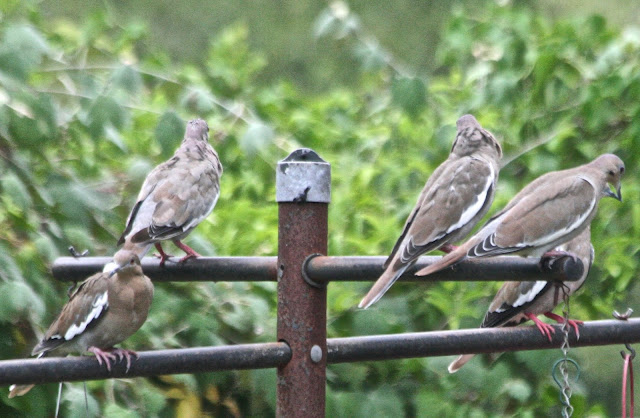
A convention of doves of the White-winged variety, meeting on my bird feeder posts.

*~*~*~*

If you hurry outside, you can still see the Snow Moon tonight.

*~*~*~*

It looks likely that February will break an unprecedented number of heat records.

*~*~*~*

More evidence that trees are our friends: Reforestation of the eastern United States is helping to stall the effects of global heating. 

*~*~*~*

Recurring atmospheric rivers are bringing lots of rain and resultant flooding to California.

*~*~*~*

It took a massive effort but a 65-foot-long whale that washed up on a beach in China was rescued and towed back to sea

*~*~*~*

Did ADHD survive in the human race because it gave an evolutionary advantage to those who possessed it?

*~*~*~*

Monarch butterfly - a representative of a genome that may look fragile but is actually very resilient.

*~*~*~*

Corals are bleaching and dying along more than 1,000 kilometers of the Great Barrier Reef.

*~*~*~*

The Pyrrhuloxia, also called the Desert Cardinal, was the American Bird Conservancy's Bird of the Week for last week.

And the Bird of the Week for this week is...

...the Red Crossbill.

*~*~*~*

Why do poison dart frogs tap their toes?

*~*~*~*

Louisiana's coastal wetlands are being slowly inundated by rising seas.

*~*~*~*

It turns out "natural gas" is not so natural.

*~*~*~*

Lobbyists who are supposedly representing the interests of the victims of the climate crisis are also often representing the perpetrators of the crisis.

*~*~*~*

How exactly do we define what a species is?

*~*~*~*

The El NiƱo weather system is causing major problems in South America.

*~*~*~*

How do baleen whales communicate by vocalizing?

*~*~*~*

Is the killing of Barred Owls in the Pacific Northwest justified in order to help the endangered Northern Spotted Owl?

*~*~*~*

Another amazing Maya tomb has been discovered in Guatemala and it is filled with "extraordinary" funerary offerings.

*~*~*~*

California's redwoods are once again proving their resilience by recovering from the wildfires of 2020.

*~*~*~*

Here is a week's worth of amazing wildlife pictures.

*~*~*~*

Though some find them a nuisance, I thoroughly enjoy watching the antics of the gray squirrels that call my yard their home.

Saturday, February 17, 2024

Poetry Sunday: February by Margaret Atwood (Again!)

Yes, yes, I know I have featured this poem here before! Actually more than once if truth be told. But one can never have too much of Margaret Atwood, can one? And this poem about February is just so...perfect!

February

by Margaret Atwood

Winter. Time to eat fat
and watch hockey. In the pewter mornings, the cat,
a black fur sausage with yellow
Houdini eyes, jumps up on the bed and tries
to get onto my head. It’s his
way of telling whether or not I’m dead.
If I’m not, he wants to be scratched; if I am
He’ll think of something. He settles
on my chest, breathing his breath
of burped-up meat and musty sofas,
purring like a washboard. Some other tomcat,
not yet a capon, has been spraying our front door,
declaring war. It’s all about sex and territory,
which are what will finish us off
in the long run. Some cat owners around here
should snip a few testicles. If we wise
hominids were sensible, we’d do that too,
or eat our young, like sharks.
But it’s love that does us in. Over and over
again, He shoots, he scores! and famine
crouches in the bedsheets, ambushing the pulsing
eiderdown, and the windchill factor hits
thirty below, and pollution pours
out of our chimneys to keep us warm.
February, month of despair,
with a skewered heart in the centre.
I think dire thoughts, and lust for French fries
with a splash of vinegar.
Cat, enough of your greedy whining
and your small pink bumhole.
Off my face! You’re the life principle,
more or less, so get going
on a little optimism around here.
Get rid of death. Celebrate increase. Make it be spring.

Friday, February 16, 2024

This week in birds - #580

 A roundup of the week's news of birds and the environment:

The female Red-winged Blackbird looks nothing like her flashy mate. One could even take her for a large sparrow until one sees her striding across the yard. That strut definitely gives her away.
*~*~*~*
One might think that climate change denialism has run its course but not with 15% of Americans it seems.
*~*~*~*
A warm Atlantic could be foretelling an active hurricane season.
*~*~*~*
Thriving plant life on the Greenland ice sheet where it really shouldn't be is causing climate scientists to be concerned.
*~*~*~*
The side of a frog may seem a strange place for a mushroom to grow, but Nature will find a way.
*~*~*~*
Parthenogenesis is yet another solution that Nature has found but it is one that isn't available to us mammals.
*~*~*~*
Paraquat, a toxic herbicide linked to Parkinson's Disease, has again been approved by the Environmental Protection Agency for use in this country. That seems like a serious contradiction of the agency's name.
*~*~*~*
How was Earth sent into its longest winter? Scientists have a new theory.
*~*~*~*
Can we set up needed solar power projects without harming Nature?
*~*~*~*
Planting trees can be a good thing but they have to be the right kind of trees.
*~*~*~*
The North Atlantic right whale is already critically endangered but after two have been found dead recently there may be reason to believe their situation is even more serious than previously thought.
*~*~*~*
A defunct golf course in California has been turned into an ecological life raft.
*~*~*~*
The Amazon rainforest could be near to reaching the tipping point of its destruction.
*~*~*~*
This is Gaia, a black-footed cat living at the Hogle Zoo in Utah. Black-footed cats are a small, cute, and vulnerable species. They also hold the title of the deadliest cat on Earth.
*~*~*~*
*~*~*~*
Did the same asteroid that wiped out the dinosaurs actually provide a boost to birds?
*~*~*~*
A new report from the Convention on the Conservation of Migratory Species of Wild Animals says that more than a fifth of species under international protection are threatened with extinction. 
*~*~*~*
Could a Stone Age wall found at the bottom of the Baltic Sea be Europe's oldest megastructure?
*~*~*~*
Alligator snapping turtles may start out as pets and then be released into the wild when the owners tire of them or can no longer care for them. Fluffy got lucky.
*~*~*~*
Raw sewage in the Tijuana River along the U.S.-Mexico border is creating a public health crisis.
*~*~*~*
Cave art recently discovered in Patagonia is over 8,000 years old.
*~*~*~*
A 23-year-old platypus found in a creek in Australia may be able to teach scientists things that will help its species survive.
*~*~*~*
*~*~*~*
These two Chilean Flamingo chicks, along with their four siblings, owe their lives to the creative thinking of an Alaskan Airlines flight attendant. 
*~*~*~*
Coral bleaching has now exceeded the parameters of the alert scale that had been in place for more than a decade.
*~*~*~*
Collaring polar bears can teach scientists a lot about those animals and their environment and how climate change is affecting them.
*~*~*~*
Here's a report about Flaco the escaped Eurasian Eagle-owl's year of freedom in the wilds of New York City.
*~*~*~*
Who invented kissing? The Sumerians, maybe?
*~*~*~*
I'll leave you with a picture of Jackie, the Bald Eagle, protecting her three precious eggs after a recent snowstorm.

Saturday, February 10, 2024

Poetry Sunday: February Days by Ellwood Roberts

Not many "northern blasts" have reached us here in the deep South this winter, but we are predicted to have some more winter-like weather next week. We shall see what the "February days" bring us, but this we know for sure: "The Spring-time days will soon be here."
 
February Days

by Ellwood Roberts

The icy northern blast sweeps by,
From wild wastes of the Arctic snow;
Above us droops a wintry sky,
A bleak white landscape lies below.
But, 'neath the chilly Polar blast,
A low, sweet undertone I hear:
"The wintry storms will soon be past,
And pleasant Spring-time days are near."

In Winter's stern and icy grasp,
Are river, pond, and rill, to-day;
Like iron bonds his fetters' clasp,
Like despot's rule his frosty sway.
But only yesterday I heard—
Though all the landscape was so drear—
The sweet voice of a lonesome bird:
"The Spring-time days will soon be here."

The air is icy, keen and chill,
All Nature lies in sleep profound,
That seems like death—so cold, so still—
But flowers are biding underground.
The sun mounts up, from day to day,
His beams each morn more full of cheer.
And to our hearts they seem to say:
"The Spring-time days will soon be here."

The ice and snow will soon be gone,
The Spring-time waits the sun's warm rays,
Already we can trace the dawn
Of brighter, warmer, sweeter days.
Each morn we watch for signs of Spring,
Each evening feel its coming near.
All Nature's voices seem to sing:
"The Spring-time days will soon be here."

And though an Arctic wind sweeps by
From wildest wastes of ice and snow,
And though above us wintry sky,
And desolate white fields below—
Beneath the wind's wild organ-blast,
A low, sweet undertone I hear:
"The wintry storms will soon be past,
The sunny Spring-time days are near."

Friday, February 9, 2024

This week in birds - #579

A roundup of the week's news of birds and the environment:

The male Northern Cardinals are singing their hearts out. It must be almost spring.

*~*~*~*

Climatologist Michael Mann is a hero of mine and I was happy to see him fight back in court against those who had defamed him. And I was even happier to see that he won!

*~*~*~*

And speaking of Mann and his warnings about climate, scientists have announced that Earth has breached a critical temperature barrier over the last twelve months.

*~*~*~*

El NiƱo has helped to exacerbate the higher temperatures. It may be almost over now but La NiƱa is waiting in the wings.

*~*~*~*

In more hot news, the Icelandic volcanic system erupted again this week.

*~*~*~*

The storms on the West Coast this week have filled up the Los Angeles River. Those storms were intensified by an atmospheric river.

*~*~*~*

We need to save the Mobile-Tensaw Delta, America's Amazon.

*~*~*~*

Vermillion Flycatcher by Jeff Bray, Macaulay Library at the Cornell Lab of Ornithology

The beautiful Vermilion Flycatcher is the American Bird Conservancy's Bird of the Week.

*~*~*~*

Here's why we need to save the sardine.

*~*~*~*

Maui has been experiencing some of the deadliest wildfires in its history.

*~*~*~*

An image of a polar bear sleeping on an iceberg won the Wildlife Photo of the Year award.

*~*~*~*

Some troubling news regarding Monarch butterflies: Their numbers are down sharply in the wintering areas of Mexico. 

*~*~*~*

But there is hopeful news regarding a possible return to the American Southwest of the jaguar. A potential barrier to that return is the stupid border wall.

*~*~*~*

Flaco, the escaped Eurasian Eagle-owl, is still free and still flying in New York.

*~*~*~*

Lions in Kenya are facing a challenge from an unexpected quarter - ants!

*~*~*~*

A fossilized tree is answering some questions about life in the Paleozoic Era.

*~*~*~*

It turns out that anenomefish, like the famous Nemo, are particular about who they share their space with.

*~*~*~*

Altruism may not be common in the wild, but here is one unexpected example provided by an elephant seal. 

*~*~*~*

A new species of mussel has been discovered in the Gulf of Mexico.

*~*~*~*

Meteorologists are considering adding another category - category 6 - to their intensity scale for hurricanes which now runs 1 - 5. 

*~*~*~*

Pollinators are less likely to be drawn to polluted plants.

*~*~*~*


*~*~*~*

Sponges living in the Caribbean Sea are warning us that global warming may be even worse than we thought.

*~*~*~*

Radical ideas are being considered to fight global warming including the use of a giant parasol!

*~*~*~*

The Arctic Sea ecosystem is an amazing place.

*~*~*~*


*~*~*~*

The pliosaur, a creature of the Jurassic Period, was the T. rex of the sea.

*~*~*~*

Orcas that had been trapped in sea ice off the coast of Japan have now managed to free themselves.

*~*~*~*

Here are some amazing images of European Starling murmurations.

*~*~*~*

Fans of a pair of Bald Eagles nesting in California have been following them closely as they have shielded their three eggs from the storms raging there. 

*~*~*~*

And in Sydney, the White Ibis is known as the "bin chicken" because of its habit of searching for food in trash containers.


Saturday, February 3, 2024

Poetry Sunday: February by John Updike

In "A Child's Calendar," John Updike wrote a poem for each month of the year. This is the one he wrote for February. It doesn't paint a picture of my February - no snow here - but I'm sure residents of more northerly climes will recognize the scenes he describes.

February

by John Updike

The sun rides higher
Every trip.
The sidewalk shows.
Icicles drip.

A snowstorm comes,
And cars are stuck,
And ashes fly
From the old town truck.

The chickadees
Grow plump on seed
That Mother pours
Where they can feed,

And snipping, snipping
Scissors run
To cut out hearts
For everyone.

Friday, February 2, 2024

This week in birds - #578

A roundup of the week's news of birds and the environment

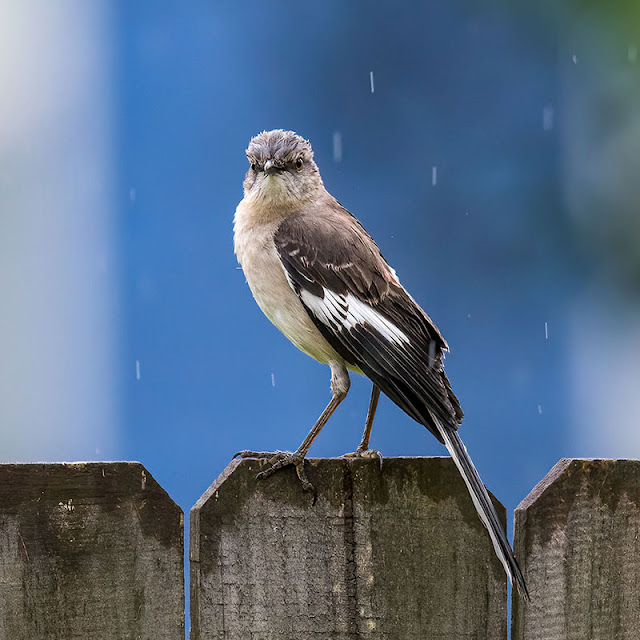
This Northern Mockingbird doesn't look too happy about the shower he's getting!

*~*~*~*

The U.S. is getting a new global climate representative since John Kerry is stepping down.

*~*~*~*

The fossil fuel industry knew of the danger of climate change as early as 1954 but resisted doing anything about it.

*~*~*~*

Here is a depiction of Earth breathing for one year.

*~*~*~*

Drought is having a deleterious effect on the Panama Canal.

*~*~*~*

The first bird flu deaths have been reported in Gentoo Penguins in the Antarctic.

*~*~*~*

Trees are good for us. Is there really any doubt of that?

*~*~*~*

This is the American Bird Conservancy's Bird of the Week. It is a neotropical falcon, the Collared Forest-Falcon.

*~*~*~*

Patagonia, the outdoor apparel brand, is following its philosophy when making its charitable donations.

*~*~*~*

Remember Flaco, the Eurasian Eagle-Owl that escaped captivity (with a little help) a year ago? Well, he's still out there, flying free, making it in New York. And if you can make it there... 

*~*~*~*

It's well established that parrots are very clever birds and they use their beaks to help them navigate through trees or the perches in their cages.

*~*~*~*

A stingless bee of the Amazon is endangered and the race is on to try to save it.

*~*~*~*

Small dogs with pointy noses generally live longer than their larger and/or flat-faced relatives.

*~*~*~*

After five days of freedom, a Japanese macaque that escaped from a wildlife park in Scotland has been recaptured.  

*~*~*~*

Was he a Chinese spy? This pigeon was suspected of being one but he has now been released after eight months of captivity in Mumbai.

*~*~*~*

This is a placoderm, a fish that lived during the Devonian Period. Apparently that strange lower jaw helped it to grasp and hold its prey.

*~*~*~*

Reef scientists are concerned that back-to-back cyclones may have damaged the Great Barrier Reef.

*~*~*~*

When one thinks of wildfires one doesn't usually imagine them occurring in the normally wet country of Colombia, but that is what has been happening recently.

*~*~*~*

Imagine the benefits to easing the climate crisis and improving human health if we were to move toward a sustainable global food system.

*~*~*~*

And imagine the benefits to the climate if we appreciated swamps and refused to drain them.

*~*~*~*

Rocky Raccoon is at it again - this time disrupting things in Toronto.