Translate

Showing posts with label birding. Show all posts

Friday, September 1, 2023

This week in birds - #562

A roundup of the week's news of birds and the environment

I feel you, Bro! It's hot in Texas. My husband informed me earlier that the forecast is for continued high temperatures in the triple digits (Fahrenheit) at least through the middle of September. Perhaps we'll get some relief in October.

*~*~*~*

Profligate use of groundwater is damaging aquifers throughout the nation an investigation has found.

*~*~*~*

The global avian flu outbreak is devastating wild birds and poultry and is threatening to make the jump to humans.

*~*~*~*
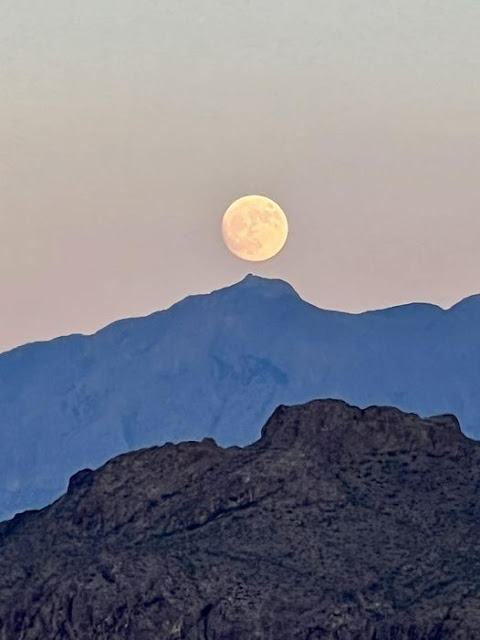
"Blue Moon" photographed over Texas' Big Bend this week.

Did you witness the "Blue Moon" this week? If not, you won't have another chance until 2037.

*~*~*~*

Tracking songbirds on migration is a daunting task, but thank goodness there are dedicated scientists who do it.

*~*~*~*

The summer evenings of my childhood were lit by fireflies but now those fireflies are disappearing

*~*~*~*

Climate scientists continue to warn us, as they have for years, that drastic action is needed if we are to keep the "crazy" extreme weather we are seeing from becoming the norm of the future. 

*~*~*~*

People have been searching for a Loch Ness monster for 1,300 years and they are doing it again this weekend.

*~*~*~*

A growing number of countries are considering passing laws to make environmental destruction a punishable crime.

*~*~*~*

The Least Tern is the American Bird Conservancy's Bird of the Week.

*~*~*~*

Following the Supreme Court's decision weakening the protections for waters under the Clean Water Act, the Environmental Protection Agency has announced new rules regarding such protections.

*~*~*~*

It turns out you can learn quite a lot from jaguar poop without ever having to capture the big cats.

*~*~*~*

There was a bee emergency in Ontario this week when boxes containing the bees fell off a truck, but beekeepers were soon on the job corralling the angry fliers.

*~*~*~*

As the climate changes, birds are moving into new territories and suddenly birders in places like New York City are getting a chance to see birds they never expected to be there. 

*~*~*~*

The recent wildfires in Maui may have been caused by bare power lines and obsolete poles.

*~*~*~*

Margaret Renkl writes in praise of "ruined flowers."

*~*~*~*

The beloved wild horses of North Dakota's Theodore Roosevelt National Park may be removed. That does not appear to be a popular idea.

*~*~*~*

A large-scale study of Indian birds found 178 species needing immediate priority for conservation.

*~*~*~*

Reefs made from sunken trees could help some marine habitats recover.

*~*~*~*

Migrating birds face many hazards and protecting them requires working and cooperating across international boundaries.

*~*~*~*

Fungi are important to ecosystem health and should be protected alongside flora and fauna.

*~*~*~*

North American grassland birds are in significant peril but in order to protect them we must protect and preserve their habitat.

*~*~*~*

Ancient bird calls were often made from bird bones.

*~*~*~*

"Nemesis birds" are a familiar and frustrating concept for devoted birders.

Wednesday, March 28, 2018

Some birds of West Texas

On our recent trip to West Texas, I was able to get in a little birding, which is always one of my chief pleasures on any trip that we take. I also tried to take pictures of the birds that I saw, but I was generally disappointed with my efforts. I had all kinds of excuses. 

There were too many people; it was spring break week and at times it seemed the whole world had descended on West Texas, normally a sparsely populated place. At Big Bend National Park, for example, usually a place of splendid isolation with its 1,252 square miles of desert and rugged mountains, we had to wait in a mile-long queue of automobiles for forty-five minutes just to get into the place. The ranger who checked us in remarked that spring-break is a four-letter word for the staff who work there. Americans of all colors, races, and creeds seemed intent on loving the great park to death. But though I saw people of many kinds, I didn't see so many birds. One covey of Scaled Quail, some Greater Roadrunners doing their thing on the roads, and an occasional sparrow or Northern Mockingbird - that was about it.

The wind was incessant. That's one reason why you see wind farms on top of so many buttes in the region. But the wind is not a friend of small birds or of people who are trying to take pictures of them. 

Oh, well, I did my best. Here are a few of the pictures of which I am least ashamed.


I did most of my birding at Davis Mountains State Park and at the Chihuahuan Desert Research Institute's Nature Center. At both places, staff have helpfully installed bird blinds and feeders to make the quest of the poor birder easier. Finches of all kinds are drawn inexorably to these feeders. There were plenty of Pine Siskins, goldfinches, and House Finches at both places. But most plentiful of all was the Cassin's Finch which is identified by its bright red, slightly raised crown. This is a western bird that we don't get in Southeast Texas so I was very glad to see it.
  

Also at the feeders at the state park were a number of Lesser Goldfinches, the bright yellow and black fellow you see here feeding with Pine Siskins.


There were also lots of Dark-eyed Juncos about. Sweet little birds. Every winter I hope that some of them will make it down to my backyard and every winter except one I've been disappointed. But "hope is a thing with feathers" and springs eternal.


The juncos come in a variety of colors and subspecies.


This Cactus Wren was visiting the water feature at the nature center. A water source is always a very popular place in a desert and a good place to see birds.


The Black-throated Sparrow is just a gorgeous little bird and I was perhaps most disappointed that I was not able to get a really good picture of it. This doesn't do it justice.


Another iconic western bird is the Pyrrhuloxia.  These birds seem to be expanding their range and, in recent years, some have turned up in my area in winter, but not in my backyard yet.


You can easily see the bird's close kinship to the Northern Cardinal, although the Pyrrhuloxia's crest is much more pointed.


The Western Scrub Jays were attracted to the suet feeder provided at the nature center blind. But then all jays are attracted by suet.


This is a female Ladder-backed Woodpecker. A staff member at the nature center told me she and her mate are getting their nest ready for a brood.


This lone Black-chinned Hummingbird was a frequent visitor to the feeder at the nature center blind while I was there.


This shy Swainson's Thrush stayed under cover for the most part but finally came out to get a drink and I was able to take this picture.


I love towhees. I saw four kinds on this trip but was only able to get a picture of the Spotted Towhee.


I was fascinated by the bird's bright red eyes. That seems to be a feature of many songbirds that have black heads. Something to do with genetics, no doubt.


And here's another example - the Phainopepla that I showed you on Saturday's post.


In addition to all the western birds, there were some familiar birds that I see every day present in these very different environments. Birds like the adaptable Northern Mockingbird.


The American Robin.


The White-winged Dove.


Even our winter visitor, the Ruby-crowned Kinglet, here showing just a tiny bit of that ruby crown that I almost never see in birds at home. 


I saw lots of that iconic western bird, the Greater Roadrunner, on this trip, but every one that I saw was - um - running across the road and I couldn't get pictures, so here's one that I took a few years ago on a previous trip to Big Bend. You'll just have to take my word that the ones I saw on this trip looked just like this. 

Tuesday, March 24, 2015

Valley birds

I guess I've complained enough about my rain-spoiled birding vacation in the Rio Grande Valley. It was a week I had long looked forward to, since it is one of the birdiest places on the planet. I was hoping to see lots of new birds. That didn't quite work out, thanks to the weather, but, in fact, I did see quite a few birds. I even managed to get pictures of some of them.


This group of Roseate Spoonbills was resting at mid-day in the wetlands of the World Birding Center on South Padre Island. 

Also at South Padre was this Long-billed Curlew.

A pair of Mottled Ducks napping in the sun - the first sun we had seen in several days.

This was one of the two Red-breasted Mergansers I saw and was able to photograph at South Padre.

Green-winged Teal were quite common in the ponds at Estero Llano Grande State Park. Lovely ducks!

As were the very distinctive Northern Shovelers.

I wasn't able to photograph very many songbirds that I saw, but this little Savannah Sparrow was cooperative.

This Tri-colored Heron is well-dressed in his showy breeding plumage.

Black-necked Stilts are fairly common shorebirds at this time of year, but I never get tired of observing and photographing them. 

This was a small section of a very large flock - over 100 birds - of White Ibises in flight that we saw on South Padre island.

A male American Wigeon enjoying a swim.

This little Pied-billed Grebe was having a vigorous wash-up and seemed very happy about it.

A male Blue-winged Teal resting on a fallen tree at Estero LLano Grande State Park. 

Who knew that Orange-crowned Warblers enjoy oranges? I certainly didn't, but now that I do I will try to provide some when they come back to us next winter. 

Another very common shorebird, the Killdeer

The Great Blue Herons also were dressed in their showy breeding feathers. This one was resting from its labors.

The Plain Chachalaca, a large chicken-like bird, is a Valley specialty. They are more often seen on the ground but a pair of them were feeding on some sort of berries in the trees around the visitor's center at Estero Llano Grande State Park, and I managed to get a few pictures.

One of the highlights of my trip was being able to get several pictures of this little Sora at South Padre Island. I saw a King Rail, a Clapper Rail, and a couple of Soras in the wetlands, but this Sora was the only one who was cooperative enough to let me photograph it.  

It wasn't all about the birds, although it was mostly. This very large alligator, viewed from the boardwalk at the World Birding Center on South Padre Island, caught the eye and the camera lens of a lot of the birders on this day.
In the end, I didn't really add many new birds to my life list, but, fortunately, I'm not an obsessive lister. For me, it is mostly just about enjoying the experience and I never get tired of watching birds, even those that are familiar to me. Throw in a nice alligator or two and I'm one happy birder!

Saturday, March 14, 2015

Big Twitch: One Man, One Continent, a Race Against Time by Sean Dooley: A review

I am a devoted birder so I am always up for a good book about birding. Here's one about an Australian "big year." 


~~~~~

Big Twitch: One Man, One Continent, a Race Against Time: A True Story about BirdwatchingBig Twitch: One Man, One Continent, a Race Against Time: A True Story about Birdwatching by Sean Dooley
My rating: 3 of 5 stars

The record for a "Big Year" in Australia was 633 birds.  That was before Sean Dooley decided to spend his year breaking it.  Not only did he want to break it, he wanted to annihilate it.  He set himself the goal of seeing and identifying 700 birds from January 1 to December 31, 2002.

It helped that he didn't have much of a personal life at the time - no family, no significant other, no one to slow him down.  No 9:00 to 5:00 job either.  He was a comedy writer in real life, but that wasn't requiring much of his time and effort just then.  He was able to single-mindedly devote himself to his obsession.

This book tells how he did it, with all the ups and downs along the way.  He had a lot of help from friends and from other birders who became interested in his quest.  But he also ran into a few snarly and unhelpful people along the way who thought that being a twitcher was just too weird.  (Twitcher is a British and an Australian term for bird watchers who obsessively list birds that they see.)

In the end, Dooley had the last laugh as he did indeed reach his goal.  In fact, he plowed right past it to 703 species.

This book is one bird chase after another and gets very repetitive after awhile.  Only a true twitcher would read every single word with relish.  I was hampered in my reading because so many of the species that he talked about were unfamiliar to me.  Still, it was an interesting read.  I don't think I'll ever be a twitcher.  I'm a simple backyard birder, but I understand the compulsion that drives people for whom birds become the total focus of their lives.       


View all my reviews

Tuesday, March 18, 2014

Birds of the Gulf Coast

The Gulf Coast of Texas is among the birdiest places one can find on this continent. On any given day, there are around 200 different species there. At times during spring migration, the number is closer to 300.

During our trip along that coast last week, I didn't get anywhere near the 200 figure. The weather was rather miserable, gray and drizzly every day, and the conditions for birding were not optimal. Still, I did manage to see a goodly number of the feathered residents.

I've already shown you the most spectacular feathered creatures we saw - the Whooping Cranes of Aransas. Here are a few others that we encountered along the way.

The Whooping Cranes were not even the only cranes that we saw on the trip. In a meadow near the entrance to Aransas National Wildlife Refuge, a small group of Sandhill Cranes were making a rest stop on their way north.


 A total of six of the birds were looking for snacks in the marshy field.

 And cranes weren't the only big birds around. We also encountered a small flock of Wild Turkeys.


 There were Inca Doves resting in the trees near a dried up pond.


 And nearby, in another tree, an American Kestrel was feeding on a bird it had caught. You can see one of the victim's legs hanging down from the limb. Another Inca Dove, perhaps?


The Laughing Gulls are everywhere along the coast and their raucous "laughter" is the background music of life here.


 A Long-billed Curlew pokes around, looking for a tasty morsel in a field.


Brown Pelicans are very colorful at this time of year when they are getting ready to nest.


Their cousins, the White Pelicans, were surprisingly numerous. In several places, they outnumbered the Browns.


A Willet stands in its characteristic resting pose with one leg tucked up into its feathers.


 I think the American Avocet is really one of the prettiest of the shorebirds.


 Redhead Ducks were one of the most numerous duck species that we saw, along with Ring-necked Ducks, Northern Shovelers, Lesser Scaup, and Ruddy Ducks. It was hard to get a clear picture of any of them because of the weather conditions. Here, a pair of the Redheads preen in the shallows of a lake.


 Of course, there were plenty of Great Blue Herons. This one was seen from our boat on the day we went on the Whooping Crane tour.


Black Skimmers are great fun to watch, whether they are skimming the surface of the water for their food or resting between snacks.


 A close-up of one of the Skimmers. What a bill!


 A Greater Yellowlegs probing for something good to eat.

I saw this grebe at Indian Point Park at Corpus Christi. It was far out in the water on a gray and misty day and I struggled to get a usable picture of it. This was about the best of the lot. I wavered on the identification. Was it a Horned Grebe or an Eared Grebe? They can be difficult to tell apart at this time of year, but finally, based on its shape and its actions, I decided it was a Horned Grebe. I just wish I could have gotten a better picture.