Translate

Showing posts with label Barbara Kingsolver. Show all posts

Tuesday, October 29, 2024

Pigs in Heaven by Barbara Kingsolver: A review

In 2022, I read Barbara Kingsolver's book The Bean Trees and I loved it, awarding it four out of five stars. When I heard realized that Kingsolver had written a new another book featuring some of the Bean Tree characters, I wasted no time getting hold of it. I'm happy to say that it did not disappoint. This one, too, is certainly worthy of four stars.

Once again we meet Taylor and her (maybe not legally) adopted daughter, Turtle. They are happily living in Tucson. Taylor is White with perhaps a drop of Cherokee blood from a great-grandparent. Turtle is a Cherokee child who had been "given" to Taylor in Oklahoma by the child's aunt who was trying to rescue her from an abusive situation. 

The events of this novel take place three years later. When Turtle is witness to an accident and a Cherokee lawyer named Annawake, who has a personal stake in the Indian Child Welfare Act, becomes involved and learns of Turtle's story, the lawyer realizes that things with Taylor's and Turtle's relationship don't quite add up.  She visits Taylor to discuss it but that causes Taylor to panic and she takes Turtle and runs. She knows that she needs to make her relationship with Turtle legal and she returns with her to Oklahoma to try to adopt her but without letting the tribe know.

Meanwhile, Taylor's mother, Alice, who has just emerged from a brief marriage, goes to stay with a relative on tribal lands and tries to get to know the family that Turtle came from in an attempt to resolve the sticky situation.  

Taylor is prone to making unwise decisions that prove unhelpful to her and Turtle's situation, but her motivation is always her love for Turtle and her fear of having her taken away from her. The reader feels for her (at least this reader does). Haven't we all been guilty of sometimes making unwise decisions, especially when our judgment is clouded by emotion? 

Kingsolver imbues her characters, even the less likable ones, with believable humanity. We care about them and their story and we want things to turn out for the best. I found Pigs in Heaven hard to put down for that reason. I couldn't wait to find out how things were going to be resolved and how the problems presented were going to be sorted out. It takes a rare writing talent to so thoroughly engage the reader's sympathies. Kingsolver is such a talent.

Monday, December 5, 2022

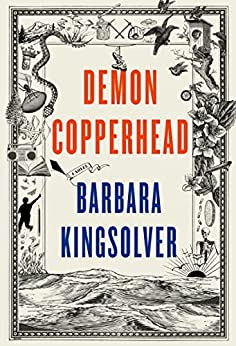
Demon Copperhead by Barbara Kingsolver: A review


Barbara Kingsolver's latest is essentially her retelling of Charles Dickens' David Copperfield set in the southern Appalachian Mountains of Virginia. The main character of her opus was named Damon by his teenage mother but, of course, that was easily turned into "Demon" by the other kids. 

Demon was born to a single mother in a single-wide trailer. His mother was a troubled adolescent who had not the first clue about caring for a baby. Demon inherited his good looks from his father who had died before he was born. Part of those looks was his distinctive copper-colored hair.

Demon soon became a ward of the state's foster care system. As such, he experienced an often traumatic existence, but from somewhere - either genes or some of his caregivers along the way - he developed a strong instinct for survival. In school, it was discovered that he had some athletic talent and that helped to smooth his way through the system.

Kingsolver tells her story through Demon's voice. The narrative is unsparing in its recitation of all the perils that he faced. Some of his foster parents forced him into child labor. The schools that he attended could be most kindly described as derelict.

After he was injured playing sports for his high school, he became addicted to painkillers. He had a long battle to overcome that addiction. He had some disastrous romantic entanglements and crushing personal losses. But that instinct for survival kicked in and he was able to overcome his challenges and setbacks.

This is quite a lengthy book of more than 600 pages and a LOT happens in it, all of which makes it a bit difficult to adequately sum up, but Barbara Kingsolver is such a terrific writer that the book never seems long. She keeps the action moving. 

In all that action, she takes us to some dark and depressing places but there is so much beauty in her telling of it that one never feels overwhelmed, never feels frustrated, or wants to hurl the book against the wall. What writing talent it takes to achieve that and to make the reader feel empathy for these characters, some of whom are not that attractive. 

I've already noticed that this book has a spot on most of the "best of 2022" lists that appear at this time of year. It would appear on my "best of" list as well. Another winner from Barbara Kingsolver.   

Wednesday, November 28, 2018

Unsheltered by Barbara Kingsolver: A review

Is it my flawed memory or have there been an unusual number of new books out this year that have featured a house as a central character? It seems to me that many of the books that I've read recently have had a house as an important element in the plot. And now here comes Barbara Kingsolver's contribution to the genre. 

Perhaps the emphasis on houses - shelters - is a reflection of the unsettled times in which we live when it seems only natural to long for sanctuary and asylum from the daily onslaught of ineptitude, belligerence, and outright brainlessness that seem to rule our national life. There is the understandable fear that the shelter which has always protected us is being ripped apart piece by piece. We are literally becoming unsheltered.

Then again perhaps I am projecting my own opinions onto the author.

Nevertheless, the characters in Kingsolver's book are in danger of becoming unsheltered as the house in which they live is unstable with the roof caving in and walls collapsing. It is true of two distinct sets of characters, with whom she presents us, from two different centuries. 

First we meet Willa Knox and her family. It is 2016 and Willa and her husband have just lost their jobs in Virginia - Willa as a magazine editor and her husband as a professor - when both of the entities they worked for closed. The family has moved to a house that Willa inherited in the community of Vineland outside of Philadelphia where her husband has obtained a new job. The house, like their lives, is falling apart.

Our first view of Willa is at her meeting with a contractor who tells her, "The simplest thing would be to tear it down." To do the necessary renovation and repairs would be prohibitively expensive.

The more than century-old house is a shambles but it will shelter Willa, her husband Iano, Iano's Greek immigrant father Nick, Willa's and Iano's daughter Tig (Antigone), and soon their son Zeke's newborn son for whom he, as a single and destitute father after the suicide death of the boy's mother, is unable to care. Oh, yes, and their ancient dog named Dixie. The shambles of a house is matched by the shambles of their lives.

Nearly 150 years earlier, in the 1870s, another family lived on the same acreage. Schoolteacher Thatcher Greenwood and his new wife Rose, her mother Aurelia and her sister Polly along with two large hounds named Scylla and Charybdis live in a decaying house and they, too, do not have the money to do repairs and so must endure the privations. 

Thatcher and Rose are poorly matched; he is a man of science and she is only interested in society and appearances. Theirs seems a doomed alliance from the start.

In time, Thatcher meets their next door neighbor, Mary Treat, a real-life naturalist who carried on extensive correspondences with Charles Darwin as well as many other scientists of the day. They are kindred spirits and she becomes a major influence on his life and work.

Willa Knox hopes to prove that their house has historical significance because of the Treat/Greenwood connection and thus to get a grant to restore and preserve it. It's the only hope she has for saving it.

The tracks of the lives of these two families run parallel in many ways. Not only do they occupy crumbling houses but they each live in a time of economic uncertainty when the truth of scientific inquiry is denied and all of its evidence dismissed because it doesn't agree with the "gut feeling" of its "very intelligent" opponents. In the case of the Greenwood family the scientific inquiry is Darwin's and in the Knox family's lives it is the conclusions regarding global climate change. 

These two parallel narratives reflect each other occasionally in surprising ways, but, taken together, they present a thoroughly absorbing story of human adaptability and survival instinct. They also provide us with a cautionary tale of where fear and denialism can take us:
“I suppose it is in our nature,” she said finally. “When men fear the loss of what they know, they will follow any tyrant who promises to restore the old order.”
My rating: 5 of 5 stars


Monday, March 9, 2015

The Bean Trees by Barbara Kingsolver: A review

I read The Bean Trees in August, 2009. Here is the review that I did at that time for the book.


~~~~~

The Bean Trees (Greer Family, #1)The Bean Trees by Barbara Kingsolver
My rating: 4 of 5 stars

Members of the legume family can grow well in very poor soil.  That is because they are sustained by microorganisms called rhizobia that provide nitrogen to the plants through their roots.  The plants and the rhizobia prosper together in a symbiotic relationship - sort of like a family.  And that is the story of Taylor Greer.

She grew up in the unpromising soil of hardscrabble Kentucky, but she was sustained and grew strong on the love of her mother.  She grew up with a determination to avoid the teenage pregnancy that sidetracked so many girls that she knew and with an equal determination to get out of Kentucky.

When I started reading this book, I immediately recognized Taylor - or Missy, as she was called then.  My own childhood and adolescence and my experience of family was not that different from hers.  I felt an immediate kinship with her.

Missy, rechristened by herself as Taylor, does make it out of Kentucky in a rattletrap car that just barely survives all the way to Tucson.  Along the way, in Oklahoma, she acquires a child, a little Indian girl thrust into her arms by a desperate woman.  The reason for her desperation becomes evident later when Taylor bathes the child.

She calls the child Turtle because it seems to fit and in Tucson she meets Mattie and then Lou Ann and Esperanza and Estevan and, slowly, Taylor and Turtle begin to weave together the disparate family that will feed their roots and sustain them.

This is a wonderful book.  It is Kingsolver's first novel, published in 1988.  I had just recently read "The Poisonwood Bible" which is a far more complex book with a many-layered plot, but this is a very straightforward and, in some ways, simple story.  It engaged me from the first pages and if I had had time, I could have finished it in one sitting.  It is that readable and that short.

This is a book for those who want to believe in the indominability of the human spirit and that sometimes, even in a world that often seems to have no more room or compassion for refuges, good can triumph.      


View all my reviews

Tuesday, August 5, 2014

The Poisonwood Bible by Barbara Kingslover: A review

(Note: My review of The Poisonwood Bible was originally published on Goodreads on July 24, 2009.)

The Poisonwood BibleThe Poisonwood Bible by Barbara Kingsolver
My rating: 5 of 5 stars

I am old enough to sort of remember the events that are at the center of the book.  I remember the newscasts at the time having stories about the declaration of the independence of the Congo and about the election of Patrice Lumumba.  Of course, all the newscasts gave the American "slant" to the story.  They were all about how this action impacted us.  Little notice was given to how it impacted the people who were actually living there.

That much I can remember.  I can also remember the announcement sometime later that Lumumba was dead and the turmoil that followed that death, but although I was old enough to hear the news, I was still too young and naive to have much understanding of what was going on.

Years later, when I was older and a little better able to understand, I remember the Church committee's investigation.  By that time, Watergate had happened and my cynicism about government had grown by leaps and bounds.  I was appalled by the findings of how our government had interfered in the affairs of a sovereign country and the chaos that we had helped to bring about in that part of the world.  But I wasn't really surprised.

It had been a long time since I had given much though to this issue - so many other atrocities had intervened in my consciousness - when I picked up this book.  I remember hearing about the book when it first came out and I knew that it had been greatly acclaimed, but somehow I had missed reading it at that time.  But when I saw it on a table at Barnes and Noble, along with The Bean Trees, it seemed like the right time to pick them both up.  So I did.  I'm very glad that I did.

This is a terrific book, a mesmerizing read.  I think of it now as something of a cross between The Mosquito Coast and Heart of Darkness, but, in truth, it is a unique perspective that stands on its own.

The year is 1959 and a Baptist evangelist, Nathan Price, a man terribly damaged by his World War II experiences, has determined to take his family of a wife and four young daughters to the Congo, there to be a missionary and save the souls of those poor benighted (as he thinks)  natives.  The family, especially Nathan, has no real understanding or appreciation of the culture that they are going into.  Indeed, Nathan plans to plant his own culture, which he believes to be far superior, there, without regard to the wishes or feelings of the people he is determined to "save".

The story of everything that happened after Nathan's ill-considered decision is told in the unique voices of the five women - Orleanna, the wife; Rachel, the oldest daughter; Leah and Adah, the twins - one perfect, one crooked; and Ruth May, the baby of the family.  It is a tour de force of storytelling.

Each of the family members' various reactions to the landscape and people of Africa are at the heart of this story.  From Nathan's rejection of and refusal to compromise with - or even to listen to - the people's ideas and their mores worked out in the jungle over thousands of years; to Leah's initial attempts to follow in her father's footsteps only to have the dawning of awareness that perhaps there is another way of being and that the African culture may have merit, to, eventually, her acceptance of Africa and the African understanding of the world.

None of the Price family is left unchanged by their experiences and they will live the rest of their lives, however long they might be, touched and marked by those experiences. They will never get Africa out of their blood.

The prose in this book is lyrical.  I found myself again and again underlining passages that I wanted to return to later.  I don't usually do that with books.  Kingsolver is a very good writer.  I have read some of her essays before but never one of her books.  I will be reading more and I hope to return to this one and read it again.  It is that good.


View all my reviews

Monday, January 7, 2013

Flight Behavior by Barbara Kingsolver: A review

I know Dellarobbia Turnbow. She is someone I grew up with and went to school with, someone whose life arc was changed forever by an unwanted teenage pregnancy. She is someone who grew up in an ultra-conservative society that is founded upon a rock-ribbed traditional understanding of the Bible. She is also whip-smart and has begun, at age twenty-seven, to question the understanding that underlies the closed society in which she finds herself.

Dellarobbia lives in the Appalachians, in the small town of Feathertown, Tennessee. She is a small woman with an outsized personality, flaming red hair, and a deep desire for something more meaningful in her life than her unchallenging duties as a wife and mother. We meet her as she is hiking up a mountain behind her home, heading for an assignation with a telephone lineman, someone she is hoping will bring a passion that is missing from her life. She is not wearing her glasses, because "men don't make passes at women who wear glasses."

The fact that she is not wearing glasses is critical, because, topping a rise, she looks out on a sea of orange. To the myopic Dellarobbia, it looks like a forest fire. It takes her breath away and changes her life forever. She feels that it is a sign to her. She gives up on the assignation and heads back down the mountain to her two young children and to the life which bores her.

Barbara Kingsolver was a scientist before she was a novelist and she is not shy about taking on the big issues of science and the environment in her writing. In this new book, she again visits her favorite themes of Nature and the burdens of cultural privilege and social injustice. Specifically, the focus of this book is climate change and its effect on one family and one community in one life-altering year, because that "sea of orange" that Dellarobbia saw was not a forest fire but millions of butterflies - migratory Monarch butterflies that should be settling down for their winter in the mountains of Mexico but, because of a changing climate, have been misdirected into an almost-certainly fatal winter in the mountains of Tennessee.

The coming of the butterflies creates fault-lines in the community and in the Turnbow family. Most see it as a sign from God, but what does the sign mean? 

As news of their coming reaches the 24-hour news cycle, a noted entomologist and expert on the Monarchs comes to town and to the Turnbow farm to study them. His presence and his willingness to share his knowledge with Dellarobbia and with her small son, Preston, the budding scientist, begins to widen Dellarobbia's world and makes her realize that perhaps it is not too late for some of the dreams she had for her life when she was a teenager. Perhaps her marriage to the kind and easy-going but lumpish Cub Turnbow does not have to be the life sentence to dullness which she has seen it to be. As she learns new things about butterflies, she learns new things about herself as well and begins to find a new passion, different from that which drove her up the mountain in the first pages of the book but no less fierce, and perhaps more productive.

Empathy for her characters is a mark of Kingsolver's fiction and it is on full display here. She lovingly draws the intricacies of the characters of each Turnbow family member, sometimes sketching them with a minimum of words, but her dense, beautiful use of language gets the job done. We know these people.

Of all the characters, I found myself empathizing most with Hester, Dellarobbia's mother-in-law. Hester and Dellarobbia start at cross-purposes. Dellarobbia sees her as an adversary, and yet, by the end of the story, she begins to understand that she and Hester are more alike than different, that they have much in common and should be natural allies. As Dellarobbia increases her understanding of the older woman, Hester comes more into focus and we see the tragedies and sorrows of her life and how it, like Dellarobbia's, has not turned out as she would have wished. 

Kingsolver's ability to take a big issue like global warming and make it personal is one of the things that I find most affecting and irresistible about her fiction. Her inspiration to put the silent and breathtakingly beautiful Monarch butterflies at the center of this issue seems to me to be a stroke of brilliance. It would take a hard heart indeed not to sympathize with the plight of these wonderful creatures and to wish to save them. One can only hope that this story might open some other minds and lives besides the fictional Dellarobbia's. 

Saturday, February 20, 2010

Offered for your attention...

I've just finished reading another book that I would like to recommend to you. It is The Lacuna by Barbara Kingsolver and it is a wonderful book.

It's the story of a man of the early 20th century, Harrison William Shepherd, born in 1917 near Washington, D.C. to a Mexican mother and American father. His father is a government employee, whom his mother soon tires of, and when Harrison is 12 years old, she ditches the father and takes the son with her to Mexico, following an oilman to his estate on Isla Pixol. There the mother and son encounter howler monkeys which terrify them. They believe they are carnivorous demons. Howlers will be a recurring theme in Harrison's life.

The mother continues to chase love and adventure in the form of various men throughout Mexico. Finally, in Mexico City, Harrison meets Frida Kahlo and Diego Rivera and starts working for their household. There he later meets the exiled Communist leader Lev (Leon) Trotsky. Through it all, he keeps diaries of events and of his impressions and he starts his first novel. Harrison is a born writer. It is what he was meant to do.

When Trotsky moves to another house, Harrison goes with him and continues his diaries. Trotsky becomes mentor and friend, almost the father that Harrison never really had. When Trotsky is killed, Harrison returns to America on a mission to deliever paintings for Frida Kahlo and to escape the "howlers" of the Mexican press.

In America, he finds that his father has died and left him a small inheritance. He moves to Asheville, N.C., and that is where Harrison becomes a published writer and where he finds two friends, his stenographer Violet Brown and his lawyer Arthur Gold.

By now, we are into the 1940s and the House Un-American Activities committee is coming to the height of its power. Because of his fame as a writer and his former associations in Mexico, Harrison comes to their attention. The "howlers" are after him once more.

I don't want to give away any important details of this book because I hope you will read it for yourself. Kingsolver has written a historical novel that resonates with today's headlines. She has woven together details of history, archaeology, food, and nature to make a powerful statement about modern America and how we came to be the people that we are. It is a call to recognize the truth of our history and to respond to the stirrings of our conscience. It is an important book.

Read it!