Translate

Showing posts with label Kazuo Ishiguro. Show all posts

Tuesday, May 24, 2022

When We Were Orphans by Kazuo Ishiguro: A review


This book was published in 2000 and all the reading world except for me probably read it then. I'm only twenty-two years late to the party, but never mind; the story still seems fresh and "of the moment" even though it begins in 1923.

This is a sort of detective story that isn't really a detective story. It starts in the early twentieth century with a mystery, the suspicious disappearance from their home in the International Settlement of Shanghai of Christopher Banks' parents. First his father and then his mother disappear and nine-year-old Christopher is left an orphan. Christopher is then sent "home" to an aunt in England. It is a home he had never seen. He's never been to England before.

His parents never turn up and he grows up in his aunt's home and becomes - perhaps not surprisingly - a detective. His urge to learn what happened to his parents is sublimated in his work of finding missing persons and solving crimes. He becomes a detective of some renown as he solves several big cases.

Still, the disappearance of his parents remains a mystery that haunts him. Christopher's mother had been an outspoken critic of the opium trade in Shanghai and Christopher had always believed that her criticism was somehow responsible for their disappearance. The grown-up Christopher sees his career as a detective as preparation to follow the trail of their disappearance and try to find out what happened to them. But by the time he is ready to begin searching in his early 30s, the Sino-Japanese War breaks out in 1937.

Christopher comes to believe that his parents' disappearance and the beginning of the war are somehow related. He believes that they had been trapped in Shanghai for all the years of their absence and that their situation is the cause of the struggle. It is both a risible and a tragic delusion, but he determines to look for them in the landscape of war. 

This story is told to us by Christopher in a straightforward and detached narrative. For someone whose career has demanded an ability to rigorously examine details and to objectively analyze them, his psychological state seems to hinge on his ability to maintain his self-deception that his parents' disappearance is a factor in the beginning of the war.

His search takes him through some of the worst of the fighting. There are scenes of horror. But then in the midst of the horror, Christopher chances to meet an old friend from his childhood. His Japanese friend is now involved in the war. Their meeting seems entirely implausible but a necessary component of the arc of the story.

Once again we have to deal with an unreliable narrator in Christopher. How much of his narrative is the truth and how much is his wishful thinking? Ishiguro continues with his favorite theme of memory and how it relates to our sense of self. How well, after all, do we really know ourselves? How clearly are we able to see and judge events around us? Are our life experiences and their sometimes traumatic effect not always the prism through which we will view the world? And does that prism inevitably skew our understanding of events? Are we not all, in Ishiguro's telling, "orphans" whose lives can never truly be our own? It is a bleak view of the world but not necessarily a wrong one.

My rating: 3 of 5 stars
Tuesday, March 1, 2022

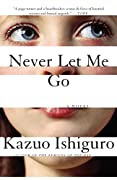
Never Let Me Go by Kazuo Ishiguro: A review


In this book which was shortlisted for the 2005 Booker Prize, Kazuo Ishiguro gives us an alternate reality of England in the 1990s. Human cloning takes place in this world and the person through whose eyes we see that world, Kathy H., is herself a clone. The clones are created to be organ donors. Kathy describes herself as a carer, one who looks after the donors. She has been a carer for about twelve years at the time of this narration. 

Kathy reminisces about her time at a boarding school called Hailsham where the teachers were known as guardians. One of the guardians was called Miss Lucy and one day Miss Lucy told the students that they were clones created to donate organs to others. After their donations, they are destined to die young. She believes that if the students are to live their best lives they must know the truth. The students simply accept what she is telling them without response. Miss Lucy is soon removed from her position because of her unauthorized disclosure.  

During her time at the school, Kathy developed close friendships with two other students, Ruth and Tommy. Tommy is bullied by the other students and Kathy supports him and often talks privately with him. They seemed on the point of developing an even closer relationship but then he and Ruth became romantically involved instead.

When they were sixteen, Ruth, Tommy, and Kathy were moved to a place called the Cottages. For the first time they are allowed in the outside world, but they still mostly stay in their insular world. Ruth and Tommy are still together and Kathy has sexual relationships with various partners. When two older students tell them that they have seen a "possible" for Ruth - i.e., an older woman who resembles her and from whom she could have been cloned - they all decide to go on a trip to find the woman. While on the trip, the older students discuss a rumor they have heard that a couple can have their "donations" deferred if they can prove they are truly in love. The former Hailsham students had heard nothing about this. They do find the "possible" but the resemblance is so superficial that Ruth becomes angry, wondering if they were all cloned from "human trash."

During this momentous trip, Tommy and Kathy separate from the others and go looking for a cassette tape that Kathy had loved but that had been lost while they were at Hailsham. The (fictional) cassette was called "Songs After Dark" by Judy Bridgewater. The fact that Tommy remembers all this is indicative of his feelings for Kathy. They do find the cassette but do not tell Ruth about it. Later, Ruth does find out about the tape and her jealousy causes her to try to drive a wedge between the two. She tells Kathy that Tommy could never have a relationship with her because of her checkered sexual history. Soon after that, Kathy becomes a carer and does not see the other two for about ten years. When she does see them again, it is as their carer after they have begun their donations of organs.

The world that Ishiguro creates of clones and their carers is so richly described as to seem real even though there is nothing related in the chronology of the novel that we can recognize. This is in spite of the fact that it takes place in the recent past. It is a horror story masquerading as science fiction and the most horrible thing about it is that the narrator accepts everything as perfectly normal. It can certainly be seen as a parable about human mortality. The students of Hailsham tell each other stories to ward off the truth about their fates even as we tell ourselves stories to keep from facing the fact of our inevitable deaths.

Every book of Ishiguro's that I read just increases my awe of the man's imagination and talent. I feel fortunate to be living at the same time as he. In the citation for the award of the Nobel Prize for Literature in 2017, the committee wrote that Ishiguro "in novels of great emotional force, has uncovered the abyss beneath our sense of connection with the world." Yes, what they said.

I would rank this one just slightly below The Remains of the Day that I recently read, but not by much.   

My rating: 4 1/2 of 5 stars 

Thursday, February 10, 2022

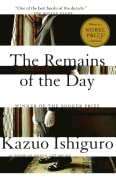
The Remains of the Day by Kazuo Ishiguro: A review


How is it I had never read this book? Just one of many oversights in my reading life, I guess. I'm glad to finally rectify my failure.

I had seen the movie based on the book long ago. It was made memorable by the performances of Anthony Hopkins and Emma Thompson in the two main roles and as I read the book, those were the faces that I saw in the characters of the butler James Stevens and the housekeeper Miss Kenton. 

Stevens and Kenton had both served in the pre-World War II household of Lord Darlington at Darlington Hall, a stately home near Oxford. We learn that Lord Darlington was a Nazi sympathizer, a fact which Stevens is slow to admit. After the war and after the death of Lord Darlington, Darlington Hall is bought by a wealthy American, Mr. Farraday. The house has a seriously reduced staff by this time. Miss Kenton is long gone, having married and moved to Cornwall. She is now Mrs. Benn. She and Stevens had remained in touch in the years after she left service and when Mr. Farraday is going to be absent from Darlington Hall for a while and urges Stevens to borrow his car and go for a road trip vacation he decides to visit Mrs. Benn. He has some hopes of persuading her to return as housekeeper since it seems that her marriage is now on the rocks. The book details Stevens' first-person narration of his road trip and his reminiscences of the events of the 1920s and 1930s.

What becomes clear early on in the narration is that Stevens is unshakeably loyal to Lord Darlington and never questioned his hosting of lavish meetings between German sympathizers and English aristocrats in the years leading up to World War II in an effort to influence international affairs. What is also clear is that the guiding principle in Stevens' life is his reverence for dignity. That and his understanding of what it means to be a "great butler" are the most important concepts for him. They are even more important than his unacknowledged love for Miss Kenton. For he was in love with her and perhaps she was in love with him, but it would have gone against the "dignity" of his position to act on it and so it was tucked away in the most hidden corner of his heart. Their relationship never strayed from that of a professional friendship, even though it seems, based on his reminiscences, that Miss Kenton might have tried to draw closer to him. 

As Stevens narrates his story for us, he seems to come to a realization, maybe for the first time, that Lord Darlington truly was a Nazi and was perhaps unworthy of his loyalty. He even seems to regret his lost opportunities with Miss Kenton. As he ponders "the remains of the day" and the remains of his life, he concludes that the evening is the best part of day and that it is best to enjoy the present of one's life rather than dwelling on the past.

This narrative was simply mesmerizing. The book received the Booker Prize for Fiction in 1989 and its author received the Nobel Prize for Literature in 2017, both richly deserved. In the announcement of his Nobel Prize, the committee stated that in Ishiguro's "novels of great emotional force, he has uncovered the abyss beneath our illusory sense of connection with the world." That seems the perfect description of The Remains of the Day and there is nothing more relevant that I could say about it.

My rating: 5 of 5 stars 


Wednesday, April 7, 2021

Klara and the Sun by Kazuo Ishiguro: A review


In Kazuo Ishiguro's latest book, we are at some point in the not too distant future when technology is able to create androids that are meant to be Artificial Friends, AFs in the shorthand employed in the book. Klara is an AF. Her primary source of energy is solar, thus her special relationship with the sun. Since the sun "heals" Klara, she believes that it can do the same for others and that belief plays a major role in this quite wonderful book.

Klara is described as having short dark hair and kind eyes. Her most outstanding characteristic seems to be her exceptional powers of observation. We meet her when she is still on display in the store waiting for a buyer. She resides there with other Artificial Friends and while they wait they form their own relationships. When Josie and her mother come into the store, Klara is immediately interested in her. Could she be the one, the teenager for whom Klara will get to be a friend? Almost as quickly, Josie is attracted to her and she tells her mother that Klara is the one she wants. Her mother is skeptical, but eventually, on a second visit, Josie gets her way and they take Klara home. 

Klara's role with Josie will be to help her get through some lonely and difficult years until college. In this world, the kids do not go to school but are taught remotely at home through the use of "oblongs" which are apparently like iPhones or iPads. They get individual attention from teachers and relay their completed assignments to them. Thus, Josie doesn't really have contact with many kids her age and is almost friendless. She does have one very good friend who lives next door. His name is Rick and they are very close but other than that she must depend on her mother to arrange something like play dates with other teenagers. These often do not go well.

We soon learn that all is not well with Josie - literally. She is ill with some unspecified disease that may prove fatal. Her mother is consumed with guilt about this, although it isn't at first clear why. Josie's parents are separated and she only sees her father infrequently. We also learn that Josie had an older sister who died very young.

We see and hear all of this through Klara's eyes and ears. She is our narrator and our understanding is limited by her ability to interpret and convey events to us. Through her, we learn that some children are marked to be "lifted" a process that means they have a greater chance for success in life. Josie it seems is among these privileged ones. Rick, on the other hand, is not. Also, elite workers are now being replaced by machines. This is called being "substituted." Josie's father, an engineer, has been substituted. The machines are resented and so, at least in some quarters, are the Artificial Friends. Klara catches the brunt of some of this resentment.

When Josie becomes gravely ill, Klara seeks a way to help her. She turns to the sun and attempts to make a deal for Josie's life. In essence, she prays to the sun for its help. Klara may be a machine but she has true feelings for this young girl. Her friendship is in no way artificial; it is real.

So, how does it end? Are Klara's "prayers" answered? Do we get a happily ever after? That's not mine to disclose; you'll have to read the book. 

I liked Klara quite a lot. She never lets us forget that she is not human; she is a machine and yet she embodies the best of human characteristics. I found it easy to empathize with her. I would like to have her as my friend.

I have not read a lot of Ishiguro. I've never read his masterpiece, Remains of the Day. I saw the movie long ago and thought it was excellent, but now I am eager to read that book and all the others I've missed along the way. I like his style of writing, the unadorned prose that tells his stories in a straightforward manner. It is very affecting and has a way of reaching straight through to the heart. The Nobel Committee did not make a mistake when they gave him that prize.

My rating: 5 of 5 stars