Translate

Showing posts with label Elena Ferrante. Show all posts

Sunday, January 3, 2021

The Lying Life of Adults by Elena Ferrante: A review

Twelve-year-old Giovanna is going through puberty and she is not having an easy time of it. She has always had a good relationship with her parents, especially her father who has always assured her that she is beautiful and brilliant. She believed him and her self-image and ego were healthy and strong. Then one night she overhears a conversation between her parents in which her father compares Giovanna to his long-estranged and thoroughly loathed sister, Vittoria. Vittoria's name has long been shorthand in their family for everything ugly and evil. Giovanna understands her father to be saying that she is ugly. She is completely devastated. In short order, she loses her moorings. She becomes moody and obstreperous with her parents and her school work begins to suffer.

Her parents come to understand that she must have overheard and perhaps misinterpreted their talk and they attempt to repair the damage, but she is unresponsive. She has become obsessed with her Aunt Vittoria whom she does not know. She demands to be able to meet her aunt and her father reluctantly arranges it. She meets and befriends the aunt and finds her strangely compelling and even attractive.  She begins to identify with the aunt and wants to visit her more and more often. At the same time, the aunt introduces her to other members of her extended family, cousins whom she had never met. She likes them all, but mostly what she likes is that her parents disapprove of them. Giovanna becomes a kind of double-agent. She reports on her aunt's activities to her parents and she reports on them to the aunt. What she reports is often embellished in the telling.

Meanwhile, the parents' marriage is falling apart. For years they have been close friends with another couple, parents of Giovanna's best friends. Now it turns out that all along her father has been in love with her friends' mother. Both couples separate and her father goes to live with the other woman. Giovanna's world is further shattered. She sees all the adults in her life as living lying lives and decides none of them can be trusted.

At about this time, she also becomes infatuated with a young man named Roberto. He is a charismatic personality and when he assures her that she is beautiful, her fragile self-image begins to be restored.  

Ferrante's fiction is always focused on relationships between women. In her Neapolitan quartet, it was all about Lila and Lenu as they grew up together and their lives took their separate paths. Here, we have a broader range of Giovanna's relationships with her mother, her aunt, her childhood friends, and the new cousins she meets along the way. The women in her books go through many, often torturous or traumatic moments in their relationships, but generally, the writer gives them a grace note at the end. If they don't live happily ever after, at least they have the possibility of doing so.

This book seemed to me to be a bit more loosely plotted than Ferrante's early books that I've read. That's not necessarily a criticism; I liked the book quite a lot but there were a few strands of the story that were left dangling. Most likely that was intentional and the truth is, I enjoyed the book from beginning to end.

My rating: 4 of 5 stars 


Tuesday, October 4, 2016

Who is Elena Ferrante? Who cares?

I have greatly enjoyed the writing of the Italian author who uses the nom de plume Elena Ferrante. During the past year, I have read all four of her series of Neapolitan novels, stories of two girls born in Naples in 1944 who grew up in that troubled city where swaggering machismo rules. I found a lot to identify with in those girls, especially in their struggles to develop their complex identities in a society that recognized only one honorable role for girls and women - that of subservient wife and mother.

These books, narrated in a straightforward manner by one of the women characters (named Elena), tell stories of poverty and violence, of the role of education and the ambition to make more out of life than those around you, and mostly they contrast feminism and patriarchy, how the two clash and how they exist side by side. They are humanistic stories that allow us to imagine ourselves as one or more of the characters and to see things from her viewpoint. They've been much acclaimed and rightly so, I think.

During all this time, the author, Elena Ferrante, has maintained her anonymity. She has said in interviews conducted by email that privacy is important to her ability to write. She had no desire to be the public writer making appearances on television and at book stores to gin up interest in her work. Her publishers have assiduously protected her identity.

But, of course, humans being what we are, speculation has run rampant about the identity of this talented and very private writer. 

There have been various announcements through the years that the writer has been unmasked and that it is this person or that person, some female, some male. Over the weekend, however, an article appeared on the website of The New York Review of Books, written by journalist Claudio Gatti, that claims to have finally and definitively discovered Ferrante's identity. He did it, he says by following the money trail and he seems quite proud of his investigative journalism.

Well, color me unimpressed. I will not reveal the name he claims belongs to the writer. You can go read the article yourself or any of the many articles about the article if you want to know. 

Who cares who Elena Ferrante is? She, he, they - whoever it may be writes beautiful, evocative prose that helps me to experience a part of the world, a part of humanity, that I would not otherwise be able to experience. Her writing makes me more empathetic and, in some mysterious way that good literature works, it makes me a better and wiser person. I do not need to invade the privacy of this person whose wish was to remain anonymous in order to receive that benefit. 

Indeed, on her behalf, I deeply resent Claudio Gatti for doing so. One can only hope that the loss of privacy attendant on this article will not imperil the reclusive Ferrante's - whoever she may be - ability to continue writing her wonderful prose.

Tuesday, April 19, 2016

The Story of the Lost Child by Elena Ferrante: A review

The Story of the Lost Child (The Neapolitan Novels, #4)The Story of the Lost Child by Elena Ferrante
My rating: 5 of 5 stars

 "Where is it written that lives should have a meaning?"
- from The Story of the Lost Child

I couldn't wait any longer to get back to the story of Elena and Lila. I had read the first three books of Elena Ferrante's Neapolitan Novels over the past five months, interspersed with my other reading. Now it was time to face up to the end; to find out how the relationship of these two women, built on a foundation of childhood friendship and resentment, would resolve itself.

In returning to the story, I quickly felt again my irritation with Elena. Do you ever feel the urge to reach into the pages of a novel you are reading, grab a character by the shoulders and shout, "No! Don't do it! You're being stupid! Can't you see that he is just like his sleazy, philandering father who disgusts you?" That's exactly how I felt throughout reading about Elena's grand passion for Nino. Really, Elena, he's such a jerk!

So, at the beginning of this book, Elena has abandoned her marriage to the professor, Pietro Airota, father of her two young daughters. Essentially, she also abandons, for long periods, those daughters, as she goes on the road following Nino and pursuing her career as a writer. She and Pietro arrive at a more or less amicable agreement for divorce and she expects that Nino will divorce his wife and then the two lovers will marry and live happily ever after. Silly woman! Nino, of course, keeps his marriage and thus his connection with the in-laws who sponsor his successes in life. He also keeps Elena as a bit on the side.

Okay. Those are the points that annoyed me about the character, Elena. But what I loved about this book, about all the books in the series, is the beautiful writing. With a precise and subtle prose, Ferrante evokes Naples of the '80s, '90s, and '00s with all of its political and social turmoil and violence, its cycle of poverty and the limitations imposed by social boundaries. And she shows us all of this through the ups and downs of the lifelong friendship of Lila and Elena.

Lila and Elena are so intricately and lovingly drawn that, even though the narrator is always Elena and we see things through her eyes, one feels that one is not just reading a story by one woman, one is living a story of two women. Living it, breathing it, experiencing the moments of triumph, of pleasure, but also the moments of unspeakable tragedy, loss, and manic grief.

While Elena experienced success as a writer and traveled around the world, Lila never left the old neighborhood. She stayed there and built her life. Along with Enzo, her partner, she built a successful computer company, state of the art for the '80s. In addition to their company, Lila and Enzo also produce a beautiful child, Tina. At the same time - literally - Elena and Nino produce a daughter. By now, Elena, too, has moved back to Naples and the two young girls grow and play together, even as their mothers did a generation before.

As Elena's writing career often takes her out of town, Lila takes care of her three daughters and becomes like a second mother to them.

This all sounds very prosaic, doesn't it? After all, it's just the story of two women who are living their lives along the paths they have chosen and experiencing all the love and loss and domestic dramas that are a part of sexual relationships with or without marriage and parenthood. And yet, the novels are so much more powerful than that simple explanation and it is difficult to put into words just why that is true.

Part of it may be that Ferrante manages to portray not just the lives of the two women but the life of the city and the country, and, indeed, world events of the period. I found particularly appealing and fascinating all of the history of Naples that she was able to weave into the story, especially in this final book. Having the historical context of the social and political boundaries and confinements made many of the events described so much more explicable.

Many reviewers have remarked upon the fact that these books read almost like an autobiography and the characters and events do seem very personal to the author. But that could be said of many literary masterpieces, and I am thinking particularly of many grand works of the nineteenth century with which it seems to me that these books have much in common. I think it is probably not a coincidence that when Lila and Elena come into some money in the first book, My Brilliant Friend, they decide to use it to buy a copy of Little Women. That decision comes up again at the end of this book. And, no, it is not a coincidence. Nothing about these books is coincidental. They are brilliant works of the imagination of a very talented writer.


View all my reviews

Thursday, March 24, 2016

Those Who Leave and Those Who Stay by Elena Ferrante: A review

Those Who Leave and Those Who StayThose Who Leave and Those Who Stay by Elena Ferrante
My rating: 4 of 5 stars

"Each of us narrates our life as it suits us." - Lila Cerullo in Those Who Leave and Those Who Stay

This is the third in Elena Ferrante's acclaimed Neapolitan Quartet of novels which chronicle the lifelong friendship of Lila and Elena. In this one, the women have reached their mid-twenties and we follow them to their early thirties. The time is 1969 to the mid-'70s.

I think it would be a huge mistake to try to read any one of these novels as a stand-alone or to read them out of order. Each one builds on the previous book(s) and each is a continuation of that narration of two lives.

Here we find that Lila, having left the comforts or at least the prestige offered by her marriage to the businessman Stefano, is working at a sausage factory and living, along with her young son, with her childhood friend Enzo who is in love with her. They maintain a platonic relationship. 


Lila is overworked and stressed out, struggling to survive financially, emotionally, and intellectually. The brilliant child that she had been had been forced to leave school early and chose marriage as her escape. When that didn't work out, she left the marriage and is now trying to make it on her own. That isn't working so well either.

Elena, of course, has been luckier. She received lots of help and support from teachers and others who believed in her along the way and she was able to complete college and write a novel that proved very successful. It was a novel that shocked many in her old neighborhood with its frank discussion of sexual relationships. 


At the beginning of this book, she is engaged to be married to a brilliant young professor from an upper class family, a man who is her intellectual equal. The book follows their first few years of marriage and the births of their two daughters. As a wife and new mother, Elena, too, is harassed and stressed out by her marital and parental responsibilities, unable to write. She is miserable.

All around the women and their families, Italy and Europe and, indeed, the Western world are exploding in the late '60s and '70s with political and social unrest. Their old neighborhood of Naples is becoming even more violent and childhood friends are involved in the labor movement and the violent clashes between communists and fascists. Some of them lose their lives in the violence.

Meanwhile, Elena is on the sidelines and seeking a way in and a way to write about what is happening. She becomes interested in the feminist movement and, in her own way, pulls Lila along.

In this book, the women's friendship is sorely tested time and again. But at the lowest point in Lila's life, the person she asks for is Elena and when Elena comes and sees the state she is in, she resolves to help her, even though at times she hates her and wishes her dead. 


Through her efforts, Lila and Enzo are able to get better jobs and to improve their condition. But Elena still is suffering a drought in her writing career.

So many events from the girls' childhood and their earlier lives come back to play pivotal points in this story - which is why it is so important to read the books in order. That time that Lila designed a shoe in book one comes back to be talked about and to play a part in book three. The day that Elena and Lila skipped school and walked as far away from the neighborhood as they could - it was Lila who finally wanted to turn back; or when Lila held a knife to a man's throat to protect herself and Elena; all of these prior events are still a part of the narrative.

Ferrante seems to say that it is from such events that may have seemed rather insignificant at the time that the fabric of female friendship is woven. It is not at all a simple or smooth fabric. It is bumpy with every human emotion including such negative ones as fear, rage, and jealousy. But there is also respect and the unbreakable thread of shared experiences that keeps it all together.

These novels are so extraordinary for showing the choices that Elena and Lila are forced to make as they attempt to escape the poverty and violence of their neighborhood. And this particular novel shows how some of those choices that may have seemed right at the time turned out to be serious mistakes. 


Elena, for example, for all of her laudable attempts to help Lila, makes some personal choices here that cast her in a very bad light and that I suspect will prove, in the fourth book, to be a source of regret. But for that we'll have to wait and see, won't we?


View all my reviews

Monday, February 8, 2016

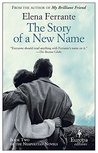
The Story of a New Name by Elena Ferrante: A review

The Story of a New NameThe Story of a New Name by Elena Ferrante
My rating: 5 of 5 stars

The Story of a New Name is the second in Elena Ferrante's highly-praised Neapolitan Quartet. In it, we again meet the two friends. Lila and Elena, both born in August 1944 and now in their late teens and early twenties.

By the end of the first book, My Brilliant Friend, teenaged Lila was already married to the wealthy grocer Stefano. Their marriage had continued the neighborhood pattern of rape and beatings. The "brilliant" Lila, who, like Elena, had longed for a different kind of life away from the impoverished neighborhood where they grew up, had escaped the poverty of her childhood in her marriage to Stefano, but she couldn't escape the culture of male domination and physical abuse. That was simply the accepted way of the world.

It was inevitable that the spirited Lila would eventually rebel and seek more from life. The only surprising thing about that was where and from whom she sought that "more."

Elena, meanwhile, with the help and encouragement of her teachers and her own hard work, as well as a little bit of luck, continued her progress through the educational system. She escaped the trap of an early marriage and managed to continue to college, which opened up a whole new world to her.

The story of Elena's first trip away from her neighborhood to go to the college at Pisa brought back some vivid memories for me. I could relate very well to the apprehension and anxiety of a girl who had lived all her life in an insular neighborhood as she struggled to find her way and her place in this new world she had entered. Been there. Done that. Got the tee shirt.

This really is, in so many ways, a heartbreaking story. The barriers that life throws up for these two young women must seem almost unreal to younger women readers living in Western societies today, but their older mothers, aunts, grandmothers can testify that the barriers really did exist and, in all too many instances, still do, even if in modified form.

Elena continues to be the narrator of this story, but her narration is informed by some notebooks of Lila's. Lila had given them to her and pressed her to keep them - but not read them - so that Stefano would not find them. They were notebooks containing her writing about her feelings and experiences from the time of childhood right up through her marriage. Of course, Elena could not resist the temptation of reading them, and so she is able to tell us what Lila was feeling concerning many of the events of both their lives.

The two young women had always been competitive, especially about school, but, as they reach adulthood, they also become competitive about men. They are attracted to the same young man, although Elena denies her attraction. This attraction will have important consequences for their friendship and for their lives.

Throughout these years, the friendship undergoes repeated trials. The lives of the two have diverged in very significant ways and, at times, they are emotionally distant as well as physically distant from each other. But always something brings them back together.

I loved this book. I thought it was even better than My Brilliant Friend. From the very first page of The Story of a New Name I was mesmerized. I would have liked to read the entire book in one sitting, but, unfortunately, life intervened. I had work to do, places to go, appointments to keep, but I always returned to it as soon as I could, because I just couldn't wait to find out what was going to happen next.

My only real problem with the book was one of the same ones I had with the first entry, namely trying to keep the cast of thousands straight! All those confusing names and all those families and their interrelationships. Had the author not again included that index of characters at the beginning as a handy reference, I might have been irretrievably lost.

As it is, I now feel that I know and understand Lila and Elena. The drama of their lives seems so real, so well-written, and so engrossing that one can't help feeling that it must be based upon real life. The author herself is something of a mystery, but she grew up in Naples and it seems likely that she experienced or observed events similar to the ones that she describes in her books.

Or maybe she just has a really vivid imagination.


View all my reviews

Monday, December 21, 2015

My Brilliant Friend by Elena Ferrante: A review

My Brilliant FriendMy Brilliant Friend by Elena Ferrante
My rating: 4 of 5 stars

With the publication of The Story of the Lost Child in 2015, Elena Ferrante completed her quartet of extravagantly praised "Neapolitan Stories." It seemed about time for me to get on board with reading the books to find out what all the shouting was about.

My Brilliant Friend, published in 2012, was the first of the series. It begins with the main protagonist, Elena, learning that her friend Lila has disappeared, not for the first time. Elena and Lila are now in their 60s and Lila's latest disappearance causes Elena to reminisce about their long friendship and the events which marked and shaped their lives. My Brilliant Friend is a telling of those reminiscences.

Elena and Lila grew up on the outskirts of Naples. It is the 1950s when we meet them. Both girls are six years old. They live in a neighborhood where violence is an everyday fact of life. Men settle their inevitable disagreements on the streets with fisticuffs, knives, or guns. Then they go home and continue to take out their anger on their families, beating their wives and children. A child turning up at school with bruises, or a wife doing her shopping with a black and blue face and arms are not instances to be remarked upon - it's just the way of the world.

In this fraught atmosphere where girl children are, on one hand, guarded as priceless treasures - any man or boy who dares to even look at one risks his life - and, on the other hand, seen as totally worthless for anything except as wives, mothers, and household drudges, Elena and Lila dream big dreams. They are both extremely intelligent and competitive with each other. Their competition pushes each of them to try to achieve more both academically and in other areas of life.

This book takes the girls through their teenage years. It is a meditation on the diverging and converging paths of their friendship over the years, and, through their friendship, we see their neighborhood, their society, beginning to change. The girls rely completely on each other even as their paths in life diverge and their destinies become separate in surprising ways. They remain always the best of friends, each knowing that her friend is the one that she can call on if she is in need.

The girls' neighborhood is home to a bewilderingly huge cast of characters. I found it difficult at times to keep all the names straight, but the author has helpfully included a list of the characters and their relationships and interrelationships at the beginning of the novel, so if the reader gets too confused, she can always return to that list.

Some of the major influences on Neapolitan society, as it is explored in this book, are tradition (of course), the Church, and an organized crime group known as the Camorra. All are intertwined and have their role to play in the highly structured and stratified way of life of the inhabitants. Both Elena and Lila, each in her own way, struggle to escape its tentacles.

I begin to see why these books have been so highly praised and I look forward to reading of the further adventures of Elena and Lila in 2016. 


If I had to select one word to describe My Brilliant Friend, it would be "fascinating." I was fascinated by the narrative from the first few lines. The plotting is masterful, invisible almost, and the narrative details and characterizations are abundant to the point of being almost overwhelming at times. The reader feels totally immersed in the stultified society in which these two brilliant girls are growing up and trying to find their way. Ferrante's style of writing renders her portrait of the two and their neighborhood in meticulous and unforgettable detail.

My only criticism of the book is that it seemed to lose a bit of its steam toward the end. I think one of the most difficult things for a writer to do is to write a bang-up ending that brings all the loose threads of the narrative together and provides a satisfying conclusion for the reader. In this case, since there are still three more entries in the story of Elena and Lila, perhaps the writer can be forgiven for easing off a bit on the ending.


View all my reviews