Translate

Showing posts with label Kate Atkinson. Show all posts

Monday, September 30, 2024

Death at the Sign of the Rook by Kate Atkinson: A review

When I read that Kate Atkinson had released another book featuring former police detective and now private detective Jackson Brodie, I put my reading list aside and picked it up. I never miss a chance to spend time in the company of Brodie.

This entry is, it seems to me, an homage to Agatha Christie's And Then There Were None which I read long, long ago and which, along with The Murder of Roger Ackroyd engendered and confirmed my love of mysteries. 

Atkinson takes us to Rook Hall, the east wing of one of England's stately homes called Burton Makepeace where a "Murder Mystery Weekend" is being hosted by the cash-strapped owners of the home as a way of raising money. For only £1250 per person, the guests which include a vicar who has lost his faith and his ability to speak, an army major who lost a leg and his interest in life, a countess, and the Dowager Lady Milton as hostess will have the opportunity to solve a murder mystery. 

But then a real mystery intervenes when a convicted murderer on the run is thought to be hiding somewhere in Burton Makepeace's surrounding moors.

To further complicate matters, Jackson Brodie shows up along with DC Reggie Chase. They are there because of the theft of some paintings including a rather valuable one by J.M.W. Turner. The suspect is the housekeeper, Sophie, who has now gone missing. 

Moreover, there was another recent art theft from the home of a recently deceased widow, a Renaissance painting titled "The Woman with the Weasel." The suspect there was the widow's caregiver named Melanie. Are Melanie and Sophie actually the same person?

So all the plot elements are set for a typical Christie-like mystery, but wait! There's more! There's humor and quite a lot of it, actually. Much of the humor comes from Brodie's internal dialogs and philosophical musings with himself.

The plot was fairly intricate and engaged the little gray cells (as Poirot would say) in trying to sort it out. The result was a highly entertaining read that made me a bit sad to turn that last page.


Tuesday, March 7, 2023

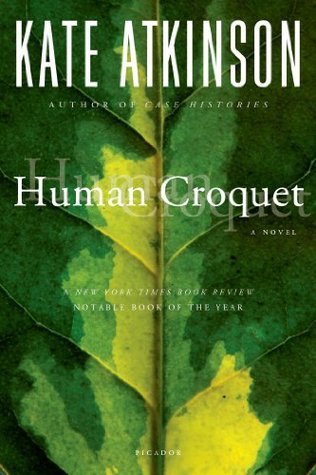
Human Croquet by Kate Atkinson: A review

Human Croquet is actually one of Kate Atkinson's early books. It was published in 1997. As such, I would rank it perhaps in the middle of her works as far as the quality of the plot and the writing. So, not one of her best but certainly not bad and well worth a read. (I don't think Kate Atkinson has ever written a bad book.) 

The book is set in a typical 1960s British suburb called Lythe. Lythe's claim to fame is that it was once the heart of an Elizabethan estate and was the home of a young writer/tutor named William Shakespeare. In the 1960s it was the home of a young girl named Isobel Fairfax. Human Croquet tells her story.

Isobel lives in a home with her quite dysfunctional family that includes a brother who is obsessed with alien abductions and an aunt who lives with many cats in her bedroom. Isobel's mother, Eliza, went missing when Isobel and her brother Charles were only children and they have never really recovered from this loss. Isobel's and Charles' father has remarried but the kids are not too keen on the new wife and Isobel, in particular, still harbors hope that her mother will someday return. 

Isobel is the narrator of the story and she has a wonderful voice. She is intelligent and witty but quite lonely and she had a profound longing for her mother which is central in her life. Isobel also has a very big crush, as only a teenager can, on a boy called Malcolm.

The mystery of Eliza's disappearance and Isobel's longing for her return dominate the story. We also get a good bit of Fairfax family history, along with Shakespearean references. And that would be my one complaint about the book; namely, that there is so much going on that it detracts somewhat from the main story. Nevertheless, Atkinson's depth of characterization and attention to detail are fully present and make for a book that is hard to put down and that the reader is sorry to see end.  


Tuesday, November 29, 2022

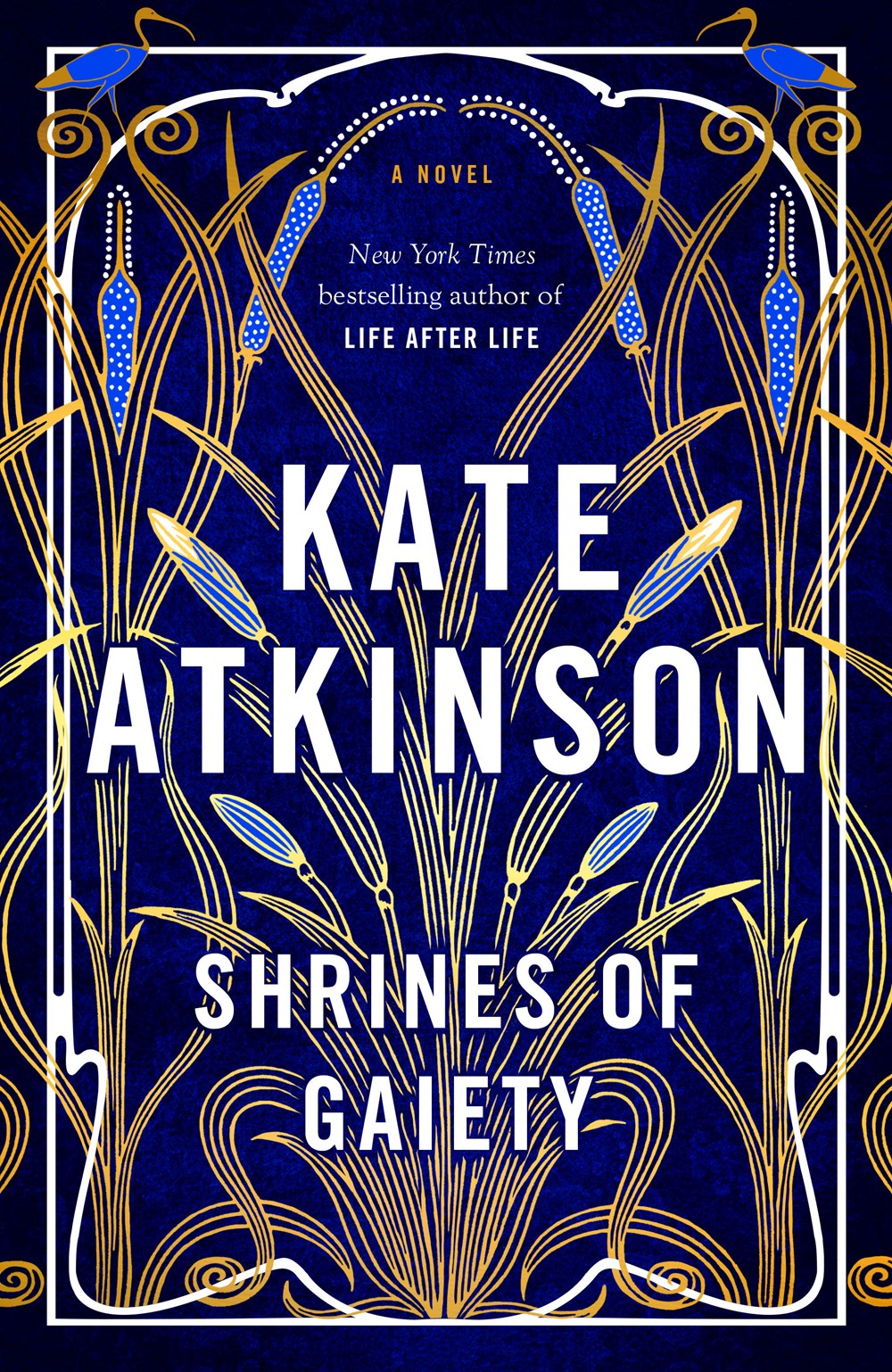
Shrines of Gaiety by Kate Atkinson: A review


In her latest book, Kate Atkinson gives us 1920s London. It was a fraught time and place with a multilayered society full of drugs, the sex trade, mob wars, and the posh clubs that were the center of it all. Overseeing all that was Nellie Coker, Ma Coker.

Nellie was the shrewd owner of a string of nightclubs. When we first meet her, she has just been released from a stay in prison. Even so, though she exists in a dangerous world and has enemies all around, she is the queen of all she surveys. 

Nellie was indeed Ma to six duplicitous children who, in addition to all of her business interests, kept her on her toes. We see many of the events through the eyes of the eldest child, Niven.  He is a rather enigmatic character, home from his recent service in World War I. His character was essentially forged by his experiences in that war, especially his time in the Somme.

In addition to Nellie and Niven, there are a multitude of other characters, almost too many to keep track of, but Atkinson is a pro and she gives each of them a unique voice which helps the reader to make connections and keep them all straight. 

Although it is eight years after the end of the Great War, England is still recovering and the frenetic nightlife of Nellie's clubs helps the patrons to forget, at least for a little while. There are hostile forces all around, many of whom would take Nellie's empire from her if they could, so in order to protect the empire and continue to provide for her children, with no husband there to help her, she must be on constant alert.  

There is so much here, it is really difficult to summarize it all in a brief review. Atkinson has obviously done much research on this period and she paints a vivid and memorable picture of post-war London. It is a compelling storyline that completely absorbed me from beginning to end. In fact, my initial rating on the book was four stars, but on reflection, I really can't think of any good reason to take away a star. Five stars it is!   

Monday, July 1, 2019

Big Sky by Kate Atkinson: A review

Kate Atkinson published the last of her Jackson Brodie novels, Started Early, Took My Dog, in 2010, but somehow I did not discover them until 2013. When I did, I read and reviewed all four, starting with the first, Case Histories, over a two month period. I thought they were all brilliant and I was eager for the next one in the series to be published. But it didn't happen. Instead, Atkinson produced two other brilliant but unrelated literary novels, Life After Life and A God in Ruins. I had to accept the fact that she was never going to produce another Jackson Brodie mystery. 

Then a couple of months ago, wonder of wonders, I read that a new Brodie book was in the works and would be published in June. I immediately preordered it and as soon as it arrived in my Kindle queue last Tuesday I started reading. It was definitely worth waiting for.

Kate Atkinson's books really defy categorization. There's certainly a mystery/thriller element to them and, of course, Jackson Brodie is a former policeman and now private detective, but this book, just like all her previous books, reads like literary fiction. The plot is intricate, complicated, and, in the end, fits together as tightly as any jigsaw puzzle. But getting to that end takes us on a very convoluted route with constant, sometimes dizzying, changes of scene and so many different characters that it was occasionally confusing at first until I got a handle on them. Nevertheless, Atkinson, the consummate writer, leaves sufficient bread crumbs for us along the way that we can be assured that we are finally going to see how all these different stories link up.

These days, Jackson Brodie's investigations consist mostly of infidelity cases and that's what he's doing when we meet up again. It's very boring. In between, he's also sharing the care of his teenage son, Nathan, and his ex-partner Julia's (the actress) elderly dog, Dido. 

While on the case, he observes a young girl with a backpack who is hitchhiking. He sees her get into a car and his instinct to preserve and protect kicks in. He tries to follow the car but loses it in traffic. A few days later on the beach, he finds a backpack like the one he saw and takes it to the police to try to interest them in an investigation. They see no reason to get involved. Jackson is sure that something bad has happened to the girl and works at trying to find out who the car belonged to so he can trace the owner.

It turns out that this sleepy little Yorkshire town has a lot of very bad stuff going on, much of it centered on the country club set that plays golf at the Belvedere Golf Club. There's a group of men with a whole industry involving scamming foreign women, especially from Eastern Europe, to come to England for jobs, but when they arrive they are drugged, chained, and become sex slaves. Human trafficking, it seems, is big business here.

At the same time, Reggie Chase, a woman who once saved Brodie's life when he was in a train wreck, is now a policewoman here and she and her partner, Ronnie, are reviewing an old case history and talking to witnesses once again. Some of the witnesses they interview overlap the as yet unexposed human trafficking enterprise. Both petite women, Reggie and Ronnie are wonderful and very tough characters who have earned the nickname "the Kray twins" among their peers. (The Krays, of course, were two of Britain's most notorious killers.)

All of these threads, including others too numerous to detail, eventually get tied together and we learn that they really did connect all along. We also learn the meaning of that enigmatic first chapter of the book, the one called "Eloping." That alone is just about worth the price of the book.

In a tale that features the most odious pedophiles and sexual predators and seems almost ripped from today's headlines, it's all about details with Atkinson and no detail is too small to warrant her attention. She lovingly weaves all the tiny bits of her intricate plot to create a tapestry representing flawed human beings, some of whom are actually trying to do their best to live ethical lives and to be on the side of justice. Even if the letter of the law sometimes isn't. It's a tour de force of writing.

Now I wonder when the next Jackson Brodie book is coming out.

My rating: 5 of 5 stars    

Friday, October 12, 2018

Transcription by Kate Atkinson: A review

No one or nothing in Kate Atkinson's new novel is exactly what it seems. There are double agents, double crosses and secrets galore. It is, as Winston Churchill once said in another context, a riddle inside a mystery inside an enigma. It is literary fiction, historical fiction masquerading as a mystery/spy thriller.

Moreover, Atkinson uses much the same technique as she employed so successfully in Life After Life to take us back and forth through the life history of her main character, Juliet Armstrong.

We meet Miss Armstrong on the day of her death. It is 1981 and she is 60 years old. She is crossing a street in London when she is struck by a car. She knows she is dying as she lies on the pavement surrounded by concerned passersby who try to help.

Flashback to 1940 when she was still only 18 and an orphan. She is recruited by the British intelligence agency, MI5, to work as a transcriptionist. She is to listen to the conversations between an MI5 agent, Godfrey Toby, and a group of British Nazi sympathizers, the so-called fifth column, and then transcribe those recorded conversations on paper. Her workplace is an apartment next door to the apartment where the agent meets with the Nazi sympathizers and attempts to get them to reveal their activities. Finally, she is recruited to do some spy work on her own, to infiltrate another group of fifth columnists. She continues working for MI5 throughout the war. 

We next meet her in 1950 when she is 28 and working for the BBC. London is still under the pall of the recent war. One day, on her lunch break, she sees Godfrey Toby on the street, but when she rushes to greet him, he denies that he is Toby and insists that she has mistaken him for someone else. She is shaken by the experience and is more shaken still when she receives an unsigned note saying that she will pay for what she did. What could the note be referring to?

Back we go again to wartime and Juliet's relationship with her boss Peregrine (Perry) Gibbons. She entertains erotic fantasies about Gibbons and when he invites her on a weekend excursion to the country, her hopes are high. Those hopes are dashed when it transpires that her boss is an amateur naturalist and he has invited Juliet along to observe the birds and beasts in their natural habitats! A certain amount of hilarity ensues.

In fact, one of the charms of this book is its humor, much of it expressed in Juliet's irreverent and sarcastic asides. At times the humor borders on the madcap as Juliet proves to be quite a capricious and careless spy.

There is tragedy as well - it is wartime, after all - and Juliet participates in her share of it. It is this which makes her fear retribution when she receives that note in 1950.

But who is this Juliet Armstrong really? Is she who and what she seems, or is she, too, hiding something? Atkinson keeps the cards on Juliet very close to her vest and only reveals them toward the end. When they are laid on the table for all to see, of course, it all makes sense. And we remember what Juliet's boss in MI5 once told her: "The mark of a good agent is when you have no idea which side they're on."

Atkinson has spun a rousing good tale. Call it a spy thriller, a mystery, or literary fiction, or better yet, don't try to categorize it at all; just go where the narrative takes you.

My rating: 5 of 5 stars   

Thursday, May 28, 2015

A God in Ruins by Kate Atkinson: A review

A God in RuinsA God in Ruins by Kate Atkinson
My rating: 5 of 5 stars

Those of us who read and loved Kate Atkinson's last book, Life After Life, have looked forward to and been curious about how she would follow it up, and maybe we worried a little bit that she wouldn't be able to again reach the high standard she had set for herself. We needn't have worried. This is a wonderful book, every bit as imaginative in its way as the hugely successful book that preceded it.

And right up front, I'll give you a piece of free advice. If you haven't read Life After Life, read it before you read this book for this is a companion piece to that book. Not a sequel as such but simply another part of the story.

In Life After Life, we met the Todd family of Fox Corner. The focus of that book was one of the Todd daughters, Ursula. Atkinson imagined various scenarios for Ursula's life. In some of those scenarios, the life was brief, tragic, and uneventful. In others, the life stretched through most of the 20th century and affected world events.

Ursula had a beloved younger brother named Edward (Teddy). A God in Ruins tells his story and, in so doing, reveals more aspects of Ursula's life, as well.

The title of the book comes from a quote by Ralph Waldo Emerson: “A man is a god in ruins. When men are innocent, life shall be longer, and shall pass into the immortal, as gently as we awake from dreams.” War, says Atkinson, is humanity's great fall from grace and fall from innocence, and, make no mistake, this is in large part a novel about war and about whether a war even if engaged in for righteous purpose may, in the end, become an exercise in savagery that victimizes the very people civilization is supposed to defend.

Atkinson tells this story through the experiences of Teddy in his life as an RAF Halifax pilot. We learn of his harrowing experiences on his bombing runs over enemy territory. He served three tours of duty, some 60 missions in all, and was one of the few such pilots to survive for a life afterward. Fewer than half of them did survive.

During his bombing runs, Teddy tries not to think about the people on the ground where his bombs are falling, but he vows to himself that if he survives, he will always be kind in his afterlife. The evil that he saw and experienced in the war forged in him the will to always be a good man, and it took an inordinate amount of evil to create the Teddy who became so unstintingly generous in his later relationships.

Though we don't get serial lives for Teddy as we did for Ursula, the author does bend time by switching back and forth to different eras of his life from chapter to chapter, and so we see him at Fox Run with his family in the '20s in one chapter, and perhaps in the next chapter he's with his own family of wife Nancy and daughter Viola in the '50s or even in the 21st century when he is alone. It's a technique that works surprisingly well to give us the fullest picture of the man. We see him in his youth, as a brother and friend, and then as husband, father, and grandfather and we learn how each role had been informed and influenced by the earlier ones.

Teddy's life is not without tragedy. His beloved father dies just on the cusp of the beginning of Teddy's War and then there are all those friends and companions that he lost in the war. The love of his life, Nancy, dies a premature death, leaving him to raise daughter Viola on his own. It would have been a daunting task under the best of circumstances and Viola is definitely NOT the best of circumstances!

At the end of his long, long life, all of Teddy's loves are gone except for his two grandchildren, one of whom is half a world away, and his cold fish of a daughter who may as well be a universe away. Fortunately, his greatly loved and loving granddaughter Bertie is at his side to escort him on his final flight from his nursing home bed as, in his mind, he struggles one last time, with shells bursting all around, to keep his Halifax on a level flight.

I love the way that Atkinson tells this story in a circular, non-chronological fashion. It makes the tale more enticing, more revealing of the personalities and motivations of the characters, I think, than a straightforward chronological narrative would have. It is the art of the writer to have chosen this inventive method of story-telling. Everything is interconnected. Minor details have great import to later events. So, stay alert throughout, reader: Attention must be paid!


View all my reviews

Tuesday, September 17, 2013

Life After Life by Kate Atkinson: A review

My rating: 5 of 5 stars

"Am I alive and a reality, or am I but a dream?"  - Edgar Rice Burroughs in The Return of Tarzan


People of a certain age - my age - remember fondly the great television series of 1959-1964, "The Twilight Zone."  Each week it presented stories of a unique vision, stories that could be loosely categorized, as could this book, as science fiction. Indeed, as I read Kate Atkinson's latest marvelous book, Life After Life, I kept thinking that this would have made a great tale for "The Twilight Zone."

Earlier this year, I first met Kate Atkinson through her Jackson Brodie series. I read all four of the books in that series, in which she explored the outer reaches of possibilities of the mystery genre, beginning with Case Histories. In this new book, she seems to be exploring the outer limits of possibilities of science fiction. She imbues the genre with her own unique brand of creativity.

But how to begin to describe this story? Well, it has its beginning on February 11, 1910.

On that date, Ursula Todd is born in a village in England, in a house called Fox Corner. But she is born with the umbilical cord wrapped around her neck and before she can draw her first breath, she is dead.

On February 11, 1910, at Fox Corner, a baby girl is born to Sylvie and Hugh Todd, their third child. She is a healthy, bouncing baby girl and she is named Ursula. She will live a long and eventful life.

Or, when she is a baby, Ursula is smothered by a cat lying on her face while she is in her cradle.

Or, she is saved when her mother shoos the cat away.

Or, when she is four, her older sister Pamela pulls her into deep water while they are on a seaside vacation, and they both drown.

Or, they are both rescued by an onlooker and carried safely back to their mother.

On her sixteenth birthday, Ursula is raped in her home by a loutish friend of her older brother. In her complete innocence, she doesn't really understand what has happened to her and is later surprised to learn she is pregnant. She goes to London and confides in her Aunt Izzie, her father's sister, who arranges for an illegal abortion, which nearly kills Ursula.

Or, on her sixteenth birthday, she shares a chaste kiss with her next door neighbor, Benjamin, a darkly handsome boy on who she has a crush, and afterward they embark on an innocent first love affair.

She goes to Germany as a student, lives with a German family, and meets and befriends a young woman named Eva Braun. She meets Eva's lover, Adolf Hitler, and one day at a cafe, she manages to shoot him, thus changing the course of history.

Or, she tries to shoot him and is herself killed by his companions.

Or, she goes to Germany as a student, lives with a German family, meets a young man and marries him and they have a daughter named Freida. She gives up her English citizenship and becomes a German citizen and as war is approaching and she desperately wants out of Germany and to get back to England and Fox Corner, she finds herself trapped with her daughter. She survives the war, but in 1945, with her husband long dead, her little daughter deathly ill and the Russians on the outskirts of Berlin, she obtains drugs for suicide. She gives them first to her daughter and watches her die and then takes the drugs herself and darkness falls.

Or, she returns home to England after her time as a student in Germany, continues her education and ends up as a civil service employee, where she serves throughout the war years. She also serves in the local brigade which has the task of rescuing living victims caught in the rubble of the blitz and digging out the dead. She has several affairs but never marries and never has a family of her own, but she is devoted to her two younger brothers and her older sister Pamela and her children.

Or, she lives until June 1967 and on the eve of her retirement from the civil service, she takes a walk in the park, sits on a bench lost in her memories and in the pain of a severe headache. And she dies. Or...

And so it goes throughout this book. Alternate lives. Alternate deaths. Not only for Ursula but for those around her. What part is "real" and what part merely a dream or a premonition of something that might have been different? Does it matter?

Or, to put it as Edgar Rice Burroughs did, "Am I alive and a reality, or am I but a dream?"

It is not really possible in a short synopsis to convey the atmosphere of this novel. It is by turns funny and sad, ironic and poignant. For me, perhaps the most poignant and the most revealing part of the book was being able to see the horror and privation of World War II for civilians both in Germany and in England through the eyes and experiences of one character. It is a brilliant and heartbreaking portrait of war, one that only a masterful writer - dare I say a woman writer? - could paint.

Kate Atkinson is a masterful writer and she has written an extraordinary book, one that moved me as few books have. Gillian Flynn, author of Gone Girl, provided a blurb for the book which appears on the front cover. It says, "One of the best novels I've read this century." To which I can only add, "Me, too."        


View all my reviews

Thursday, June 27, 2013

Started Early, Took My Dog by Kate Atkinson: A review

One of the great pleasures - one of many - for me in reading Kate Atkinson is all the cultural and literary references in her books. It's sort of an "inside baseball" thing, I guess. The cognoscente feel especially smart and privileged to understand the references.

Many of her references relate to television series that any fan of PBS/BBC mysteries will recognize. For example, I think every one of her books that I have read so far has had someone in them watching Midsomer Murders! As a prodigious fan of that series and owner of an (almost) complete collection of DVDs of it, I know just who she's talking about when she refers to those people.

Another television investigative team she mentions in this book is that of Inspector Morse and Sergeant Lewis, another of my all-time favorites. There are also literary references to everyone from Shakespeare to Faulkner to, in this case, Emily Dickinson. It's from one of Dickinson's poems that the rather weird title of this book is derived.

But enough about cultural references. What about the story itself?

The story is typical Atkinson. It has its roots in an event that happened in the 1970s. A prostitute is murdered and her child(ren?) disappear(s). One of those who finds the body is WPC Tracy Waterhouse. She picks up the child in the apartment where the murder took place, a little boy of four, and cuddles him to comfort him. Then a social worker comes and takes him away and shortly after he is made to disappear, apparently sent to an orphanage under a new name. More than thirty years later, Tracy Waterhouse continues to be haunted by this.

By now, Waterhouse has retired from the police force and is working as head of security at a place called Merrion Centre in Leeds. One day she witnesses a woman being abusive to a small girl, presumably her daughter, in the Centre. Tracy follows the woman, whom she knows is a prostitute from her years with the police, and impulsively offers to buy the small child from her! Tracy Waterhouse's lonely, humdrum life will never be the same.

Also witnessing the abusive event is an elderly woman named Tilly, an actress on a soap opera. Tilly wants to interfere to protect the child but is stopped by her physical frailty and incipient dementia.

In another part of Merrion Centre that day, Jackson Brodie witnesses a hulk of a man with a little dog, a Border terrier. The man has a rope tied too tightly around the little dog's neck and is dragging him along. Jackson follows the man and when he gets to a somewhat more private area, he hails the man, says "On guard!" and punches him hard in the stomach. The man goes down and Jackson takes the dog and walks away.

How the stories of all three of these characters intertwine and how they are all a part of the continuing story that began with the murder of a prostitute back in 1975 is the complicated tale that Atkinson enthralls us with in Started Early, Took My Dog. We learn again, as Faulkner told us, that the past is never history; it is not even past. 

Moreover, this book, as all those of Atkinson's that I've read, is full of her sly humor - some of it chuckle-worthy, some of it laugh-out-loud funny. But overall and binding it all together is a sense of morality and intelligence. Jackson Brodie may be a flawed character, as is Tracy Waterhouse and certainly poor Tilly, but all are ethical beings who are driven (and perhaps doomed) by their impulse to protect the weak. Perhaps it is significant that both Tracy and Jackson are former police officers and that Tilly still mourns the death of her black child that she failed to protect.

This was the fourth in the Jackson Brodie saga. Kate Atkinson has now gone on to write other things and it is not clear if she will come back to Brodie. I sincerely hope she does. There is, I think, a lot more development possible here and I'm just not finished reading about him. I would hate to think that my last glimpse of him would be looking at his ringing cell phone and thinking of Emily Dickinson's Hope is the Thing With Feathers.

Tuesday, June 4, 2013

When Will There Be Good News? by Kate Atkinson: A review

Thirty years ago, Lance Corporal Jackson Brodie and his fellow soldiers were called out to do a search and rescue for a little girl lost. Six-year-old Joanna Mason had been walking along a quiet country lane with her mother, sister, and baby brother when they were attacked by a mad man wielding a knife. As her mother fought with the man, she screamed at Joanna to run. Joanna did and she was the only one who survived. After an extensive search, she was found and rescued by Jackson Brodie.

Now, Joanna is a successful doctor married to a man who may be a fraud and a criminal. She has a baby son, the same age as her brother when he was killed, and she learns that the man who killed her family is to be released from prison. It looks like Joanna's life is falling apart again. 

Jackson Brodie's life has taken a radical turn for the better. He thinks. He has no money worries thanks to a bequest and he is recently remarried to a woman he had only known for two months, but he is happy. He married after he learned that Louise, the Detective Inspector of the Lothian and Borders Police that he met in the last book, was also getting married. He and Louise had a strong mutual attraction, but neither of them could ever admit it to the other.

Louise is the second wife of a good and patient man whose first wife was a paragon of virtue. A paragon Louise is not, and the marriage isn't quite what she had signed up for.

Joanna has a teenage mother's helper named Regina - Reggie. Reggie is the latest in Atkinson's fascinating characters. She has an intellectual bent and is working on a translation of the Iliad. She's also charming, funny, compassionate, self-reliant, and always prepared for emergencies as she was taught by the doctor. When there is a terrible train crash behind the house where she is, she rushes to the scene and saves a man's life. Guess whose. 

As is her trademark, Kate Atkinson once again manages to bring all these disparate, seemingly unrelated stories - plus others that I haven't mentioned - together in a satisfying denouement. In doing so, she shines a light into the darkest corners of her characters' secrets and inhibitions but she does it always with compassion. 

This novel, like the two earlier ones in the series that I've read, is full of wit and wisdom and is sprinkled with philosophical meditations on life, death, love and loss. It is a darkly humorous book, but not so dark as to ever be depressing, in spite of the terrible events it relates. 

These books get categorized as detective novels or crime novels because they feature a detective - or ex-detective - and the stories do involve crime. But to call them that is to try to fit them into too tight a box. They are literary fiction that examines the human condition. The plots are intricate enough to satisfy the most demanding reader and they are purely character-driven. 

The tone of the books is the most important thing and the tone is one of sardonic wit and amazement at the foibles of human beings, even human beings who should know much better. True, the writer has chosen to tell her story in the form of a thriller and it is an unputdownable page-turner at that, but it is really a satisfying medley of thriller, mystery, crime fiction, and literary fiction. Maybe we need a new category. We could just call it "Atkinsons."

In the end, Kate Atkinson did not tie all of her characters' stories up in a neat little knot, so we'll have to move on to the next book in the series to find out where all of this is going. We can only hope that there will be several more entries to come.

Saturday, May 18, 2013

One Good Turn by Kate Atkinson: A review

Kate Atkinson's mysteries read like literary fiction. Very, very good literary fiction. She manipulates her multiple story lines to construct a tight and intricately woven tale that is fast-paced and keeps the reader turning those pages. She writes with wit and humor, but also manages to convey the melancholy, loneliness, and regret of her characters without ever being maudlin. In other words, she is able to present a full portrait of their humanity. 

Moreover, in One Good Turn, she delivers a delicious and particularly satisfying twist at the end. I loved it!

In this book, we again meet Jackson Brodie, the ex-army, ex-police, and now ex-private detective. At the end of Case Histories, Jackson had inherited two million pounds from a grateful client and had sold his private detective agency and gone to live in France. 

He had started an affair with one of his former clients from that first book, Julia the actress. Now, Julia has taken a part in a production to be presented at the Edinburgh Fringe Festival and Brodie travels with her to the city.

On a street in Edinburgh one day, Jackson witnesses an incident of road rage. A car has to brake suddenly to avoid hitting a pedestrian and the vehicle behind rear-ends the car. The driver of the rear vehicle, a mountain of a man, jumps out of his SUV with a baseball bat and attacks the driver of the car. The man goes down and his attacker turns his ire to the victim's car and beats it to a pulp. Then he returns to the victim to deliver the coup de grace as horrified bystanders, including Jackson Brodie, watch. 

Before he can complete the action, one of the bystanders tosses his briefcase with a laptop in it at the attacker. Miraculously, it hits him and knocks him down. When he picks himself up, he gets in his vehicle and leaves. 

The owner of the briefcase goes to the aid of the injured man as the police arrive. Brodie, who had been preparing to intervene, is off the hook and goes on his way. But he had automatically noted the license plate number of the attacker's vehicle. Thereby hangs a tale.

One of the bystanders was a woman named Gloria Hatter, the wife of a local entrepreneur named Graham. Graham is a builder who puts up particularly shoddy housing all over town, while bribing inspectors to look the other way. He also has other business interests that will come to light in the course of the book. He is just about half a step ahead of the Fraud Squad. Graham is a very rich and a very cruel man. Gloria is a desperately unhappy woman with a plan. 

Another of the bystanders, the man who threw the briefcase, is Martin Canning, a writer of schlocky mysteries. Martin has a major role to play in this story.

All of the disparate threads of this tale seem totally unconnected at first. In addition to the ones I've mentioned, we have Russian prostitutes, teenage delinquents, a female inspector with the Lothian and Borders Police, a stand-up comedian, and others too numerous to mention. But Atkinson weaves her magic and in the end all of those disparate threads come together in a pattern that has the execrable Graham Hatter squarely at its center, and we finally see that everything really does connect. 

This is absolutely a masterful job of plotting and of handling a large cast of characters while making each of them distinct and memorable. Atkinson is a formidable writer, whether you label her work mysteries or literary fiction. She defies categorization. And that is a good thing.

Tuesday, April 23, 2013

Case Histories by Kate Atkinson: A review

Case Histories is certainly not your typical mystery. It is more of a literary fiction/mystery hybrid, perhaps weighted on the side of literary fiction. Still, it contains all the elements and many of the stock characters of the mystery formula, including exploited teenage runaways, innocent female murder victims, blowsy and outrageous middle-aged actresses, strait-laced and uptight spinsters, pathetic and hapless males, and wives with secrets. Moreover, it has the world-weary detective, existing in his own world of pain, who feels driven to try to protect, or occasionally avenge, all of these characters.

The book begins with the telling of three case histories, any one of which could have been the backbone and beginning of a literary fiction novel.

First, we have the story of Olivia Land, the youngest and favorite of four Land daughters. The child disappears one hot summer night when she is three years old and she is never seen or heard from again. Thirty years later, two of the sisters find a troubling clue regarding her disappearance which makes them look for a detective to reopen the investigation of the case. 

Second, we meet Theo, a man with two daughters, Jennifer and Laura. Laura is the younger and more beloved daughter. Theo delights in her beauty and intelligence. She is perfect in every way in his eyes. Then she goes to work as an intern in her father's law offices and, on her first day there, the unspeakable happens, turning poor Theo's world upside down. The perpetrator of the unspeakable crime is never found and many years later, Theo seeks the truth and closure.

Third, Michelle is a young wife and mother who is stressed out, probably suffering from postpartum depression. Her husband is not understanding. One day she snaps and her world as well as her family's - including her sister's - is shattered. Years later, the sister, too, looks for a detective who will bring her closure. But is the story that she tells true? 

After reading these three case histories, we meet the detective who will take on all three. Jackson Brodie is a bit of a down-and-outer whose private detective agency is not going very well. Mostly, he is engaged to investigate domestic disputes. He's presently following an airline attendant whose husband thinks she is cheating on him. In fact, following her is extremely boring because she doesn't seem to be doing anything.

Then, in rapid succession, Brodie is presented with these three new cases, long cold cases for which his clients need resolution, much as he needs resolution in his own sloppy personal life.

Brodie has an ex-wife who seems a bit of a bitch and an eight-year-old daughter who seems to be slipping out of his control and yet whom he adores. He has an old client, whom he has never billed, a cat lady who hires him to locate her missing cats! She will loom large in the development of one of his new cases.

Jackson Brodie certainly fulfills the formula of the former policeman, world-weary private detective with a heart of gold. He is an engaging and empathetic character who is also full of humor and gets off some good one-liners throughout the book.

In fact, a big part of Atkinson's talent is her humor. She is able to write about very sad and troubling events with a light touch which makes them bearable to read about. Indeed, as one reviewer that I read wrote, she is "able to see the way happiness and sadness can emerge from the same situation." That seems a rare gift for a writer and it made reading this book a joy.

In the end, the reader gets some resolution of all the case histories. Brodie's clients are not all necessarily as lucky. But then, as we learn, they don't all necessarily deserve such resolution. As I said at the beginning, this is not your typical mystery.