Translate

Showing posts with label Amor Towles. Show all posts

Sunday, November 21, 2021

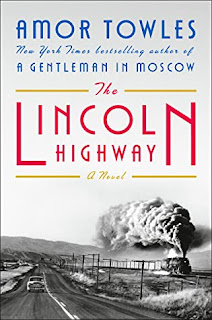
The Lincoln Highway by Amor Towles: A review


Amor Towles' latest features two young brothers, an older teenager and a pre-teen, who set out from Nebraska to go to San Francisco where the younger brother has hopes of finding their mother who left them years earlier. Their father has recently died and their home, a farm, is being foreclosed by the bank which holds the mortgage. They have to go somewhere and San Francisco seems like a good option.

It is June 1954 and eighteen-year-old Emmett Watson has just been driven home by the warden of the work farm where he was sentenced after being found guilty of involuntary manslaughter. His sentence has been reduced because of his father's death and the fact that his eight-year-old brother, Billy, has no other family to care for him. Emmett has a 1948 Studebaker Land Cruiser that he had bought with wages earned as a carpenter before being sentenced. His plan was to take his brother and head to Texas where he thought there would be work for a carpenter and he could support the two of them. Billy, though, is dead set on California and after some research at the library, Emmett decides that there's work for carpenters in California as well, so San Francisco, here they come!

Well, not quite.

Before they can hit the road on the Lincoln Highway, two of Emmett's friends from the work farm, Duchess and Woolly, show up, having hidden themselves in the trunk of the warden's car. They have escaped and now Duchess has a plan to get Emmett to take them to New York where Woolly, who is estranged from his wealthy family, will be able to access money left to him by his grandfather. Woolly is an innocent with a good heart and some undefined psychological problem for which he takes medication. Duchess is a user of people and I disliked him from his first "Ta-da!" I never changed that opinion even after I learned some of his sad history. Emmett is not interested in going to New York. He's ready to head west.

Unable to persuade Emmett, Duchess steals ("borrows") his car, and he and Woolly head to New York, stranding Emmett and Billy. Naturally, all the money they had was in the trunk of the car, so they are left with no money and no transportation. They manage to hop a freight train and head to New York to find Duchess and Woolly and the car.  Easy peasy, right? That was just one of the things about the book's plot that stretched my credulity.

Emmett and Billy are fortunate in finding friendly people along the way who help them out. After they leave, Sally, the young woman who had cared for Billy before Emmett was released, decided that she would drive to New York to find Billy and Emmett, and of course, she does, and of course, they do get the money (of Woolly's) that Duchess had promised. But there are a couple of tragedies that happen before the two brothers can finally head west on the Lincoln Highway. 

I loved Towles' A Gentleman in Moscow and I dearly wanted to love this one, too, but I just couldn't. I can't really explain why but it never really "grabbed" me. The story was told from five different viewpoints, Emmett's, Billy's, Sally's, Duchess's, and Woolly's, which gave it a somewhat unfocused feel. It was a bit long, I felt, and could have used a stricter editor. The story seemed repetitive and it got rather tiresome for me. I started with a lot of empathy for the brothers, for young Billy particularly, but as the plot advanced, his constant perkiness just began to irritate me. It's certainly not a bad book, and I know many readers have really liked it, and I guess I liked it well enough but just not as much as I was expecting to.

My rating: 3 of 5 stars


Monday, July 17, 2017

A Gentleman in Moscow by Amor Towles: A review

The gentleman in Moscow is Count Alexander Ilyich Rostov. A former member of the landed aristocracy from the beautiful region of Nizhy Novgorod, famous for its apple trees, Rostov was a resident of the grand Metropol Hotel in Moscow in 1922. He had been living in a luxury suite in the hotel and enjoying a life of culture and leisure. But then came the revolution.

The triumphant Bolsheviks set about ridding their new society of aristocrats. Rostov was called before a tribunal and was sentenced by them to a life under house arrest. But instead of continuing to live in his luxurious suite of rooms, those rooms, along with most of his furniture and other possessions, were taken from him and he was moved into a small 100 square foot room in the belfry of the hotel. This would be his home - and his prison - for the next thirty plus years.

In addition to being a man of culture, erudition, and wit, Rostov possessed an indomitable spirit and an ability to deal with reality without blinking. He took steps to make himself as comfortable as possible in his new surroundings and continued his daily routine at the hotel.

That daily routine included interactions with several of the staff members as well as other residents. The staff members who became his fast friends and surrogate family included: Emile, the head chef of the restaurant; Andrey, the maitre d'; Marina, the hotel's seamstress; and Vasily, the concierge. This "family" became increasingly important in Rostov's life as events unfolded. 

Rostov proves to be a charming man of hidden depths and his life changes drastically when he meets a nine-year-old resident of the hotel named Nina. Nina is an endlessly curious, adventurous, and precocious child, and the two become unlikely best friends. As Nina explores all the interesting nooks and crannies of the great hotel, Rostov becomes her companion and follower. Through their adventures together, a whole new world opens up for him. 

Eventually, Nina's father moves her out of the hotel, but Rostov continues to find adventures. His new outlook on the world leads him to seek employment and he becomes the headwaiter in the restaurant at the hotel, a position for which his experience and knowledge suits him right down to the ground. 

He settles into a comfortable routine with his friends from the hotel and occasional visits by friends from past life, but, of course, he is never able to leave the hotel.

Then one day, Nina comes back into his life. She is a grown woman, married, and with a child in tow. She relates an all-too-familiar tale of the new Bolshevik utopia. Her husband has been arrested and sent to Siberia. She plans to follow him and find a place to live there. But she cannot take her five-year-old daughter with her. She wants to leave Sofia with Rostov, saying that she has no one else she can turn to and she will return in a month or so after she finds a place to live and retrieve her daughter. How can Rostov refuse?

And so the count's life changes drastically once again. His next fifteen years are devoted to raising Sofia, who becomes his adopted daughter because her parents never return and are never heard from again.

The cast of characters in this engrossing novel are compelling, top to bottom. Not just the main characters but all the secondary supporting cast are thoroughly human, completely realized personalities. They are, for the most part, a humane and lovable lot, with only one real notable exception. But then every tale needs a bete noire.

The story really gets going once Sofia comes into Rostov's and his "family's" lives. It is amazing and yet thoroughly believable the adjustments that are made by these people to ensure that Sofia is properly cared for.

I admired the way that Towles seamlessly wove in bits of Russian literary history as well as the political history of the twentieth century, as the Bolsheviks tightened their grip on the reins of the country. Moreover, he was able to relate his tale with wit and an intentional lightness of spirit. We are never weighed down by tragic events. Although we are always made aware of what is happening outside the hotel, the focus is quite personal and individual, a testament to the undaunted human spirit. 

Towles never loses sight of his end game and how the plot should be directed. As he brings the book to its very satisfying end, he manages to draw all of his important themes together: the gravitational pull exerted by one's home, parental duty, the pivotal role of friendship and romance in our lives.

I loved this book and the character of Count Rostov. From the first sentence to the last, I was completely captivated.

My rating: 5 of 5 stars