Translate

Showing posts with label Louise Erdrich. Show all posts

Monday, December 9, 2024

The Mighty Red by Louise Erdrich: A review

Any time that I learn that Louise Erdrich has published a new book, I jump on it just as quickly as I can so when I heard about The Mighty Red I made sure to get access to it as soon as possible. It did not disappoint and was, in fact, everything one could wish for in an Erdrich book.

The novel is set in the town of Argus, North Dakota, alongside the Red River that flows north through Minnesota and into Canada following the border between Minnesota and North Dakota. It is an agricultural area and the main crop is sugar beets. 

Sugar beets are the basis of the economy. Most of the families of this area are involved in some way with their production - growing them, harvesting them, transporting them, and processing them. They depend upon sugar beets and their fortunes rise or fall based on the outcome of the year's crop. 

It is 2008/2009 but the author takes us back through the beginnings of sugar beet farming along the Red River. She shows us how the use of fertilizers and pesticides and growing the same crop over and over on the land has depleted the soil. By this point, only the use of genetically modified seeds and toxic chemicals keeps the fields producing. It is a time of recession and the economic downturn has hit the already struggling community hard. 

We experience the story mostly through the character of Crystal Frechette who is a hauler of sugar beets. She works twelve-hour shifts on the highway during which she has plenty of time to worry about her 18-year-old daughter Kismet. When Crystal's husband, Martin, absconds with the town's church renovation fund, she and Kismet are left to live with the consequences of his action.

Kismet has transformed from a goth who had endured the derision of her peers and is now marrying Gary Geist who is set to inherit not one but two farms. Gary suffers from the trauma and fear resulting from a tragic accident and is ruled by his own need for redemption, while Kismet just yearns for escape. Their marriage forms the centerpiece of the novel.

Along with these characters, we also meet: Hugo, a homeschooled boy who is infatuated with Kismet; Eric, Gary's loyal friend; Winnie and Diz, Gary's parents who have their own marital struggles as well as the tension of trying to keep the farm going; and Jeniver, Crystal's lawyer, who possesses a sharp tongue to go with her brilliance. Each of these characters' stories help to fill out the portrait of a community going through changes and facing challenges.

As with so much of Erdrich's writing, the land itself is another character. The harsh climate and fertile soil of the Red River Valley helps to shape the lives of those who live there. The valley's cycle of flood and drought and of planting and harvest are metaphors for the challenges faced by its residents.

Erdrich employs multiple narrators to tell the story of people living through interwoven timelines that are a reflection of the meandering path of the river itself. By the end, she has given us a masterful story that reveals the tapestry of those lives and their environmental impact on the land they occupy. 

My rating: 4 of 5 stars


Monday, May 2, 2022

Tales of Burning Love by Louise Erdrich: A review


Jack Mauser is dead. He has most definitely shuffled off his mortal coil. But before he died, he married five women. No, not all at the same time. Serially. The first one of them is also dead, having died not long after their marriage, but the four others are still living and they are in a reflective mood after the death of their ex. When they are stranded in a North Dakota blizzard after the funeral, they spend their time together telling stories of Jack, of how they met and married him, and why their relationships with him did not last. We get to eavesdrop on their conversation.

The mystery is why these accomplished and responsible women each fell in love with this loser of a man. The man they describe, perhaps accidentally, is an incredibly selfish and short-sighted person. He is completely irresponsible and seems to have betrayed everyone he had ever had a serious relationship with. Still, these women loved him and some of them still do and it seems likely that on some level he returned their love. At least of some of them. There is no explaining the ways of the human heart.

But perhaps the experience of loving the wrong person at some point in our lives is something that most of us can relate to. In this sense, the "burning love" that Erdrich describes is a pain that all of us have felt.

Each of the four women telling their story here is a very different person. It seems the only thing they really have in common is Jack. Only one of the women had a child with him, but, ironically, she seems to be the least affected by his death and perhaps the least committed to him in life.  

Each of these characters - Jack Mauser and his four wives, Eleanor, Candice, Marlis, and Dot - are dysfunctional human beings, and yet it could be argued that they all did the best they could. Their lives are messed up, but then whose life isn't at some time and on some level? Each of these messed up human beings are getting through life the best way they know how and what more can we expect of anyone?

Erdrich writes of them all with affection and humor. The humor, in fact, is the saving grace of this book, in my opinion. I didn't really like most of the characters and for that reason, it was a bit difficult for me to "connect" with it. But Erdrich writes so beautifully that she almost pulls it off in spite of her unlikeable characters. And anyway, any Erdrich book is always worth reading.

My rating: 3 of 5 stars

Monday, November 29, 2021

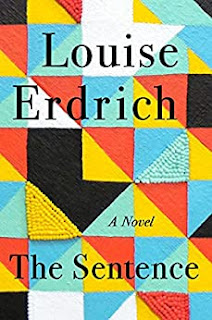
The Sentence by Louise Erdrich: A review


Acclaimed author Louise Erdrich who is also the owner of an independent bookstore called Birchbark Books & Native Arts in Minnesota has given us a new book that features an acclaimed writer named Louise who has an unnamed independent bookstore in Minneapolis. The book's Louise, however, is not the central character in the new book; that role belongs to an Ojibwe woman called Tookie.

Tookie had led a checkered life prior to her employment at the bookstore. In response to a friend's request, she had stolen the corpse of the woman's boyfriend, wrapped it in a tarp, and taken it across state lines to deliver it to another friend. It was a stupid but not evil thing to do. She was trying to help out a friend. What she didn't know was that the "friend" had duct-taped crack cocaine under the armpits of the man. Unlucky Tookie is found out and arrested by a tribal policeman. She is indicted and found guilty and sentenced to 60 years.

After ten years, Tookie's former friends confess to what they had done and absolve Tookie. That is the result of her lawyer and the tribal policeman who had arrested her having worked tirelessly to secure her release. Her sentence is commuted and she is released. She's able to continue her education and get on with her life. 

During her imprisonment,  one bright spot and consolation for her was that she had learned to love books. Reading took her out of herself and her present circumstances. When she got out, she applied for a bookseller's job at that independent Minneapolis bookstore. Louise, who interviews her, does not ask about her work history or her stint in prison. Instead, she asks her what she is currently reading. Tookie replies that she is reading Almanac of the Dead by Leslie Marmon Silko. Apparently, that is a good enough recommendation for Louise. She tells her that it is a dark time for bookstores and that hers probably won't make it, but then she offers her a job.

Tookie's life is finally looking up. She has reconnected with the tribal policeman who had arrested her and the two of them marry. She loves her work as a bookseller. Then four years after she takes the job, the store's most annoying customer, Flora, dies while reading a book. And five days after her death, her ghost finds its way to the bookstore and starts haunting Tookie.

Flora was an apparent White woman who had always claimed to be Indigenous in a former life and she was obsessessed with all things Indigenous. She even brought a photograph to the store of a woman who she said was her great-grandmother and who she presumes is Indigenous. Tookie takes a look at the picture and concludes, "The woman in the picture looked Indianesque, or she might have just in in a bad mood." Wonderful line and the book is replete with such wonderful lines.

Flora's daughter gives the book that her mother was reading when she died to Tookie. The passage that was found open by her body is marked. When Tookie looks at the book, she superstitiously becomes convinced that a sentence in the book killed Flora.  Thus, the title of this book has a double meaning; it may refer to the sentence that Tookie served in prison or it may reference that killer sentence in Flora's book. Tookie tries to destroy this malevolent book but she is less than successful.

Then, in the midst of all this haunting and malevolence, the pandemic arrives. It's the spring of 2020 and at the corner near Cup Foods, a place where Tookie's husband often stops to buy things on the way home, the police kill George Floyd and the city explodes. Clouds of tear gas fill the air. And suddenly everyone wants to read about why people are so angry. The bookstore becomes a very popular place just as everything is beginning to close down because of the pandemic.

The Sentence is chock full of literary references and with descriptions of the ins and outs of running an independent bookstore, from dealing with publishers to packaging mail orders, or curbside and even home deliveries of books during the pandemic. It is quintessentially Erdrich from page one to the appendix featuring a list and sublists of Tookie's favorite books. The narrative is at times dark and at times laugh-out-loud funny. More often it features Erdrich's wry humor and her well-known dichotomy of interests in shamanic religion and Christian beliefs and in the nuclear family as opposed to tribal kinships. She is able to explore all of these in this wonderful book.

There is a point in the novel where Tookie is talking with Louise, her boss, and she tells her her theory about the book that Flora was reading containing a sentence that was powerful enough to kill her. Louise responds, "I wish I could write a sentence like that." Well, if anyone could...

My rating: 5 of 5 stars   

Monday, April 20, 2020

The Night Watchman by Louise Erdrich: A review

Louise Erdrich builds the characters in this book with infinite patience and care until they completely come alive for the reader. We feel as though we could reach out and touch them, have a conversation with them. Perhaps they are so real because they are based on real people that the author loved. All of the books in her ongoing Chippewa chronicles feel personal, but this one feels almost visceral. It is a story derived from her family history.

The night watchman of the title is Thomas Washashk (the word means muskrat) and he is based on Erdrich's grandfather who was, in fact, a night watchman. Thomas works guarding a factory where the women of the Turtle Mountain clan work during the day to fashion gemstones as drill bits for Defense Department ordnance and for watches. The factory must be protected at night from potential thieves. It is the major employer on the reservation and vitally important to the Turtle Mountain economy.

One of the women who work in the factory is Thomas's niece, Patrice, also called (much against her will) Pixie. Erdrich tells her story through these two characters.

The time is 1953 and a Termination Bill has been introduced in Congress that promises to "emancipate" America's indigenous people from their lands and their tribal affiliations. The effect of the bill would be to abrogate all those treaties between the tribes and the U.S. government. The treaties that had promised to be in effect "as long as the grass shall grow and the water run." It would "free" Indians to be just like any other citizens with no special protections or acknowledgment that the land had been theirs. When Thomas understands what the bill portends, he determines to fight it for the Turtle Mountain clan. He embarks on a letter-writing campaign to every politician who he imagines may have some influence in the matter and he takes delegations of his people to meet with many of them, culminating finally in a trip to Washington to testify before Congress.

Patrice, meanwhile, is fighting her own battles. The main battle is simply to survive, to get enough food to keep her family fed. She and her mother are haunted by the disappearance of Patrice's sister, Vera. She had moved to Minneapolis and then the family had lost all contact with her. Eventually, Patrice gets together enough money and gets time off from her job to go to Minneapolis to look for her. On the journey, she is accompanied off and on by a Turtle Mountain boxer called Wood Mountain. In the city, Patrice becomes entangled in a toxic and surreal world which frankly defies description. Just know that I will never be able to forget the image of the "waterjack." You'll have to read the book to understand.

The horror discovered by Patrice is reflective of the ongoing tragedy of missing and murdered Native American women and the scandal in that so little attention is paid to it. Erdrich manages to convey this, without overwhelming us, with a series of unforgettable images. And about halfway through the book comes a chapter entitled "Agony Would Be Her Name." The chapter is only nine sentences that describe the experiences of a victim who may be Vera. It is searing, shattering.

Patrice does not find her sister but she does find her baby that the family did not know existed. She and Wood Mountain take the tiny boy back home.

Thomas and his supporters find the government mostly unresponsive to their inquiries and their petitions regarding the Termination Bill. At one point, one of his supporters, Eddy, speaks these prescient and profound lines:
"Government is more like sex than people think. When you are having good sex, you don't appreciate it enough. When you are having bad sex, it is all you can think about."
Indeed.

At the risk of revealing too much, let me say that the Turtle Mountain clan survives. It is not "terminated," but some other Native American groups are not so lucky, and in an afterword, Erdrich notes that the Trump administration has tried to revive the policy (which was itself terminated during the Nixon administration) to apply to the Wampanoag, "the tribe who first welcomed Pilgrims to these shores and invented Thanksgiving."

This is one of the most deeply moving books I have read in a long time. Erdrich's novels are like that, and this one is one of her best, in my opinion. I will not soon be forgetting Thomas and Patrice and all of their family and friends. In the final two sentences of her afterword, Erdrich writes: "Lastly, if you should ever doubt that a series of dry words in a government document can shatter spirits and demolish lives, let this book erase that doubt. Conversely, if you should be of the conviction that we are powerless to change those dry words, let this book give you heart."

It does. Thank you, Louise.

My rating: 5 of 5 stars


Wednesday, January 3, 2018

Future Home of the Living God by Louise Erdrich: A review

How do you decide what books to read? I read reviews by reviewers whom I respect. I take recommendations from family and friends who know what I like to read. I look at the best sellers lists. I look at the magazine Bookmarks, which compiles reviews from various places and assigns a rating to books. And then I choose from all those sources the books that appeal to me and that I think I might enjoy reading. It's a system that works well for me. I rarely pick up a book to read that turns out to be a total stinker.

And then there are some favorite authors that I will read regardless of what the reviews say or whether anyone recommends them. Louise Erdrich falls in that category.

Her latest book, Future Home of the Living God, got very mixed reviews and, for the most part, they were not kind. Bookmarks' assessment, after compiling the reviews, was "Not recommended, even for Erdrich fans." But I was undeterred.

I thought the book had an interesting concept. It seems that the world as we know it is ending and evolution is reversing itself. The birds in the sky are becoming more dinosaur-like, reverting to Archaeopteryx type. Cougars are becoming more saber-tooth cat-like. And humans? Well, that is the question. Are they destined to go all the way back to Australopithicene form? And just how did this reversal of evolution come about? The answer to that question is, in fact, one of the many holes in the plot.

Erdrich tells her story through the character of Cedar Hawk Songmaker, an Ojibwe woman who was adopted as a child by a white liberal upper middle class Minneapolis couple. When we meet Cedar, she is four months pregnant and in hiding with the child's father, Phil. The narrative is told through a diary which Cedar is writing for her unborn child. 

The United States has elected a repressive religious government that closely monitors pregnant women through a robot called "Mother" and all pregnant women are forced to report to a government birthing center. Cedar is trying to avoid that. But she feels compelled to go and meet and get to know her birth family on the reservation.

Soon she is discovered and imprisoned in one of the birthing centers. Her efforts to escape complete the main action of this (very) dystopian novel.

Erdrich started writing this novel in 2002 and abandoned it. Last year, after the election of 2016, she was inspired to pick it up and finish it. Unfortunately, I never really got the sense that Erdrich had committed herself to the story. It felt rushed and incomplete and there were holes in the plot that one could drive a truck through. I think she might have been well advised to leave it back in 2002.

Louise Erdrich is such a gifted writer and even here her brilliant way with words shines though and we get flashes of that imagination and wit which make reading her books a special experience, but in the end, this effort just fell flat and I have to concur with Bookmarks' assessment: "Not recommended, even for Erdrich fans."

I'll still read her next book though.

My rating: 2 of 5 stars 

Thursday, June 23, 2016

LaRose by Louise Erdrich: A review

LaRoseLaRose by Louise Erdrich
My rating: 5 of 5 stars

Louise Erdrich is a national treasure. That's my considered opinion. Every book of hers that I've read has shone with the light of a transparent power, a use of language that is deceptively plain but rich and transformative. Like her Native American ancestors, it seems that she has taken from the anglo culture and language that which she can use, but she has retained the best parts of her heritage that help her to make sense of those things and to keep them from overpowering the sensibilities of the unique society from which she came. She does it all again in LaRose, her latest novel.

LaRose is the third book in a sort of loose trilogy that started with The Plague of Doves, continued with The Round House and now reaches (perhaps) a conclusion with this book. Or perhaps there will be more books set in this community of the Indian reservation, a place where different characters and their ancestors recur and where the past seems a part of the present. As Faulkner said, "The past is never dead. It is not even past." It was true in Faulkner's books and it is true in Erdrich's books, as well.

The title character of this current book is a young boy, five years old when we meet him, who is descended from generations of female LaRoses. He is the fifth in a line of LaRoses in his family and, in time, we meet them all. Soon after the beginning of the story, we go back to 1839 and the first LaRose, who was sold to a white man who raped her. Ultimately, she played a part in his murder, and she achieved a happier future, finding love, romance, marriage, and family. But she also suffered for many years with tuberculosis and when she died in the care of white scientists, those scientists stole her bones and put them on display. Generations of her family fought to have those bones returned to her community.

But back to the fifth LaRose, who is five years old in 1999 when fears of Y2K - remember that? - were abroad in the land.

LaRose's father goes hunting one day and finds the buck that he wishes to kill to feed his family. He sights the animal with his rifle, but as he pulls the trigger, there is a blur between him and the deer and the deer runs away. He has hit something but it wasn't the buck. To his horror, he finds that he has shot a child. It is Dusty, the five-year-old son of his best friend and neighbor and the playmate of his son, LaRose.

LaRose's father is a home health aide, a beloved and respected member of his community, but the question which the book asks is, can a person do the worst thing possible and still be loved? This man has done the worst thing possible in killing an innocent child. Can his community forgive him or will he be ostracized?

He searches for a way to make atonement and finds a possible answer in the traditions of his people. He convinces his wife that they must give their own son to the parents of the dead child as a replacement for that child. (Erdrich notes in her postscript that such transfers did occasionally happen.)

The transfer is made and LaRose becomes a kind of ambassador between the two families, working to alleviate the suffering of both. He has the gift of healing and of seeing into the world where the spirits of the dead dwell, and the act of sharing this special child sets in motion a chain of events that will, in the end, transform the lives of all it touches.

In her last book, The Round House, we saw the workings of revenge/justice. In LaRose, Erdrich explores the other side of that coin - forgiveness. She answers the question of whether a person can still be loved after doing the worst thing possible with a resounding "Yes!"

There are so many rich and wonderful characters in this book. I cannot even attempt to mention them all here, but Erdrich's writing makes splendid use of all those multiple voices in telling this story. We get to know each of them and to respect them as individuals and as part of a larger community that values and cares for them, even the ones with messed up lives, usually ruined by drugs and/or alcohol.

Erdrich brings us her unique perspective of a culture which the larger American society has sought in its worst moments to annihilate. She shows us that that culture is still standing, still nurturing its people, and that we are all richer for it.


View all my reviews

Friday, June 7, 2013

The Round House by Louise Erdrich: A review

This is a story that, unfortunately, resonates with current events happening all too often on Indian reservations in this country. It involves violence against Native American women by white men. It is a problem which raises knotty jurisdictional issues for law enforcement.

This may sound familiar to those who follow the news out of Washington. During the debate over reauthorizing the Violence Against Women Act last year, certain Republicans in Congress balked at some of the provisions because they did not want Native American courts and law enforcement to have authority to arrest and prosecute white perpetrators of such crimes. This is the issue that is at the heart of Louise Erdrich's latest book about Ojibwe culture, the National Book Award winner, The Round House.

The events in the book take place in 1988. In the spring of that year, Geraldine Coutts, an Ojibwe woman living on a reservation in North Dakota is the victim of a horrific rape. It leaves her physically battered and psychologically traumatized and reluctant to talk to the police or to her husband about what happened.

The story is told, from the perspective of later years, through the eyes of Geraldine's thirteen-year-old son, Joe. The attack on his mother has torn his safe world apart. He longs for justice for her but justice is slow in coming and, meanwhile, his mother has taken to her bed and will not leave it. She exists in a world of solitude that neither Joe nor his father, Bazil, a tribal law judge, seems capable of breaking through.

The investigation of the crime soon enough leads to the arrest of a suspect, but he is a white man, and it is not clear just where the crime took place. Was it on the reservation or off? Which court exactly has jurisdiction over the crime? There seems no doubt that this man is the perpetrator, but soon he is released when jurisdictional issues cannot be decided. This sends Geraldine into an even deeper tailspin of grief and depression.

Joe is understandably frustrated and angry at the course of events and he determines to find a way on his own to wrest justice from this tragic situation. In this, he is aided by his friends, Cappy, Zack, and Angus. Much of the story revolves around these four teenage boys' activities in the summer following the attack on Geraldine as they pursue their "investigation" and as Joe slowly evolves a plan. Difficult as the story is, the boys bring a great deal of humor to it. They are, after all, simply goofy, typical teenage boys, full of hormones and curiosity, and eager to grow up. 

Bazil, meanwhile, attempts to work through the law, which he reveres, to find justice for his wife, but when the rapist is released from jail and Bazil encounters him at the grocery store, something snaps inside him and he attacks the man. When Joe joins in the attack, it seems to bring Bazil to his senses and he backs away and the man escapes. In tragedy piled on top of tragedy, Bazil then suffers a mild heart attack in the grocery store, further traumatizing his son.

There is so much sadness in this story and yet it never really seems depressing. The saving grace for the Coutts family is their own closeness and the solidarity which the rest of the reservation folk feel with them. Many of their friends and relatives, each in his or her own way, set about trying to heal the family. They are always supported and loved and the sense of community is a palpable part of the tale.

Though, eventually, a kind of rough justice was achieved, the ending of the saga was still more distressing, and yet, it is hard to see how it could have been different. It fit the arc of the story perfectly. 

One small quibble: What has Louise Erdrich got against quotation marks? Her writing is lyrical, but sometimes unnecessarily unclear simply because no quotation marks are used. Are we listening to a conversation or reading exposition? Much as I liked the book, this lack irritated me. 

Saturday, November 5, 2011

The Beet Queen by Louise Erdrich: A review

It's only within the last year that I've begun reading the works of Louise Erdrich. Don't ask me why I waited so long. After all, The Beet Queen was published in 1986 and Love Medicine in 1984. She was always on my radar, but there are always so many books to read and so little time. Belatedly, I have entered Erdrich's world and I'm very glad to have finally made it here. 

Louise Erdrich writes about ordinary people. They are not superheroes, or even heroes (for the most part) in the common understanding of the word. They are people who struggle to play the hand that Fate has dealt them through nature and nurture (or lack of nurture) as best they can. They go through life never really understanding their own motives or what makes them tick. Mostly, they are too busy making a living to give much thought to that. Even so, these characters sometimes have flashes of insight that just about literally take the reader's breath away. 

In this, as in other of her books, Erdrich employs the method of the multiple perspective narration in telling the story. Whenever I read a book that uses this method, I am reminded of William Faulkner's As I Lay Dying where it was used so effectively. The Beet Queen measures up well to that iconic work.

The core of this story concerns three children, Karl and Mary Adare and their newborn baby brother, who are abandoned by their mother, Adelaide, who was in despair following the death of her lover and the loss of his support which left the little family destitute. Adelaide flies off with the Great Omar, a barnstorming pilot. Her baby is immediately kidnapped by a couple who have just lost their own baby. They bring him up as their own. Karl and Mary hop a freight train to Argus, North Dakota, where they have an aunt. However, along the way, Karl takes another path and ends up being raised in an orphanage. Mary actually makes it to Argus and is taken in, cared for and raised by the family. The rest of the book revolves around the events in Argus and in Mary's life and the lives of those who touch her. But Karl, who becomes a salesman, and the baby brother, who grows up to be a priest, will inevitably be drawn back into the tale. 

The Beet Queen herself is Dot, a thoroughly unlovable character who is the progeny of Karl and of Mary's best friend, Celestine. Unlovable she may be but she is loved deeply by three of the book's characters, Celestine, Mary, and Wallace, friend of the two women and one-time lover of Karl. In fact, it is Wallace who delivers the baby Dot (whose real name is Wallacette Darlene) on a cold snowy night. Thereafter, his fate is forever tied to hers. 

Erdrich writes lyrically, one might even say lovingly, of her characters. These are not attractive people, but she makes us understand the ties of sympathy, jealousy and betrayal that bind all the members of the Adare family and their Argus neighbors together. She makes us see ourselves in them and care about their fates, even as we may be repelled by the darker aspects of their personalities. We see in their story the impatient flow of history over forty years on the harsh landscape of North Dakota and we experience the lives of the hard yet vulnerable people who are able to survive there. This wonderful book brings the rich panoply of personal tales together for our enjoyment. I'm so glad that I have finally entered Erdrich's world and come to know these people.

Thursday, September 8, 2011

Tracks by Louise Erdrich: A review

Reading this book reminded me of trying to work a jigsaw puzzle without the benefit of the box top picture. You begin to wonder if these pieces REALLY fit together or have you forced them. Will there be a recognizable picture when you finish or will it just be a splatter of dots that mean nothing?

One doesn't expect Louise Erdrich to tell a linear story and she certainly doesn't in Tracks. It is a thoroughly non-linear, stream-of-consciousness kind of tale, an Ojibwe tale. Her storytelling has been compared to Faulkner's and one can clearly see why in this book.

Erdrich employs two narrators, Nanapush and Pauline. Nanapush is an old man who is telling stories to his granddaughter, Lulu. He is telling her about her origins and how she came to be who she is. Pauline's story is her own - a story of how she came to be a bride of Christ - but tangentially, her story also touches Lulu through Lulu's mother, Fleur.

Fleur was a woman of power. Her community ascribed those powers to the supernatural. In fact, in the Ojibwe community of 1912 - 1924, when these events take place, all of life was seen as influenced by the supernatural, by beings from another plane of existence. Often, these were the ancestors, relatives, and friends who had passed on to the next life. The Ojibwe had a mixture of religious belief that embraced the ancient faith as well as the Catholic one. At times, it was difficult to see where one left off and another began.

The language of this novel, as always in Erdrich's novels, is quite beautiful. Occasionally, the reader comes on a passage that strikes right to the center of her heart. Even so, I found the story a little difficult to follow. Once in a while I wished for a straightforward, linear path through the tangled web of these lives. "This happened and then this happened which led to this and ultimately resulted in that." One will always wish in vain for such a straight telling of an Erdrich story.

Saturday, July 16, 2011

Love Medicine by Louise Erdrich: A review

Louise Erdrich can surely string words together! What is amazing to me is that in this, her very first book, published in 1984, she was able to string them together with such a sure and confident touch. The book is now 27 years old and I don't know why it took me so long to get to it, but I'm very glad that I finally did. The stories told here of the Kashpaw and Lamartine families of the Chippewa Reservation - and off the reservation - stand up well over time. They are just as relevant, poignant, and funny, that is to say just as human, today as when first published.

The stories begin with a death, the lonely death in a North Dakota snowstorm of a Chippewa woman named June Kashpaw. She was just trying to make her way home at Easter in the deepest snow that had fallen in the area in forty years. Although June disappears from the book in the first few pages, her presence lingers throughout. She continues to impact her family and everyone who cared for her. She is never truly dead to them.

The stories that Erdrich tells are of a people existing on the edges of civilization, halfway between the old ways and the new. They are caught in a time warp, as they try to hold on to the best of their past while at the same time making accommodations in order to survive in the white man's world. The stresses are enormous and many of the Chippewa seek release in alcohol which creates further stresses of its own, often tearing families and individual lives apart.

The women in Erdrich's stories are the glue that holds everything together. They are strong and passionate and they are keepers of the memories of the past. They are the providers who keep the families fed and cared for. Her description of some of the scenes of food preservation reminded me of my own mother, a farm wife who spent summers canning vegetables and fruits by the hundreds of jars. I found that I knew and understood these women very well.

The stories are told in the voices of their various characters and they all ring true. They feel and sound right. Their tone helps us to understand and empathize with each speaker.

The book does not tell a linear story. It goes back and forth in time and back and forth between characters. The result is a patchwork effect of story-telling, but when the reader looks at the whole, she can see the full pattern and it is beautiful. That is the talent of Louise Erdrich, to make us look at a people and see things that perhaps we had not seen before and to see that it is all part of a whole that makes sense.