Translate

Showing posts with label Jonathan Franzen. Show all posts

Wednesday, December 8, 2021

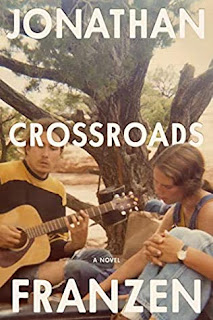
Crossroads by Jonathan Franzen: A review


Having finished with William James' The Varieties of Religious Experience may have prepared me for reading Jonathan Franzen's latest. It is a book with strong religious themes and each member of the Hildebrandt family around whom he builds his story experiences religion or rejection of religion in his/her own individual way. Franzen has said that this book is the first in a planned trilogy that, in a nod to Middlemarch, he calls A Key to All Mythologies. 

This is a very different book from his others that I have read. For one thing, it is long, nearly 600 pages and it builds very slowly. It is set in the 1970s and the feeling of it is mellow, definitely lacking the acerbic manners of some of his previous novels.

The Hildebrandt family lives in suburban Chicago in fictional New Prospect. It is comprised of husband Russ, wife Marion, and four children: Clem, Becky, Perry, and Judson. Russ is the associate pastor of a local liberal church called First Reform where there is a popular youth group called Crossroads. Its name is a reference to the choices young people must make about their lives, but here it also refers to Russ who seems to be at a crossroads in his own life. And throughout the book, each of the Hildebrandts, except for the youngest, Judson, faces a crossroads of some kind.

Russ is middle-aged and dissatisfied. He is a tall, attractive man, who reminds people of Charlton Heston while his wife, Marion, after four children and years of being stuck in mommyhood is now overweight and a bit unkempt, and a careless dresser. Russ definitely feels that he could do better and he has a candidate in mind. She's a pretty, young, blond widow in his church who has reached out to him for counseling. She has a teenage son who knows and idolizes Perry, Russ' son.

In his flirty interactions with the widow, Russ mentions that he is a fan of the blues and owns a lot of old blues records, including those of Robert Johnson, who, according to the legend, met the devil at the crossroads of Highways 49 and 61 in Clarksdale, Mississippi and exchanged his soul for mastery of the guitar. The allegory is clear. Russ, too,  must decide what the devil has to offer him. He loans some of those records to the widow, hoping they will have the desired effect.

Marion, meanwhile, is not unaware of Russ's desire to stray and essentially gives him permission to do it. She is taking stock of her own life and making changes, not to get her husband's attention but to regain her own self-respect and self-image. She will be a frump no longer. 

As we learn about Marion's life, it becomes clear that there is much of her background that is unknown to Russ. In her 20s, she had had an affair with a married man and became pregnant. The only recourse available to her for an abortion was from a man who as payment got to rape her repeatedly over many days. She suffered from severe depression and spent months in a mental hospital. When she got out, she turned to religion and the church to sustain her. It was at the church that she met Russ. She later told him that she had had a brief marriage that ended in divorce; she did not tell him the truth about her background.

For me, Marion was the most fully realized character of the novel. I admit that may be a gender bias, but she was the character I could most, if not identify with at least understand where she was coming from, what motivated her. She describes herself as a mother of four "with a 20-year-old's heart." She feels that she is not a good person, but she is determined to change her life for the better.

As for the Hildebrandt children, Clem is off to college where he experiences sexual awakening and a moral dilemma. He is so obsessed with his new sexual relationship that he's unable to concentrate on course work and his grades suffer. He decides that he doesn't deserve to keep his academic exemption from the draft. He writes to his draft board that he is quitting school and giving that up and he's ready to be drafted and to go to Vietnam. This is a blow to his pacifist father and that is part of the attraction for Clem.

Becky is the most strictly religious of the children, her father's favorite. She is the social star at her high school. Everybody wants to be in her group. She has her own awakening when she is attracted to Tanner, a boy at the church who is part of a rock 'n' roll band. Through him, she enters into that world which also gives her an experience with drugs. Her sexual relationship with Tanner changes the course of her life forever.  

Perry may be a genius. He's certainly very smart, but not smart enough to stay away from drugs. He becomes not just a consumer but a purveyor of drugs and his promising life spins out of control.

Judson is a bit of an enigma. He is a very laid-back and seemingly well-adjusted child. We don't see much of him in this novel but I suspect he may play a larger role in the sequels that follow.

There's a lot going on in this book including adultery, suicide attempts, arson, a car wreck, and the list goes on. It's difficult to sum it all up. Much of the action relates to that church group's work with the Navajos. Russ is very deeply involved in that. He suffers several professional humiliations when the group no longer wants him and he is replaced by a younger, cooler man. He hates that man and refuses to speak or interact with him. He plots ways to thwart him. Marion, meanwhile, loses her excess weight and recovers her former selfhood. In her reformed life, she manages to deflate Russ's own high opinion of himself. 

This is one of those books that stays with you and that one mulls over its meaning. I remember one of the reviews that I read of it made the comparison to the work of Joseph Campbell and I think I can see that now. God and sex - those are the major themes of the book; how those two "cultural ideas" control our lives in so many ways. It's a book that does not lack for sympathy with human frailties. That, too, is a bit of a difference from some of Franzen's earlier novels that were less forgiving. When I finished reading the book last week, I initially rated it as four stars, but I want to amend that. Having given it more thought, I think it deserves five. Of all the Franzen books I've read, I feel this is the best. It will be interesting to see where the trilogy goes.

My rating: 5 of 5 stars

Monday, August 22, 2016

Purity by Jonathan Franzen: A review

PurityPurity by Jonathan Franzen
My rating: 3 of 5 stars

Purity is the legal name of the central character of this book and moral purity as a concept seems to be the philosophical idea which the author wants to explore through his characters and their stories. He does it at great length in this interesting but rather ponderous novel.

(Full disclosure: I originally rated the book at a four-star read, but after sleeping on it overnight, I dialed it back to three stars. I think a bit of editing, trimming down some of those long passages that seem to go on forever repetitiously and to no great effect at advancing the plot, would have definitely made it a four-star.)

Purity Tyler, by the time we meet her as a young college graduate, has adopted her school nickname, Pip, as the name that she goes by. This Pip does not have any great expectations. She's in a dead-end job, burdened by crushing college debt and a lack of direction.

She is also burdened by a lack of knowledge about her family history. She was raised in a tiny cabin in the Santa Cruz Mountains by a mother who borders on the insane and who will not tell Pip who her father is or even her (the mother's) real name. At some point, she had taken on a false identity for reasons that Pip cannot even fathom and she is completely paranoid about being discovered. But why? We have to read a few hundred pages before we get to the bottom of that particular mystery.

In addition to Pip and her mother, there are at least three other main characters in the story.

There is Andreas Wolf, originally from East Germany before the Berlin Wall fell. He is now in Bolivia running something called the Sunlight Project, a Wikileaks-type operation. In fact, Andreas is very envious of and competitive with Julius Assange and with Edward Snowden over the attention that their leaks and whistleblowing garner. He is a self-obsessed and manipulative character, who is apparently irresistible to women. Once he has had an affair with a woman, she stays loyal to him forever!

We also meet Tom Aberant, who runs an online investigative journalism magazine from Denver. He is the opposite of Wolf, a serious journalist who is quiet and unassuming but fiercely dedicated to his craft. 


Tom has an associate who is also his lover, Leila Helou. Leila is married to a famous author who is a paraplegic and she divides her time between the house where her husband lives and the home of her lover.

What do all of these characters have in common? Where do their stories intersect? There is a long-ago murder involved, but Pip is the key, and we have to do a considerable amount of reading to make all the connections.

This is a novel about secrets and lies and the damage they can do, particularly to relationships between parents and offspring. It's about manipulative, self-absorbed people who are so frightened of revealing themselves that they can never have truly intimate relationships with other human beings. So, even though there are moments of humor, Purity reveals an essentially melancholy view of life.

Franzen uses the narrative method here that is familiar from his previous books, The Corrections and Freedom; namely, he gives over large swaths of the story to each character, so that we hear Pip's, Tom's, Andreas', Leila's, and even Pip's mother's tale from each of their own perspectives. This includes, as it did in Freedom, the private autobiography of one of the characters. As a method of storytelling, it reminds me most vividly of the leisurely pace of the 19th century novel. That's not necessarily a bad thing - there's a reason why Anthony Trollope is still read and enjoyed - but it does tend to result in fat books that could have an alternative life as a doorstop.


View all my reviews


Monday, October 22, 2012

The Corrections by Jonathan Franzen: A review

In The Corrections, his National Book Award-winning novel from 2001, Jonathan Franzen gives us the Lamberts, an American Gothic family from the Midwest: Alfred, the emotionally constipated paterfamilias, who sacrificed himself for his family in many ways that we discover as the novel proceeds and who now faces a slow death from Parkinson's Disease; his wife, Enid, a woman who longs for a warmth from her husband and children that she has never received, a woman who lives on the expectation that things will get better; Gary, the oldest son, married and living in Philadelphia with his manipulative wife Caroline who is teaching their three young sons the art of the disdainful manipulation of their father; Chip, the middle child, who we first meet as a self-absorbed twit but who grows into something more fully human by the conclusion of the book; and Denise, the youngest child, a talented chef who betrays her employer in Philadelphia through her ambiguous sexuality and loses, if not everything, at least her sense of self and self-worth. They are truly a dysfunctional family writ large.

We first meet Enid and Alfred as they visit son Chip in New York. The only thing is, Chip skips out on them, chasing his lover, leaving sister Denise to deal with them as they get ready to embark on a cruise that Enid had been looking forward to. This first part of the book, the first 25 to 30 pages are a "hump" that the reader must get over. At this point, these characters are so unattractive and unendearing that one is strongly tempted to throw the book in the corner and forget about it. Don't do that though. The book rewards perseverance and reveals its gifts slowly.

The structure of the book is to focus on each member of the family in one section. Thus, we get to know each of them intimately. They do not necessarily improve upon closer acquaintance and yet we begin to understand why they are so messed up and why this family falls so short of the ideal. But then, don't all families?

As we come to better know each of them, our empathy is aroused and we wish that they would make better choices, that they had made better choices in their lives. Mostly, I wished that Enid would find the fulfillment so lacking in her life. She gave so much of herself to this family and seemed to get so little in return.

Enid is the eternal optimist, always looking to a future that she is sure, all evidence to the contrary, will be rosier. In particular, she looks for one last family Christmas at their home in St. Jude. She wants all three children, her daughter-in-law, and the three grandchildren to be there - one big happy family with her and Alfred. It's soon obvious to the reader that the mean-spirited daughter-in-law will not be there and that she's going to find a way to keep her children, if not her husband, in Philadelphia. Gary promises to come. Denise promises to come. But Chip? Well, Chip is in Lithuania working a dodgy scam and seems unlikely to show up. It appears that Enid's dreams will be unfulfilled once again.

Meanwhile, Alfred's mental and physical conditions are deteriorating rapidly. Changes will have to be made. How will this family summon the fortitude to make them?

I resisted reading this book for eleven years, mostly because I was irritated by Franzen's prickly personality. I eventually got over that enough to read a couple of his other books and discovered that he is, in fact, as all the critics swooned, quite a remarkable and talented writer. This book, which is essentially a tragedy, is also filled with such humor and insight and, yes, empathy for human frailties that it becomes an absorbing epic that one wishes would not end.

In Anna Karenina, Tolstoy wrote: "Happy families are all alike; every unhappy family is unhappy in its own way." The Lambert way of unhappiness is to keep secrets, withhold affection, and demand that others fit into the molds that you have constructed for their lives. Actually, it sounds not that dissimilar from other unhappy families I have known. Each unhappy family may have its own twist on the unhappiness theme, but there are things that they all have in common. Things that they have in common with all of us. The Lamberts as Everyfamily. 

Tuesday, August 28, 2012

Farther Away by Jonathan Franzen: A review


The famously cranky writer Jonathan Franzen, who once dissed Oprah and her book club, has published this book of essays which gives some insight into some of his crankiness, how his mind works, and how he thinks about writing - his own and that of others. It is an eclectic collection of essays ranging from such subjects as modern technology to birding and ecology to literary criticism. I found myself most often agreeing with him about the things that annoy him and I was very interested to read of the fellow writers whom he championed here, most of whom I had never read and of some of whom I had never heard. After reading this book, I'm adding several of them to my "to be read" list.

I share with Franzen a passion for birds and birding and so the most interesting essays for me were the ones related to that subject, although, often, they are not only about that subject. The essay which gives the book its title, "Farther Away," concerns Franzen's trip to a lonely island off the coast of Chile called Masafuera (literally, Farther Away). He carries with him a copy of Daniel Defoe's Robinson Crusoe and a small box containing some of the ashes of his friend, the writer David Foster Wallace, which he will scatter on the island. He will be alone on the island for a few days and he hopes to be able to see the Masafuera rayadito, an endangered native songbird. He ruminates about being alone, about writing novels and the value of reading novels, about the impact of invasive species on the island, and he tries to come to terms with the loss of Wallace to suicide. He writes of his friend:
He was a lifelong prisoner on the island of himself... Fiction was his way off the island, and as long as it was working for him - as long as he'd been able to pour his love and passion into preparing his lonely dispatches, and as long as these dispatches were coming as urgent and fresh and honest news to the mainland - he'd achieved a measure of happiness and hope for himself. When his hope for fiction died, after years of struggle with the new novel, there was no other way out but death. If boredom is the soil in which the seeds of addiction sprout, and if the phenomenology and the teleology of suicidality are the same as those of addiction, it seems fair to say that David died of boredom.
Interestingly, he writes of his efforts to get Wallace to care about and find pleasure in the world of Nature and particularly of birds, but Wallace couldn't be bothered. He seemed unable to get out of himself long enough to appreciate such a world. A bit further along in the essay, Franzen tellingly writes "A funny thing about Robinson Crusoe is that he never, in twenty-eight years on his Island of Despair, becomes bored." He may have been trapped on a desert island, but he was never a "prisoner on the island of himself."

"Farther Away" was my favorite of these essays, but a close second was "The Chinese Puffin," the story of his trip to China and of meeting birders there and learning about the nascent ecological movement in that vast country. It was a sad and frustrating tale to hear of how so many birds - and other animals - are being hounded into extinction by a dirty environment and rampant industrial development, and yet it was also hopeful in that there is a small cadre of people who do care deeply about the natural world and are fighting the good fight to save the remnant of it that is left.

More difficult for me to read - I had to hurry past some sections - was "The Ugly Mediterranean" which is about the cultural tradition of slaughtering songbirds on migration. It's estimated that a billion of the little birds are trapped and slaughtered each year as they make their way from Africa to their summer range in Europe. 

I don't want to leave the impression that these essays are just about birds. A good number of them are about fiction. "The Greatest Family Ever Storied" is about Christina Stead's The Man Who Loved Children, which is highly praised by Franzen. (Never heard of it or her.) "On The Laughing Policeman" is about the writing of the Swedish authors Maj Sjowall and Per Wahloo, a happily married couple who wrote a series of ten books about their policeman, Inspector Martin Beck. I'd heard good things about this series before and it is actually already on my TBR list. Now, maybe I'll move it up a few notches.

There are also essays on Frank Wedekind's Spring Awakening (again, never heard of it or him), James Purdy's Eustace Chisholm and the Works, the short stories of Alice Munro (He's a big fan.), The Man in the Gray Flannel Suit and Paula Fox's Desperate Characters. Throughout many of these essays, the ghost of David Wallace looms as Franzen struggles through his sadness and anger over the waste of his death. One of the essays included is his eulogy given at Wallace's memorial service.

Much of Franzen's crankiness can be traced to technology and the misuse or abuse of technology. "I Just Called to Say I Love You" is about the rudeness of people who use their cell phones in public and insist on inflicting the most intimate details of their lives on those around them. He remarks upon the fairly recent phenomenon of these people ending every conversation with "I love you" or more often "Love you." As a fellow sufferer, I found myself nodding in agreement.

Well, I could go on. The twenty-two essays in this collection cover a very wide range of subjects but all are written with a lucidity and straightforwardness and are often autobiographical and revelatory of Franzen's private life and thoughts. I came away from them feeling that I understood the man and his writing much better. I read Freedom and enjoyed it. I think perhaps now I am ready for The Corrections. After all, Oprah liked it. 

Monday, May 16, 2011

Freedom by Jonathan Franzen: A review

When Freedom came out last year, all the reviewers went into orgasmic paroxysms of delight over it. I was bemused by all the hoopla, remembering Franzen's last book, The Corrections, and the big kerfuffle that was caused when Oprah chose the book for her book club and Franzen seemed to diss her readers, opining that his "lit'rature" was much too high-brow for such low-brow readers. (No, of course, he didn't actually use those words! I'm paraphasing and interpreting.) Oprah subsequently de-selected the book and moved on. I figured it was probably too high-brow for me, too, and I never got around to reading it.

But then came Freedom with a picture of the beautiful Cerulean Warbler on the cover. How could I, as a birder, resist it?

It turns out that the Cerulean Warbler is an integral part of the plot of the book. Walter Berglund, a lawyer who works for 3M in outreach and philanthropy, has a strong environmentalist streak. Environmentalist causes become his life's work which he will pursue with messianic fervor. One of those causes is establishing safe havens for the Cerulean Warbler. This part of the plot (as is much of the story) is taken from real life. There is an actual Trust that works to establish sanctuaries for the bird in this country and in its wintering grounds in Colombia.

During the course of the novel, Walter's wife, Patty Berglund, spends a summer reading Tolstoy's War and Peace, something I, myself, did one summer long, long ago in another lifetime. Perhaps it was that power of suggestion but this book reminded me a bit of War and Peace.

To state the obvious similarity, they are both very long books, but it's a bit more than that. There are the multi-layered characters and an intricate plot that unfolds almost organically, in a rather stream-of-consciousness way that must have taken painstaking planning. There's the underlying theme of the brutality and, in many cases, the stupidity of war. There are the misplaced passions of characters who fall in love with the wrong people.

This book is about Patty and Walter Berglund, their family, friends, neighbors, and enemies. They are nice people of strong character from Minnesota (although Patty is originally from New York). They meet in college. Both of them are from dysfunctional families with problematic fathers and irritating siblings who never seem to grow up in the thirty years or so covered by this novel. Walter and Patty have two children of their own and vow not to make the same mistakes with them that their parents made. To some extent, they succeed, but it is hard to resist the gravitational pull of becoming our own parents as we grow older.

This is an extremely rich work of fiction the setting of which is the social history of the Bush years. The Berglunds are liberals in a reactionary and jingoistic society. There are many journalistic touches to their story, references to the events of the times, particularly after they move from the Midwest to Washington, D.C.

Their children grow up and suprise them, as children have a way of doing. Their marriage grows cold and they grow apart and still the Berglunds persevere until...

This is a page-turner of a book about very interesting, if not always lovable, characters. I wished several times that I could just sit and read the book through to its conclusion at one sitting. I wanted to see how it would end. But I have a life that precluded that and so it took me a few days. I was glad to discover that it really wasn't too high-brow for me after all. Maybe now I'll give The Corrections a chance. Franzen really is a terrific writer.

Thursday, September 16, 2010

The great literary feud is over!

Remember the brouhaha several years ago when Oprah Winfrey selected The Corrections by Jonathan Franzen for her book club? Franzen was not amused. In fact, he was appalled. He made some churlish statement to the effect that he was afraid his selection by Oprah would turn off male readers, that they would think that his book was "middlebrow" and would not pick it up.

Well, I don't know how male readers felt, but I was certainly turned off by Franzen's ungracious and supercilious attitude. Apparently, the only people he thought were good enough and smart enough to read his book were male PhDs! Since I don't qualify, I decided I wouldn't read his book and I never have.

After his stated consternation at being given the Oprah stamp of approval, Oprah rescinded her stamp and rescinded her invitation to appear on her show. Franzen ultimately apologized for his behavior, but it was too late.

Ten years passed. Now Franzen is out with another book, Freedom. All the critics are wetting themselves with excitement and inventing new superlatives to praise it. And today there was a report that Oprah liked it, too, and that she is going to announce it as her final book club selection. Franzen, through a spokesman, said he would be happy if she did.

I'm not an Oprah fanatic and I've never joined her book club, but knowing where she came from and what she has made of her life, I do admire her. The woman has class and apparently she has the magnanimity of spirit to overlook Franzen's past behavior and judge this new book solely on its merits. I haven't decided yet if I will be that magnanimous.