Translate

Showing posts with label Jacqueline Winspear. Show all posts

Monday, July 26, 2021

The Consequences of Fear by Jacqueline Winspear: A review


1941 London. England has been at war for two years. German bombs are still falling on the country. Psychologist/detective Maisie Dobbs' contribution to the war effort is to work for British intelligence services evaluating potential candidates for undercover work in France and elsewhere. Meanwhile, she continues to carry on her private detective agency business with the invaluable help of her assistant, Billy Beale.

At the same time, her private life has taken a definite step forward. Her adopted daughter is the light of her life. She stays with Maisie's parents at her home in Kent and Maisie goes there on weekends. Also, she is in an affair with American Mark Scott which seems very promising. Mark better watch his back though. Men who fall in love with Maisie usually wind up dead!

During this period of the war, British intelligence services were employing young boys as runners to deliver messages around London. These young kids ran past decimated buildings and dead bodies, sometimes dodging bombs to deliver their messages. It's outrageous to imagine this now but there was no internet and even phone service was spotty in wartime London of '41. Kid runners were deemed to be the best option.

One of those kid runners was twelve-year-old Freddie Hackett. One night on his way to a delivery, he witnesses two men in hand-to-hand combat. He hides in a doorway and watches in horror as one of the men pulls a knife and stabs the other to death. The murderer walks away. Poor traumatized Freddie continues to hide for a few minutes but then recovers himself and goes to the address he's been given to deliver the message. Imagine his shock when the man who opens the door to receive the message is the murderer!

Freddie tries to report the murder to the police but when they go to check there is no body and the site has been cleaned up. They don't even find any blood. They assume Freddie is simply imagining things and don't investigate any further.

At one time, Freddie had delivered a message to investigator Maisie Dobbs and she had been kind to him. Now he goes to her office with his story and asks for help. Maisie accepts the truth of his report and goes to investigate. At the site, she finds a couple of clues overlooked by the police, including traces of blood, and she determines to find out what has really happened.

Meanwhile, she continues her profiling work for the intelligence services and is sent to Scotland to interview some potential candidates. And there she meets the man who Freddie believes is a murderer. He is with French Resistance and is considered a valuable ally. Maisie's two jobs have collided at this point. How will she resolve her conundrum of helping Freddie while fulfilling her obligations to the intelligence service?

As always in these novels, there is a lot of historical detail and background as well as the background of the characters involved. We learn, for example, that young Freddie's background is particularly fraught with an abusive stepfather and a mother and younger sister with Down Syndrome who he is determined to protect. The tension of it all is driving this twelve-year-old to distraction. But we can be assured that Maisie will find a way to help.

The character of Maisie can often come across as too much of a goody-two-shoes, just a little bit too virtuous, too perfect. And the characters overall do tend to be a bit stereotypical, but the stories are good, the historical facts well-researched. This is the sixteenth entry in the series, the first book of which was published in 2003. On the whole, the quality of the writing has held up well. That remains true with The Consequences of Fear

My rating: 4 of 5 stars

Monday, July 8, 2019

The American Agent by Jacqueline Winspear: A review

In Maisie Dobbs' world, it is the autumn of 1940 and London is suffering under Hitler's vaunted blitzkrieg. Most of Europe has fallen to Germany's onslaught and Britain now stands alone in opposing them. Churchill's "few," the RAF, are doing their heroic best to counter the blitz, and, in this effort, they are being helped by many American fliers who have come to join their fight. 

Back in America, the isolationists, led by people like Charles Lindberg, still hold sway. FDR, sympathetic to the British cause, does all he can to aid them, but he is unable to actually send troops.

Other Americans, particularly journalists, have also come to aid the British. Their aid is in the form of reporting events back to their country and giving their fellow Americans a bird's-eye view of what is happening under the blitz. Of course, the most famous of these was Edward R. Murrow, but in Jacqueline Winspear's telling, there is also a young woman journalist called Catherine Saxon. She will figure prominently in this story.

The American ambassador in London, Joseph Kennedy, is an isolationist with an affinity for the German cause. In time we learn that there is an American agent working directly for the president who is keeping an eye on Kennedy's activities. This agent is named Mark Scott and he is known to Maisie. She met him in Munich when she was sent there on special assignment by her government.

Maisie and her best friend, Priscilla, both of whom were nurses in France during the first world war, are now volunteering as ambulance drivers in London and they make their way around bombed out buildings and streets to retrieve the injured and deliver them to hospitals.

Meanwhile, Maisie also continues her efforts to adopt the little girl, Anna, whom she took in after she was orphaned in the previous book.

Against that background, Maisie is contacted by her friend from British intelligence, Robert MacFarland, and requested to work a murder case. It seems that the young American journalist, Catherine Saxon, has been found dead in her flat, a murder victim. Since she was an American, Maisie is asked to work the investigation with Mark Scott as a representative of the American embassy.

The investigation quickly becomes entangled in American politics (Catherine's father is an isolationist senator and her older brother is an aspiring politician) and in the propaganda efforts to sway American opinion. Maisie is suspicious of Mark Scott's role in the investigation but at the same time feels herself attracted to him.

Winspear's descriptions of London under the Blitz and of the bravery and stoicism of ordinary people were particularly strong parts of her narrative. Moreover, the death of Saxon was an intriguing mystery that had a rather unexpected conclusion. The plot was well executed and the characters were mostly likable people that we wanted to see survive and do well.

One thing that irks me about these novels is the dialogue. It always seems stilted. But what do I know? Maybe that is actually the way people talked then. Overall, this latest entry was one of the strongest in the series and one of my favorites.

My rating: 4 of 5 stars

Friday, February 22, 2019

To Die But Once by Jacqueline Winspear: A review

We first met Maisie Dobbs in the years before World War I when she was a young girl who had lost her mother and was being raised by her father. Her father found a position for her as a maid to an aristocratic family. That benevolent family took an interest in the young girl and helped to educate her. Her relationship with the family was the making of her. It was through them that she became the person that she was as an adult, and eventually, she married the son of the family and emigrated to Canada. But tragedy followed her. Her husband was killed and she returned to England.

In this latest installment, we have progressed all the way to the beginnings of World War II. It is 1940 and England is on edge. It has not been attacked directly yet, but an attack is expected imminently. Meanwhile, their forces in Europe are being pushed back to the sea. The Dunkirk rescue looms.

Maisie is still pursuing her profession as an investigator and psychologist, ably assisted by her longtime right-hand man Billy Beale. 

A local pub owner asks Maisie's help in finding out what has happened to his son. The young man had taken a job with a painting firm that had a government contract to paint various government buildings with fire retardant paint. He was away in Kent doing this work and had been in contact with his family on a regular basis but now has missed calling them for a couple of weeks and the parents are worried. Maisie agrees to investigate.

Meantime, Billy is worried about his older son who is with the forces in Europe and his younger son who is chafing at the bit to get involved in the war effort. And Maisie's friend Priscilla is terrified of losing her three sons in the war as she lost her three brothers in the First World War. Her oldest is in the RAF; the middle son wants to join the military but is too young without the parents' permission; the youngest is not yet old enough but if the war continues for years, he, too, will want to be involved.  

To further complicate the book's plot, Maisie has decided that she wants to adopt Anna, the young girl that she took in as an evacuee along with her grandmother. The grandmother had subsequently died and left Maisie as the child's guardian. Now she wants to become her mother, but the authorities are reluctant to allow a single mother (widow) to adopt.

And it's all just too much. Yes, I do realize that in real life all of these things do happen simultaneously, but in a work of literature, I think it is helpful to have the focus on one or perhaps at most two events. Winspear is asking us to focus on and care about all of these different occurrences. She rushes from one storyline to another and the various stories lose some of their emotional impact in the process.

As always, Winspear does an excellent job of setting the historic scene. One can feel the fear and uncertainty experienced by those who lived through these perilous times. For those of us who take for granted our ability to travel and to communicate and stay linked to friends and family far away, Winspear helps us to feel what it was like not so very long ago when those things were not possible. 

And that is why I keep reading these books - for the historical perspective which they provide of the daily lives of ordinary people. It's there that Winspear really shines. 

My rating: 3 of 5 stars 

Monday, July 23, 2018

In This Grave Hour by Jacqueline Winspear: A review

September 1939. Very soon a state of war will exist between England and Germany.  Appeasement has failed. It will never succeed with a bully; they always demand more. The title of this book is taken from the king's speech at the beginning of England's war.

Faithful readers of this series, myself included, have now followed Maisie Dobbs from her late childhood before World War I, through that war where she served as a military nurse and was seriously injured along with the doctor with whom she was in love, and after the war as she began to recover from her wounds and accepted that Simon, her doctor lover, never would, and began to build her business as a private investigator and psychologist. We've seen her fall in love again after Simon's death and eventually marry and become pregnant, only to see her husband die in the crash of the plane he was testing and herself delivering a stillborn child on that same day. After a stint in Spain helping the Republicans in their war against the Nationalists and a mission to Munich on behalf of British intelligence, we find her back in England, still building her business and preparing, like the rest of the British population, for war. Now you are all up to date and don't have to read all those twelve earlier books! 

But you would miss a lot of good reading if you skipped them. Winspear is a fairly meticulous researcher and her books are very good at evoking the flavor of the period about which she writes. The action of the novels is set in the actual events of the day and the books give one a sense of what ordinary people were going through at the time. Her main character Maisie can be quite stolid and a bit too perfect at times - really, does the woman have no faults or weaknesses? - but, on the whole, the characters are well-drawn and the plots, though somewhat esoteric, do move along. 

The plot of this one harkens back to World War I when England took in many refugees from Belgium. After the war, most went back home, but some, especially those who were in their late teen years when they emigrated, had put down roots in England and chose to stay there. Now one of them has been murdered and the police are not making any headway in solving the crime. The Belgian Embassy, in the person of a Belgian intelligence operative with whom she has worked before, contacts Maisie and hires her to investigate.

No sooner has Maisie begun her investigation than another man who was a Belgian refugee during the First World War is killed in a manner similar to the first victim. Delving deeper, Maisie finds that a third such man had died just a year earlier, with his death attributed to suicide, but she suspects that it, too, was murder. What connected all these men, other than the fact that they were Belgian refugees who settled in England? What happened in their shared past that has led someone, more than twenty years later, to take their lives?

Meantime, as the country gets ready for war, the children of London are being evacuated to the country and Maisie's home is offering sanctuary to three of them. The family of the two boys, brothers, is known, but there is a little girl, perhaps five years old, who is unknown and possibly an orphan. Complicating matters, she arrived with no documentation and she is not speaking. Another mystery for Maisie Dobbs to solve.

While this was not the strongest entry in this series, it was well-written and held my interest throughout. I solved the mystery of the murders pretty early on, although I had to wait for Maisie to follow the trail and figure out the "why." And it seemed pretty obvious to me from the beginning that the little girl Anna was going to be taken in by Maisie, perhaps on a permanent basis. Perhaps I'll find out for sure when I read the latest entry that came out in March of this year.

My rating: 4 of 5 stars  

Friday, June 17, 2016

Journey to Munich by Jacqueline Winspear: A review

Journey to Munich (Maisie Dobbs, #12)Journey to Munich by Jacqueline Winspear
My rating: 4 of 5 stars

With Journey to Munich, the twelfth and most recent in Jacqueline Winspear's Maisie Dobbs series, we've now spent more than twenty years in the company of this character; from the years just before the beginning of World War I to 1938, the time of this novel.

We've followed Maisie from a child whose mother had just died and whose father gave her into domestic service with an aristocratic family, through her fortunate years and her education with that family, to the trenches of France as a nurse in the Great War, and afterward as she set up her business as a private investigator and psychologist.

We saw her marry the son of the family with whom she had been in domestic service and then lose him in an airplane crash in Canada and, on the same day, lose the child she was carrying. In the last book, we saw her on her way home after those terrible events, stopping off in Gibraltar and getting involved in the Spanish Civil War. But now we find her back home again in England where she belongs.

She's still in mourning and still trying to figure out what to do next, but in the midst of all that she is contacted by MI5, for whom she had worked at least once before, and asked to do a job for them.

It seems that a British citizen, a talented engineer, has been arrested by the Nazi government in Germany and is being held in Dachau. He has been there for a couple of years while the British government has negotiated for his release. Finally, the Nazis agree to give him up in return for a payment of cash but they will only release him to a family member. That creates a problem since his only family member is his daughter who is seriously ill with consumption and cannot travel. For some reason, it seems that the Nazis are unaware of this.

The body type of the daughter is similar to Maisie's and so MI5 decides she is the perfect candidate to impersonate her and bring the prisoner home where, it is thought, he will be able to aid the war effort which is just now gearing up.

After one week of training with a weapon and with self-defense maneuvers, Maisie is deemed ready to fool the Nazis and is sent off to Munich on her mission of mercy. And really, what could possibly go wrong?

A second twist in the plot is that Maisie's husband's former employer, whom she holds responsible for his death, learns - we never know how because it is supposed to be a tightly held secret - that she is going to Munich and he approaches her and asks her to contact his daughter, who has abandoned her husband and son and fled to Munich, and persuade her to come home. Of course, Maisie accepts the challenge, and, with no address for the woman, she wades right in once she is in Munich and, within a day, has located her and made contact. Honestly, sometimes Maisie is just a bit TOO perfect!

Of course, things never go quite as planned and yet Maisie is always perfectly up for the job and never seems to be in any real danger in what was, at that time, a very dangerous city.

And that encapsulates my only real problem with this tale; Maisie's perfection is a bit beyond believable. She never makes mistakes. She never misjudges. She's always perfectly prepared and one step ahead of her adversary. We always know that, like most protagonists in long-running series, she's going to come out on top in the end, but she never seems to break a sweat! For that reason alone, I wavered between giving the book three or four stars in my rating, and, if I could, I probably would have given it 3.5, but since I am such a generous and forgiving reader, I gave it four. So sue me.

The strong points of the book were that it did give us the flavor of the political atmosphere in 1938 Munich and the constant fear felt by average citizens who had to walk the daily tightrope to avoid the attention of the brownshirts. We also got a glimpse of the horrors of Dachau and, back in England, of a population hoping against all hope to stay out of another terrible war.

It was one of those fraught periods of European history where the common people were being dragged inexorably into the horrific maw of war once again. Words and politicians failed and the result was a barbarous tragedy of enormous proportions.


View all my reviews

Friday, March 4, 2016

A Dangerous Place by Jacqueline Winspear: A review

A Dangerous Place (Maisie Dobbs, #11)A Dangerous Place by Jacqueline Winspear
My rating: 4 of 5 stars

It is 1937 and Europe is on the inexorable path that will lead to World War II. Maisie Dobbs is in Gibraltar, the strategic position of which makes it invaluable as a listening post for many countries. Spies seem to be lurking around every corner and some of them are inordinately interested in what Maisie is doing.

And what is Maisie doing? Well, she is trying to come to terms with a recent double tragedy in her life.

She had married her lover, James Compton, and moved with him to Canada where he was employed testing aircraft that would play an integral part in any war to come. It was a happy time for her. She was eight months pregnant with their first child. Then catastrophe struck.

The plane that James was testing went down in a fiery crash and James was killed. This all happened as Maisie watched. She started running toward the crash site, tripped and fell. Her child was delivered early and was dead. On one momentous day, she lost the two loves of her life.

After she was sufficiently recovered physically, she sailed for England by way of India. She spent some quiet and peaceful time in India and then continued on, but when she got to Gibraltar, she found herself not ready to face her friends' and family's sympathy and the familiar surroundings that she had shared with James, so she disembarked and decided to spend some time there and wait for a later ship to take her home.

Placing Maisie in Gibraltar gives Jacqueline Winspear an opportunity to explore some of the events leading up to the world war, as well as some of the tangled relationships between various countries and political groups. Nearby, the civil war in Spain is raging and both the communists and the fascists are present and attempting to further their cause in Gibraltar. A Dangerous Place indeed.

Maisie soon becomes embroiled in the efforts of a group of people supporting the Republican cause in Spain. She does this by stumbling over a dead body on a dark path near her hotel one night. Having found the body, she feels a responsibility to find out what happened to the man and how he came to be struck down. This leads her down some dangerous paths as she gets to know his family and associates and tries to learn what he was doing that might have led someone to want him dead.

I felt that Winspear did a very good job of describing the setting and developing a real feel for what must have been the fraught atmosphere of those times. Moreover, since Maisie is adrift without her usual cast of secondary characters, the author introduced several strong and sympathetic new characters. Many of these characters have secrets and are not what they first appear to be. They add complexity and a new element of suspense to the story.

This was quite different from the usual Maisie Dobbs tale that we've come to know. But, again, Winspear does a good job of weaving Maisie's backstory into the plot, so she is able to recount her rags-to-riches narrative, her tragic experience as a nurse in World War I, and her time as an independent businesswoman in London and make it all come together in a coherent account. Even if one had not read the earlier books in this series, this book could easily be read as a standalone.

So, where is Maisie to go from here? She and the series are at a crossroads it seems, even as the world itself reaches a crossroads. Will she follow the world into war once again? Will she become a spy? Winspear has given us quite a lot to think about here and it will be interesting to see where she takes her character next.


View all my reviews

Thursday, May 21, 2015

Leaving Everything Most Loved by Jacqueline Winspear: A review

Leaving Everything Most Loved (Maisie Dobbs #10)Leaving Everything Most Loved by Jacqueline Winspear
My rating: 3 of 5 stars

I decided to go ahead and read the last Jacqueline Winspear book that I had on Kindle just to get it out of my queue. It had been there for a long time and I was tired of seeing it. It turns out that this entry marks something of an end to one chapter of Maisie Dobbs' life and so it is a good "ending," a good place for me to pause in my reading of the Dobbs saga and move on to something else for a while.

Dobbs is dissatisfied with her life. She is a successful businesswoman, fabulously wealthy thanks to a bequest from her mentor, has a good and caring (and rich) man as a lover, and is well-respected everywhere she goes. In short, everyone loves Maisie, so why wouldn't she be discontented? Yeah, right!

This is actually one of the things that annoys me about this character. She really seems to have little actual depth of understanding of just how lucky she is. Oh, she gives lip service to such understanding, but it seems about paper-thin depth. Moreover, she never really faces any disapproval from society about her life or any major obstacles to her achieving her aims. Yes, everyone loves Maisie. It strains credulity.

Maisie's discontent this time is rooted in the fact that she doesn't really want to get married, although her lover is pressing her to do so, and she wants to travel, to visit distant lands as her mentor Maurice did. To do that would mean closing down her detective agency, but then what would become of her two employees? Not to worry! Everything falls magically into place, as it always does in the world of Maisie Dobbs.

Maisie decides that she wants to go to India, and what do you know? Just a couple of months before, an Indian woman living in London was murdered. The police have been unsuccessful in solving the crime. Indeed, they don't seem to have expended much effort on it. As Inspector Caldwell admits to Maisie, no one was pressing them for a solution.

Then the woman's brother shows up. He has traveled from India to light a fire under the investigation and find out what happened to his sister. Maisie Dobbs' name was given to him by one of his fellow countrymen who had been another mentor and adviser to Maisie. When he speaks to Caldwell, the police agree to contract with Maisie to carry on the investigation and try to bring some justice to the dead woman.  

It turns out to be a complicated mystery that has roots stretching all the way back to India, and soon it becomes even more complicated when a friend of the murdered woman is also killed in the same manner as the first. As Maisie becomes more deeply involved in the investigation, she is more and more intrigued by Indian culture and by the Indians that she meets in the course of her inquiries, all of which makes her more definite than ever that she wants to travel to that exotic land.

But first she has to wrap up her investigation.

She does, of course, with minimal help this time from her assistant Billy Beale who is still suffering from the injuries that he sustained in Elegy for Eddie or her secretary Sandra who is slowly emerging from her widow's shell and taking an interest in life once again.

So, everything gets tied up in a neat little bow. The villain is arrested, but he isn't really such a villain, even though he has murdered two women. He's a victim, too.

The lives of everyone she cares about have now fallen into place, just as Maisie would have wanted, so she is free to move on to her own future. That moving on proceeds slowly as we are treated to a long summing up of Maisie's life so far and as she looks forward to her trip to India. But finally, she's on the boat and on her way.

It's a little difficult to see just where Winspear is going with this, but there are several more entries in the series, so undoubtedly, she has a plan. I think it would be interesting to see, just once, something not work out exactly as Maisie wants it to. Maybe the ship sinks on the way to India, or she loses all her money and is left with nothing but her native resources, or her lover James finally gets fed up with her dithering and marries that dashing young aviatrix with whom he seems to have a lot in common. Well, I can dream, can't I? 


View all my reviews

Thursday, May 14, 2015

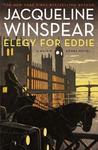
Elegy for Eddie by Jacqueline Winspear: A review

Elegy for Eddie (Maisie Dobbs #9)Elegy for Eddie by Jacqueline Winspear
My rating: 3 of 5 stars

Maisie Dobbs has come a long way since her impoverished childhood in Lambeth. This daughter of a costermonger, having been lucky in her mentors and also a willing student and hard worker, has parlayed all of her resources into a successful career as a businesswoman, a private detective/psychologist. She is extremely wealthy, thanks to a bequest from her mentor. She is respected in the community and retains her ties to her old neighborhood, as well. She has a wealthy, titled lover, Viscount James Crompton, the son of the family who did so much for her education when she was a child. Crompton loves her and wants to marry her, but Maisie is unsure of how she feels about that.

In fact, for such an accomplished and successful woman, Maisie is unsure about a lot of things. It seems that what she is very sure of is what is best for those that she cares about, her father and her employees, primarily. She tends to try to manipulate them to order their lives in the way that she thinks is best, regardless of their opinions, and that comes back to bite her repeatedly in this book.

The story begins with Maisie being visited by a delegation of costermongers from the old neighborhood. They've come to request her professional services. A young mentally-challenged man, much loved in the community, has been killed in a factory accident. The question is whether it was really an accident or was it murder? The costermongers suspect the latter and they want Maisie to find out the truth.

The young man, Eddie Petitt, was a horse whisperer. He was born in a stable and had a lifelong connection with horses, and although he had mental limitations, he had some unsuspected talents, one of which was a fantastic photographic memory and an ability to draw detailed pictures of things he had seen only briefly. As Maisie and her assistant Billy Beale continue their investigation, she begins to suspect that Eddie may have seen something that he wasn't meant to see and that he may have copied it. The search is on to find any papers that he may have left behind.

In the course of the investigation, Maisie learns that Eddie had a relationship with a reporter named Bartholomew Soames who was the son of one of Eddie's old teachers who was also tutoring him once again. Did the reporter use Eddie's talents to get information for a story he was working on? Maisie can't ask him because he is dead, too. He fell from a bridge into the river, while supposedly drunk, and drowned. His death seems just a little too convenient.

Meanwhile, Maisie's social life continues unabated and she finds herself in some rarified circles with some heavy hitters in the worlds of politics and publishing, including someone named Winston Churchill and a Rupert Murdoch type who owns several newspapers and a publishing company and uses them all to subtly promote a particular world view with which he intends to get Britons ready for another war - which he is sure is coming. The time is 1933 and this coterie of individuals among whom Maisie finds herself seem preternaturally prescient about the storm that is coming with the elevation of Hitler to the chancellorship in Germany. Maisie learns that James and her friend Priscilla's husband are part of this group which is busy spreading propaganda in support of resistance to Germany.

The investigation of Eddie's death continues and suddenly there is another death - another "suicide" - this time of a man whom Maisie suspects was responsible for Eddie's "accident."

And then, of course, Billy gets beaten to a pulp and almost killed and the reaction of his wife forces Maisie to finally face the fact that she really can't order other people's lives, even if she does think she knows best.

This is a fairly complicated plot and the conclusion was not entirely satisfactory for me, but on the whole, it was an interesting read. I do wish that Winspear would learn to write more believable dialogue. I realize people may have talked a little differently a hundred years ago, but surely not that stilted, I think.


View all my reviews

Monday, April 6, 2015

A Lesson in Secrets by Jacqueline Winspear: A review

A Lesson in Secrets  (Maisie Dobbs, #8)A Lesson in Secrets by Jacqueline Winspear
My rating: 3 of 5 stars

This eighth entry in the Maisie Dobbs series was a bit slow getting started and there were parts of it that didn't ring true for me, that seemed a bit "off" - I'm not quite sure how else to explain it - so, on the whole, I can't say it is one of my favorites. Still, it wasn't a stinker. It just wasn't as entertaining as some.

This book actually marks a bit of a turning point in the series. Up until now, the focus has been on the events of World War I and the years following that war. Now, we have arrived at the 1930s and Maisie herself is in her 30s and is a successful businesswoman. There is unrest in Germany. The Nazis and their leader Adolf Hitler are near to being able to take over the country and the philosophy espoused by Hitler is finding adherents in other countries as well. Including England.

In the beginning, Maisie finds herself being followed and determines that it is the police doing the following. Why? Well, she soon has her answer. The Special Branch wants to recruit her for intelligence work and the surveillance is a kind of test to see how observant she is.

Dobbs eventually meets with the government's representatives and they explain what they want her to do. They want her to go undercover as an instructor at a college established by a well-known pacifist. The goal of the college is to bring young people from different countries and backgrounds together to encourage dialogue and to foment peace in the world. However, the intelligence service suspects that there may be something more going on at the college, something that may be a threat to the Crown.

Maisie accepts the assignment and becomes a lecturer in philosophy at the college and soon learns that there are stresses and strains in the relationships among the staff there. She also finds that there are admirers of Hitler present at the college.

Meantime, back at her other business, her assistant Billy is carrying the load. That includes investigating the supposedly accidental death of the husband of Sandra, a friend and associate from Maisie's past. Billy is stressed because his wife is expecting their fourth child, after the death of the third child about a year before, and he and his family are living in a slum and he needs to get them into healthier living quarters. And here's one of my quibbles with these books. Maisie is condescending toward her assistant. She often treats him like he's not very smart, although he gives every evidence of being quite bright and street-smart, as well as a very responsible husband and father. He deserves better from her.

Maisie's investigation at the college proceeds more or less smoothly. Then, the head of the college is unexpectedly murdered. Is this related somehow to the matters that Maisie is investigating?

The plot of this novel was kind of all over the place and included a line regarding Maisie's romantic relationships. She is having an affair with James Compton, the son of the family that she worked for as a maid when she was a teenager. Meantime, a colleague from the police with whom she works, Richard Stratton, also carries a torch for her and, to this reader at least, seems a much better match for Maisie. Frankly, I find the Compton relationship a bit unbelievable.

Still another strand of the plot involves Maisie's aging father, who now seems to have his own romantic involvement, Maisie tends to try to order her father's life as well. She's actually a busybody in the lives of people she cares about. Her attitude is she knows best what is good for them, regardless of their opinions in the matter.

Overall, I didn't really feel engaged by the plot of this book. It was too muddled for my taste. But I do care about the main characters and so I kept reading to see where it was going. In the end, I didn't feel that the story moved any of the characters that much forward, but at least now we have arrived beyond the immediate post-World War I period. Interesting times are ahead. I wonder what Winspear will do with them.


View all my reviews

Thursday, September 18, 2014

The Mapping of Love and Death by Jacqueline Winspear: A review

The Mapping of Love and Death (Maisie Dobbs, #7)The Mapping of Love and Death by Jacqueline Winspear
My rating: 3 of 5 stars

Jacqueline Winspear still mines the trenches of World War I in this seventh entry in the Maisie Dobbs series. It is 1932, more than a decade past the end of hostilities and yet the war continues to have repercussions in Dobbs' life and the lives of her clients.

Her clients this time are an elderly American couple searching for their son's past. Mr. and Mrs. Clifton have recently been informed that their son's remains - he had been listed as missing in the war - have been found in France. Among their son's belongings were found some letters from an English nurse whom he had met and had apparently had an affair with. The parents hire Maisie to find the woman, who must now be in her thirties.

The son, Michael, had been a gifted cartographer and it was in that capacity that he served the British Army. In August 1914, he had been mapping the land he had just purchased in the Santa Ynez Valley in California, believing that there was oil beneath it, when he heard that war had been declared in Europe. He felt a responsibility to go to England, the land of his father's birth, and join the fight.

The value of the land that Michael had been surveying is considerable and, as part of his estate, certain parties are now anxious to have its ownership resolved, but the plot thickens when a postmortem exam of Michael's remains indicate that he was not killed by shelling as originally thought but that he had actually been murdered before the shelling.

The plot thickens even further when Michael's parents are attacked and almost killed in their hotel room. Could this attack have anything to do with the fact that they have hired Maisie Dobbs? Was the attacker trying to recover Michael's belongings, the letters perhaps? Did it have something to do with the fact that their son was murdered? Maisie's famous intuition tells her that everything is related and to solve one crime may be the key to solving the other.

While Maisie and her assistant Billy Beale pursue their inquiries, they must also deal with upheaval in their personal lives. Maisie's beloved mentor, Maurice Blanche, is very ill and it seems that he may not survive for much longer. She wants nothing more than to spend all of her time with him and yet she must meet her responsibilities to clients. Maurice would expect that.

At the same time, she begins to have romantic feelings for the son of her patroness who has sponsored and nurtured her through the years. That these feelings are obviously returned does not assuage her concern that the man's rich and powerful family may consider this a match that is beneath him.

As for Billy, his wife has recently been released from the mental hospital where she was being treated for depression following her inability to cope with the death of their daughter and now the family is trying to get back to normal, but it is not clear that that will ever happen.

And so Maisie must deal with The Mapping of Love and Death both as it pertains to her clients and to her own personal situation. It is a quandary, but Maisie Dobbs, as always, is up to the task.


View all my reviews

Tuesday, August 26, 2014

Among the Mad by Jacqueline Winspear: A review

Among the Mad (Maisie Dobbs, #6)Among the Mad by Jacqueline Winspear
My rating: 3 of 5 stars

It's Christmas Eve 1931 in Maisie Dobbs' world, more than ten years past the end of the Great War that was to "end all wars."

The war goes on though for so many of those who participated in it. Millions of men and women who were grievously wounded either physically or psychologically - or both - continue to struggle with their wounds and with trying to make a place for themselves in the world. Maisie Dobbs' work as a psychologist and investigator often seems to bring her into contact with these desperate people and that is the case once again in Among the Mad.

It begins with Maisie walking down a London street with her assistant Billy Beale, on their way to meet with a client. Suddenly, Maisie gets one of her premonitions. She orders her assistant to go back as she walks forward toward a disabled man sitting on the street. He has one missing leg and the other injured and Maisie feels the distress coming from him. As she approaches him with her arm outstretched, he detonates a hand grenade, blowing himself up and injuring some of those on the street. Luckily, Maisie is not seriously injured but she is deeply affected by the event.

The next day the prime minister's office receives a letter threatening a massive loss of life if the writer's demands are not met. Curiously, the letter mentions Maisie's name which leads her to be investigated by Scotland Yard's elite Special Branch. She is cleared and then seconded to the Special Branch as a part of the team investigating the letter and trying to prevent a terrorist attack on the city.

While Maisie is involved in this case, she is also trying to help Billy, whose wife has descended fully into the abyss of melancholia following the death of their small daughter several months before. She is finally deemed to be a danger to herself or her two living children and she is committed to an institution for the care of the mentally disturbed, but this particular institution turns out to be a chamber of horrors and Maisie and Billy work to get her moved to a more humane facility.

Meanwhile, an incident at a veterinary facility results in the death of several dogs from some sort of chemical attack and this is followed by the killing of a number of birds by, apparently, the same means. Further letters received at Special Branch warn that the next victims will be human. And, indeed, a young government official is then killed. The letter writer warns that the next event will be a mass killing.

Maisie and the rest of the team race to find the writer of the letters and to stop him before he can accomplish that killing. They each follow different leads and Maisie investigates those who have been involved in research into chemical warfare. Her inquiry leads her into the world of shell-shocked men, a world of the darkness that she first encountered as a nurse during the war.

Jacqueline Winspear once again explores the theme that she has adopted as her main topic in this series, which is that of the treatment of those who fight a country's wars when they return home, often battered and damaged, from those wars. It was an issue after the First World War and every war since and it is still an issue today. We can read it in the headlines of any of today's newspapers. Winspear, through her character Maisie Dobbs, is an advocate for the humane treatment of such victims of man's inhumanity. These novels seem very timely in that regard and they give us pause to think about how far our treatment of shell-shock - now called PTSD - has come in a hundred years. Or not.  


View all my reviews

Friday, July 18, 2014

An Incomplete Revenge by Jacqueline Winspear: A review

An Incomplete Revenge (Maisie Dobbs, #5)An Incomplete Revenge by Jacqueline Winspear
My rating: 3 of 5 stars

It's been quite a while since I checked in on Maisie Dobbs. Time to remedy that.

An Incomplete Revenge is the fifth entry in Jacqueline Winspear's series of mysteries featuring psychologist/private investigator Dobbs, a former military nurse during World War I who is forever scarred, both physically and emotionally, by that experience.

The time is 1931. The world has moved on from the conflagration of war and the chaos of the immediate post-war period, but a new shadow is cast by economic uncertainty. Maisie is worried about the survival of her struggling private investigation business in such times.

In the midst of such worries, she receives a seemingly straightforward assignment from an old friend to investigate the situation in a small rural community where there is an estate that he is considering purchasing. There is a worrisome pattern of petty crimes and fires in the area and Maisie's client wants to know the origin of these incidents and if they are in any way related to the land he wishes to purchase.

Maisie's inquiries take her to a village in Kent, in an area that grows hops. During the hop-picking season - which happens during the time of this investigation - day laborers descend on the area from many quarters to gather the hops. Among them are Maisie's assistant and his family, who spend their "vacation" hop-picking, along with many others from London, or the "Smoke" as they refer to it.

Also present to help with the hop-picking, and even less welcome than the Londoners with the local villagers, are a tribe of gypsies. Upon arriving in the village, Maisie immediately senses the hostility of the villagers toward outsiders and she wonders at the source of it. She soon learns of the tragic history of the village which included a Zeppelin raid during the war and the legacy of events surrounding that raid.

There is a peculiar secrecy that hangs over this picturesque village and Maisie becomes convinced that it is related to the incidents that she has been sent to investigate. But with no one really willing to talk freely to her, how will she ever connect the dots and figure out what is going on? Well, that, of course, is where her finely honed detection skills as well as her knowledge of human psychology come into play. With a mixture of shrewd questions and keen observations, Maisie Dobbs always gets to the bottom of things and gives satisfaction to her clients.

Jacqueline Winspear is meticulous about setting the stage for these mysteries. She pays great attention to historical detail and that is one of the strengths of her writing. Her characterizations tend to get a bit syrupy and facile at times which can be annoying, but, overall, the characters are sympathetic and one wishes them well. It will be interesting to see just where she takes this series as she heads into the 1930s.


View all my reviews

Tuesday, July 31, 2012

Messenger of Truth by Jacqueline Winspear: A review

Artist Nicholas Bassington-Hope is a lightning rod, attracting both passionate admiration from his supporters and passionate anger and even hate from his detractors. On the night before the opening of his exhibition at a famed Mayfair gallery, Bassington-Hope falls to his death from some scaffolding as he prepares to hang his masterpiece. He was alone at the time. Or was he? Was it really an accident or was it murder? The police rule an accident. His twin sister Georgina isn't so sure. 

On the advice of her former mentor at Girton College, Georgina enlists the aid of fellow Girton graduate Maisie Dobbs to investigate and discover the truth. As Maisie pursues her inquiries, she finds herself strongly attracted to the Bohemian lifestyle of the Bassington-Hope family, artists all, except for the eldest daughter Noelle, the practical one in the family.

At the same time, Maisie's personal life is in a shambles, as she struggles to find a civil way to break off a romantic relationship that she has come to realize isn't going anywhere and is one that she doesn't really want. She still has not completely mended the breach with her teacher and mentor Maurice Blanche, and to top it off, tragedy strikes when the daughter of her assistant Billy Beale is struck with deadly diphtheria. Then his two sons also get the disease. Maisie is beset with anxieties and concerns but still must struggle to focus on keeping faith with her client and giving her her best effort. 

But as she probes deeper into the mystery, she uncovers more and more concerning the secretive Nicholas and his circle of artist friends, as well as his younger brother who it seems may have been involved with some underworld characters and who Nicholas may have been attempting to extricate from his difficulties. Could those associations have led to his death?

Once again, Maisie's uncanny, almost supernatural, intuition guides her through the maze of information and clues and leads her to a solution that will eventually bring peace to her client, which is always Maisie's ultimate goal.

Jacqueline Winspear again, in her fourth Maisie Dobbs mystery, recreates the atmosphere of the early thirties in London; the desperation of jobless men trying to find a way to care for and feed their families, the anguish of parents with sick children and no money for doctors or medicine, and, above all, the haunted and sorrowful memories of those who served in and survived the Great War, many of them with injuries both physical and mental that will never heal. One feels the sadness and depression suffered by an entire society in that long ago period. Ms. Winspear has done her research on the period very well indeed.

Monday, July 16, 2012

Pardonable Lies by Jacqueline Winspear: A review

The year is 1930, more than ten years after the end of the Great War. Still, England and Europe are mired in the past. They cannot forget all that they have lost. The pain and suffering continue as they try to honor the memories of the dead, while getting on with their lives.

What is true of her country is also true of Maisie Dobbs of London, psychologist and private investigator. She continues to be called on to investigate and resolve cases related to the war and war injuries and deaths. Now, she is being asked by Sir Cedric Lawton to prove that his son, Ralph, is truly dead.

Ralph was an aviator in the war and was reported to have died in a fiery crash in France, but his mother never believed that he was dead. She continued to try to prove her belief through the use of mediums and spiritualists. Her obsession had finally driven her mad, but on her deathbed, she extracted a promise from her husband, Sir Cedric, that he would continue the search and finally prove whether or not their son had perished. 

Sir Cedric is convinced that he is dead and that seems to be a relief to him for his son was not the kind of son that he wanted. He was a homosexual and that was a supreme embarrassment to his father. Nevertheless, he honors his promise to his wife and hires Maisie to search for the truth.

As always, Maisie's search for truth does not proceed in a linear fashion. She is also involved in the investigation of the supposed murder of a pimp by a teenaged girl who was found covered in his blood and with the murder weapon in her hand, but Maisie comes to believe that she is innocent and enlists Sir Cedric in a quid pro quo arrangement to defend the girl. At the same time, Maisie's old friend Priscilla begs her to search for the truth surrounding the death of her brother Peter, who also died in the war. In time, all of these investigations will converge. Moreover, Maisie will find that someone wants to stop her from getting at the truth, even if it means "stopping" her permanently!

Jacqueline Winspear is particularly good at recreating the atmosphere of the times about which she is writing. One can feel the sadness and despair of her characters as they try to rebuild their lives after the man-made cataclysm that changed them forever. Moreover, she creates sympathetic characters that we care about and want to see live happily ever after. But the solutions to the mysteries in her stories are just a little too pat, a little too convenient, to believe in. And Maisie's intuition, her sixth sense, that helps to get to the bottom of the mysteries, seems a bit contrived to me. Those quibbles aside, this third book in the series was an interesting read about a traumatic and colorful period of history.

Wednesday, May 23, 2012

Birds of a Feather by Jacqueline Winspear: A review


Maisie Dobbs has been on her own as a private investigator/psychologist for about a year in this second entry in Jacqueline Winspear's well-written series. She has gained a new office, new living quarters, and an assistant, Billy Beale, and she has gained some measure of respect from the police, especially Detective Inspector Stratton of Scotland Yard.

She is contacted by a self-made, brash, and impatient businessman named Joseph Waite (An impatient businessman named Waite. Get it? Sorry, couldn't resist!) It seems that Waite's daughter, 32-year-old Charlotte, has run away from the family home and Waite wants her found and brought back immediately if not sooner.

Meantime, the police are investigating the murder of a young woman about Charlotte's age, but before the crime can be solved, another young woman is murdered in similar fashion. As Maisie proceeds in her search for the missing woman, she discovers that there may be a link between her and the murdered women. Then she learns that another woman with a connection to all three has recently committed suicide. At least, it was thought to be suicide. Maisie has her doubts.

She and Billy proceed with their investigation, but Maisie comes to realize that something is seriously wrong with Billy. His leg wound from the Great War is bothering him and he may have turned to illicit drugs to try to ease his pain. And then her beloved father is injured while caring for a horse on the estate where he lives. With all of these concerns on her plate, will Maisie be able to retain her focus on the missing person case?

Winspear manages to weave many interesting historical facts into her historical fiction. Here, we learn about the Order of the White Feather, a group of women who, during World War I, went around England handing white feathers to young men who were not in uniform. The feather was supposed to represent cowardice and it was a form of group pressure to try to get the men to enlist.

Interestingly, we also learn a bit about the inventor of Pilates exercises, which, at the beginning, were meant to help those injured in the war strengthen their bodies and learn to cope with disabilities.

Winspear also does a good job of recreating the cultural atmosphere of the times. This story takes place in 1930 when England, and much of the world, was in a depression, and hunger and want were everyday companions for so many people. Winspear's descriptions of those people seem poignant and real and lend much authenticity to this very interesting series.

Tuesday, May 1, 2012

Maisie Dobbs by Jacqueline Winspear: A review

Isabel Dalhousie, meet Maisie Dobbs. That's what I was thinking as I delved into this first book of Jacqueline Winspear's popular series. The character of Maisie at first reminded me a great deal of Isabel. Both are philosophers and psychologists, and are deeply intuitive people who rely on those intuitions to understand and solve mysteries. As I got further into the book, though, I found significant differences. For one thing, I liked Maisie a lot, whereas I often find Isabel irritating and exasperating in the extreme with her constant agonizing over the moral issues of everything. ("Shall I wear the pink blouse or the white blouse today? Which is the moral choice? What would David Hume do?") Maisie is a more down-to-earth, practical sort of person who lives in the real world of England ten years after the Great War and has real problems.

I suppose one of the things which makes Maisie a more sympathetic character for me is the fact that she comes from the working class. Her father was a costermonger and when her mother died just as she was entering her teenage years, she went into domestic service. Isabel Dalhousie, on the other hand, is very, very rich and never had to struggle for a place in the world. But, enough! It's unfair of me to compare the two. I enjoy them both. It's just that I find it easier to identify with Maisie.

Maisie had a bit of luck with the family with whom she was placed as a servant. Lady Rowan Compton was a suffragette and a feminist who wanted to improve the world. She recognized when she caught Maisie reading philosophy books in the family library that this was a special girl, one that she might be able to help to achieve something in the world. She sponsored her, found a tutor for her and saw to her education. Then along came the First World War and everything was put on hold.

Winspear has structured her book in three parts. The first part begins in 1929 as Maisie is launching her career as a psychologist and confidential investigator. We follow her first case which turns out to be a domestic mystery - a man suspects his wife of cheating on him. As Maisie gets into the case, she finds it much more complicated than it would have seemed at first glance. Following one line of inquiry leads to another. And another. And another.

The second part of the book gives us Maisie's backstory. We return to a time before the war and just after the death of her mother and we go with her as she enters domestic service and begins to forge new relationships and learn new things. We follow this story up until the beginning of the war and the mobilizing of the country. A traumatic event in Maisie's life forces her to reevaluate her position and she decides to volunteer as a nurse. She receives her training and is sent to France and meets her first love.

The final part of the book returns to 1929. Maisie has followed her case down all its pathways and has solved the original mystery but that has led her to further conundrums. She discovers a farm that has been set up as a "retreat" for badly injured and damaged veterans of the recent war. It sounds like a noble enterprise, but Maisie's worrisome intuition tells her something is not quite right here and that she must probe further.

This book is ostensibly a mystery but it could just as easily be classified as a historical novel. Indeed, the book reminded me somewhat - and in a good way - of Upstairs, Downstairs and Downton Abbey as it is set in much the same historical period and the relationships of the characters are somewhat similar. I read that the book was very well-received by critics when it came out in 2003. It was nominated for and received several awards including the 2003 Agatha Christie Award for Best First Novel. The New York Times named it as one of its "notable books of 2003." I can only add my voice in agreement to these assessments. This is a fine first novel, well-written with a wealth of historical detail, and with sympathetic characters whom one wants to get to know better. I'm glad there are several more books in the series and I look forward to reading them.