This week in birds - #578

A roundup of the week's news of birds and the environment

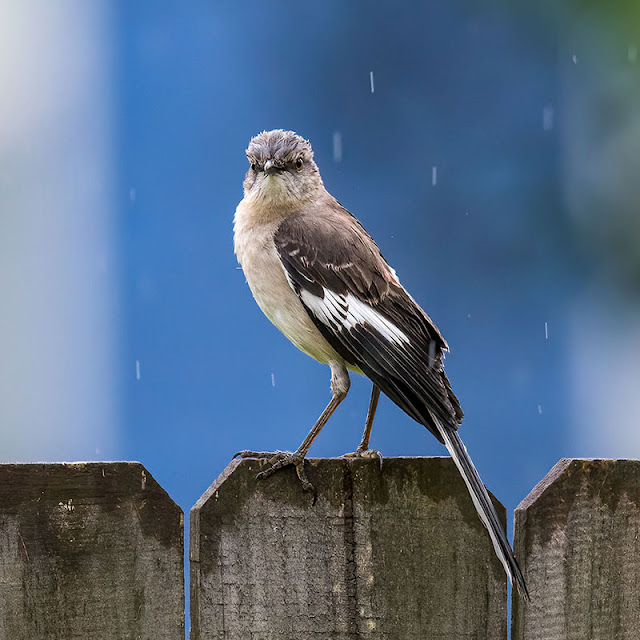
This Northern Mockingbird doesn't look too happy about the shower he's getting!

*~*~*~*

The U.S. is getting a new global climate representative since John Kerry is stepping down.

*~*~*~*

The fossil fuel industry knew of the danger of climate change as early as 1954 but resisted doing anything about it.

*~*~*~*

Here is a depiction of Earth breathing for one year.

*~*~*~*

Drought is having a deleterious effect on the Panama Canal.

*~*~*~*

The first bird flu deaths have been reported in Gentoo Penguins in the Antarctic.

*~*~*~*

Trees are good for us. Is there really any doubt of that?

*~*~*~*

This is the American Bird Conservancy's Bird of the Week. It is a neotropical falcon, the Collared Forest-Falcon.

*~*~*~*

Patagonia, the outdoor apparel brand, is following its philosophy when making its charitable donations.

*~*~*~*

Remember Flaco, the Eurasian Eagle-Owl that escaped captivity (with a little help) a year ago? Well, he's still out there, flying free, making it in New York. And if you can make it there... 

*~*~*~*

It's well established that parrots are very clever birds and they use their beaks to help them navigate through trees or the perches in their cages.

*~*~*~*

A stingless bee of the Amazon is endangered and the race is on to try to save it.

*~*~*~*

Small dogs with pointy noses generally live longer than their larger and/or flat-faced relatives.

*~*~*~*

After five days of freedom, a Japanese macaque that escaped from a wildlife park in Scotland has been recaptured.  

*~*~*~*

Was he a Chinese spy? This pigeon was suspected of being one but he has now been released after eight months of captivity in Mumbai.

*~*~*~*

This is a placoderm, a fish that lived during the Devonian Period. Apparently that strange lower jaw helped it to grasp and hold its prey.

*~*~*~*

Reef scientists are concerned that back-to-back cyclones may have damaged the Great Barrier Reef.

*~*~*~*

When one thinks of wildfires one doesn't usually imagine them occurring in the normally wet country of Colombia, but that is what has been happening recently.

*~*~*~*

Imagine the benefits to easing the climate crisis and improving human health if we were to move toward a sustainable global food system.

*~*~*~*

And imagine the benefits to the climate if we appreciated swamps and refused to drain them.

*~*~*~*

Rocky Raccoon is at it again - this time disrupting things in Toronto.


Comments

  1. Good morning, Dorothy. Thank you for the roundup. I am very happy to see that one of Toronto’s renowned Raccoons is in the news. A pox on those who wish to have these animals euthanized. They are smart, engaging and an integral part of the urban landscape. It’s the dumb humans who don’t secure their trash properly who are the problem and no one calls for them to be euthanized! Vive Rocky Raccoon, I say! All the best - David

    ReplyDelete
    Replies
    1. Rocky's relatives pay us a visit just about every night. I frequently see them investigating our back porch when I'm sitting in my den. They are welcome here.

      Delete
  2. Oh, that poor mockingbird. Great photo!

    There is so much interest in dogs. I can see that many people would love to know more about dog longevity.

    ReplyDelete
  3. Love that mockingbird pic. He does look a little miffed. :D

    ReplyDelete
  4. ...and Arvid Gustaf Högbom in 1896 noted that industrial activity was adding carbon dioxide to the atmosphere!

    ReplyDelete
  5. I'm happy to see that Flaco is doing well in the Big Apple.

    ReplyDelete
    Replies
    1. Yes, it is definitely a story with a happy ending - at least so far.

      Delete
  6. It would be a bit shocking to see a monkey or macaque in one's backyard. 5 days on the lam -- he seems lucky to have been found ....though it seems he had an adventure.

    ReplyDelete

Post a Comment

Popular posts from this blog

Poetry Sunday: Don't Hesitate by Mary Oliver

How about we share another Mary Oliver poem? After all, you can never have too many of those. In this one, the poet seems to acknowledge that it is often hard to simply live in and enjoy the moment, perhaps because we are afraid it can't last. She urges us to give in to that moment and fully experience the joy. Although "much can never be redeemed, still, life has some possibility left." Don't Hesitate by Mary Oliver If you suddenly and unexpectedly feel joy, don’t hesitate. Give in to it. There are plenty of lives and whole towns destroyed or about to be. We are not wise, and not very often kind. And much can never be redeemed. Still, life has some possibility left. Perhaps this is its way of fighting back, that sometimes something happens better than all the riches or power in the world. It could be anything, but very likely you notice it in the instant when love begins. Anyway, that’s often the case. Anyway, whatever it is, don’t be afraid of its plenty. Joy is no...

Poetry Sunday: Hymn for the Hurting by Amanda Gorman

You probably remember poet Amanda Gorman from her appearance at the inauguration of President Biden. She read her poem "The Hill We Climb" on that occasion. After the senseless slaughter in Uvalde this week, she was inspired to write another poem which was published in The New York Times. It seemed perfect for the occasion and so I stole it in order to feature it here, just in case you didn't get a chance to read it in the Times . Hymn for the Hurting by Amanda Gorman Everything hurts, Our hearts shadowed and strange, Minds made muddied and mute. We carry tragedy, terrifying and true. And yet none of it is new; We knew it as home, As horror, As heritage. Even our children Cannot be children, Cannot be. Everything hurts. It’s a hard time to be alive, And even harder to stay that way. We’re burdened to live out these days, While at the same time, blessed to outlive them. This alarm is how we know We must be altered — That we must differ or die, That we must triumph or try. ...

Poetry Sunday: Blackberry-Picking by Seamus Heaney

My mother was a farm wife and a prodigious canner. She canned fruit and vegetables from the garden, even occasionally meat. But the best thing that she canned, in my opinion, was blackberry jam. Even as I type those words my mouth waters!  Of course, before she could make that jam, somebody had to pick the blackberries. And that somebody was quite often named Dorothy. I think Seamus Heaney might have spent some time among the briars plucking those delicious black fruits as well, so he would have known that "Once off the bush the fruit fermented, the sweet flesh would turn sour." They don't keep; you have to get that jam made in a hurry! Blackberry-Picking by Seamus Heaney Late August, given heavy rain and sun For a full week, the blackberries would ripen. At first, just one, a glossy purple clot Among others, red, green, hard as a knot. You ate that first one and its flesh was sweet Like thickened wine: summer's blood was in it Leaving stains upon the tongue and lust ...