
This week in birds - #531

A roundup of the week's news of birds and the environment


A pair of Whooping Cranes searching for crabs in the waters of the Gulf.

*~*~*~*

Though it hasn't been as cold here as in more northerly parts of the country, it has been pretty cold relatively speaking. We can handle 102 degrees Fahrenheit quite well but temperatures in the 20s not so much. The same is true for wintering bats in the area, many of whom had to be rescued and nursed back to health. 

*~*~*~*

The top conservation issues for 2023 include rising sea levels and the need for the protection of wetlands.

*~*~*~*

The Revelator rates its best articles of 2022.

*~*~*~*

Fossils of a 30-foot-long prehistoric lizard have been found near the North Sulphur River in North Texas.

*~*~*~*

What will the human epoch of geologic time be called?

*~*~*~*

The iconic California mountain lion known as P-22 is no more. He was euthanized after apparently having been hit by a car. His fame made him an ambassador for city wildlife

*~*~*~*

The government has declared that the Ivory-billed Woodpecker is extinct but some birders as well as professional ornithologists refuse to give up hope that it still survives somewhere in a southern swamp.

*~*~*~*

The Biden administration has finalized rules that protect hundreds of thousands of small streams, wetlands, and other waterways under the Clean Water Act. This act has made a significant difference in American life, including cleaning up New York Harbor.

*~*~*~*

In order to keep the archaeological park of Pompeii from being overrun by vegetation, its keepers have employed a low-tech solution: hungry sheep.

*~*~*~*

Could offshore wind power be the wave of the future in energy production?

*~*~*~*

It's turtle shells all the way down - the ubiquitous ingredient of the planet's fossil record.

*~*~*~*

And speaking of ubiquitous, ants may be the most ubiquitous creatures on Earth.

*~*~*~*

Jaguars once roamed freely across the southwestern mountains of this country and there are plans afoot to ensure that they do so once again. 

*~*~*~*

Canadian researchers, taking inspiration from the construction of the feathers of Gentoo Penguins, have created a wire mesh to shed ice from surfaces.

*~*~*~*

One hazard of low temperatures in South Florida is stunned iguanas falling from trees.

*~*~*~*

Some scientists believe that Arctic warming is altering the jet stream and pushing frigid air down our way more frequently than in the past.

*~*~*~*

It seems somewhat contradictory but parts of the planet are warming more slowly than others.

*~*~*~*

Bird flu is still around and creating misery. Europe is having its worst-ever avian flu season and the virus is spreading. 

*~*~*~*

There has been a dramatic decline in the number of polar bears in the western part of Hudson Bay on the southern tip of the Canadian Arctic.

*~*~*~*

Roughly 190 nations have approved a United Nations agreement to protect 30 percent of the planet's lands and oceans by 2030. Unfortunately, Republicans have blocked this country's participation in the agreement.

*~*~*~*
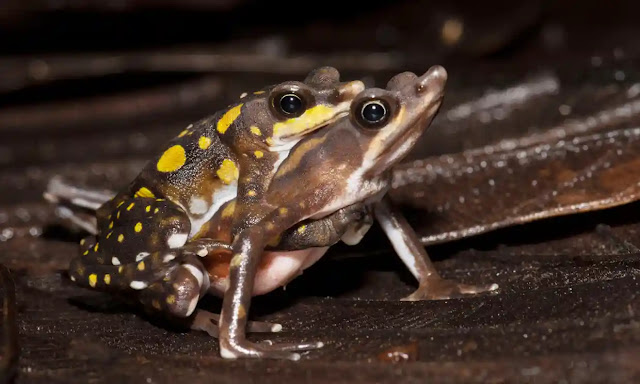
This is the longnose harlequin frog, native to Ecuador's Intag Valley and, contrary to reports of its extinction, it is very much alive!

*~*~*~*

Stone tools found in Idaho have been dated to about 16,000 years ago, meaning that migrants must have arrived on this continent earlier than had previously been thought.

*~*~*~*

These are Emperor Penguins. They, along with two-thirds of other native Antarctic species, are at risk of extinction as a result of global warming.  

*~*~*~*

There is a move afoot to plant chestnut trees across the country's mid-Atlantic region. The trees would be a benefit to the environment but would also be a boon to farmers and could help provide food security for communities.

*~*~*~*

The unique dragon's blood tree is seriously endangered but the islanders where it grows are working hard to ensure that it doesn't go extinct.

*~*~*~*


*~*~*~*

New designs have been discerned among the famous geoglyphs on Peru's Nazca plain.

*~*~*~*

It turns out that not all black bears are black. Some are cinnamon-colored.

*~*~*~*

Can the endangered white rhino be saved from extinction? There is hope.

*~*~*~*

The Keystone pipeline continues to be an environmental disaster, having suffered its third major spill in five years.

*~*~*~*

An Alaskan Native group is declaring 44,000 acres of its land near Bristol Bay to be off-limits to future development.

*~*~*~*

Rewilding is now a thing and it provides hope for the future.

*~*~*~*

Nature rules at a famous Parisian cemetery where many celebrities are buried.

*~*~*~*

How well did you keep up with news of Nature in 2022? Take The Guardian's quiz and find out!


Comments

  1. Thank you for the last roundup of 2022, Dorothy, and all those you have assembled and published on your blog throughout the year. They are very much appreciated. Let me take this opportunity to wish you all the very best for 2023, with more roundups to come. David

    ReplyDelete
    Replies
    1. Thank you, David, and thank you for being a faithful reader of and commenter on these roundups. You, too, are much appreciated!

      Delete
  2. Thank you for this weekly series, Dorothy. I know how much work goes into something like this, and I look forward to yours each week. Happy New Year!

    ReplyDelete
  3. I have followed P-22's life and was very sad by the news. He was a hero in a concrete city. He was amazing to have lived in Griffith Park.

    ReplyDelete
    Replies
    1. I, too, had followed reports of his life over the years and it is sad to say goodbye to him. I agree that he lived a heroic life.

      Delete
  4. I greatly appreciate this weekly round up, Dorothy. I always click your links and learn more about the world. Thank you!

    ReplyDelete

Post a Comment

Popular posts from this blog

Poetry Sunday: Don't Hesitate by Mary Oliver

How about we share another Mary Oliver poem? After all, you can never have too many of those. In this one, the poet seems to acknowledge that it is often hard to simply live in and enjoy the moment, perhaps because we are afraid it can't last. She urges us to give in to that moment and fully experience the joy. Although "much can never be redeemed, still, life has some possibility left." Don't Hesitate by Mary Oliver If you suddenly and unexpectedly feel joy, don’t hesitate. Give in to it. There are plenty of lives and whole towns destroyed or about to be. We are not wise, and not very often kind. And much can never be redeemed. Still, life has some possibility left. Perhaps this is its way of fighting back, that sometimes something happens better than all the riches or power in the world. It could be anything, but very likely you notice it in the instant when love begins. Anyway, that’s often the case. Anyway, whatever it is, don’t be afraid of its plenty. Joy is no...

Poetry Sunday: Blackberry-Picking by Seamus Heaney

My mother was a farm wife and a prodigious canner. She canned fruit and vegetables from the garden, even occasionally meat. But the best thing that she canned, in my opinion, was blackberry jam. Even as I type those words my mouth waters!  Of course, before she could make that jam, somebody had to pick the blackberries. And that somebody was quite often named Dorothy. I think Seamus Heaney might have spent some time among the briars plucking those delicious black fruits as well, so he would have known that "Once off the bush the fruit fermented, the sweet flesh would turn sour." They don't keep; you have to get that jam made in a hurry! Blackberry-Picking by Seamus Heaney Late August, given heavy rain and sun For a full week, the blackberries would ripen. At first, just one, a glossy purple clot Among others, red, green, hard as a knot. You ate that first one and its flesh was sweet Like thickened wine: summer's blood was in it Leaving stains upon the tongue and lust ...

Poetry Sunday: Hymn for the Hurting by Amanda Gorman

You probably remember poet Amanda Gorman from her appearance at the inauguration of President Biden. She read her poem "The Hill We Climb" on that occasion. After the senseless slaughter in Uvalde this week, she was inspired to write another poem which was published in The New York Times. It seemed perfect for the occasion and so I stole it in order to feature it here, just in case you didn't get a chance to read it in the Times . Hymn for the Hurting by Amanda Gorman Everything hurts, Our hearts shadowed and strange, Minds made muddied and mute. We carry tragedy, terrifying and true. And yet none of it is new; We knew it as home, As horror, As heritage. Even our children Cannot be children, Cannot be. Everything hurts. It’s a hard time to be alive, And even harder to stay that way. We’re burdened to live out these days, While at the same time, blessed to outlive them. This alarm is how we know We must be altered — That we must differ or die, That we must triumph or try. ...