
This week in birds - #530

 A roundup of the week's news of birds and the environment:
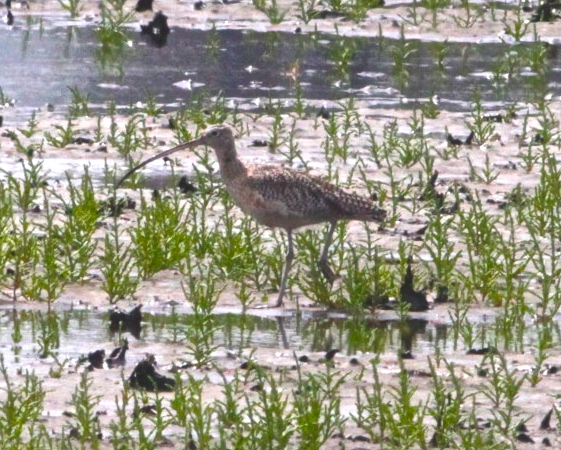
The very appropriately named Long-billed Curlew takes a stroll along the edge of the Gulf.

*~*~*~*

We all know about the pleasures of bird watching but it turns out there are positive health benefits as well. And perhaps the greatest benefits can be realized by "slow birding."

*~*~*~*

California's most famous and beloved mountain lion, P-22, is getting quite aged for a cat in the wild and may be experiencing distress. Wildlife officials are planning to capture the big cat to assess his health. 

*~*~*~*

And, in fact, P-22 has now been captured and taken to a wild animal facility for that assessment. The assessment revealed he probably had been hit by a car at some point. It is unlikely he will be returned to the wild. 

*~*~*~*

The Arctic's weather is changing, becoming wetter and stormier. The effects of such changes will be widespread, reaching far beyond the Arctic.

*~*~*~*

A Maryland couple decided to make their yard a habitat instead of a boring lawn and they ended up changing a state law.

*~*~*~*

Are you familiar with a website called iNaturalist? If not, maybe you should be.

*~*~*~*
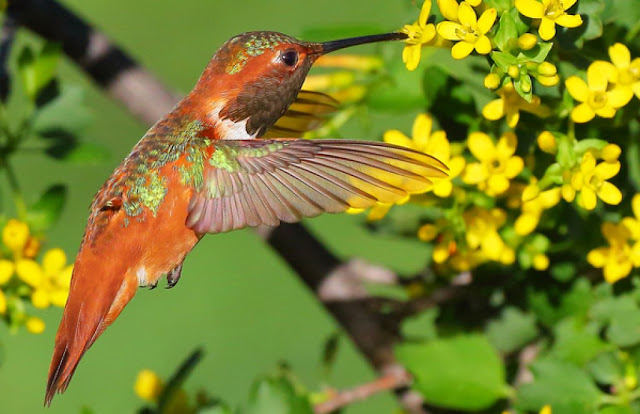
Meet the American Bird Conservancy's Bird of the Week: the Allen's Hummingbird.

*~*~*~*

The right-wing's fever dream for years has been to build a wall along the border with Mexico and now Arizona's governor who has poorly disguised ambitions for higher office has made their dream come true by stacking shipping crates along the border to make what must be an impregnable wall!

*~*~*~*

A humpback whale suffered a broken back, probably after being hit by a boat, but that did not deter her from making her 3,100-mile migration from British Columbia to Hawaii.

*~*~*~*

A flurry of births among the gray wolves of California is proof of the species' amazing comeback in a state where they had been exterminated a century ago.

*~*~*~*

Brazilian gold miners are laying waste to the forest in an Amazon reserve.

*~*~*~*

Scientists are raising concerns about the potential for a population collapse among critically endangered eels. 

*~*~*~*

There's very bad news from the world's forests: In Oregon, millions of conifers have suffered a record die-off. And in the East, ash trees are vanishing due to an onslaught from the ash borer. 

*~*~*~*

But there is some hope. In Haiti, a magnolia that had been thought to be extinct for a hundred years has been found alive and well.

*~*~*~*

In Canada, the critically endangered caribou has been given protection under the Endangered Species Act.

*~*~*~*

The benefits of cover crops in agriculture have long been known and now farmers in the Midwest have heeded the call to repair the soil and slow erosion by planting them.

*~*~*~*

Snow Geese in flight. How do they keep from bumping into each other?

*~*~*~*

Honeybee hives in Florida were decimated by the destructive power of Hurricane Ian.

*~*~*~*

As humans take over much of the planet, they are pushing wildlife out. Will there be any space left for those creatures to live?

*~*~*~*

The Keystone Pipeline has had at least three significant spills within the last five years.

*~*~*~*

NASA's SWOT (surface water and ocean topography) satellite will give an unprecedented view of the planet's oceans, lakes, and rivers. 


Comments

  1. Good morning, Dorothy: Thank you for the roundup. This morning Miriam and I will be participating in the annual Christmas Bird Count, where the number of birds and the species mix is diminishing year after year. Even "common" species are in decline. We ravage this little planet and its inhabitants more every day. As for iNaturalist, I currently have 14,838 entries on that site.

    ReplyDelete
    Replies
    1. Ah, the CBC! I hope you find lots of healthy birds!

      Delete
  2. So many links this week that struck a chord. Turning yard into a habitat. That poor humpback whale. P-22 who was euthanized. The endless benefits of bird watching. And what is it with the Arizona government and shipping containers? They're using them, not only as a border wall, but to house the homeless here in Phoenix as well!

    ReplyDelete
    Replies
    1. OMG! Well, I suppose on second thought it is better than having no place to lay your head, but seriously, can't we do better?

      Delete
  3. I saw the article on the benefits of birding. I felt those over the past few years when we isolated ourselves from others but didn't have to worry about the birds.

    I'm a huge fan of iNaturalist. What a great tool it is for citizen science.

    ReplyDelete
    Replies
    1. I agree that iNaturalist is a valuable site, especially for all of us "amateurs."

      Delete

Post a Comment

Popular posts from this blog

Poetry Sunday: Don't Hesitate by Mary Oliver

How about we share another Mary Oliver poem? After all, you can never have too many of those. In this one, the poet seems to acknowledge that it is often hard to simply live in and enjoy the moment, perhaps because we are afraid it can't last. She urges us to give in to that moment and fully experience the joy. Although "much can never be redeemed, still, life has some possibility left." Don't Hesitate by Mary Oliver If you suddenly and unexpectedly feel joy, don’t hesitate. Give in to it. There are plenty of lives and whole towns destroyed or about to be. We are not wise, and not very often kind. And much can never be redeemed. Still, life has some possibility left. Perhaps this is its way of fighting back, that sometimes something happens better than all the riches or power in the world. It could be anything, but very likely you notice it in the instant when love begins. Anyway, that’s often the case. Anyway, whatever it is, don’t be afraid of its plenty. Joy is no...

Poetry Sunday: Blackberry-Picking by Seamus Heaney

My mother was a farm wife and a prodigious canner. She canned fruit and vegetables from the garden, even occasionally meat. But the best thing that she canned, in my opinion, was blackberry jam. Even as I type those words my mouth waters!  Of course, before she could make that jam, somebody had to pick the blackberries. And that somebody was quite often named Dorothy. I think Seamus Heaney might have spent some time among the briars plucking those delicious black fruits as well, so he would have known that "Once off the bush the fruit fermented, the sweet flesh would turn sour." They don't keep; you have to get that jam made in a hurry! Blackberry-Picking by Seamus Heaney Late August, given heavy rain and sun For a full week, the blackberries would ripen. At first, just one, a glossy purple clot Among others, red, green, hard as a knot. You ate that first one and its flesh was sweet Like thickened wine: summer's blood was in it Leaving stains upon the tongue and lust ...

Poetry Sunday: Hymn for the Hurting by Amanda Gorman

You probably remember poet Amanda Gorman from her appearance at the inauguration of President Biden. She read her poem "The Hill We Climb" on that occasion. After the senseless slaughter in Uvalde this week, she was inspired to write another poem which was published in The New York Times. It seemed perfect for the occasion and so I stole it in order to feature it here, just in case you didn't get a chance to read it in the Times . Hymn for the Hurting by Amanda Gorman Everything hurts, Our hearts shadowed and strange, Minds made muddied and mute. We carry tragedy, terrifying and true. And yet none of it is new; We knew it as home, As horror, As heritage. Even our children Cannot be children, Cannot be. Everything hurts. It’s a hard time to be alive, And even harder to stay that way. We’re burdened to live out these days, While at the same time, blessed to outlive them. This alarm is how we know We must be altered — That we must differ or die, That we must triumph or try. ...