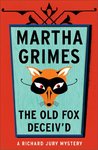
 The Old Fox Deceiv'd by Martha Grimes
My rating: 3 of 5 stars
Twelfth Night in the tiny Yorkshire fishing village of Rackmoor. It is a typically chilly and very foggy night with a North Sea wind blowing. The perfect night for murder.
A young woman in costume apparently on her way to a Twelfth Night party at the local manor house is brutally murdered, her body left on steps on the way to the party. She was stabbed with some sort of two-pronged instrument. The police can't find the murder weapon or very many clues to what actually happened.
Days later, when the trail has already grown cold, New Scotland Yard is called in and Inspector Richard Jury, along with his sidekick Wiggins, is assigned to the case. He's soon joined by his unofficial sidekick, Melrose Plant, who just happens to be a guest in that aforementioned manor house.
There are many questions about the victim of the murder. First of all, her identity. Was she really Dillys March, the long-lost much-loved ward of Colonel Titus Crael, owner of the manor house? She certainly bore a remarkable resemblance to Dillys, but that wasn't the name she gave. Was she truly Gemma Temple, the name which she had used? What was she doing in Rackmoor? Was she involved in some kind of scam in which she was trying to convince the Colonel that she was his ward so that she could share in his fortune? And, most of all, who stood to gain by her death?
As Jury and his cohorts begin to pursue these questions, they uncover an unexpectedly tangled web that leads to other undiscovered murders. And, of course, it all has its roots in a decades-old maze of unrequited loves and unavenged wrongs in the village. The quiet, unassuming English village once again proves to be a very dangerous place.
As in Martha Grimes' first entry in her Inspector Richard Jury series, which I just read earlier this week, we find that Rackmoor has its full complement of eccentric residents, several of whom have potential motives for murder and all of whom seem to have strong opinions about the murdered woman, as well as some of the tragedies of earlier years which have possibly led up to this particular murder.
Two of the most sympathetic characters whom we meet in The Old Fox Deceiv'd are a young boy named Bertie and his dog Arnold. Both ultimately play a role in the unmasking of the murderer. Twelve-year-old Bertie has been left on his own by his mother who has gone off to London to pursue her dreams, which would only be impeded by the presence of an almost teenage son. Bertie and Arnold actually manage quite well without her. Bertie works part time and various people look in on him daily and make sure he has what he needs. The village takes care of its own. Who needs social services?
Rackmoor does indeed seem to have been an idyllic place before those pesky murders intruded. Things are never quite what they seem though, are they?
Again, Grimes has constructed a charming cozy mystery with quirky characters and plenty of gentle humor. Just the ticket for a summer day when it is too hot to do much of anything except sit in the shade with a cooling drink and read.
View all my reviews
No comments:
Post a Comment