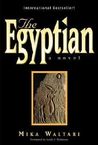
The Egyptian by Mika Waltari: A review

I had long wanted to read The Egyptian and in September, 2009, I finally got around to it. It was an interesting read and, once again, I reviewed it on Goodreads.


~~~~~ 

The EgyptianThe Egyptian by Mika Waltari
My rating: 3 of 5 stars

I have long had an interest in the history of ancient Egypt, particularly the Amarna period when the heretic pharaoh Akhnaton attempted to overthrow the ancient gods of the land and replace them with the One God, Aton.  It was a turbulent time when blood often flowed in the streets, a time that was rich in drama on many levels.

"The Egyptian" is set in that period.  It is presented as the "autobiography" of the mysterious Sinuhe, a man of uncertain origins who rose from poverty to be the physician to the king.

Before he attained that high position, he traveled throughout the Mediterranean area, to Syria, Mitanni, Babylonia, and Crete.  During his travels, he treats the sick and learns form other physicians and his renown grows.  He also gathers information for his friend, Horemheb, a commander of Egyptian forces who is preparing them for war even as the pacifist pharaoh decrees peace.

On returning to his city of Thebes, Sinuhe finds the city much changed and a restless spirit among the people.  Soon Pharaoh Akhnaton determines to abandon the city which he sees as irredeemably evil and to build his own city of Akhetaton in a new place.  This he does and from then on it seems that there is no going back.  A tragic sequence of events is set in motion.

This book was published in 1949 and some of the events described are at odds with later archeological findings and interpretations of the history of the period, but it seems very faithful in spirit to the story of Akhnaton.  The device that Waltari uses of having Sinuhe narrate the story in somewhat awkward words that might have been taken directly from an ancient papyrus is an effective one.  The reader has the sense that she is reading an authentic ancient manuscript.

When the book was first published here, it was branded as obscene.  I presume that charge referred to the sex, although more obscene to me were the scenes of violence and the terrible injuries humans inflict on other humans.

Sinuhe's story is a fascinating one.  One empathizes with him as a fellow human and feels his pain over the terrible tragedies that he suffers.  Always, he is the one who walks alone and stands apart.  He is a participant/observer and a faithful chronicler of the period.  Waltari creates and brings him to life most vividly.


View all my reviews

Comments

Post a Comment

Popular posts from this blog

Poetry Sunday: Don't Hesitate by Mary Oliver

How about we share another Mary Oliver poem? After all, you can never have too many of those. In this one, the poet seems to acknowledge that it is often hard to simply live in and enjoy the moment, perhaps because we are afraid it can't last. She urges us to give in to that moment and fully experience the joy. Although "much can never be redeemed, still, life has some possibility left." Don't Hesitate by Mary Oliver If you suddenly and unexpectedly feel joy, don’t hesitate. Give in to it. There are plenty of lives and whole towns destroyed or about to be. We are not wise, and not very often kind. And much can never be redeemed. Still, life has some possibility left. Perhaps this is its way of fighting back, that sometimes something happens better than all the riches or power in the world. It could be anything, but very likely you notice it in the instant when love begins. Anyway, that’s often the case. Anyway, whatever it is, don’t be afraid of its plenty. Joy is no...

Poetry Sunday: Hymn for the Hurting by Amanda Gorman

You probably remember poet Amanda Gorman from her appearance at the inauguration of President Biden. She read her poem "The Hill We Climb" on that occasion. After the senseless slaughter in Uvalde this week, she was inspired to write another poem which was published in The New York Times. It seemed perfect for the occasion and so I stole it in order to feature it here, just in case you didn't get a chance to read it in the Times . Hymn for the Hurting by Amanda Gorman Everything hurts, Our hearts shadowed and strange, Minds made muddied and mute. We carry tragedy, terrifying and true. And yet none of it is new; We knew it as home, As horror, As heritage. Even our children Cannot be children, Cannot be. Everything hurts. It’s a hard time to be alive, And even harder to stay that way. We’re burdened to live out these days, While at the same time, blessed to outlive them. This alarm is how we know We must be altered — That we must differ or die, That we must triumph or try. ...

Poetry Sunday: Blackberry-Picking by Seamus Heaney

My mother was a farm wife and a prodigious canner. She canned fruit and vegetables from the garden, even occasionally meat. But the best thing that she canned, in my opinion, was blackberry jam. Even as I type those words my mouth waters!  Of course, before she could make that jam, somebody had to pick the blackberries. And that somebody was quite often named Dorothy. I think Seamus Heaney might have spent some time among the briars plucking those delicious black fruits as well, so he would have known that "Once off the bush the fruit fermented, the sweet flesh would turn sour." They don't keep; you have to get that jam made in a hurry! Blackberry-Picking by Seamus Heaney Late August, given heavy rain and sun For a full week, the blackberries would ripen. At first, just one, a glossy purple clot Among others, red, green, hard as a knot. You ate that first one and its flesh was sweet Like thickened wine: summer's blood was in it Leaving stains upon the tongue and lust ...