Thanks for Following

Monday, November 29, 2021

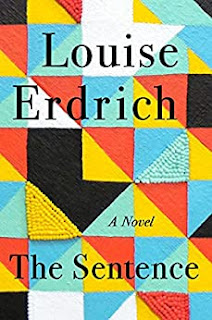
The Sentence by Louise Erdrich: A review


Acclaimed author Louise Erdrich who is also the owner of an independent bookstore called Birchbark Books & Native Arts in Minnesota has given us a new book that features an acclaimed writer named Louise who has an unnamed independent bookstore in Minneapolis. The book's Louise, however, is not the central character in the new book; that role belongs to an Ojibwe woman called Tookie.

Tookie had led a checkered life prior to her employment at the bookstore. In response to a friend's request, she had stolen the corpse of the woman's boyfriend, wrapped it in a tarp, and taken it across state lines to deliver it to another friend. It was a stupid but not evil thing to do. She was trying to help out a friend. What she didn't know was that the "friend" had duct-taped crack cocaine under the armpits of the man. Unlucky Tookie is found out and arrested by a tribal policeman. She is indicted and found guilty and sentenced to 60 years.

After ten years, Tookie's former friends confess to what they had done and absolve Tookie. That is the result of her lawyer and the tribal policeman who had arrested her having worked tirelessly to secure her release. Her sentence is commuted and she is released. She's able to continue her education and get on with her life. 

During her imprisonment,  one bright spot and consolation for her was that she had learned to love books. Reading took her out of herself and her present circumstances. When she got out, she applied for a bookseller's job at that independent Minneapolis bookstore. Louise, who interviews her, does not ask about her work history or her stint in prison. Instead, she asks her what she is currently reading. Tookie replies that she is reading Almanac of the Dead by Leslie Marmon Silko. Apparently, that is a good enough recommendation for Louise. She tells her that it is a dark time for bookstores and that hers probably won't make it, but then she offers her a job.

Tookie's life is finally looking up. She has reconnected with the tribal policeman who had arrested her and the two of them marry. She loves her work as a bookseller. Then four years after she takes the job, the store's most annoying customer, Flora, dies while reading a book. And five days after her death, her ghost finds its way to the bookstore and starts haunting Tookie.

Flora was an apparent White woman who had always claimed to be Indigenous in a former life and she was obsessessed with all things Indigenous. She even brought a photograph to the store of a woman who she said was her great-grandmother and who she presumes is Indigenous. Tookie takes a look at the picture and concludes, "The woman in the picture looked Indianesque, or she might have just in in a bad mood." Wonderful line and the book is replete with such wonderful lines.

Flora's daughter gives the book that her mother was reading when she died to Tookie. The passage that was found open by her body is marked. When Tookie looks at the book, she superstitiously becomes convinced that a sentence in the book killed Flora.  Thus, the title of this book has a double meaning; it may refer to the sentence that Tookie served in prison or it may reference that killer sentence in Flora's book. Tookie tries to destroy this malevolent book but she is less than successful.

Then, in the midst of all this haunting and malevolence, the pandemic arrives. It's the spring of 2020 and at the corner near Cup Foods, a place where Tookie's husband often stops to buy things on the way home, the police kill George Floyd and the city explodes. Clouds of tear gas fill the air. And suddenly everyone wants to read about why people are so angry. The bookstore becomes a very popular place just as everything is beginning to close down because of the pandemic.

The Sentence is chock full of literary references and with descriptions of the ins and outs of running an independent bookstore, from dealing with publishers to packaging mail orders, or curbside and even home deliveries of books during the pandemic. It is quintessentially Erdrich from page one to the appendix featuring a list and sublists of Tookie's favorite books. The narrative is at times dark and at times laugh-out-loud funny. More often it features Erdrich's wry humor and her well-known dichotomy of interests in shamanic religion and Christian beliefs and in the nuclear family as opposed to tribal kinships. She is able to explore all of these in this wonderful book.

There is a point in the novel where Tookie is talking with Louise, her boss, and she tells her her theory about the book that Flora was reading containing a sentence that was powerful enough to kill her. Louise responds, "I wish I could write a sentence like that." Well, if anyone could...

My rating: 5 of 5 stars   

Saturday, November 27, 2021

Poetry Sunday: Perhaps the World Ends Here by Joy Harjo

Joy Harjo is currently serving her second term as the country's poet laureate. She is the first Native American to be poet laureate. She is a member of the Muscogee Nation. In this poem, she gives us an appreciation of the humble kitchen table. It serves so many functions in our lives and perhaps the world even begins and ends there.

Perhaps the World Ends Here

by Joy Harjo   

The world begins at a kitchen table. No matter what, we must eat to live.

The gifts of earth are brought and prepared, set on the table. So it has been since creation, and it will go on.

We chase chickens or dogs away from it. Babies teethe at the corners. They scrape their knees under it.

It is here that children are given instructions on what it means to be human. We make men at it, we make women.

At this table we gossip, recall enemies and the ghosts of lovers.

Our dreams drink coffee with us as they put their arms around our children. They laugh with us at our poor falling-down selves and as we put ourselves back together once again at the table.

This table has been a house in the rain, an umbrella in the sun.

Wars have begun and ended at this table. It is a place to hide in the shadow of terror. A place to celebrate the terrible victory.

We have given birth on this table, and have prepared our parents for burial here.

At this table we sing with joy, with sorrow. We pray of suffering and remorse. We give thanks.

Perhaps the world will end at the kitchen table, while we are laughing and crying, eating of the last sweet bite.

Friday, November 26, 2021

This week in birds - #478

 A roundup of the week's news of birds and the environment:

Cedar Waxwings have reportedly been seen in the area already, although it is a bit earlier than I normally see them here. I took this picture last year. I always look forward to their arrival. They are a most welcome winter visitor.

*~*~*~*

Nature itself is our best defense against runaway increases in greenhouse emissions and encouraging and working to conserve biodiversity in the landscape is the best way for us to assist Nature in this important work. Here are some ways for us to best accomplish that.

*~*~*~*

Apparently, right-wingers are beginning to acknowledge that there might just possibly be something called climate change going on but they are now pairing this acknowledgment of possible ecological disaster with their fears of immigrants. This narrative is finding its way into mainstream politics.

*~*~*~*

New legislation in Britain will require that all new buildings there have a charging point for electric vehicles.

*~*~*~*

It's Thanksgiving week so cue the stories of Wild Turkeys being "rough and rowdy." After a crash of their population in the early 20th century, they have now rebounded spectacularly in many parts of the country to the point of sometimes being a pest in urban areas.

*~*~*~*

Will the elusive porpoises called vaquitas be the next animal to go extinct? Only about ten are known to exist in the wild but scientists still hold out hope for the species' survival.

*~*~*~*

As COP26 was winding down, Egypt was hit by the arrival of a plague of scorpions. Yet another warning by Nature of the potential for disaster? Scientists generally did not feel confident that COP26 had done enough to protect Nature.

*~*~*~*

Rising ocean temperatures have severely undercut fishing seasons in the Pacific off the West Coast. Now the Pacific Coast Federation of Fishermen's Associations is suing some of the largest oil companies for causing the climate crisis and damaging their livelihood, in spite of the fact that their industry is very dependent upon oil.

*~*~*~*

Did you hear about the Roadrunner that hitched a 3,000-mile ride from Las Vegas to Maine? It was captured and taken to an avian sanctuary there and wildlife officials are hoping to send it back to its desert home after veterinarians okay it for travel.

*~*~*~*

Beavers are an emblematic Canadian animal but in some regions, their increased population is creating problems as their dams cause flooding in areas.

*~*~*~*

America's fledgling offshore wind sector has kicked off with the beginning of construction of its first commercial-scale offshore wind farm located in waters 15 miles off Martha's Vineyard near Cape Cod in Massachusetts.

*~*~*~*

Jaguars roamed the mountains of the southwestern United States for centuries until they were almost driven to extinction in the mid 20th century. Now scientists and conservationists are advocating for the reintroduction of the big cat to the area.

*~*~*~*

Southern California is facing the year's worst fire danger as Santa Ana winds whipped the area with gusts of 70 mph this week amid humidity of less than 10 percent.

*~*~*~*

Albatrosses are some of the world's most reliably monogamous creatures, but now researchers say that global warming is causing Black-browed Albatrosses such as these to "divorce" more frequently because they must travel farther and farther to find food.

*~*~*~*

River otters are on the rebound in Texas. The furry, playful creatures are reclaiming their place in Texas rivers. They have even been seen frolicking in Houston's Buffalo Bayou. 

*~*~*~*

And in California, the western Monarch butterfly also seems to be making a comeback. Even though its numbers are still far short of its once-normal population, the recent exponential increase is a welcome sign of recovery.

*~*~*~*

The Biden administration is considering new protections for the Greater Sage-Grouse, reversing the relaxation of those protections by the previous administration. The bird has become a symbol of the clash between conservationists and energy companies that are eager to drill on land that comprises the range of the grouse.

*~*~*~*

The first-ever Native American has been confirmed by the Senate to be the head of the National Park Service. Charles "Chuck" Sams III, an enrolled tribal member of the Confederated Tribes of the Umatilla Indian Reservation was unanimously confirmed.

*~*~*~*

New Zealand's Black Robin, pictured here, was once the rarest bird in the world but it was brought back from the brink of extinction. However, this conservation success story is now in danger of reversal and the robin is once again in trouble.

*~*~*~*

In Manu National Park in Peru, a previously unknown species of bird has been discovered. It is a member of the tanager family and the team that discovered it has named it Inti Tanager, after the word for "sun" in the Quechua and Aymara languages.

*~*~*~*

How do we prioritize regions that we must conserve in order to reduce global warming? Researchers have found that areas such as the forests and peatlands of Russia, Canada, and the United States are as vital to that effort as the tropical forests of the Amazon, Congo, and Southeast Asia. Peat bogs, mangrove swamps, and eucalyptus forests are also vital to reducing greenhouse gases.

*~*~*~*

The commercial crabbing season in parts of California has been delayed due to concerns for the endangered humpback whales that share the waters where the crabs are found. Humpback entanglements in the heavy nets used by commercial crabbers have increased in recent years.

*~*~*~*

Finally, a photographer of wildlife shares his story of photographing a male Harrier, the "Grey Ghost."


Wednesday, November 24, 2021

Happy Thanksgiving!

My favorite holiday of the year is here! I have a lot to be thankful for but near the top of my list is you, dear reader. Thank you for reading the blog this year and for being a part of the conversation. My fondest hope is that that will continue.


Tuesday, November 23, 2021

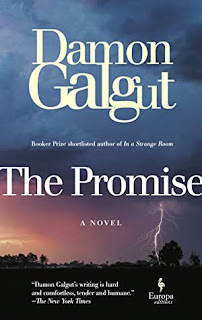
The Promise by Damon Galgut: A review


Can I share a shameful secret with you? I don't think I had ever heard of Damon Galgut before he won the Booker Prize for fiction with this book. If I had heard his name mentioned or seen it in print, it obviously did not register with me for I'd forgotten it. But he has actually published eleven novels beginning in 1983 when he was only seventeen. His works have been highly praised and some have won prizes and he had previously been shortlisted for the Booker in 2003 and 2010. He is also a playwright. His writing documents life in his native South Africa both during apartheid and after it was abolished.

This current novel details the experiences and actions of the Swart family who live on a farm outside Pretoria. There are three adult children. It begins during the apartheid period and stretches all the way to the present. When we meet the family, their mother has died and they gather for her funeral. Before she died, she extracted a promise from her husband that he would sign over to their Black maid Salome the house that she lives in. She had served the family for many years and had faithfully nursed her during her final illness. The promise was witnessed by the youngest sibling in the family, Amor.

There is much resentment in the family, especially from Pa because his wife had abandoned their conservative Christian faith and had returned to her Jewish roots. She requested a Jewish funeral and he complies but he's not happy about it. He resents all the trappings and traditions of the Jewish faith.

After the funeral, Amor reminds him of the promise that he made to her mother. It is clear almost from the first that he has no intention of fulfilling that promise. So things continue much as they had. Salome continues serving the family and continues living in a house that she had hoped would be legally hers. More cause for resentment, both from Salome and from Amor who expected the promise to be honored.

Years pass and eventually Pa dies also, leaving the older daughter, Astrid, in charge. Astrid was in her second marriage and had two children, twins. Once again, Amor brings up the promise that was made to Salome and urges Astrid to sign over the home to her. But Astrid has an acquisitive nature and does not want to give up any part of what the family owns. I think you can see where this is headed.

Meantime, Amor has moved on with her own life. She had been living in London prior to the death of her father. Returning, she decides to move to Durban and train as a nurse, a decision that confounds her family. This is during the worst of the HIV/AIDS epidemic and she takes a position nursing the victims of the horrible disease. She is disgusted with the behavior of her family, their excess drinking, marital infidelities, self-deceptions, and general moral bankruptcy. She cuts her ties to them. But then tragedy strikes and she has to be notified. The only one who has her phone number is Salome and she calls her to tell her that Astrid has been murdered. Once again, Amor comes home for a funeral.

Amor's brother, the middle child, Anton is now in charge of the farm. Amor approaches him as she had her sister and father previously and reminds him of the promise that was made to their mother long ago. He reassures her that he will take care of it but he continually finds excuses to delay the deed transfer. It's clear that it really isn't going to happen. Salome once again is denied.

More than thirty years pass since that original promise was made. Anton is a drunk who is an incompetent manager. Apartheid has now passed into history, but still, Salome and her son Lukas are tied to the land and the Swart family. And then the unexpected happens. Anton is found dead, a result of his overindulgence. Finally, ownership and management of the farm fall to Amor and there is nothing preventing her from accomplishing the deed transfer which she does. But now there are other threats to the land that make it less than valuable and Lukas views Amor's action as an empty gesture. He responds in fury.

This family's story appears to be Galgut's way of depicting the history of South Africa during this whole period; the squandering of opportunities and failures to live up to its promise are not just familial failures but a society-wide picture of moral insolvency. It is a portrait of a country with deep and abiding divisions as it attempts to put apartheid behind it and move toward a more equitable society. Galgut accomplishes all of this deftly and with great finesse. I suspect all of the praise and awards he has received over the years for his writing are well-earned.

My rating: 4 of 5 stars


Sunday, November 21, 2021

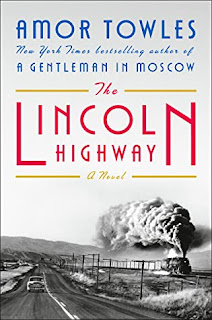
The Lincoln Highway by Amor Towles: A review


Amor Towles' latest features two young brothers, an older teenager and a pre-teen, who set out from Nebraska to go to San Francisco where the younger brother has hopes of finding their mother who left them years earlier. Their father has recently died and their home, a farm, is being foreclosed by the bank which holds the mortgage. They have to go somewhere and San Francisco seems like a good option.

It is June 1954 and eighteen-year-old Emmett Watson has just been driven home by the warden of the work farm where he was sentenced after being found guilty of involuntary manslaughter. His sentence has been reduced because of his father's death and the fact that his eight-year-old brother, Billy, has no other family to care for him. Emmett has a 1948 Studebaker Land Cruiser that he had bought with wages earned as a carpenter before being sentenced. His plan was to take his brother and head to Texas where he thought there would be work for a carpenter and he could support the two of them. Billy, though, is dead set on California and after some research at the library, Emmett decides that there's work for carpenters in California as well, so San Francisco, here they come!

Well, not quite.

Before they can hit the road on the Lincoln Highway, two of Emmett's friends from the work farm, Duchess and Woolly, show up, having hidden themselves in the trunk of the warden's car. They have escaped and now Duchess has a plan to get Emmett to take them to New York where Woolly, who is estranged from his wealthy family, will be able to access money left to him by his grandfather. Woolly is an innocent with a good heart and some undefined psychological problem for which he takes medication. Duchess is a user of people and I disliked him from his first "Ta-da!" I never changed that opinion even after I learned some of his sad history. Emmett is not interested in going to New York. He's ready to head west.

Unable to persuade Emmett, Duchess steals ("borrows") his car, and he and Woolly head to New York, stranding Emmett and Billy. Naturally, all the money they had was in the trunk of the car, so they are left with no money and no transportation. They manage to hop a freight train and head to New York to find Duchess and Woolly and the car.  Easy peasy, right? That was just one of the things about the book's plot that stretched my credulity.

Emmett and Billy are fortunate in finding friendly people along the way who help them out. After they leave, Sally, the young woman who had cared for Billy before Emmett was released, decided that she would drive to New York to find Billy and Emmett, and of course, she does, and of course, they do get the money (of Woolly's) that Duchess had promised. But there are a couple of tragedies that happen before the two brothers can finally head west on the Lincoln Highway. 

I loved Towles' A Gentleman in Moscow and I dearly wanted to love this one, too, but I just couldn't. I can't really explain why but it never really "grabbed" me. The story was told from five different viewpoints, Emmett's, Billy's, Sally's, Duchess's, and Woolly's, which gave it a somewhat unfocused feel. It was a bit long, I felt, and could have used a stricter editor. The story seemed repetitive and it got rather tiresome for me. I started with a lot of empathy for the brothers, for young Billy particularly, but as the plot advanced, his constant perkiness just began to irritate me. It's certainly not a bad book, and I know many readers have really liked it, and I guess I liked it well enough but just not as much as I was expecting to.

My rating: 3 of 5 stars


Saturday, November 20, 2021

Poetry Sunday: When I am an old woman, I shall wear purple by Jenny Joseph

I have to admit that purple has long been a favorite color of mine and I frequently wore it even before I became an old woman. As for the red hat, well, I'm not really into hats so much but if I wore one it would definitely be red. So, you could say I've been practicing at being an old woman for quite some time now. I should be really good at it by now. Perhaps I've already made up "for the sobriety of my youth." 

When I am an old woman, I shall wear purple

by Jenny Joseph 

When I am an old woman I shall wear purple
With a red hat which doesn't go, and doesn't suit me.
And I shall spend my pension on brandy and summer gloves
And satin sandals, and say we've no money for butter.
I shall sit down on the pavement when I'm tired
And gobble up samples in shops and press alarm bells
And run my stick along the public railings
And make up for the sobriety of my youth.
I shall go out in my slippers in the rain
And pick flowers in other people's gardens
And learn to spit.

You can wear terrible shirts and grow more fat
And eat three pounds of sausages at a go
Or only bread and pickle for a week
And hoard pens and pencils and beermats and things in boxes.

But now we must have clothes that keep us dry
And pay our rent and not swear in the street
And set a good example for the children.
We must have friends to dinner and read the papers.

But maybe I ought to practice a little now?
So people who know me are not too shocked and surprised
When suddenly I am old, and start to wear purple.

Friday, November 19, 2021

This week in birds - #477

 A roundup of the week's news of birds and the environment:

A Tufted Titmouse stops by my little fountain for a drink and maybe a quick bath. 

*~*~*~*

COP26 wrapped up with an agreement signed by almost 200 countries that would intensify global efforts to fight climate change. Many activists were disappointed that the agreement was not more forceful in setting higher goals for countries to reach, but looking on the brighter side, at least it established a clear consensus that more is needed from those countries.

*~*~*~*

The success of COP26 will in large part depend upon whether certain powerful countries like the United States, China, and India that are major emitters of greenhouse gases actually live up to their promises.

*~*~*~*

Satellite data reveals that the deforestation of Brazil's Amazon rainforest rose by nearly 22 percent over the past year. It was the worst loss of any year since 2006. Many blame the policies of President Jair Bolsonaro. 

*~*~*~*

In some better news for rainforests, the Biden administration will propose restoring the Clinton administration's ban on logging and road-building in more than half of North America's largest temperate rainforest, Tongass National Forest. 

*~*~*~*

Torrential rains resulted in floods that created widespread devastation in western Canada this week. The floods were exacerbated by the summer wildfires that wiped out much of the vegetation that could have slowed the flooding.

*~*~*~*

In the U.S., the mountain states of Colorado, Wyoming, and Montana are still battling wildfires even in late autumn. The fires are whipped by strong winds that cause them to engulf entire mountains.

*~*~*~*

And of course, hotter summer days mean more fires. A new study reported on research that adds to the growing body of evidence that climate change is increasing the fire risk in California and elsewhere in the West.

*~*~*~*

As COP26 drew to a close, China made the point that developing nations will be unable to make the transition from coal to greener sources of energy without substantial help from developed nations. 

*~*~*~*

What do grizzly bears eating out of trash cans in the United States have to do with COP26? It seems there is actually a connection.

*~*~*~*

The Biden administration has submitted to the Senate for its approval a treaty that would fight hydrofluorocarbons which are hundreds of times more potent than carbon dioxide. It has support from both political parties so its passage, while not assured, is at least possible.

*~*~*~*

For years, tribes have requested that oil and gas drilling be banned around the Chaco Canyon in New Mexico, one of the nation's oldest and most culturally significant Native American sites. The administration announced this week that it would ban new leases for drilling within a 10-mile radius of the site. This was a part of new initiatives that are aimed at improving public safety, health, education, and justice for Native Americans.

*~*~*~*

Unfortunately, it is not all good news from the administration this week. They announced that they will auction off leases for drilling for fossil fuel extraction in more than 80 million acres of the Gulf of Mexico. To add insult to injury, the announcement was made in the immediate aftermath of COP26.

*~*~*~*

We often hear of plans to plant trees to offset carbon emissions and that is all very good but there isn't enough room to plant all the trees that would be needed to actually save the planet.

*~*~*~*

There are plenty of trees and plenty of opportunities for outdoor activities in America's newest national park, the New River Gorge in West Virginia.

*~*~*~*

Saving the endangered Ashy Storm Petrel on the Farallon Islands requires controlling invasive mice and convincing hungry owls to leave the birds alone. The two needs are related.  

*~*~*~*

The U.S. Fish and Wildlife Service has finalized a rule that will list the Atlantic pigtoe mussel as an endangered species. The tiny mussel is only found in North Carolina and Virginia and it has waited thirty years to receive this protection.

*~*~*~*

A GAO report details that moving the Bureau of Land Management to Colorado as the previous administration did two years ago has undercut diversity and led to confusion and inefficiency and that may very well have been what was intended. As Interior Secretary Deb Haaland announced in September, that action is being reversed. The agency's headquarters will once again be in Washington while Grand Junction, Colorado will serve as its western hub.

*~*~*~*

There appears to be something of a baby boom happening among the mountain gorillas of Virunga National Park in the Democratic Republic of Congo. Authorities this week announced the birth of two more babies.

*~*~*~*

Show us that foot, Froggie! This is a Bornean rock frog making a foot-flagging display. It may not look scary to you but this is the way that these male frogs intimidate and threaten their competition.

*~*~*~*

The owner of Black Rock Rhino sanctuary in South Africa has come up with a novel way to help fund conservation efforts: virtual horns tokenized as NFT's, non-fungible tokens.  

*~*~*~*

Consider the opossum, an unjustly much-maligned animal. Opossums - or possums if you prefer - have an omnivorous diet that consists of insects, rodents, venomous snakes, grubs, frogs, carrion, and overripe fruit and vegetables. They are valuable members of the ecosystem and serve in some of the same ways that vultures do, in that they help to keep the environment neat. Furthermore, I think they are kinda cute.

*~*~*~*

Did you get to see the partial eclipse of the Beaver Full Moon this week? Neither did I. But here are some photos to help us enjoy it vicariously.  


Thursday, November 18, 2021

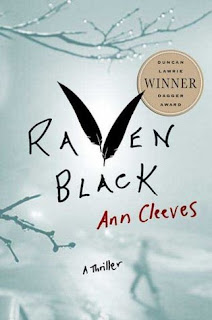
Raven Black by Ann Cleeves: A review


I had seen the "Shetland" series on television but had never read any of the books, even though I am a big fan of Ann Cleeves' writing. So I decided to remedy that starting with the first book in the series. It was a creditable beginning.

Raven Black takes place in the fictional town of Ravenswick, Shetland, where on New Year's Eve a simpleton loner named Magnus Tait is visited by two teenage girls, Sally Henry and Catherine Ross. When the girls turn up at his door, he invites them in to toast the New Year. The girls then leave but they, especially Catherine, have left a vivid impression on Magnus. A few days later when he's riding a bus, Catherine gets on. When they both start to leave the bus, Catherine offers him her hand to help him down and he invites her in for a cup of tea. 

A deep layer of snow covers Ravenswick but the next morning a local artist on her way home sees some bright colors in the distance on the snow and ravens circling around the area. She goes to investigate and discovers Catherine Ross's strangled body which the ravens have already been feeding on. The body is quite near Magnus Tait's home. The police come to investigate, led by Inspector Jimmy Perez.

Perez is another strong and realistic detective creation of Cleeves. His name comes from a Spaniard who had been shipwrecked on Fair Isle and subsequently made it his home. It was there that Perez was born and raised. He went to school at Ravenswick and Lerwick on the main island, so he is very familiar with the area. Soon, a high-powered team of detectives from Inverness is sent in to head up the investigation and Perez is relegated to a relatively minor role. But he establishes a good working relationship with the head of the new team and they begin working well together to try to solve the crime. 

The community is sure that they know who killed the girl. Several years earlier, a young girl went missing in Ravenswick and she was never found. The neighbors were sure that Magnus Tait was responsible. Now they have jumped to the conclusion that he is responsible for this death also. The investigators are interested in him but can find no physical evidence linking him to the crime and Perez follows the evidence. Moreover, he finds himself feeling sympathetic toward the lonely man who is an outcast in his community. It soon develops that there are other potential suspects in the murder.

Then a complication arises. While out walking, Fran Hunter, the woman who had found Catherine's body, finds another body that had been buried under some rocks. It is the girl who had gone missing years earlier, Catriona Bruce. This body also was found in the vicinity of Magnus Tait's home. Now Perez must determine whether the two deaths are connected and if indeed Tate is responsible for two murders.

I found that I liked this book much better than the television series. I sometimes found the series perhaps unnecessarily complicated with story lines that were difficult to follow. It's much easier for me when I see it all in print. 

One of the strongest parts of the narrative, in my opinion, is Cleeves' evocation of this small, close-knit Shetland community. Everyone knows everyone else and many of the people are related in one way or another. One can feel the claustrophobic context of those relationships. 

It's not just the community relations that are a strong element; Cleeves also gives us a powerful picture of the unique Shetland culture, for example their upcoming celebration of a holiday called Up Helly Aa. It is a festival that marks the end of the Yule season and involves a torchlit parade of costumed participants that ends in the burning of an imitation Viking galley. We are given to understand that this is an important holiday for them and there is much discussion of it througout the book. The Viking influence and heritage is strong on the island.

As usual, Cleeves hid the solution to the mystery(ies) of the two deaths very well indeed. I admit I was totally flummoxed and surprised by the conclusion. And that, I suppose, is the mark of an excellent writer of thrillers, a description that fits Cleeves to a T.

My rating: 4 of 5 stars 

Tuesday, November 16, 2021

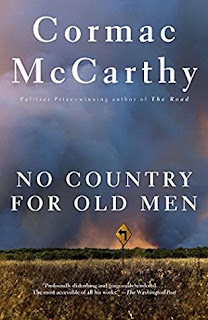
No Country for Old Men by Cormac McCarthy: A review


"Don't read Cormac McCarthy," they said. "He's too bloody and violent. You wouldn't like him," they said. And for years I heeded that warning. But finally, this year in thinking about ways to challenge myself with reading, I considered McCarthy again. After all, how bad could he be? How much worse than some of the other bloody stuff I've read? (I'm looking at you, Jo Nesbo.) So, I picked up No Country for Old Men and began to read. What I learned was he's not bad at all. In fact, he's very, very good. Oh, he's bloody enough all right. I quickly lost track of the body count that continued to rise throughout the book. But the violence was never particularly explicit. It was just reported rather matter of factly.

You've probably read the book or seen the popular 2007 Coen brothers movie based on the book. There was, of course, a lot of talk about the movie after it came out and especially after it won the Oscar for Best Movie, so even though I hadn't read the book or seen the movie, I was already fairly familiar with the plot. My memory of the plot may have been a bit faulty though, or maybe the emphasis of the movie was different from the book. Mostly what I had remembered was the killer Anton Chigurh and the trail of bodies he leaves behind. The book, however, featured a narrative by Sheriff Ed Tom Bell which gave a lot of exposition and moved the plot along.

The other central character was Llewelyn Moss who initially sets the plot in motion. While out hunting pronghorns, Moss stumbles on the aftermath of a drug deal that went awry, somewhere along the Mexican/American border in remote Terrell County, Texas. Moss finds everyone dead except for one badly wounded Mexican who pleads with him for water, but Moss has none to give. When he searches the vehicles, he finds a truck full of heroin. Some distance away from the other bodies, he finds a dead man with a satchel that contains $2.4 million in cash. He takes the money and goes home, but then he returns to the scene with a jug of water for the wounded man. He finds that the man has been shot and killed in the interim. He is seen by the apparent killers and they chase him across a desert valley. He manages to escape but for most of the rest of the novel, the killers are chasing him.

Returning home, Moss sends his wife, Carla Jean, to her grandmother in Odessa, hoping to keep her safe, while he takes the money and runs.

Sheriff Bell investigates the drug deal gone bad and the resultant deaths. Learning of Llewelyn's involvement, he attempts to protect him and his wife. They are residents of his county and he feels responsible for them. But his attempt to keep them safe is complicated by the arrival of ruthless hitman Anton Chigurh on the scene. He has been hired to find and return the money. He will go to any lengths to accomplish the task he has been hired for and will kill anyone who stands in his way. The reader intuits pretty quickly that this will not end well for Llewelyn Moss.

This book was published in 2005. The story was originally written as a screenplay. I looked at some of the reviews of the novel that appeared at the time of its publication and saw that some of the professional critics who did not like it, and there were a few, complained about the book being "too cinematic." Huh? Is that really a bad thing? Not being a professional critic, maybe I'm just not sophisticated enough to see the problem with that. I loved McCarthy's vivid exploration of the darker side of human nature, not only in Anton Chigurh but in Sheriff Bell as well. Bell is haunted by his actions in World War II. (This book takes place in 1980 when he is in his 50s.) He received a Bronze Star for action in which he feels that he failed his unit and left them to die. He has spent the rest of his life trying to make up for that failure.  I particularly enjoyed Bell's narrative in the book and felt that it was both the glue that held the plot together and the engine that moved it along. 

Llewelyn's actions, too, have their dark side. He could have turned the money in. He didn't have to run with it and focus the attention of a professional killer on himself and his wife, putting her as well as himself in mortal danger. And, of course, Chigurh is darkness itself. He is essentially a psychopathic killer who takes a lot of pleasure in his work. 

McCarthy is an extremely gifted writer and I enjoyed this book quite a lot. Several of the critics that I read said that it is inferior to his other work. Now I need to read some of that other work and make my own judgment.

My rating: 5 of 5 stars

Monday, November 15, 2021

Garden Bloggers' Bloom Day - November 2021

And just like that, here we are in November. Where has the year fled? We've been enjoying unusually pleasant (for us) autumn weather here in zone 9a. Cool, sunny days and often quite chilly nights, sometimes dipping into the lower 40s F. And while the garden still looks a bit raggedy around the edges, it, too, has enjoyed this cooler weather with the occasional fall rains. Here's what has survived to bloom this month.


The Encore azaleas have been putting out a few blooms recently.


If it's autumn, then of course Esperanza "yellow bells" must be in bloom.


A pot of pansies on the patio table, just added for fall and winter color.


And I must have my red cyclamen, also for seasonal color.


The Cape honeysuckle has been in bloom for several weeks and shows no signs of letting up.


Another autumn "must-have" - petunias.


Duranta erecta blossoms with their beautiful attendant, a Tiger Swallowtail. These butterflies seem to particularly like these blossoms. I see them there frequently. 


Here's what those Duranta blooms become when they ripen - the yellow berries called "golden dewdrops" that give the plant its common name.


The gerbera daisies are still blooming, in orange...
 

...and in yellow.


The echinacea got its second wind and began blooming again, in purple...


...and in other colors.


The blooms of the yellow cestrum look almost orange in the autumn sun.


And the leaves of the Hamelia patens become almost as red-orange as its blossoms. 


The tropical milkweed is still offering its blossoms to passing butterflies.


No bloom here, just my little tiger doing a bit of goldfishing/watching. (No, he didn't catch anything.)
 

Firespike is at its best in the fall.


The buddleia is still in bloom although its blooms are smaller now.


And more buddleia.


The Turk's cap is really outdoing itself with fall blooms.


This white penta bloomed all summer and now well into the fall.


And so did this fuchsia-colored one, now joined by a bit of pink dianthus.
 

'Peaches and cream' lantana.


Purple trailing lantana.


Blue plumbago, of course.


Autumn sage doing its thing.


And the coral vine does its autumn thing as well. It, too, has been absolutely cover in these pink blossoms this fall.


My lady roses are putting on a fall show. Here's 'Belinda's Dream.'


With lots more of those big, squashy blooms to come.
  

And, of course, last but never least, the 'Lady of Shallott.' Her blooms, too, seem quite a bit more orange in the autumn sun than they were earlier in the year.

I hope you and your garden are flourishing. I look forward to visiting you soon. Thank you so much for visiting here. Happy Bloom Day.

And thank you to Carol of May Dreams Garden for hosting us once again.   

Saturday, November 13, 2021

Poetry Sunday: Fire and Ice by Robert Frost

Will the world end in fire or ice? Considering how the planet is rapidly heating up, it seems most likely that it will end in fire. But after the fires burn out and all the humans are gone, ice may once again have its chance. It's a question that Robert Frost considered in 1920 and, of course, he wrote a poem about it. It is brief and to the point.

Fire and Ice

by Robert Frost 

Some say the world will end in fire,
Some say in ice.
From what I’ve tasted of desire
I hold with those who favor fire.
But if it had to perish twice,
I think I know enough of hate
To say that for destruction ice
Is also great
And would suffice.

Friday, November 12, 2021

This week in birds - #476

 A roundup of the week's news of birds and the environment:

The American Bird Conservancy's Bird of the Week is the Greater Sage-Grouse. The Sage-Grouse is one of the most prominent inhabitants of the sagebrush "sea" that covers millions of acres across 13 U.S. states and portions of a few Canadian provinces. It is considered an "umbrella" species meaning that efforts to conserve it also benefit many other species.

*~*~*~*

The bird of the week in my backyard is the Ruby-crowned Kinglet. The little birds have arrived in the area for their winter sojourn with us.

*~*~*~*

Cop26 is winding down. Has it been successful or not? Researchers from the world's top climate analysis coalition are not impressed. Their report says that the world is still on track for disastrous heating of 2.4 degrees Celsius by the end of this century. This is in spite of the pledges made by governments at this conference. 

*~*~*~*

It turns out that the largest delegation at Cop26 was not from a single country but from the fossil fuel industry. There were 503 delegates linked directly or indirectly to fossil fuels.  This is according to the advocacy group, Global Witness.

*~*~*~*

Twenty-four countries and several automobile companies signed an agreement to end the sale of fossil fuel vehicles by 2040. However, the agreement may be most notable for those who didn't sign. The U.S., China, and Germany did not sign and the auto companies Toyota, Volkswagen, and BMW likewise did not sign, all saying that they had some reservations about the terms of the agreement.  

*~*~*~*

The world's two biggest emitters of greenhouse gases, the U.S. and China, did sign another agreement, however. They jointly pledged to work together to slow global warming in this decade and to ensure that the Glasgow summit results in meaningful progress.

*~*~*~*

The U.S. Fish and Wildlife Service announced this week that it was reversing a rule promulgated by the previous administration that would have would have opened up millions of acres of West Coast forests, habitat to the endangered Northern Spotted Owl, to potential logging. The reason for the reversal was that the rule had been based on faulty science. Government biologists had objected to the rule at the time the administration announced it, saying that it would put the endangered owl on the road for extinction. 

*~*~*~*

The climates of Europe and North America have been regulated for thousands of years by the circulating currents of the Atlantic Ocean which produce relatively moderate weather conditions. But now the effects of anthropogenic climate change have diminished the flow of the conveyor belt and there is recent scientific research that suggests it may be headed for collapse. This would be devastating for the two continents. 

*~*~*~*

At the climate summit this week, President Biden announced a series of steps that this country will take to reduce our emissions of methane. Central to the plans is an Environmental Protection Agency rule that aims to cut methane pollution from the oil and gas industry to a quarter of 2005 levels by the end of this decade.

*~*~*~*

New research is suggesting that the role of salt marshes as powerful carbon sinks has been vastly underestimated and that we continue to ignore them and fail to protect them at our peril.

*~*~*~*

And now comes another dangerous effect from the COVID-19 pandemic. Mismanaged plastic waste consisting of things like gloves and masks has ended up in the oceans of the world. It's estimated that nearly 26,000 metric tons of the waste is now added to the plastic pollution of the ocean.

*~*~*~*

The Middle East and North Africa, already the hottest and driest regions on the planet, could become uninhabitable in the coming decades if temperatures reach 60 Celsius or higher.

*~*~*~*

As well as salt marshes, peatlands, too,  are vastly important as carbon storage units. A wetlands scientist in Wales refers to them as the "superheroes of the natural world."

*~*~*~*

Parts of the Thames River were once declared biologically dead but 60 years and decades of cleanup efforts later, it is now home to hundreds of wildlife species including seahorses and sharks.

*~*~*~*

Did you know that bees can scream? Apparently so, not with mouths but with their bodies. When they are threatened by giant hornets, Asian honeybees use their wings to create a noise that sounds like a cry for help and alerts the nest to the presence of their mortal enemy.

*~*~*~*

We think of Antarctica as a land of ice and it is, but it was also once a land of fire. During the Cretaceous period, an era known for fires that raged on every continent, Antarctica, too, was on fire

*~*~*~*

This is a Steller's Sea Eagle in flight. These birds are normally at home in China, Korea, Japan, and the east coast of Russia. They have been known to sometimes stray into Alaska but one has now wandered as far as the Atlantic Coast and may even have made a trip to South Texas. The bird may be seriously lost but its flight has set all kinds of new records for the species. 

*~*~*~*

Hawaii's Kilauea volcano had been erupting in one form or another since 1983, but in 2018 from May to August, it produced its "magnum opus." It unleashed 320,000 Olympic swimming pools'-worth of molten rock from its eastern flank. Scientists learned lessons from the outburst that have changed how first responders prepare for eruptions in other areas.

*~*~*~*

Over the last half-century, as global heating has dramatically increased, the number of "fire weather days" in Northern California has likewise risen.

*~*~*~*

Over the centuries, New Zealand's population of sea lions was seriously depleted by hunting. They are among the world's rarest sea lion species but now they are making a comeback. Their numbers are increasing and they are turning up in the most unexpected places.

*~*~*~*

Anomalies abound in Siberia where parts of the region are up to 62.6 degrees warmer than usual. Flowers bloom and strawberries are ripening at times and places where they never would have before.

*~*~*~*

A new study shows that deer can catch coronavirus and can pass it on to other deer and to humans. One more thing to worry about with the pandemic.

*~*~*~*

Don't call it a moon they say but Earth has another space object besides our moon that is following the planet around the sun. Apparently, it was shorn off our moon by a meteor impact.

*~*~*~*

Yet another lost bird, this one, an Adélie Penguin from Antarctica, has traveled 3000 km of icy waters to land on the shores of New Zealand. New Zealanders have affectionately named him Pingu.


Wednesday, November 10, 2021

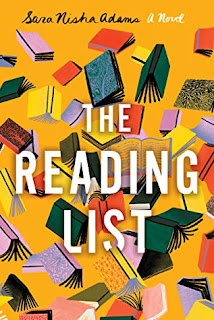
The Reading List by Sara Nisha Adams: A review


The list of the title is a series of eight well-known books. It was a list written by an unknown (until near the end of the book) hand and tucked into several different books at the struggling public library in Wembley which the lister frequented. The list read as follows:

Just in case you need it -

To Kill a Mockingbird
Rebecca
The Kite Runner
Life of Pi
Pride and Prejudice
Little Women
Beloved
A Suitable Boy

As it happens, the people who find one of the lists need it very badly indeed. The first one who does is Aleisha, a seventeen-year-old teenager working at the library.

Aleisha is not a reader. She's only working at the library because she desperately needed a job and her beloved brother, Aidan, a book lover who had previously worked at the library, recommended it. Between shelving books and working at the front desk, she is bored senseless and spends much of her time looking at her phone. That's what she is doing the day that Mukesh comes to the library.

Mukesh is an eighty-year-old Indian immigrant from Kenya who had lived in England for most of his life. He is a widower, having lost his beloved Taina Naina two years earlier. He is stuck in the early stages of grief still and has not been able to move on with his life. Taina Naina was an avid reader who always had a book going. Mukesh is not a reader. He is a devoted viewer of David Attenborough documentaries. His three adult daughters have been directing and organizing his life since their mother died. Now, his oldest daughter insists that they need to clear out her mother's clothing and other things. Some things are stored under the bed and when the box is pulled out it pushes out a book that was there.

The book is The Time Traveler's Wife by Audrey Niffenegger. The library book is two years overdue. It was the last book Taina Naina was reading when she died. Mukesh had never understood his wife's love of books, but when he finds this book and remembers seeing her reading it, he is drawn to try to find out what fascinated her. He opens the book and begins to read. He is soon completely absorbed in the story, feeling as though his wife is talking to him. He is surprised to learn that he finds great comfort in reading. When he finishes the book, he decides to return it to the library even though it is so long overdue and to ask for other books that he might read. That is how he comes to meet Aleisha.

Aleisha was having a bad day. In fact, there is very little about her life at the moment that is good. She and her brother are trying to care for their mentally ill mother at home after their father abandoned the family. It is not going well. When Mukesh, who had never been to the library, tentatively approached her at the front desk and asked for her, she was rude and abrupt and had no time for him. She pointed him in the direction of books but didn't help him. He decided on the spur of the moment that he would keep The Time Traveler's Wife. He left the library, unsatisfied, without another book to read. When Aleisha's boss learned what had happened, she was warned that she was on shaky ground and there were other people who would be glad to have her job. She must make an effort or be fired.

Meanwhile, Aleisha had found that reading list in the back of a returned copy of To Kill a Mockingbird. On a whim, she decided to read the first book on the list to see what all the shouting about reading was about. She found out. She was completely mesmerized by the story of Scout and Jem and Atticus Finch. In an effort to atone for her treatment of Mukesh, she recommended the book to him as well. When he read the book and returned it, she was eager to discuss the book with him. That was the beginning of a beautiful friendship. She recommended the next book on the list to him and the pattern of the friendship was laid.

Reading helped Mukesh to get closer to his young granddaughter, who like her grandmother was an avid reader. It also opened the world to him and helped him to finally step out of his grief. Reading aloud to her mother became a way for Aleisha to connect with her and to help her begin to emerge from her depression. Reading changed the lives of these two people. But we learn that it had a similar effect on the other people who found "the list." The books all had something of value to say to their readers.

This book is really a love letter to books, libraries, and to readers. The writer, Sara Nisha Adams, is a British Indian editorial director at a publishing house in London. This is her debut book. Adhering to the dictum of writers to write what they know, the book is steeped in British Indian culture and, of course, the love of all things bookish. There is no magic in the book, other than the magic of good writing. At one point, Aleisha's family suffers a crushing tragedy which leads her to turn against books and regret the time she spent with them, but her friend, Mukesh, gently reminds her, "Please try to remember that books aren't always an escape; sometimes books teach us things. They show us the world; they don't hide it."

Yes. What he said.

My rating: 5 of 5 stars