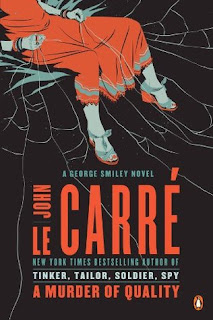
This second one references boarding schools which, in a foreword, the author states that he was sent to from age five to sixteen. He hated them and something of that sentiment comes through in the book which finds Smiley being prevailed upon to help investigate what turns out to be a murder of the wife of an instructor at such a school, a sort of posh prep school. He becomes involved when he receives a request from a former wartime colleague. The woman, Ailsa Brimley, is now the editor of a publication called the "Christian Voice" and she has received a note from one of her long-time and valued subscribers who tells her that she is afraid her husband is going to kill her. Unwilling to go to the police with such sketchy information, Miss Brimley calls Smiley, and since he is at loose ends he accedes to her request and travels to the city of Carne. Unfortunately, he arrives too late. The woman had been killed the night before.
Since he arrived too late, Smiley feels an obligation to find out what happened and secure justice for the murdered woman. Thus, in this book, we get not Smiley, the spy, but Smiley, the investigator. He teams with the police to try to discover the murderer. It develops that there is no shortage of suspects. Could it be a jealous wife, one of the tutors at the private school, or a possessed lady? Or maybe it really was the husband.
As an investigator, Smiley gets to use some of the same skills that he employed as a spy. He is a careful observer, a student of human nature, and he is not easily fooled. The author leads us through the process that Smiley takes to solve this heinous crime and the reader, along with Smiley, soon begins to get an idea of just who the killer is. Even though I felt pretty confident early on just who that killer was, it was fascinating to watch Smiley work as he followed the clues to their inevitable conclusion.
Reading John le Carré is such a pleasure. Each individual sentence has such crispness and it seems that not one could be removed from the book without changing its meaning. Here, for example, is a description of Smiley which left me feeling that I understood his soul: “It was a peculiarity of Smiley's character that throughout the whole of his clandestine work he had never managed to reconcile the means to the end. A stringent critic of his own motives, he had discovered after long observation that he tended to be less a creature of intellect than his tastes and habits might suggest; once in the war he had been described by his superiors as possessing the cunning of Satan and the conscience of a virgin, which seemed to him not wholly unjust.”
And then there is Smiley's assertion that one must take the facts just as they are without embellishing them: “A fact, once logically arrived at, should not be extended beyond its natural significance.” That's advice from which we all might benefit.
The characters, the plot, and the pacing in this book are just about perfect. Le Carré really was one of the best writers of the twentieth and early twenty-first centuries of not just genre espionage novels but novels period. How lucky we readers are to have had him.
My rating: 5 of 5 stars
i read the first one a long time ago, but lost track since then... how many of the Smiley adventures are there?
ReplyDeleteThere are nine featuring Smiley, the last one published in 2017 after a pause of 27 years.
DeleteBoarding schools to me always seem an unwarranted act of cruelty inflicted on children.
ReplyDeleteLe Carré agreed with you. I could hardly believe it when I read in his foreword that he was sent to boarding school at five years of age.
DeleteI get distracted away from my reading lists all the time! I loved the one Len Deighton book I read, Berlin Game, and I always meant to read more of his writing, but I obviously got distracted and never made it back to his other books. But I should try him again sometime. He is such a good writer.
ReplyDeleteThat's one reason why I seldom set reading goals for myself. I always seem to get distracted so I find it is usually best to just read whatever appeals to me at the moment.
DeleteThis reminds me of how long it's been since I've read one of those Smiley novels; I think I've only read four or five of them, all told. I remember enjoying them because they were kind of the anti-James Bond books to me. It was nice to find an author who took spy novels to a realistic place in contrast to the Bond style (I loved those, too, but was looking for something more real).
ReplyDeleteHaving worked for British intelligence himself, I think le Carré had a good understanding of how the spy game worked and that most of the time it was very boring stuff. He brought that understanding to the Smiley novels and created in his main character, as you say, the anti-Bond. Smiley was all cerebral whereas Bond was all action. Personally, I prefer the cerebral.
DeleteWhile this doesn't sound like my kind of thing, I'm really glad you liked it!
ReplyDeleteI'm always up for le Carré!
DeleteThat's a worthy goal to reread all of the Smiley books. Now what year was this one published? I didn't realize he did non-spy Smiley books?! Just murder mysteries? My. I will ask my husband if he has read any of these mystery ones.
ReplyDeleteThis one was published in 1962 and as far as I can remember, it is the only one in the series that didn't directly involve spies.
DeleteI get distracted the same way all the time. I started a challenge for myself to read a book about every single president, not just Kennedy, Lincoln, or Washington. In 2016. I am nowhere near done, and here we are almost at the end of 2021.
ReplyDeleteRobert Burns could have been writing about us readers; our best laid plans often go astray.
DeleteI have not read anything by John Le Carre that I can recall. I need to remedy that. A Murder of Quality sounds like a good read.
ReplyDeleteEven though this one features George Smiley, it could easily be a standalone read.
Delete