Books, gardens, birds, the environment, politics, or whatever happens to be grabbing my attention today.
Translate
Tuesday, August 30, 2022
What Jonah Knew by Barbara Graham: A review
Saturday, August 27, 2022
Poetry Sunday: Late August by Margaret Atwood
I went searching for a poem for late August and there it was! Margaret Atwood had provided the perfect words to describe the season.
Late August
by Margaret Atwood
Late August—
This is the plum season, the nights
blue and distended, the moon
hazed, this is the season of peaches
with their lush lobed bulbs
that glow in the dusk, apples
that drop and rot
sweetly, their brown skins veined as glands
No more the shrill voices
that cried Need Need
from the cold pond, bladed
and urgent as new grass
Now it is the crickets
that say Ripe Ripe
slurred in the darkness, while the plums
dripping on the lawn outside
our window, burst
with a sound like thick syrup
muffled and slow
The air is still
warm, flesh moves over
flesh, there is no
hurry
Friday, August 26, 2022
This week in birds - #515
A roundup of the week's news of birds and the environment:
House Finches are regular visitors to my bird feeders.Thursday, August 25, 2022
Things We Do in the Dark by Jennifer Hillier: A review
Tuesday, August 23, 2022
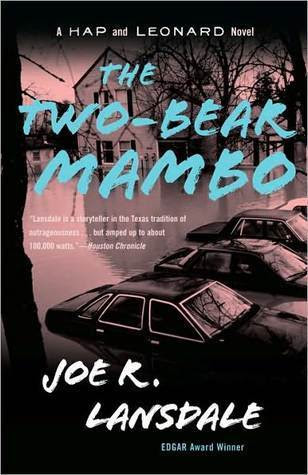
The Two-Bear Mambo by Joe R. Lansdale: A review
There are twenty-six books in Joe K. Lansdale's Hap and Leonard series dating all the way back to 1990. Two-Bear Mambo is the third book in the series, published in 1995. I've not read any of the others and just decided on a whim to read this one. The series is set in the fictional town of LaBorde in East Texas, an area I'm somewhat familiar with.
Hap and Leonard are described as amateur investigators and adventurers. Hap Collins is a White working-class laborer who spent time in federal prison back in the day when he refused to be drafted into the military during the Vietnam War. He believes in non-violence and does his best to avoid conflict. Leonard Pine is a gay, Black Vietnam vet with some serious anger issues. He has no tolerance for racist and/or gay slurs. He is quick to anger and doesn't really understand Hap's more passive approach to life. These two opposites are the best of friends.
In this entry, Hap's ex-girlfriend Florida Grange, who is also Leonard's lawyer, had set out to try to recover some long-lost tapes of a deceased blues musician. Unfortunately, the tapes are thought to be in the Klan-infested town of Grovetown in East Texas and the ex-girlfriend has now apparently disappeared there. There is reason to fear for her safety because she is a Black woman who was asking inconvenient questions in a racist town.
She had been investigating the jailhouse death of a legendary bluesman's son who is believed to have been in possession of those missing tapes. He had supposedly committed suicide while in jail but there may be reason to question the official explanation.
As Hap and Leonard set out to try to find Florida, they also must face a threat from the weather. An East Texas monsoon is brewing with its attendant flooding and they must race to try to find Florida before the storm adds another layer of difficulty to an already difficult task.
The relationship between Hap and Leonard is an interesting and complex one and Lansdale describes it believably. Moreover, his descriptions of the East Texas landscape and zeitgeist rang true for me. As one who traveled those roads for many years as a state employee, I could clearly recognize both the people and countryside which they inhabit. In reading about the author, I was interested to see that he himself lives in Nacogdoches in the same county where I lived for many years, so I think he came by his knowledge of the area quite honestly.
Saturday, August 20, 2022
Poetry Sunday: As imperceptibly as grief by Emily Dickinson
Summer is beginning to wind down although we still have several more weeks of potential triple-digit temperatures here in Southeast Texas. But already I can feel a difference in the air when I sit outside on my patio in the late afternoon. Moreover twilight creeps in earlier and earlier every day. The days are getting shorter, the surest indication that autumn is, in fact, on its way.
Emily Dickinson observed that summer passes into fall with "A courteous, yet harrowing grace" which is almost imperceptible at first. As imperceptible as grief.
As Imperceptibly as Grief
by Emily Dickinson
As imperceptibly as grief
The summer lapsed away, —
Too imperceptible, at last,
To seem like perfidy.
A quietness distilled,
As twilight long begun,
Or Nature, spending with herself
Sequestered afternoon.
The dusk drew earlier in,
The morning foreign shone, —
A courteous, yet harrowing grace,
As guest who would be gone.
And thus, without a wing,
Or service of a keel,
Our summer made her light escape
Into the beautiful.
Friday, August 19, 2022
This week in birds - #514
A roundup of the week's news of birds and the environment:
Just about anytime I look out a window, I'll see at least one of these guys in my yard - the ever-present White-winged Dove.*~*~*~*
The top environmental news in this country this week has been the dangerous heat wave that has affected much of the continent. It may just be a preview of our future as much of the U.S. will be part of an extreme heat belt by the 2050s. And as extreme heat becomes our norm, gardeners are looking for ways to help their gardens survive and flourish.
*~*~*~*
Europe also is enduring a scorching summer that is putting a strain on its energy systems.
*~*~*~*
The president this week signed an energy bill, one aim of which is to reduce dependence on fossil fuels.
*~*~*~*
"Forever chemicals" may soon be less than forever chemicals as scientists are making progress on a method of breaking them down.
*~*~*~*
Mexico is fighting for its share of the water from the Colorado River, water that largely gets taken by U.S. states as it travels its course. Meanwhile, the U.S. has imposed drastic cuts in water available to the states along the river.
*~*~*~*
This little beauty is the American Bird Conservancy's Bird of the Week. It is the Royal Sunangel, a bird of northern Peru and southern Ecuador.Wednesday, August 17, 2022
A blast from my blogging past
We have recently been watching and enjoying the "Joe Pickett" television series on Paramount+ which led me to reminisce about when I read and reviewed the first book in that series. It was eleven years ago and I liked the book quite a lot and subsequently read the others in the series. Here is that review.
*~*~*~*
Open Season (Joe Pickett #1) by C.J. Box - A review
Box has created an enormously appealing character in Joe Pickett. A Wyoming game warden, Joe is a devoted family man with two young daughters and a pregnant wife when we first meet him. He and his family are able to barely scrape by financially on the meager salary of a state employee (Been there, done that!), but Joe is a happy man because he's living his dream. Being a game warden was what he always wanted to be.
Not only Joe but his whole family are lovingly drawn by Box. We get to know them well and to like them and want them not just to endure but to triumph. Seven-year-old Sheridan, particularly, who has an important role to play in this story, is a child after my own heart. I know her well because I could easily see seven-year-old Dorothy in her.
The story begins with Joe's sidearm being taken from him by local wilderness outfitter/game poacher Ote Keeley when he confronts Keeley about his poaching, catching him red-handed, literally hands dripping blood, with the carcasses of his out-of-season kills. Keeley eventually gives the gun back and Joe writes him a ticket for poaching. Soon the story of how the bumbling game warden was disarmed is making the rounds and Joe becomes something of a laughingstock. But, he stoically continues doing his job every day to the best of his ability and continues to write tickets for scofflaws, even when it might be more convenient or popular for him to look the other way.
Then comes the night sometime later when a mortally wounded Ote Keeley rushes into the yard of the Pickett family with a plastic tub in his hands. His face is seen at her bedroom window by Sheridan but she convinces herself that it was only a dream and doesn't wake her parents. The next morning, Ote Keeley's dead body is found next to the Picketts' woodpile with an open plastic tub containing some kind of animal scat by his side. Why would Keeley use his dying breath to drag himself to the Pickett home? What was he carrying in that plastic container? Joe is intrigued, of course, and he gathers some of the scat into envelopes to send for analysis before he calls in the local sheriff.
As the investigation proceeds, Joe begins to suspect that something is rotten in the state of Wyoming. He and another game warden and a local deputy are sent into the wilds to find Ote's two partners, who, it is suspected may be responsible for shooting him. When they arrive at the camp, they find another eccentric local coming out of one of the tents with a gun, but the other two men in Pickett's party shoot the man before he has a chance to say anything. Searching the camp, they make another gruesome find in one of the other tents.
This is a real page-turner of a first novel. Box keeps the action going and keeps the reader guessing until close to the end, even though it seemed obvious pretty early on who the bad and badder guys were going to be. I look forward to reading more in the series and seeing how these characters develop.
I did have quibbles with one part of Box's narrative. His presentation of the effects of the Endangered Species Act seemed quite biased to me. He bemoaned the fact of the negative impact on the local economy when logging and other outdoor jobs were lost because of the need to protect a dwindling population of his fictional "Miller's weasels," which seemed to be based on the real-life experience of the endangered black-footed ferret. In the next breath, he talks about outsiders pouring into town to see the ferret or to take part in its protection. Surely, those people have to stay somewhere. They have to eat something. They have to buy gas for their vehicles or supplies for their treks into the wilderness. This would seem to pump a lot of money into the local economy and to create new jobs and new opportunities for entrepreneurship. Does the word "ecotourism" ring a bell? I know it certainly does along the Texas coast with all its bird and butterfly festivals and its year-round influx of birders and other outdoors-lovers from right around the world. I don't see why that wouldn't work in Wyoming as well.
Monday, August 15, 2022
Garden Bloggers' Bloom Day - August 2022
I admit that I completely forgot about Carol Michel's meme Garden Bloggers' Bloom Day this month. It was only after I started seeing other bloggers' posts that I remembered, so I grabbed my camera and ran outside to record what is blooming in my garden this month. It didn't take long because there is not much there. Only the toughest of the tough plants can still manage to produce a few blooms when the temperatures hover around 100 degrees Fahrenheit every day and the few puffy clouds have forgotten how to drop their moisture. Here then are the hardy few that still brighten my garden and provide sustenance for the butterflies. (If some of them look wilted, it's because they are. The pictures were taken when it was 96 degrees and felt like 103.)
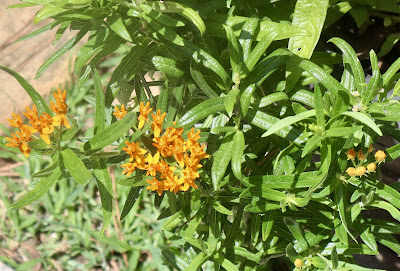
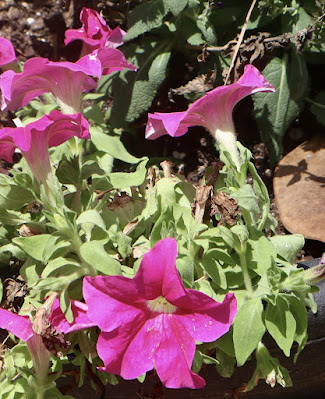
The native butterfly weed is impervious to heat and drought.And the old standard, petunias, can match the Asclepias for toughness.
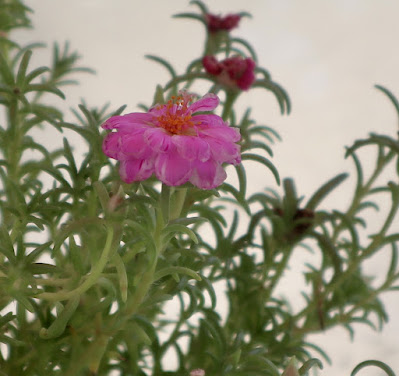
Purslane, of course, in pink...
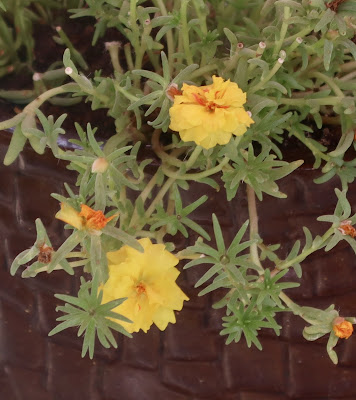
...and yellow.
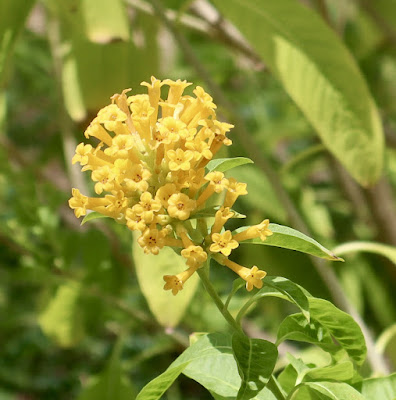
And so will yellow cestrum.
Some of my zinnias have given up, but these bloom on.
And so does this one.
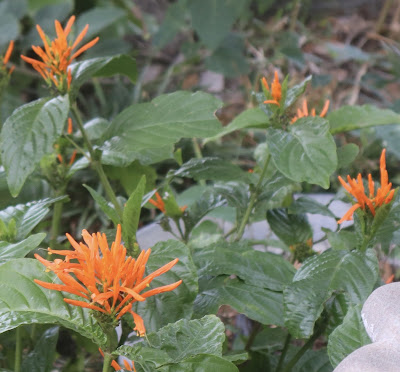
Hamelia patens.
At least the water lily doesn't go thirsty.
Thank you for visiting my hot and dry zone 9 garden in Southeast Texas this month. I look forward to visiting your garden in what I hope is a somewhat cooler clime!
Saturday, August 13, 2022
Poetry Sunday: An August Cricket by Arthur Goodenough
Sitting on the swing in the backyard, listening to the song of a cricket in the shrubbery next to my little pond, I thought, "Someone should write a poem about that cricket who is completely undaunted by the heat." And, sure enough, someone already had!
An August Cricket
by Arthur Goodenough
When August days are hot and long,
And the August hills are hazy,
And clouds are slow and winds also,
And brooks are low and lazy.
When beats the fierce midsummer sun,
Upon the drying grasses;
A modest minstrel sings his song
To any soul that passes.
A modest, yet insistent bard
Who while the landscape slumbers;
And Nature seems, herself asleep,
Pours out his soul in numbers.
His song is in a tongue unknown,
Yet those, methinks, who hear it
Drink in its healing melody
Renewed in frame and spirit.
His life is brief as is the leaf
To summer branches clinging!
But yet no thought of death or grief,
He mentions in his singing.
No epic strain is his to sing;—
No tale of loss or glory;—
He has no borrowed heroines;
His heroes are not gory.
He is no scholar; all he knows
Was taught by his condition,
He never studied synthesis,
Nor simple composition.
His lays are all of rustic themes;
Of summer's joys and treasure
Yet scarce could Homer's masterpiece,
Afford us keener pleasure.
Friday, August 12, 2022
This week in birds - #513
A roundup of the week's news of birds and the environment:
White Pelicans preen next to Galveston Bay.
*~*~*~*
The fact that the Climate Bill actually managed to pass in both houses of Congress is little short of a miracle. It's less than what environmentalists were hoping for, of course, and, in fact, some groups believe it will do more harm than good. I guess they would have preferred nothing.
*~*~*~*
It's not exactly concerning our earthly environment but the pictures of our larger galactic environment from the Webb telescope are nothing short of spectacular.
*~*~*~*
Even as the climate bill was being debated, word came that our planet's Arctic region is heating up much faster than had been predicted.
*~*~*~*
This is the American Bird Conservancy's Bird of the Week. It is the Newell's Shearwater ('A'o), a Hawaiian specialty. The species is listed as critically endangered, with less than 10,000 remaining in the wild.Wednesday, August 10, 2022
The House Across the Lake by Riley Sager: A review

Shades of "Rear Window," the classic Hitchcock movie. In this case, instead of looking into a neighboring apartment, a woman spending time at her family's lake house in Vermont passes her days by watching her neighbors in The House Across the Lake. Her neighbors are Tom and Katherine Royce and Casey Fletcher becomes somewhat obsessed with them. Tom is a tech mogul and Katherine is a gorgeous former model.
Casey has retreated to her lake house to escape the bad press she was recently receiving in New York. She is a successful actress who was widowed when her husband drowned in that very lake. She is attempting to assuage her grief with alcohol. Her viewing of - some might say spying on - her neighbors is fueled by a plentiful supply of liquor.
A fateful change in her relationship with those neighbors comes when Casey saves Katherine from drowning in the lake. It is the beginning of their friendship, but as Casey gets to know her better, she learns that Katherine's marriage to Tom is a fraught affair.
And then Katherine vanishes after telling Casey that her husband would never let her go. He would kill her first. Casey suspects the worst and she is determined to find out what has happened to her friend. But it becomes apparent that there is a serial killer on the loose. Several young girls have been killed. Was Katherine a victim of the same killer? And is that killer Tom?
The basic plot here was interesting, but there was quite a bit of repetitive "padding" to the story that didn't necessarily move the plot along. The book was almost four hundred pages and I felt that if some of that repetition had been cut, it would have been a better read. In spite of those caveats, the book was still a solid three-star read for me.
Monday, August 8, 2022
Horse by Geraldine Brooks: A review
Geraldine Brooks has written a fictionalized account of the life of a record-breaking thoroughbred named Lexington who lived in pre-Civil War Kentucky. It is an account of the horse's life and the life of the enslaved groom named Jarret who loved and cared for him.
Jarret was just a boy himself when he was first given the care of the new foal as his responsibility. The boy and the horse formed an unbreakable bond that saw Lexington through a long series of record-setting victories in races throughout the South.
In those years, a young itinerant artist was hired to paint Lexington's picture. Those paintings were quite successful and helped the young artist to make his name as a professional. When the war began, the artist took up arms for the North, and in that role, he would encounter the horse and his groom one more time.
A hundred years later, a gallery owner in New York became obsessed with an equestrian painting from the nineteenth century, a painting of unknown provenance by a then-forgotten artist. It is completely different from the paintings that she usually champions, the work of edgy contemporary artists. But the power of the work speaks to her and she seeks to learn everything she can about it.
Fast forward to the present day and a Nigerian-American art historian named Theo and a Smithsonian scientist from Australia named Jess become connected through their interest in the horse in the painting. That horse's bones are in the American treasure trove that is the Smithsonian and Jess is studying them for clues to the horse's power and endurance. Meanwhile, Theo is interested in the Black horsemen who were so instrumental in Lexington's success.
From the essential facts of the horse's life, Geraldine Brooks has woven a multi-layered tale that examines the social fabric of the time in which he lived and raced. She addresses the record of racism that was a part of that time and the consequences of which still plague the country today. I thought she did quite an incredible job of bringing together all the various elements of the story - the racism and slavery as well as the history of nineteenth-century horse racing and modern-day art and science. Her development of the main characters in all three time periods in which her story exists was interesting and I was fully invested in their stories.
I debated with myself as to what rating to assign the book. In the end, I couldn't quite bring myself to give it five stars but bestowed an enthusiastic four. I highly recommend the book to anyone who enjoys horse stories or anyone who just enjoys good writing.
Saturday, August 6, 2022
Poetry Sunday: In August by Paul Laurence Dunbar
In August
by Paul Laurence Dunbar
When August days are hot an' dry,
When burning copper is the sky,
I'd rather fish than feast or fly
In airy realms serene and high.
I'd take a suit not made for looks,
Some easily digested books,
Some flies, some lines, some bait, some hooks,
Then would I seek the bays and brooks.
I would eschew mine every task,
In Nature's smiles my soul should bask,
And I methinks no more could ask,
Except—perhaps—one little flask.
In case of accident, you know,
Or should the wind come on to blow,
Or I be chilled or capsized, so,
A flask would be the only go.
Then I could spend a happy time,—
A bit of sport, a bit of rhyme
(A bit of lemon, or of lime,
To make my bottle's contents prime).
When August days are hot an' dry,
I won't sit by an' sigh or die,
I'll get my bottle (on the sly)
And go ahead, and fish, and lie!
Friday, August 5, 2022
This week in birds - #512
A roundup of the week's news of birds and the environment:
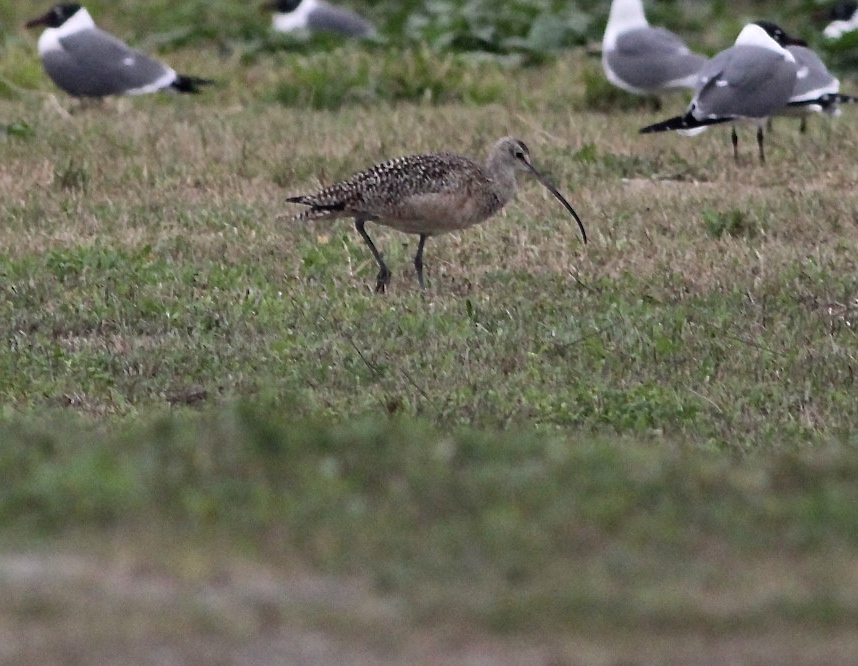
A Long-billed Curlew searches for his dinner in a field populated with Laughing Gulls.*~*~*~*
The big news in the environment on this continent this week has been the heat wave that has affected more than 80 million Americans in the central and eastern states. The hot weather will continue for the next several weeks, with only the Southwest and Alaska forecast to have cool or average temperatures.
*~*~*~*
Are we truly headed toward a climate meltdown on the planet and is it too late to prevent a global catastrophe?
*~*~*~*
This tiny green sea turtle, after being rescued on a Sydney beach, pooed nothing but pure plastic for the first six days after it was brought in, startling evidence of the damage that is being done to the ocean environment.