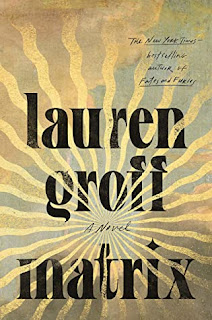
The Marie that she gives us is, in 1158, a member of the court of Queen Eleanor, history's Eleanor of Aquitaine who in her life was the queen of both France and then England. Marie was an awkward and unwelcome member of the court. She was extremely tall and had a giant bony body. She was too unattractive to ever be considered for a marriage, so what to do with her? She was educated and had had to fend for herself since she was twelve years old and her mother died, so she was resourceful and well able to manage an estate. Eleanor reasoned that if she could manage an estate, she could just as easily run a nunnery and as it happened she had just such a place in mind.
The particular nunnery that needed someone to take it in hand was a "dark and strange and piteous place, a place to inspire fear." Marie was seventeen years old and had already discarded the religion in which she was raised. She could not accept the paternalism of that religion. She did not wish to leave the court because she harbored an unrequited love for Eleanor and could not bear the thought of being separated from her, but she wasn't given a choice. So off to the nunnery she goes.
What she finds there would be enough to make anyone quail. It was a community of sick and starving women who had no resources to feed or cure themselves. Marie used some of her own money to buy food and then to buy animals who would later provide more food. She organized the women who were able to do so to plant and care for gardens that would provide food as well as medicinal herbs. Gradually, she was able to transform the failing community into a sprawling and successful complex tucked away in the Arthurian forest. She had been filled with self-pity when she first came to the nunnery but she soon began to realize that she had a unique opportunity with the real estate and the women who could be organized to work the land. She could make this into a successful enterprise.
She created a scriptorium to provide copying services at a fraction of what the monasteries charged, and the nunnery began to flourish. Through the long years of Marie's life, it achieves ever greater success and renown as she continues to ignore the paternalism of the church and to pursue her own feminist philosophy. This sometimes causes concern for the nuns as Marie takes on priestly functions an action which some of them deem blasphemous, but she manages to override those concerns more or less through the force of her personality. Female ambition and power are the themes of the novel as Marie continues to refuse to acknowledge an inferior position for women in the church.
This narrative is essentially without men except as incidental characters. It focuses tightly on the grand life of one remarkable woman. She started as an orphan who was entrusted with the lives of others and through the force of her will, she molded them from a group of weak and dying women into a strong and resourceful community. We follow Marie year after year as she completes this work and through all those years up until the time of Eleanor's death she continues to love her from afar and to hope that she will some day retire to the nunnery that she has transformed. Alas, it is not to be. It is one of the few but defining disappointments of her life.
Marie is not always an entirely lovable character but one always has to admire her strength and the fact that she remains true to her vision throughout. It makes for a compelling and entertaining story.
My rating: 5 of 5 stars
I love this author as well but, from the sound of it I wasn't sure I wanted to rush out and read it. You changed my mind. I have the audio and may request print version from library to supplement it. Thank you Dorothy - now I'm intrigued.
ReplyDeleteI had the same reticence as you when I first heard of this book. Really? A twelfth century nunnery? But it is in fact quite a wonderful read.
DeleteI've read Groff's "The Monsters of Templeton" and "Fates and Furies" and reacted differently to them. The first one turned into one of those books I had to force myself to finish, and the second one was a book I couldn't put down without still thinking about it for a while. I'm very curious to see how this one reads for me.
DeleteI think you might enjoy the historical fiction aspect of it, Sam. I found it to be pretty propulsive reading.
DeleteYour review of Matrix gives this novel justice! I am glad you enjoyed Matrix as well. It is a wonderful read and am glad I read it myself.
ReplyDeleteThat's kind of you to say. I found it not a particularly easy book to review, I think simply because of the length and all the substance of Marie's life.
DeleteI found it difficult to review the Matrix as well for the reasons you mentioned.
Deletei read a bio of Eleanor recently and i think it mentioned Marie at one point... this sounds like a fascinating read and i think i'll see if i can find a copy... tx for the interesting post!
ReplyDeleteMarie was apparently at court with Eleanor for a while, so it seems likely that she might have been mentioned. Obviously, Groff imagined her life so I'm not sure how much of this aligns with the facts.
DeleteThis is one of our Inprint books this year, and when it arrived, I simply set it aside. I am now eager to read this book. Thank you, Dorothy.
ReplyDeleteI'll be interested to know what you think of it once you read it.
DeleteI haven't read any of Groff's books, but my best friend was visiting about a month ago and recommended them. I need to read this one!
ReplyDeleteShe's a very good writer and I can honestly say I've enjoyed every book of hers that I've read. I think you would enjoy them, too.
DeleteFates & Furies sure was a doozy about a marriage. This one sounds completely different. I am warming to the idea of it. And plan to check it out. I usually like historical fiction.
ReplyDeleteThis one was, indeed, very different from Fates and Furies but equally well written.
Delete