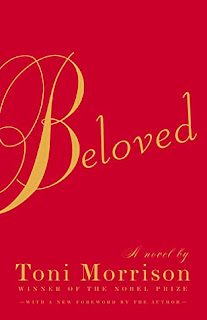
The novel is set after the end of the Civil War during the Reconstruction period. It was not a peaceful time. Even though slavery had been officially ended in the country, those who had been given their freedom or who had bought their freedom earlier were still victims of a lot of random violence. That was a constant cloud hanging over the freed Blacks. Among those living under that cloud were a woman in her mid-thirties named Sethe and her family. Sethe lived in Ohio with her daughter, Denver, and her mother-in-law, Baby Suggs, in a home found by abolitionists for Baby after she was freed. But there is another presence in the house. It is the ghost of Sethe's other daughter who died under horrific circumstances eighteen years earlier. After her death, Sethe wanted to get a headstone for her grave. She traded ten minutes of sex with the tombstone engraver to get it. She wanted Dearly Beloved engraved on the stone but she only had enough strength for the one word. Beloved it was.
The ghost of Beloved is an angry, sad, and malevolent spirit who often breaks and smashes things in the house. She had driven away Sethe's two young sons. Denver, though, seeks the company of the spirit because her family is ostracized and she has no other friends. As the novel opens, Baby Suggs, after a lifetime spent in slavery and then time in freedom after her son, Sethe's husband, purchased her freedom with his labor, dies leaving Sethe and Denver alone in the house with the spirit.
The action of the novel takes place in this Reconstruction time period but there are flashbacks to an earlier time which reveal the backstories of the characters and their time in slavery. They had been slaves on a Kentucky plantation that was named, quite ironically, Sweet Home. But, in fact, it was not as bad as many plantations. It was owned by a Mr. Garner who was relatively benevolent and treated his "property" well. But then Mr. Garner died and his widow brought in one of her male relatives to help run the place. He was called "the schoolteacher" and his viciousness knew no bounds. Soon the slaves were trying to escape. Some were murdered and some went crazy. Sethe takes a nightmarish trek to freedom. This all happened eighteen years before the time during which the current action of the novel occurs.
It is through these flashbacks that we learn of the hideous and gruesome existence of slaves caught in this awful system. Their families are viciously ripped apart. They are deprived of their mates and their children and their kin. Family members vanish and are never seen again, sold away, or victims of an even crueler fate. Their bodies were not their own but merely units of commerce. Any evil could be visited upon them or their loved ones by their owners and there was nothing they could do about it. Can you begin to imagine what that does to a person?
Back in the present time of the novel, a man from Sethe's past at Sweet Home shows up in Ohio. His name is Paul D. and he, too, escaped from the plantation but has endured harrowing, nauseating experiences along the way, including time on a Georgia chain gang. Paul D. and Sethe attempt to set up a "real" family and when the baby ghost acts up, he drives it out.
But then a young woman turns up. She seems to be about twenty years old but she talks like a child and can't remember where she came from. She is intensely interested in Sethe. She says her name is Beloved. Sethe believes that this young woman is her long-dead daughter and she becomes a catalyst for other revelations and memories.
The supernatural is an integral part of this layered story. All the characters believe in ghosts and the "ghosts" are reported in a matter-of-fact manner as are all the other events. At one point, Sethe wishes that her memories could be erased, that she could "go crazy" like some of the slaves and forget. But it was not to be. Her brain absorbed it all and loaded her down with the past, leaving no room to plan for the future.
There are so many different stories and voices in this novel that it becomes difficult at times to keep them all straight. Toni Morrison's versatility and technical skill in telling her stories cannot even be fully comprehended by an ordinary reader like myself. The stories are truly horrifying and appalling which explains why I hated them when I first read the book. I still hate them. Only a monster could "enjoy" this book. But I don't think Morrison intended it to be enjoyed. It was intended to explicate an almost inexplicable human experience and make it real for people living comfortable modern lives, and she succeeded with skill and an astounding emotional range. On my second reading, I think I have gained a better appreciation of that skill and emotional range. I honestly don't think a person in my position can ever truly comprehend the slave's experience but at least I have a more complete understanding of what it is I can't understand. The amazing Toni Morrison did that for me.
My rating: 5 of 5 stars
I cannot imagine what it is like for the Nobel Prize selectors to evaluate literature in different languages. It seems to me to be an impossible task. I wonder also whether it is in some degree politically and regionally- based.
ReplyDeleteIt's an interesting question. I suspect that political considerations do enter into the decisions as they would almost have to.
DeleteYou are right. I don't think Morrison intended Beloved to be enjoyed. It was uncomfortable, at best, and it was horrifying. I read it in the 1990's, along with The Bluest Eye and Song of Solomon. It may be time for a reread.
ReplyDeleteRereading books like this one is always a revelation to me. I'm amazed at what I missed the first time around.
DeleteGreat review of this book! I tried to read it once but didn't make it through it. Maybe I should try again.
ReplyDeleteIt is a difficult read for sure, but definitely worth the effort.
DeleteNone of us are the same people we were 20 years ago, or, for that matter, two years ago. I have a small list of books I disliked when I was younger but think I should give another chance to. I'm happy you gave this book another chance, and that you found great value in it.
ReplyDeleteThere was value in it even the first time I read it, but the story is so horrific it was hard to appreciate it.
DeleteThank you so much for sharing this
ReplyDeleteI'm always happy to share.
DeleteI have not read Beloved. Great review as usual, Dorothy, you write very thorough book reviews and I love them. Beloved sounds like it is a fantastic read, but a book that would be too difficult to read in some respects due to what you described.
ReplyDeleteIt is certainly difficult to read. I had to take frequent breaks. But it is such an important book for explaining a part of our history that usually doesn't get sufficiently explained.
DeleteThank you, Dorothy Borders, for sharing another review of a great piece of literature. I read this book just as the movie, starring Oprah Winfrey, was released. As an Black American of a certain age, I have heard, by word of mouth, the horrific and subhuman conditions savagely heaped on my enslaved African ancestors. I can't describe my pain when I think about this so I choose not to stay in that mindset. Love your blog, especially the week in birds. Be blessed!
ReplyDeleteYour pain at these stories is certainly understandable, especially to anyone who has read Morrison's book. Thank you for your kind comment.
DeleteIt makes me so angry when people want books banned. Just ugh. While I've not read this book I've heard many great things about it.
ReplyDeleteTrying to ban a book is always a stupid and ultimately useless enterprise because it invariably backfires.
DeleteI read this novel long ago ... and think it shook me to the core (as well as The Bluest Eye). But I don't remember it well now and would probably need to do a reread it. Isn't it crazy how it became an issue in the Virginia Governor's race?! Oh gosh the Dems need that state to be Blue. Huge race at stake. I'm holding my breath for Virginia, but it's pretty conservative in places.
ReplyDeleteI have a cousin who lives in Virginia Beach and she's very nervous about the outcome of the race. At this point, we can only hope for the best. It just seems incredible to me that Virginians would elect Youngkin.
Delete