Here's a poem for Halloween for you. Annie Finch writes about Samhain, the Celtic Halloween, but the images she uses will be familiar to all of us in the northern hemisphere during the Halloween season.
by Annie Finch
(The Celtic Halloween)
Books, gardens, birds, the environment, politics, or whatever happens to be grabbing my attention today.
Here's a poem for Halloween for you. Annie Finch writes about Samhain, the Celtic Halloween, but the images she uses will be familiar to all of us in the northern hemisphere during the Halloween season.
(The Celtic Halloween)
A roundup of the week's news of birds and the environment:
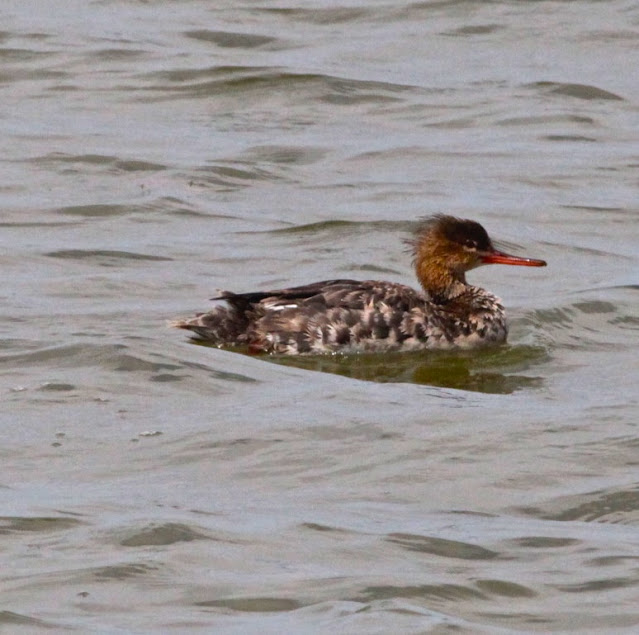
One of our winter visitors - the Red-breasted Merganser.*~*~*~*
It's not really a surprise but it is still disappointing - countries' pledges to help control climate change are falling short of the mark. The UN has determined that there is no credible pathway to meet the goal of keeping the increase in the planet's temperature to under 1.5 degrees Centigrade.
*~*~*~*
So what will the world look like after climate change? Here is a visualization.
*~*~*~*
Already Europe is experiencing an unseasonably warm autumn and climate scientists say that climate change is the cause.
*~*~*~*
And in this country the mighty Mississippi River is looking not so mighty anymore; it is drying up.
*~*~*~*
It's Bat Week and the Department of the Interior has thirteen (of course!) interesting and largely unknown facts about the underappreciated species.
*~*~*~*
Bar-tailed Godwit*~*~*~*
Here is a video tour of the amazing Lava Beds National Monument.
*~*~*~*
The Salish Sea in autumn is a busy, birdy place.
*~*~*~*
Here's a story about the last-ditch effort to save the critically endangered black rhino.
*~*~*~*
It's that time again - time to sign up for Project Feederwatch. It's an important effort to document what birds come to our feeders in winter.
*~*~*~*
How do elephants actually use their trunks?
*~*~*~*
Swarms of insects can be electric - literally. You might say they are all potential lightning bugs.
*~*~*~*
The asteroid that wiped out the dinosaurs and probably many anonymous others also changed the face of the Earth.
*~*~*~*
In Iraq, archaeologists have uncovered some 2,700-year-old rock carvings from the time of the Assyrian empire.
*~*~*~*
The leaves are falling and they are worth their weight in gold to the soil. If you can, please let them lie.
*~*~*~*
There's something in the water in Virginia and that may not be a bad thing.
*~*~*~*
There's something in Lake Mead's water, too, and that may not be such a good thing.
*~*~*~*
Using drones to save whales? Yes, that really is a thing.
*~*~*~*
These are Emperor Penguins. This week they were given protection under the Endangered Species Act. They are threatened because of the changing climate.*~*~*~*
It sometimes seems that news of the climate is all doom and gloom, but in fact, there is hope.
*~*~*~*
Lastly, here is the American Bird Conservancy's Bird of the Week - the magnificent Great Gray Owl.I've always thought that the skies of October take on their own special shade of blue. It's a crisper and deeper color than the skies of summer that are washed out by bright sunlight or the skies of winter that often seem overlaid with frost. Helen Hunt Jackson understood what I'm trying to describe. She told us about it in this poem.
October's Bright Blue Weather
by Helen Hunt Jackson
O suns and skies and clouds of June,
And flowers of June together,
Ye cannot rival for one hour
October's bright blue weather;
When loud the bumblebee makes haste,
Belated, thriftless vagrant,
And goldenrod is dying fast,
And lanes with grapes are fragrant;
When gentians roll their fingers tight
To save them for the morning,
And chestnuts fall from satin burrs
Without a sound of warning;
When on the ground red apples lie
In piles like jewels shining,
And redder still on old stone walls
Are leaves of woodbine twining;
When all the lovely wayside things
Their white-winged seeds are sowing,
And in the fields still green and fair,
Late aftermaths are growing;
When springs run low, and on the brooks,
In idle golden freighting,
Bright leaves sink noiseless in the hush
Of woods, for winter waiting;
When comrades seek sweet country haunts,
By twos and twos together,
And count like misers, hour by hour,
October's bright blue weather.
O sun and skies and flowers of June,
Count all your boasts together,
Love loveth best of all the year
October's bright blue weather.
A roundup of the week's news of birds and the environment:
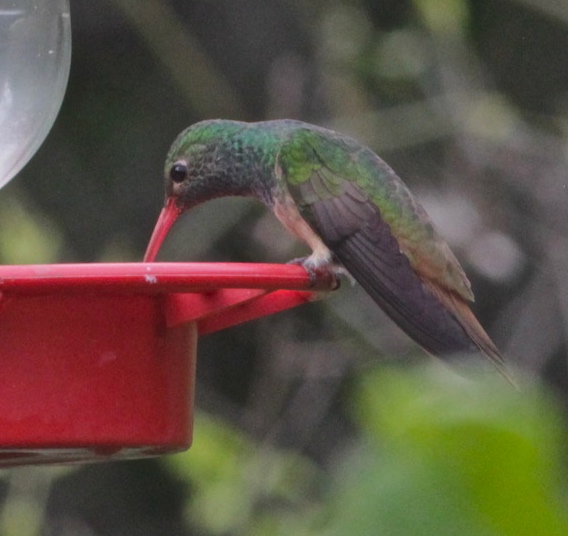
A Buff-bellied Hummingbird sips from a feeder in the Rio Grande Valley of Texas.*~*~*~*
An Energy Department study has found that the wildfires in the West affect not only the area where they occur but they fuel extreme weather in the other states as well.
*~*~*~*
In Alaska, billions of snow crabs have disappeared from the waters around the state and as a result, officials have canceled the snow crab season.
*~*~*~*
Twenty nations that are at high risk from climate change are considering halting repayments on their debts and plowing the money into conservation instead.
*~*~*~*
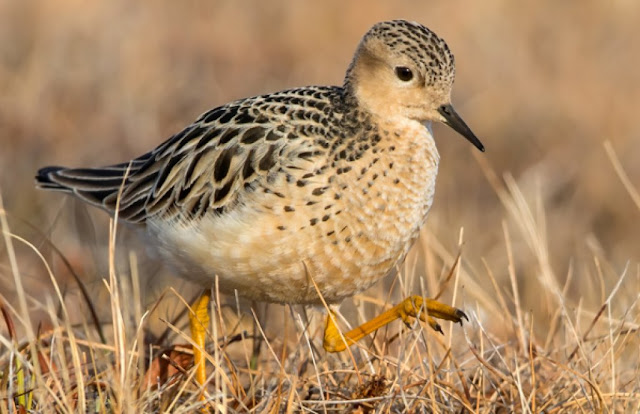
The American Bird Conservancy's Bird of the Week is the little Buff-breasted Sandpiper, a bird that once numbered in the millions but is now uncommon and its numbers are decreasing even further.*~*~*~*
The drought is causing such low water levels in the Mississippi River that ancient shipwrecks are being uncovered.
*~*~*~*
Climate change that makes precipitation and snow melt less predictable is forcing changes to the way of life in the Pacific Northwest.
*~*~*~*
The establishment of Hawaii's marine reserve area has proved to be a boon to overfished tuna populations and is helping them to recover.
*~*~*~*
The Biden administration is one step closer to making a massive West Coast wind farm a reality.
*~*~*~*
As their environment changes with the melting of glacial ice, bighorn sheep and mountain goats are finding themselves in competition for the same territory. It's a competition that the goats almost always win.
*~*~*~*
Here are some pictures of birds in early autumn on the Salish Sea.
*~*~*~*
Here's a strange phenomenon: It seems that Erect-crested Penguins on the Antipodes Islands in the South Pacific willingly abandon one-half of the eggs that they lay.
*~*~*~*
The Brazilian Amazon is being deforested to make way for cattle ranching.
*~*~*~*
When plans are made to combat the effects of climate change, too often the needs of people with disabilities are not considered.
*~*~*~*
North Dakota seems to be a treasure trove of mummified dinosaurs. It's a treasure trove that has long fascinated the public as well as paleontologists.
*~*~*~*
The wonderfully-named sarcastic fringehead fish is a creature to reckon with.
*~*~*~*
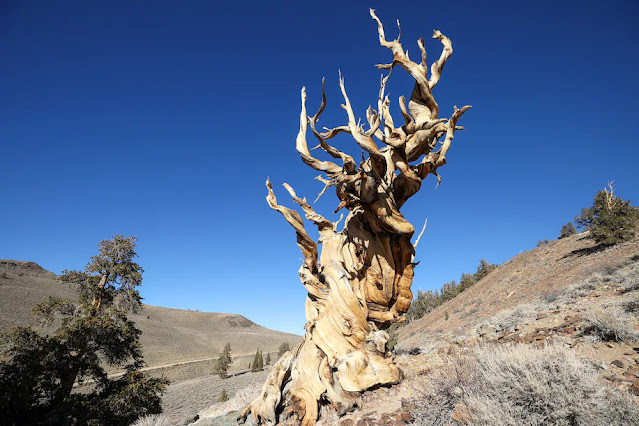
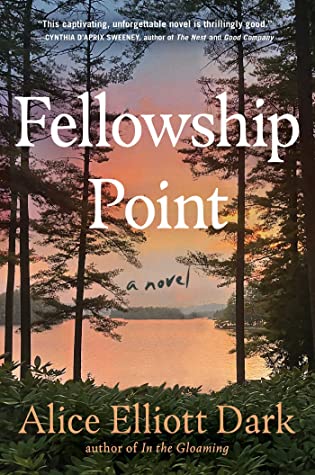
Is this Earth's oldest tree? It is a bristlecone pine that lives in the Inyo National Forest in California. These trees can live 5,000 years or more.Agnes is a successful author of children's books featuring a ten-year-old girl named Nan. She has never married and has no children of her own.
Polly is a traditional wife and mother of a son named James. James is keen to see Fellowship Point developed. Agnes and Polly are determined to see the place protected from such "progress."
The storyline of the novel involves a young editor named Maud from the publishing house that handles Agnes' books. Maud is a single mother to a daughter. She is very interested in Agnes' life story and approaches her about writing a memoir. Agnes is absorbed in her own health issues and in making sure that Fellowship Point is protected; she has little energy left over to think about writing a memoir.
A secondary character who plays an important role in the plot is a man named Robert who was unjustly, erroneously accused of robbery and assault and as a result, spent years in prison. All of these characters are deeply involved in the decision that is to be made about what will become of Fellowship Point.
Back in the late 1800s, Agnes' great-grandfather had purchased 145 acres on the Maine coast and named the place Fellowship Point. He built five houses for family and friends and also a sixth house for servants who would work for the families. Most of the land eventually was controlled by an association with specific rules about membership and dissolution. In the twenty-first century, the land came to the attention of a local developer who recognized possibilities for its commercial exploitation.
Alice Elliott Dark develops her story very slowly over almost six hundred pages of fiction. Honestly, there were moments when that story seemed a bit too slow and my interest would begin to flag, but then the writer would pull me right back in and I would keep turning those pages because I just had to see what was going to happen next to Agnes and Polly and Maud and Robert. I was completely invested in all of those characters and wanted to see how their stories would turn out, hoping all the while for the best for them.
This is only my second 5-star read for this year. (The first was Remarkably Bright Creatures by Shelby Van Pelt.) I can't say that this is necessarily the best-written book or the most original that I've read, but it was a book that I connected with from its first pages, and that connection stayed with me all the way to the end. What a pleasure it was to encounter it and spend time with its characters!
Autumn is my favorite time of year - although if you asked me next April, I might say that spring is. But no, I really do enjoy these months as the year is winding down and we finally have some reprieve from the heat of summer. Around here, we still have daytime temperatures that approach 90 degrees F on some days, but even on those days, there is a difference, a freshness in the air. John Keats knew and he described this time of year poetically and beautifully.
To Autumn
by John Keats
Season of mists and mellow fruitfulness,
Close bosom-friend of the maturing sun;
Conspiring with him how to load and bless
With fruit the vines that round the thatch-eves run;
To bend with apples the moss'd cottage-trees,
And fill all fruit with ripeness to the core;
To swell the gourd, and plump the hazel shells
With a sweet kernel; to set budding more,
And still more, later flowers for the bees,
Until they think warm days will never cease,
For summer has o'er-brimm'd their clammy cells.
Who hath not seen thee oft amid thy store?
Sometimes whoever seeks abroad may find
Thee sitting careless on a granary floor,
Thy hair soft-lifted by the winnowing wind;
Or on a half-reap'd furrow sound asleep,
Drowsed with the fume of poppies, while thy hook
Spares the next swath and all its twined flowers:
And sometimes like a gleaner thou dost keep
Steady thy laden head across a brook;
Or by a cider-press, with patient look,
Thou watchest the last oozings, hours by hours.
Where are the songs of Spring? Ay, where are they?
Think not of them, thou hast thy music too,--
While barred clouds bloom the soft-dying day,
And touch the stubble-plains with rosy hue;
Then in a wailful choir the small gnats mourn
Among the river sallows, borne aloft
Or sinking as the light wind lives or dies;
And full-grown lambs loud bleat from hilly bourn;
Hedge-crickets sing; and now with treble soft
The redbreast whistles from a garden-croft,
And gathering swallows twitter in the skies.
A roundup of the week's news of birds and the environment:
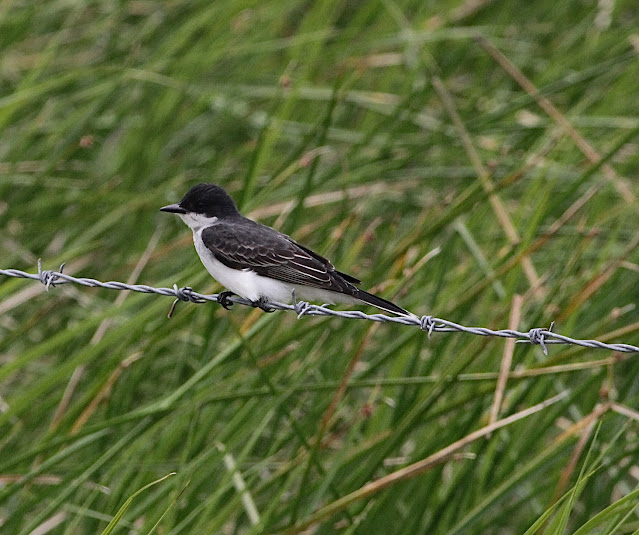
An Eastern Kingbird sits on a barbed wire fence.*~*~*~*
Since it is also Bloom Day, we'll just do an abbreviated roundup of environmental news this week.
*~*~*~*
Hurricane Ian cut a swathe up the eastern coast of the United States last month causing at least a billion dollars worth of damage in the process.
*~*~*~*
Lack of rainfall has caused water levels in the Mississippi River to become critically low, resulting in a number of barges being stranded causing shipping delays and a backlog of vessels.
*~*~*~*
The latest assessment of the world's wildlife found that populations had declined by an average of 69 percent since 1970.
*~*~*~*
The Denman glacier in east Antarctica is melting at an alarming rate of 70.8 tons a year due to the ingress of warm seawater.
*~*~*~*
Yet another alarming report on the environment documents the decline in gray whale numbers along the West Coast. Numbers are down nearly 40% just since 2016.
*~*~*~*
Here are some of the best wildlife pictures of the year.
*~*~*~*
A loophole that was created in the final months of the previous president's term is allowing chemical companies to dodge the federal law designed to track how many PFAS "forever chemicals" they discharge into the environment.
*~*~*~*
Five California tribes will reclaim their right to manage coastal land significant to their history under a first-in-the-nation program backed by state money.
*~*~*~*
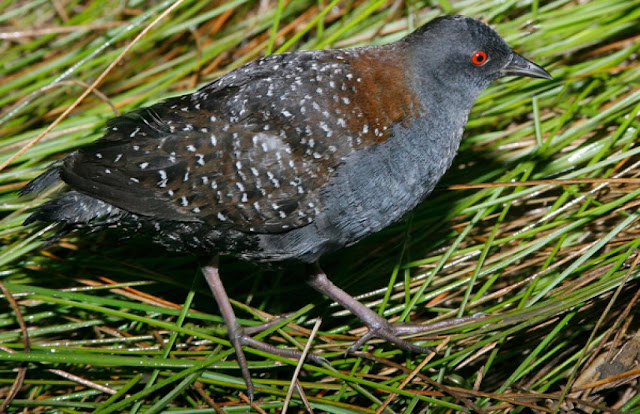
This is the Black Rail, the American Bird Conservancy's Bird of the Week. It's the smallest of all North American rails and it is endangered.*~*~*~*
The removal of a century-old dam in California has had many benefits for the environment and has resulted in endangered species being found in Mill Creek for the first time since the removal.
*~*~*~*
A highly contagious strain of avian influenza has broken out in the central part of the country and threatens to spread with fall migration.
*~*~*~*
Are monarch butterflies truly endangered? It turns out that the answer to that question may be complicated.
There's not much to show you from my zone 9 garden here in Southeast Texas on this October Bloom Day. We are in an extended period of drought stretching all the way back into mid-summer and that has been very hard on my plants. I haven't provided much supplemental water, having decided to let the plants make it or not on their own. And they are making it but they are in survival mode which doesn't leave much energy for blooms.
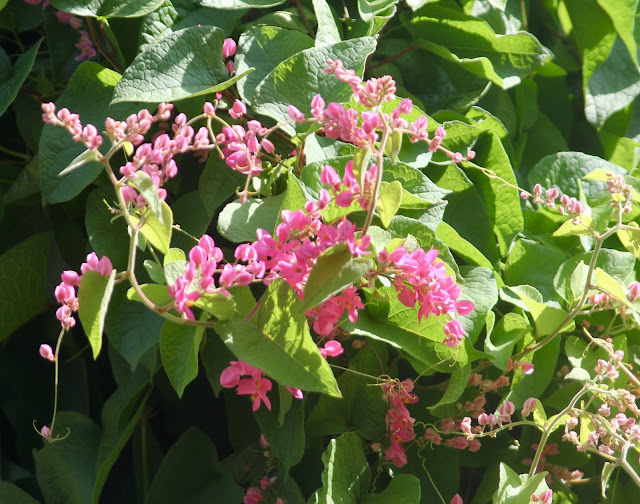
Coral vine might be an exception to that; it seems to have more than enough energy for blooms.Turk's Cap blooms are not very showy but there are plenty of them.The almond verbena blooms also are fairly unobtrusive unless you have a sense of smell in which case you will never be able to ignore their sweet fragrance.The yellow cestrum does not seem to be bothered by the lack of rain.The American beautyberry bloomed profusely and now is full of colorful berries which don't last too long because the birds love them.Blue plumbago is a dependable bloomer regardless of the weather.Justicia 'Orange Flame' is another tough bloomer.If it is autumn, then the autumn sage must be in bloom. This one is a bit past its prime.The Duranta erecta is another bloomer that seems impervious to the weather.And, of course, if it is October then the "Naked Ladies" (red spider lilies) must be showing their stuff.These tough old plants gladden my heart with their blooms every time I walk into the garden. I only hope that their toughness will soon be rewarded by a plentiful amount of autumn rain.
As always, a thank you to Carol of May Dreams Gardens for this monthly meme. Happy Bloom Day!
We also learn that Faye and Joe have established a new archaeological firm and that their firm has just been selected for a project in America's oldest city, St. Augustine, Florida. Four hundred years have given the city a lot of history and a lot of artifacts and skeletons to explore, and Faye is eager to get on with that exploration.
But soon after Faye's arrival on the scene, a woman from the archaeological team disappears. A trail of blood at the scene fuels fears for the woman's safety and her survival. The scene is also littered with priceless artifacts, and the detective in charge of the case hires Faye as a consultant to discover their origin. The plot thickens when, two days after the woman disappears, her boyfriend's body is found floating in the Matanzas River. His throat had been slashed.
Among the artifacts that Faye discovers is the diary of a priest who had left Spain in 1565 and was present at the founding of the city of St. Augustine. She sets about translating the diary. Her translation is intermingled with the telling of present-day events. The story is presented in rotating chapters from the present day and then a chapter of the translated diary. Over the course of the book, this adds clarity and depth to the story.
Quite a bit of the history of St. Augustine is interwoven into this story and I found that particularly illuminating. It definitely gave an extra dimension to the plot. Moreover, Faye and Joe are both interesting and likable characters and it is easy to root for them and to experience events through their eyes. This is a well-written series and I especially like the archaeological angle since archaeology has always been a keen interest of mine. I look forward to reading more about Faye and Joe and their exploits.
Now is the time when the woods are at their most colorful. The trees are in their glory, showing off brighter colors after a summer of wearing green. It doesn't last long; enjoy it while it does.
In October
by Bliss Carman
Now come the rosy dogwoods,A roundup of the week's news of birds and the environment:
I photographed this Cactus Wren on a trip to West Texas a couple of years ago.*~*~*~*
This is not really a surprise: Climate change is making summers hotter and drier, exacerbating the drought that is affecting wide areas at the moment.
*~*~*~*
In the southwestern United States, the long-lasting megadrought may bring an end to the farming/ranching way of life that has long been so much a part of the culture of the area.
*~*~*~*
But in another part of the world, the problem isn't drought but monsoon; climate change is increasing the rainfall and making the phenomenon less predictable.
*~*~*~*
In this country, the conservative-packed Supreme Court seems bent on destroying the meager protections for the environment that have been in place. They appear likely to take their scissors to the Clean Water Act, one of the basic protections holding back the developers. What will be left after their hacking away at it?
*~*~*~*
The American Bird Conservancy's Bird of the Week is the little Yellow-bellied Sapsucker. It nests throughout the northern regions of the continent and winters throughout much of the southern half.
Four women in or nearing their sixties have worked since the 1970s as assassins for an international clandestine organization that is never actually named but which they refer to as "The Museum." They are now ready to retire and in celebration of that event, their employing organization has sent them on an all-expenses-paid cruise. When they discover that someone else from that organization is with them on the ship and is traveling clandestinely in disguise, they begin to suspect that the Museum has decided to retire them permanently. Have they really become expendable now that they are of "a certain age"? Now the four must use all their skills to ferret out anyone who is sent to dispose of them and to turn the tables on their would-be killers. That, in a nutshell, is the basis of the plot of Deanna Raybourn's book, Killers of a Certain Age.
The story is told mainly through the point of view of one of the women, named Billie, but we also get some flashbacks of the other women (Mary Alice, Helen, and Natalie) and how they each came to be recruited and become a part of this company of assassins. They are each quite extraordinary characters and quite likable despite their deadly profession.
Deanna Raybourn plots her story well and writes an engaging and entertaining tale with a lot of wit and humor. Even though this is a story of assassins, her focus is actually on the friendship of the women and their connections with each other. She also makes a point about the invisibility of older women. Who pays any attention to an old woman poking around a place, maybe even into areas where she has no business going? She's just an old lady after all; what possible harm can she do?
Well, if she's a trained killer - and maybe even if she isn't - old women can definitely be a force to be reckoned with. I appreciate that message that this book delivers with a dry wit, maybe because I am an old woman myself. Readers of a mature age will have no difficulty at all identifying with these characters and cheering them on as they set out to prove that they are still at the top of their game. Those readers will surely want them to prove their point for all of us at "a certain age."
Forsaken Country is the sixth entry in a series featuring Minnesota detective Max Rupert. I had not read the earlier books which might have been helpful to orient me in the "country" of this story, but I managed to get the gist of Rupert's backstory, enough to get a sense of what makes him tick.
The most salient fact of his life is that he is a widower whose wife had been murdered and he is still mourning her. He had tracked down her murderer and disposed of him and left behind his career as a Minneapolis homicide detective to go live in his cabin in the woods. He's just on the verge of becoming an actual hermit and thinking that that might be a very good idea when his friend, Lyle, - maybe his only friend - contacts him to ask for his help.
Lyle's daughter Sandy and his six-year-old grandson Pip have gone missing. Sandy had an acrimonious relationship with her ex-husband, Pip's father, and Lyle suspects that their disappearance is his work. But he can't get the local sheriff to take any action to investigate and he reaches out to Max to request him to get involved.
Upon making inquiries, Max becomes convinced that Lyle is correct in his suspicions. He and Lyle begin tracking the ex-husband Reed to try to find Sandy and Pip. As he realizes that Max and Lyle are on his trail, Reed makes a break for the Boundary Waters, a 1.3 million acre wilderness, with Pip in tow. How will two old men ever be able to catch up to Reed and rescue Pip?
What follows then is essentially a race for the Canadian border as the men attempt to find Reed and Pip and figure out how to retrieve the child without causing him injury. As one reads the description of the wilderness through which they must search, one can appreciate how daunting such a task would be but Allen Eskens manages to find a way for his protagonist to power through and succeed in that seemingly impossible task.
I had read and enjoyed one other book by Eskens, Nothing More Dangerous, in 2020, so when I saw this new one of his on Goodreads, I decided to give it a read. I'm glad I did. It did not disappoint.
Can it really be October already? It scarcely seems possible and yet here we are. In places that have trees that actually change color at this time of year, it is probably more evident. Around here, the trees are mostly still green and the temperatures still flirt with the 90 degrees F every day. And yet...
There is that perceptible change in the air, especially in the early morning and late afternoon. It's highly unlikely that frost will "turn her auburn locks to gray" around here in October; that's her specialty a bit farther north. But we can feel a welcome change nevertheless and there is a rumor that winter is coming.
October
by Paul Dunbar
October is the treasurer of the year,
And all the months pay bounty to her store;
The fields and orchards still their tribute bear,
And fill her brimming coffers more and more.
But she, with youthful lavishness,
Spends all her wealth in gaudy dress,
And decks herself in garments bold
Of scarlet, purple, red, and gold.
She heedeth not how swift the hours fly,
But smiles and sings her happy life along;
She only sees above a shining sky;
She only hears the breezes' voice in song.
Her garments trail the woodlands through,
And gather pearls of early dew
That sparkle, till the roguish Sun
Creeps up and steals them every one.
But what cares she that jewels should be lost,
When all of Nature's bounteous wealth is hers?
Though princely fortunes may have been their cost,
Not one regret her calm demeanor stirs.
Whole-hearted, happy, careless, free,
She lives her life out joyously,
Nor cares when Frost stalks o'er her way
And turns her auburn locks to gray.