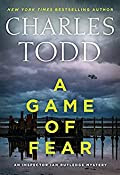
The time is the spring of 1921. As we are reminded at one point in the book, Inspector Ian Rutledge, the World War I veteran, is still quite a young man in his twenties. His superior at Scotland Yard is still the odious Chief Superintendent Markham who despises and is jealous of him and takes every opportunity to give him assignments that have a high potential for failure. In this case, the assignment is to go to the small village of Walmer in Essex and find a killer who is a ghost.
The ghost is one Captain Roger Nelson who was killed in the recent war, but Lady Felicia Benton who is herself a war widow and who knew Captain Nelson claims that as she stood by a window of her manor house she witnessed him kill someone. No body has been found and the local police are understandably skeptical about her story. But Lady Felicia is a relative of the Chief Constable of Scotland Yard and so Rutledge is dispatched to sort it all out.
What he finds in Walmer is a set of mysteries all surrounding what was once a busy airfield housing airmen and support staff for the RAF. Lady Felicia lives in a house that was formerly an abbey located next to the airfield. She had entertained many of the airmen in her home during the war. Rutledge finds her to be a sensible woman of sound mind and not likely to have imagined the crime that she reported. He seeks other explanations for what happened and soon finds them.
He is approached by a woman whose son, a local boy, had disappeared during the war, never to be accounted for. Several people in the community also reported having seen a ghost during the war who foretold the deaths of pilots. A bunch of kids had reported something at the old airfield before it was torn down, something that has scared them into silence. Mysteries seem to abound in this remote village and an entire shoal of red herrings swims around the place muddying the waters.
There are many dead-end leads that confuse things and Rutledge keeps getting redirected to other places. He's back and forth to London and finally is sent to France to follow an obscure lead. And every time he gets sidetracked, it seems that something terrible happens. Moreover, there is a side plot concerning Rutledge's attraction to Kate Gordon which has been hinted at now in a couple of the books, and the reader wonders if this is actually finally going somewhere. We also learn in the last chapter that Rutledge is being promoted to Chief Inspector, a prospect that appalls the odious Markham.
Maybe I was subliminally affected by the knowledge that half of the writing team had died while the book was being prepared, but I felt that its plot was really scattered and all over the place. The action just seemed to jump around without any clear plan in mind. Even though in the end all the clues came together and the solution was explained, the whole thing felt awkward and forced. Certainly not the best effort in this very long series.
My rating: 3 of 5 stars
Sorry this wasn't better for you. I only read one book by this duo; it was about 10 years ago and I didn't love it so never read more.
ReplyDeleteIt was okay but it suffered a bit in comparison to other books in the series.
DeleteI loved the earliest books in this series and continue to like Rutledge. I haven't read many of the later books, although I did read one recently. I've noticed a couple of series by dual authors that simply can't achieve the same quality if one partner dies.
ReplyDeleteI've always liked the character of Rutledge as well and that is why I've continued reading the series. I don't know if the son intends to continue with the series, now that his partner is gone, although I would assume that he will.
DeleteThat's so sad about his mom. I've never actually read any of this series, but I've read and enjoyed some of their Bess Crawford mysteries.
ReplyDeleteAnd I'm just your opposite - I've never read the Bess Crawford books but I might get to them one of these days.
DeleteIt's too bad that half of the writing team has passed away. I wonder what will happen next. It's not a good sign that you were disappointed with this one.
ReplyDeleteI suspect that the fact that the mother may have been ill during the writing of this one affected it. We'll see if the son continues the series and how that might work out.
DeleteThat's too bad that this one did not live up those that came before. I can see how that would happen, if one of the team is suddenly no longer there.
ReplyDeleteShe was still alive during the writing of the book, but, obviously, she may not have been at her best.
Delete