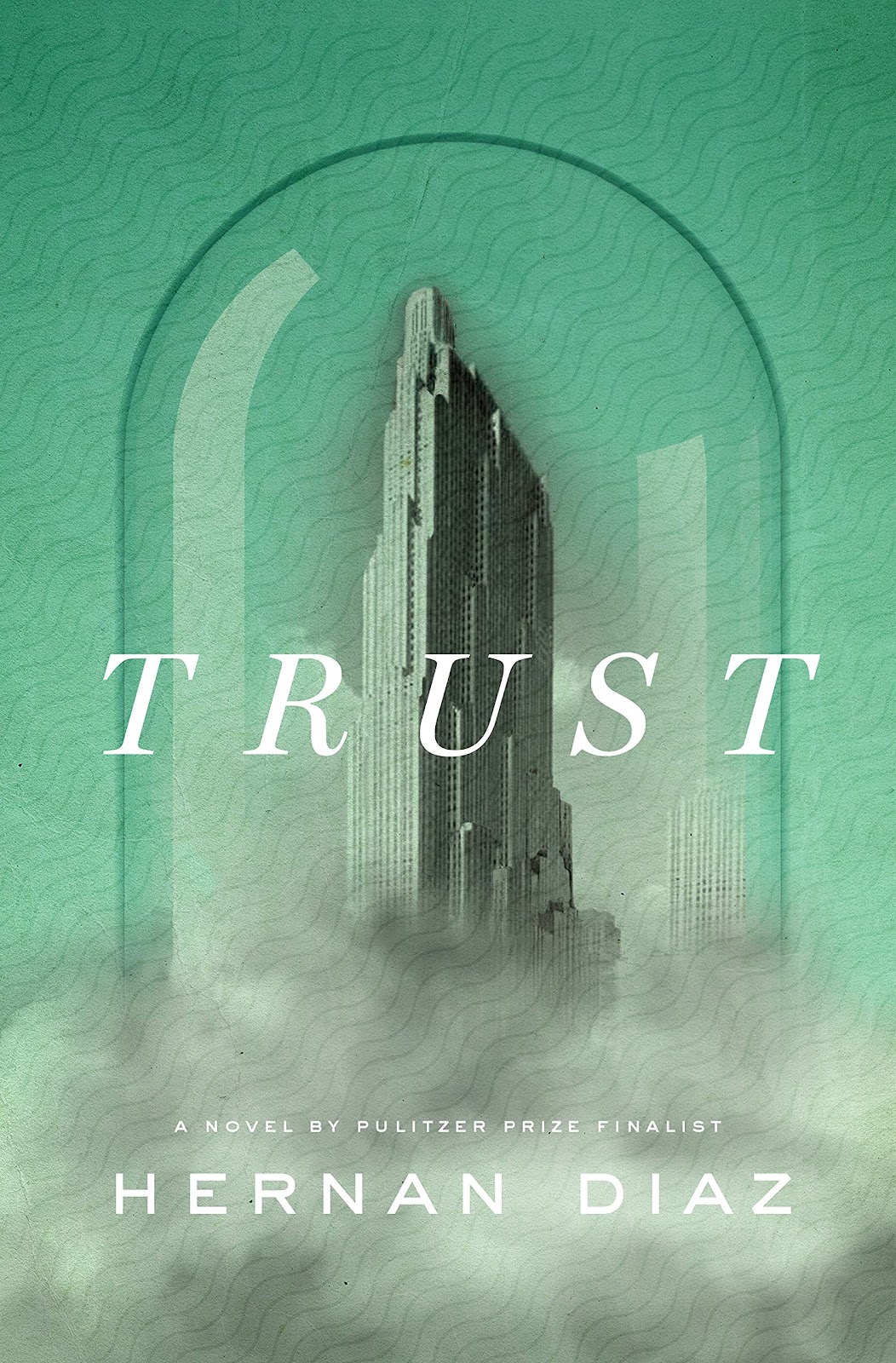
Trust by Hernan Diaz: A review

I finished reading this book a few days ago and, at the time, gave it a three-star rating. But when I sat down at my keyboard tonight to try to review it, I found I was completely blank. I couldn't remember the book. Maybe that three-star rating was a bit generous??? 

In the end, I had to refer to the Goodreads synopsis of the book to jog my memory and to try to recall why I had awarded it three stars. Not a very auspicious beginning for a book review.

I think the problem may have been not so much the book or the writing but simply that I was distracted by other things while I was reading. Sometimes a book can take one out of his/her distraction and focus attention but that proved to be difficult for me in this instance.

Anyway, bearing that caveat in mind, these are my best recollections of and reactions to Hernan Diaz's book.

The book is set primarily in the Roaring '20s in New York with some side trips to Europe. It is the story of a prominent financier Benjamin Rask and his wife Helen. Benjamin is a legend on Wall Street and Helen is the daughter of eccentric aristocrats. They seem to possess unlimited wealth and as such, are prime targets of envy and gossip. 

The book is divided into four parts. The first part is a novel within the novel by an author named Harold Vanner. The second is a short memoir by a financier named Andrew Bevel. In the third, a woman named Ida Partenza tells of her time working with Andrew Bevel to compile his memoirs. And, finally, the fourth section comprises journal entries for Mildred Bevel, the wife of Andrew. The plot centers on the world of finance in the late 1800s and up to about the mid-twentieth century. 

I think my main problem with the book was that I just couldn't get into that novel within the novel and I couldn't really make any connection to any of the characters. I couldn't really make myself care much about what happened to any of them. The shifting relationships and the slow reveal of the multiple layers of the story just left me somewhat confused and not really willing to make the effort to sort it all out. So, yes, maybe three stars were a bit generous, but it was my initial reaction and I'll let it stand.  
 

Comments

  1. I saw this one for sale at the little bookshop at the Galveston library yesterday. I have read several reviews of this book and all of them came away from the book with a meh rating. Maybe it has been overhyped and that ramped up what we were hoping to take away from the book.

    ReplyDelete
    Replies
    1. I had seen positive comment about the book and had looked forward to reading it, so I was a bit disappointed to find that it didn't live up to my expectations for it.

      Delete
  2. Never a good sign when you can't remember much about a book only days after you finish reading it! ;D When that happens to me I know I was either very tired when I read it, or the book was very unmemorable.

    ReplyDelete
  3. I read Trust last year and gave it three stars on Goodreads, too (I don't publish reviews). I found the concept of the book interesting but the execution somewhat lacking. I interpreted as a story told from four angles, so in a way, four different truths. Which one could you trust? The only story I really got into was the last one, the viewpoint of the financier's wife as her health declined, and maybe that was the story one could trust the most. But, like you, I struggled to understand why it got so many glowing reviews.

    ReplyDelete
    Replies
    1. Exactly. I just felt that I had missed something that every other reader got from it, so it is comforting to hear that I wasn't the only one!

      Delete
  4. Ohh good to know. Perhaps I will take this one off my list. I had started it last year and put it down when it wasn't grabbing me but thought I might try it again. Perhaps it's too much finance? The first part seemed very dry.

    ReplyDelete

Post a Comment

Popular posts from this blog

Poetry Sunday: Don't Hesitate by Mary Oliver

How about we share another Mary Oliver poem? After all, you can never have too many of those. In this one, the poet seems to acknowledge that it is often hard to simply live in and enjoy the moment, perhaps because we are afraid it can't last. She urges us to give in to that moment and fully experience the joy. Although "much can never be redeemed, still, life has some possibility left." Don't Hesitate by Mary Oliver If you suddenly and unexpectedly feel joy, don’t hesitate. Give in to it. There are plenty of lives and whole towns destroyed or about to be. We are not wise, and not very often kind. And much can never be redeemed. Still, life has some possibility left. Perhaps this is its way of fighting back, that sometimes something happens better than all the riches or power in the world. It could be anything, but very likely you notice it in the instant when love begins. Anyway, that’s often the case. Anyway, whatever it is, don’t be afraid of its plenty. Joy is no...

Poetry Sunday: Hymn for the Hurting by Amanda Gorman

You probably remember poet Amanda Gorman from her appearance at the inauguration of President Biden. She read her poem "The Hill We Climb" on that occasion. After the senseless slaughter in Uvalde this week, she was inspired to write another poem which was published in The New York Times. It seemed perfect for the occasion and so I stole it in order to feature it here, just in case you didn't get a chance to read it in the Times . Hymn for the Hurting by Amanda Gorman Everything hurts, Our hearts shadowed and strange, Minds made muddied and mute. We carry tragedy, terrifying and true. And yet none of it is new; We knew it as home, As horror, As heritage. Even our children Cannot be children, Cannot be. Everything hurts. It’s a hard time to be alive, And even harder to stay that way. We’re burdened to live out these days, While at the same time, blessed to outlive them. This alarm is how we know We must be altered — That we must differ or die, That we must triumph or try. ...

Poetry Sunday: Blackberry-Picking by Seamus Heaney

My mother was a farm wife and a prodigious canner. She canned fruit and vegetables from the garden, even occasionally meat. But the best thing that she canned, in my opinion, was blackberry jam. Even as I type those words my mouth waters!  Of course, before she could make that jam, somebody had to pick the blackberries. And that somebody was quite often named Dorothy. I think Seamus Heaney might have spent some time among the briars plucking those delicious black fruits as well, so he would have known that "Once off the bush the fruit fermented, the sweet flesh would turn sour." They don't keep; you have to get that jam made in a hurry! Blackberry-Picking by Seamus Heaney Late August, given heavy rain and sun For a full week, the blackberries would ripen. At first, just one, a glossy purple clot Among others, red, green, hard as a knot. You ate that first one and its flesh was sweet Like thickened wine: summer's blood was in it Leaving stains upon the tongue and lust ...