
This week in birds - #534

 A roundup of the week's news of birds and the environment:
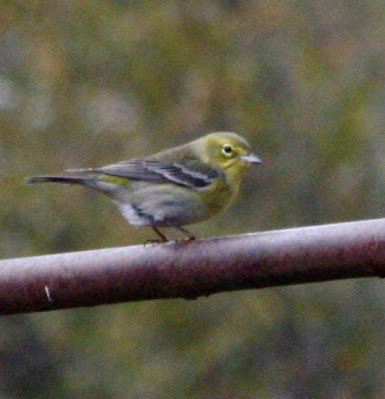
One of my favorite winter visitors - the Pine Warbler.

*~*~*~*

Dust that billows up from desert storms and arid landscapes is helping to cool the planet and may be obscuring the true extent of global warming caused by fossil fuel emissions.

*~*~*~*

California has suffered years of ongoing drought and even though it has recently received an abundance of snow and rain, it's not enough to make up for the years of drought. But many Californians are trying to find ways to hang onto the recent deluge.

*~*~*~*

A study of southern resident orcas off British Columbia has found that they have appallingly high levels of a "forever chemical" in their bodies.

*~*~*~*

The combined effects of a hydroelectric dam and earth-shifting livestock have altered the landscape in northern Brazil and have upended people's lives there.

*~*~*~*

The largest animal ever to exist on Earth is the blue whale. How did this titanic creature get to be so big?

*~*~*~*

Beavers are famed for building dams, but why do they do it?

*~*~*~*

A recent study has revealed that a fossil flower preserved in amber had been given a mistaken identity for 150 years.

*~*~*~*

Traditional lawns have lost some of their popularity recently because of their lack of biodiversity and their voracious appetite for fertilizer, herbicides, and mowing. Maybe trees are a better option.

*~*~*~*

Here are some amazing wildlife pictures from the past week.

*~*~*~*

'Fairy circles' are a mystery that has puzzled scientists for decades but they may be just a bit closer to solving that mystery.

*~*~*~*

This is a Sprague's Pipit, a bird of the grasslands of North America, and the American Bird Conservancy's Bird of the Week.

*~*~*~*

The Greenland ice is melting as parts of the island are hotter now than they have been at any time in the past 1,000 years.

*~*~*~*

The rare Rice's whale lives in the Gulf of Mexico and environmentalists fear it is facing extinction unless tougher oil and gas restrictions are implemented to protect it. 

*~*~*~*

It might be called "The Case of the Missing Claws." Why were some grizzly bears missing toes?

*~*~*~*

Oyster mushrooms would seem to be harmless denizens of the forest but it turns out they can be deadly for nematodes. They devour them! 

*~*~*~*

For beekeepers trying to protect their colonies from the deadly disease known as American foulbrood, there is new hope. It is the world's first vaccine for honeybees.

*~*~*~*

On Poland's Oder River, one man has found a way to protect native species from invasives like American minks and raccoons. He constructs predator-proof islands for the birds.

*~*~*~*

The plague that struck black-tailed prairie dogs in 2017 caused a huge die-off of that species, but it had consequences for other species as well.

*~*~*~*

The southern tip of South America is sometimes referred to as "the end of the world." But even there you will find birds.

*~*~*~*

The glow from artificial lighting on Earth is reducing the number of stars that are visible to the naked eye.

*~*~*~*

Moose are not supposed to be blond and yet here one is. It was recently spotted during an aerial survey in Alaska.

*~*~*~*

As global temperatures continue to be pushed higher by carbon emissions, scientists say by the end of the century the extreme heat could put 40% of land vertebrates in danger of extinction.  

*~*~*~*

A find of ten mummified crocodiles in an Egyptian tomb is shedding light on ancient mummification practices and on the lives of those who lived in the necropolis. 

*~*~*~*

A previously unknown colony of Emperor Penguins has been discovered using satellite images of one of the most remote and inaccessible regions of Antarctica. 

*~*~*~*

In the state of Washington, the Columbia Basin pygmy rabbit is the world's smallest bunny and it is endangered. Scientists are working on ways to protect and preserve it.

*~*~*~*

Here is the roll call of the dead: the species that were declared extinct in 2022.


Comments

  1. It's terribly sad to see photos of the species that are no longer with us. Extinct. It is tragic.

    I love seeing the occasional Pine Warbler here. Yesterday I was delighted to see a Ruby-crowned Kinglet in my backyard.

    ReplyDelete
    Replies
    1. The kinglets are indeed delightful. Always busy. I love watching them.

      Delete
  2. Thanks for the roundup as always, Dorothy. Sorry to be late coming to the party but I am visiting my daughter in Ottawa and we are busy! Right now an eager grandson and an equally eager dog are anxious to go for a walk in the snow. Back to normal next weekend!

    ReplyDelete
    Replies
    1. Snow...oh, yes! I remember that. The white stuff, right? Enjoy your walk and your grandson.

      Delete
  3. The more I read, the more I realize how everything on this planet is connected. We all need each other to survive and thrive.

    ReplyDelete

Post a Comment

Popular posts from this blog

Poetry Sunday: Don't Hesitate by Mary Oliver

How about we share another Mary Oliver poem? After all, you can never have too many of those. In this one, the poet seems to acknowledge that it is often hard to simply live in and enjoy the moment, perhaps because we are afraid it can't last. She urges us to give in to that moment and fully experience the joy. Although "much can never be redeemed, still, life has some possibility left." Don't Hesitate by Mary Oliver If you suddenly and unexpectedly feel joy, don’t hesitate. Give in to it. There are plenty of lives and whole towns destroyed or about to be. We are not wise, and not very often kind. And much can never be redeemed. Still, life has some possibility left. Perhaps this is its way of fighting back, that sometimes something happens better than all the riches or power in the world. It could be anything, but very likely you notice it in the instant when love begins. Anyway, that’s often the case. Anyway, whatever it is, don’t be afraid of its plenty. Joy is no...

Poetry Sunday: Hymn for the Hurting by Amanda Gorman

You probably remember poet Amanda Gorman from her appearance at the inauguration of President Biden. She read her poem "The Hill We Climb" on that occasion. After the senseless slaughter in Uvalde this week, she was inspired to write another poem which was published in The New York Times. It seemed perfect for the occasion and so I stole it in order to feature it here, just in case you didn't get a chance to read it in the Times . Hymn for the Hurting by Amanda Gorman Everything hurts, Our hearts shadowed and strange, Minds made muddied and mute. We carry tragedy, terrifying and true. And yet none of it is new; We knew it as home, As horror, As heritage. Even our children Cannot be children, Cannot be. Everything hurts. It’s a hard time to be alive, And even harder to stay that way. We’re burdened to live out these days, While at the same time, blessed to outlive them. This alarm is how we know We must be altered — That we must differ or die, That we must triumph or try. ...

Poetry Sunday: Blackberry-Picking by Seamus Heaney

My mother was a farm wife and a prodigious canner. She canned fruit and vegetables from the garden, even occasionally meat. But the best thing that she canned, in my opinion, was blackberry jam. Even as I type those words my mouth waters!  Of course, before she could make that jam, somebody had to pick the blackberries. And that somebody was quite often named Dorothy. I think Seamus Heaney might have spent some time among the briars plucking those delicious black fruits as well, so he would have known that "Once off the bush the fruit fermented, the sweet flesh would turn sour." They don't keep; you have to get that jam made in a hurry! Blackberry-Picking by Seamus Heaney Late August, given heavy rain and sun For a full week, the blackberries would ripen. At first, just one, a glossy purple clot Among others, red, green, hard as a knot. You ate that first one and its flesh was sweet Like thickened wine: summer's blood was in it Leaving stains upon the tongue and lust ...