Translate

Saturday, July 30, 2022

Poetry Sunday: Fireflies by Frank Ormsby

I well remember the summers of my childhood when I played outside until dark and my mother had to call me in. I loved that time of day and one of the things I loved best about it was the fireflies. We lived in the country and there were always plenty of fireflies around in those days. Today I live in the suburbs of the country's fourth largest city and I seldom see fireflies. I don't know if that is a function of where I live or if fireflies have become that much scarcer. Both perhaps.

Frank Ormsby remembers fireflies, too, and he wrote a poem to celebrate them.

Fireflies

by Frank Ormsby

The lights come on and stay on under the trees.
Visibly a whole neighborhood inhabits the dusk,
so punctual and in place it seems to deny
dark its dominion. Nothing will go astray,
the porch lamps promise. Sudden, as though a match
failed to ignite at the foot of the garden, the first squibs
trouble the eye. Impossible not to share
that sportive, abortive, clumsy, where-are-we-now
dalliance with night, such soothing relentlessness.
What should we make of fireflies, their quick flare
of promise and disappointment, their throwaway style?
Our heads turn this way and that. We are loath to miss
such jauntiness in nature. Those fugitive selves,
winged and at random! Our flickery might-have-beens
come up from the woods to haunt us! Our yet-to-be
as tentative frolic! What do fireflies say?
That loneliness made of light becomes at last
convivial singleness? That any antic spark
cruising the void might titillate creation?
And whether they spend themselves, or go to ground,
or drift with their lights out, they have left the gloom,
for as long as our eyes take to absorb such absence,
less than it seemed, as childless and deprived
as Chaos and Old Night. But ruffled, too,
as though it unearthed some memory of light
from its long blackout, a hospitable core
fit home for fireflies, brushed by fireflies' wings.

Friday, July 29, 2022

This week in birds - #511

A roundup of the week's news of birds and the environment

A Sora picks its way among the reeds along the Gulf. Note those long toes that help the bird gains purchase through an uneven environment.

*~*~*~*

The world of Nature lost a champion this week with the death of James Lovelock who died on his 103rd birthday. Lovelock was the author of the Gaia Theory which posited Earth as a self-sustaining entity.

*~*~*~*

A deadly heatwave is taking a heavy toll on wildlife in the U.K.

*~*~*~*

Cutting trees to save a forest certainly sounds counter-intuitive but that is what is happening in Yosemite National Park.

*~*~*~*

Some of the fastest-growing cities in the country could become unlivable as a result of climate change.

*~*~*~*

Remember all the kerfuffle about "murder hornets" in the Northwest a few years ago? Well, those critters have a new name. They are now "Northern giant hornets." That doesn't sound nearly as intimidating, does it?  

*~*~*~*


Brown Pelicans were once on the edge of extinction but reports of their demise proved premature. They have made a comeback but they are still not home free.

*~*~*~*

Recent attacks on humans by a macaque in western Japan resulted in the marauder being killed but as the macaque population grows, more clashes with humans are likely.

*~*~*~*

In Norway, a charismatic walrus named Freya is sinking boats and causing a bit of mayhem. As a result, she has become something of a tourist spectacle.

*~*~*~*

The Bureau of Land Management is allowing 1.5 million cattle to graze on federal land and scientists fear that overgrazing will deteriorate the land's ability to store carbon.

*~*~*~*

This is the Crested Honeycreeper, or ‘Ä€kohekohe, a Hawaiian native that is the American Bird Conservancy's Bird of the Week.

*~*~*~*

The world's oldest pot plant dates back to 1775. It is a giant cycad that lives in Kew Gardens in London.

*~*~*~*

A map of Europe that shows the location of deadly wildfires in recent weeks could give one the impression that the entire continent is ablaze.

*~*~*~*

Can gardening save the world? If it can help save New York City, then perhaps it can. After all, if it can make it there, it can make it anywhere.

*~*~*~*

Plastic may be changing the whole food web. It seems that it is turbocharging the growth of bacteria which may impact the entire food chain.

*~*~*~*

Here is some good news about twelve ways that President Biden is using governmental power to help protect the environment

*~*~*~*

One of Japan's most active volcanoes, Sakurajima on the southwestern island of Kyushu, erupted again last Sunday night.

*~*~*~*

Here's a story about banding birds in Yosemite Park.

*~*~*~*

Yosemite was threatened by a huge wildfire this week and thousands of people had to evacuate the area. More than 14,200 acres burned.

*~*~*~*

The Biden administration has plans to plant more than one billion trees over burned and dead woodlands in the West.

*~*~*~*

Here's a mystery for you: The floor of the Atlantic Ocean has holes in it and scientists have no idea why.

*~*~*~*

The U.K. is being invaded by non-native plants and that is not a good thing.

*~*~*~*

Crustaceans may be the "bees of the sea." They assist in the pollination of seaweed.

*~*~*~*

Fish poop may have many unexpected benefits to the environment. One of them is helping coral overcome bleaching

Wednesday, July 27, 2022

Unraveled by Reavis Z. Wortham: A review


Reavis Wortham is an author who is new to me but he has written a number of books including those in the Red River mystery series. This book was the sixth in that series and even though I had not read any of the earlier books, I did not feel at all lost or confused by the action in this one.

The series is set in the (fictional) Northeast Texas community of Center Springs and the time is 1968, so I guess this would qualify as a historical mystery. The action kicks off when a car carrying the White mayor and one of his office employees who is Black plunges through a guard rail in a tight curve on Highway 271. The two occupants of the car are flung down the new Lake Lamar Dam and are killed. Each of the victims was married to other people and the community senses a scandal in their being in a car together. No one knows where they were going or what they were doing together.

All of this is viewed through the eyes of a White fourteen-year-old boy named Top Parker who lives with his grandparents in a little house near Red River. Top's grandfather is Constable Ned Parker, a man with a lot of common sense. Interestingly, there is a Black deputy named John Washington who seems universally respected in the community and there is also a female deputy! (In 1968 rural Texas? I don't think so, but then this is fiction.)

Top has a friend and cousin named Pepper.  I'm sure their relationship harks back to the earlier books that I haven't read, but Wortham does a really good job of establishing their emotional connection and bringing those of us who have not read the earlier books up to speed. They are well-drawn characters who seem to run around just being kids and they are easy to like.

The plot here involves a traveling carnival, racism, and a family feud that has smoldered for years. Two deaths threaten to spark the smoldering into a full-blown fire. 

This was a quick and easy read. Once I got into the book, it held my interest and I found it hard to put down. Wortham does a good job of describing rural northeast Texas, a place I have some familiarity with. There are now eight books in this series and I believe more are probably in the works. But I think I might actually go back and read some of the earlier ones as well. They are undemanding, the characters are believable, and the writing overall is quite good.    

Monday, July 25, 2022

Phantom Prey by John Sandford: A review

I've read a few of the books in this series, four I think prior to this one, but it's been a while since I read one and I didn't have a real firm grasp of the Lucas Davenport story. I remembered that he was from Minnesota and that he was a detective in a crime detection state agency there. And that was about it. So I came to Phantom Prey with no particular pre-conceived expectations.

In this one, Alyssa, a woman friend of Weather, Davenport's wife, arrives home to find that her home security system had been disarmed and there are bloodstains on the wall of her kitchen. She expected her daughter, Frances, and her housekeeper, Helen, to be there, but the house is empty. There's no clue where the two have gone or where they might be. The housekeeper does finally show up but Frances remains missing.

The other thing is that there was a lot of blood in the kitchen and testing reveals that it is Frances' type. The case becomes a missing person investigation but there is an underlying belief that she is probably dead. The police seem to be making no progress on the case, so Alyssa contacts her friend Weather and requests that she ask her husband to get involved in the investigation. Lucas doesn't have much on his plate at the moment and probably welcomes the distraction of a hot case.

The action of the book is set in the early 2000s and Lucas learns that Frances was heavily into the Goth scene in the Twin Cities which was apparently very active at that time. He's only just begun his investigation when two of the Goths who were a part of Frances' circle of friends are murdered. This, of course, increases fears that if she is not already dead she may soon be and adds an extra element of urgency to Davenport's inquiries.  

I seem to remember that the other books in the Davenport series that I have read featured a good bit of humor and that was the case with this one as well. This was the eighteenth in the series so Sandford obviously had his formula well established by the time the book was published in 2008. There are now a surprising thirty-two books in this series, plus the writer has at least a couple of other series going all of which simply boggles my mind. How does a writer come up with that many different ideas? I guess that the answer may be that they are not "different" ideas; they are simply a new set of characters and situations set within that same formula and all the writer has to do is fill in the blanks. Sounds easy, doesn't it? But it probably isn't. 

Saturday, July 23, 2022

Poetry Sunday: Baseball by Gail Mazur

Baseball is sometimes referred to as a metaphor for life and I suppose it can be interpreted that way, but for those of us who love it, it is first and foremost just a game. A game that is played on lovely green fields within the designated chalk lines. It has rules and it has disinterested arbiters to enforce those rules. The winners are determined by the skill and acumen of the players and their ability to play within those rules. Would that winners in life were always determined in that same way.

Baseball

by Gail Mazur

for John Limon

The game of baseball is not a metaphor   
and I know it’s not really life.   
The chalky green diamond, the lovely   
dusty brown lanes I see from airplanes   
multiplying around the cities   
are only neat playing fields.   
Their structure is not the frame   
of history carved out of forest,   
that is not what I see on my ascent.

And down in the stadium,
the veteran catcher guiding the young   
pitcher through the innings, the line   
of concentration between them,   
that delicate filament is not   
like the way you are helping me,   
only it reminds me when I strain   
for analogies, the way a rookie strains   
for perfection, and the veteran,   
in his wisdom, seems to promise it,   
it glows from his upheld glove,

and the man in front of me
in the grandstand, drinking banana   
daiquiris from a thermos,
continuing through a whole dinner
to the aromatic cigar even as our team
is shut out, nearly hitless, he is
not like the farmer that Auden speaks   
of in Breughel’s Icarus,
or the four inevitable woman-hating   
drunkards, yelling, hugging
each other and moving up and down   
continuously for more beer

and the young wife trying to understand   
what a full count could be
to please her husband happy in   
his old dreams, or the little boy
in the Yankees cap already nodding   
off to sleep against his father,
program and popcorn memories   
sliding into the future,
and the old woman from Lincoln, Maine,   
screaming at the Yankee slugger   
with wounded knees to break his leg

this is not a microcosm,   
not even a slice of life

and the terrible slumps,
when the greatest hitter mysteriously   
goes hitless for weeks, or
the pitcher’s stuff is all junk
who threw like a magician all last month,   
or the days when our guys look
like Sennett cops, slipping, bumping   
each other, then suddenly, the play
that wasn’t humanly possible, the Kid   
we know isn’t ready for the big leagues,   
leaps into the air to catch a ball
that should have gone downtown,   
and coming off the field is hugged   
and bottom-slapped by the sudden   
sorcerers, the winning team

the question of what makes a man   
slump when his form, his eye,
his power aren’t to blame, this isn’t   
like the bad luck that hounds us,   
and his frustration in the games   
not like our deep rage
for disappointing ourselves

the ball park is an artifact,
manicured, safe, “scene in an Easter egg”,   
and the order of the ball game,   
the firm structure with the mystery   
of accidents always contained,   
not the wild field we wander in,   
where I’m trying to recite the rules,   
to repeat the statistics of the game,
and the wind keeps carrying my words away

Friday, July 22, 2022

This week in birds - #510

 A roundup of the week's news of birds and the environment:

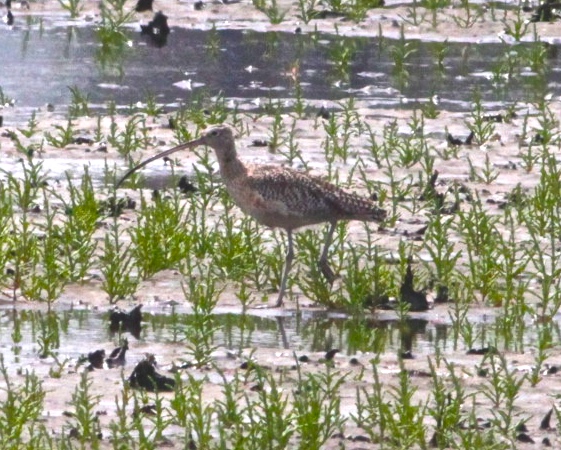
A Long-billed Curlew takes a walk along the Texas Gulf Coast.

*~*~*~*

The big environmental news this week has been the incredible heat that is burning the northern hemisphere. A record-breaking heat wave in Europe has been deemed a virtual "heat apocalypse" which has led to the deaths of hundreds on that continent. The UK has suffered its hottest day in history. Exacerbating the problem, a wildfire in France was actually started by an irresponsible human. The heat and drought have fueled wildfires in many places, including Alaska. Extreme heat alerts were issued for 28 states and temperatures of 115 degrees Fahrenheit were recorded in Texas and Oklahoma. Weather maps around the northern hemisphere were essentially all red.

*~*~*~*

But in Hawaii, the big news was water; specifically huge waves, some more than twenty feet high.

*~*~*~*

Meanwhile, Lake Mead in the Colorado River Basin has withered to only 27% of its capacity because of sustained drought over several years.

*~*~*~*

In Australia, thousands of dead frogs are turning up and scientists are at a loss to explain what is happening to them.

*~*~*~*

In some potentially good news for the environment, the Presbyterians have decided to divest from five oil companies after several years of debate. It would be great to see others follow their example.

*~*~*~*

In California, reservoirs are not necessarily the answer to the drought problem.

*~*~*~*

While much of the country is baking, the Northeast and Mid-Atlantic are enjoying a blissfully mild summer.

*~*~*~*

In 1957, the Thames was declared "biologically dead" but reports of its death were premature. The Thames is back, baby!

*~*~*~*

One of the ways that polar bears are adapting to the challenges of climate change is by scavenging garbage

*~*~*~*

In the Salish Sea in the Pacific Northwest, the river otters are doing just fine, thank you!

*~*~*~*

The American Bird Conservancy's Bird of the Week is the endangered Hawaiian bird, the 'Akikiki, pictured above.

*~*~*~*

Wild European bison have been returned to the UK for the first time in thousands of years.

*~*~*~*

A new report has documented that Australian wildlife is in serious decline because of a devastating combination of threats.

*~*~*~*

Tiger sharks and great white sharks are growing to tremendous proportions in the planet's oceans thanks in part to protected no-fishing zones. We may, in fact, "need a bigger boat!"

*~*~*~*

Penguins managed to beat the heat and survive by heading south to the colder climes of Antarctica.

*~*~*~*

Thanks to a 2020 volcanic eruption in Iceland, scientists were able to gain access to Earth's mantle, coming closer to an actual look at the planet's core.

*~*~*~*

The International Union for Conservation of Nature has added our Monarch butterflies to their endangered species list. And speaking of Monarchs, you can participate in the sixth International Monarch Monitoring Blitz on July 29 through August 7.

*~*~*~*

In Sri Lanka, the failure of the government's environmental policies is fueling popular protests and the resignation of the president.

*~*~*~*

There is a global initiative to plant a trillion new trees. Can that actually make a difference?

*~*~*~*

A new study postulates that the threat of global extinction may be even greater than has previously been thought.

*~*~*~*

Here's a look at some of the birds of Europe.

*~*~*~*

The world of Nature never ceases to amaze. And here is one more amazing thing: glowing fish.


Thursday, July 21, 2022

Land of Shadows by Rachel Howzell Hall: A review


Los Angeles homicide detective Elouise (Lou) Norton and her new partner Colin Taggert are sent to investigate a suspicious death. A teenage girl's body has been found hanging in a closet in a condominium complex. Colin initially thinks that it is a suicide but Lou insists, correctly, that it is homicide.

Early in the narrative, we learn that Lou had an older sister, Tori, who disappeared twenty-five years earlier. Lou and Tori were at a neighborhood store owned by a man named Napoleon Crase when Tori was caught stealing candy. Elouise panicked and ran from the store. She never saw her sister again. The police investigated the disappearance but apparently not very assiduously and the case was never solved.

Lou is haunted by the disappearance of her sister. It may be one of the reasons she joined the police. Now, in a possible instance of karmic payback, it turns out that the apartment building where the dead teenager was found is owned by Napoleon Crase. Lou will have a legitimate excuse for investigating Crase who has been a thorn in her memory for all these years.  

In a side issue, we learn that Lou is married to a very successful game developer who is presently in Japan. They do not talk often and it seems that the marriage ties are not very strong. Her husband has been unfaithful to her in the past. When he was caught, he bought her a Porsche SUV to buy her off. She suspects that he is up to his old tricks again.

As Lou and her partner pursue the case, they encounter a pretty sleazy cast of characters and find their investigation leading them down some twisted avenues, but she is undaunted and grimly determined to run down every lead until she finds out what happened and is able to bring some justice to the victim. 

This was Rachel Howzell Hall's first book in what is intended to be a series and it was a good introduction to the character of Lou. Moreover, I found her descriptions of the setting in South Los Angeles to be quite believable. Consequently, I felt that I could "see" those streets and those people. They all felt real to me. Hall is the author of a number of books, including at least one where she paired with James Patterson to write. This was the first one of hers that I had read and I was sufficiently impressed to put her on my reading list. I hope to get to some of the other books in this series perhaps later this year.  

Tuesday, July 19, 2022

Remarkably Bright Creatures by Shelby Van Pelt: A review


Marcellus McSquiddles - a name to reckon with. And it belongs to a creature to reckon with, a giant Pacific octopus who is one of the main characters and the narrator in Shelby Van Pelt's debut novel, Remarkably Bright Creatures. What a pleasure it was to get to know Marcellus and what a pleasure this book was to read.

Marcellus is a captive in the Puget Sound Sowell Bay Aquarium and he may be a genius among octopuses. (Or maybe he's just average; who knows?) He is clever enough to squeeze out of his tank in the aquarium and go roaming for a late-night snack. He is also sensitive enough to maintain a kind of relationship with the 70-year-old woman who cleans the space at night. Tova Sullivan is recently widowed and has volunteered as a cleaner at the aquarium. As she goes about her duties, she carries on a "conversation" with Marcellus who is her favorite. 

Tova likes things to be just so, a place for everything and everything in its place. She is an assiduous cleaner. Her life has not been an altogether happy one. In addition to the recent death of her husband, thirty years before she had suffered the death of her 18-year-old son, Erik. Erik's body had been found at the bottom of a lake and his death was ruled a suicide but Tova has never believed that verdict.

A second line of the narrative follows a thirty-year-old garage rocker and odd jobber named Cameron. His mother had left him with her sister in a California trailer park when he was nine years old. She left him there and never returned. His life since has been one failure after another. In the hope of turning things around, he decides to search for his father in Sowell Bay and try to get money from him. 

Cameron's story is compelling in its way. He finds a job at the aquarium where he meets Tova, and at this point in the story I began to suspect how it might end, but it didn't hinder my enjoyment of it.

More compelling for me though was Tova's story. She is one determined woman. She has decided that it is time to check herself into a nursing home and she proceeds with getting rid of her belongings and selling her house, the house that her father built. She has no children or grandchildren and, although she has devoted friends, she knows she must make decisions about her future herself. She is resolved that she will not allow herself to be a burden to others. She has an ally in Marcellus who it turns out may be able to help her resolve one of the mysteries of her life.

I have nothing negative to say about this book. I found the narrative thoroughly engaging as Van Pelt crisply moved her story along with no wasted asides. In fact, when I first finished reading the book, I had rated it as a 4-star read. But that was several days ago and on reflection, I believe it is worthy of a 5-star rating, my first one of 2022. And of all the characters I have met in books this year, Marcellus and Tova are definitely my favorite couple!  

Saturday, July 16, 2022

Poetry Sunday: A new poet laureate

Ada LimĂłn has been announced as the twenty-fourth poet laureate of the country. Her assignment begins this fall. The main duty of the poet laureate is to be an ambassador for the form and to help introduce it to those who may not have an appreciation of it. 

Many of LimĂłn's poems refer to our relationship to the natural world; trees, for example, are important characters in her poetry. Here is an example.

Instructions on Not Giving Up

by Ada LimĂłn

More than the fuchsia funnels breaking out
of the crabapple tree, more than the neighbor’s
almost obscene display of cherry limbs shoving
their cotton candy-colored blossoms to the slate
sky of Spring rains, it’s the greening of the trees
that really gets to me. When all the shock of white
and taffy, the world’s baubles and trinkets, leave
the pavement strewn with the confetti of aftermath,
the leaves come. Patient, plodding, a green skin
growing over whatever winter did to us, a return
to the strange idea of continuous living despite
the mess of us, the hurt, the empty. Fine then,
I’ll take it, the tree seems to say, a new slick leaf
unfurling like a fist to an open palm, I’ll take it all.

Friday, July 15, 2022

This week in birds - #509

 A roundup of the week's news of birds and the environment:

Snowy Egret searching among the rocks along Galveston Bay for a tasty morsel.

*~*~*~*

One of our national treasures, Yosemite National Park, was burning this week. A wildfire had consumed nearly 4,400 acres by Thursday of this week.

*~*~*~*

In Europe, an extreme heat wave pushed temperatures all the way up to 115 degrees Fahrenheit. In several countries on the continent, water restrictions have had to be imposed.

*~*~*~*

It isn't just our imagination. Summer in America is becoming longer, hotter, and more dangerous.

*~*~*~*

Glyphosate, a controversial ingredient tied to cancer and found in many weedkillers, has been found in 80% of U.S. urine samples in a CDC study. 

*~*~*~*

The Texas power grid has been stressed to its very limit this week as we suffer daily temperatures in excess of 100 degrees Fahrenheit. The Electric Reliability Council (ERCOT) has asked residents to voluntarily limit their use of electricity and in our house, at least, we are complying. 

*~*~*~*

Italy's longest river, the Po, is dying a slow death as northern Italy faces its worst drought in seventy years.

*~*~*~*

The decline in wild plant and animal life around the planet poses challenges for the millions of people who rely on them.

*~*~*~*

A pilgrimage in India's Kashmir region turned deadly this week when a cloudburst killed at least 16 people.

*~*~*~*

The American Bird Conservancy's Bird of the Week is the California Condor, once near extinction but now recovering due to the heroic efforts of many in the campaign to save the species.

*~*~*~*

Studying viruses in the laboratory can pose hazards in that the viruses may have a chance to evolve in that environment and become more deadly.  

*~*~*~*

Indigenous tribes are working to bring back and protect the bison and the bison in turn provide a benefit for the entire ecosystem that is nurtured by their presence.

*~*~*~*

A second glacier collapse and the resulting avalanche have demonstrated the perils of human-caused climate change in parts of Europe and Asia that are suffering through a blistering hot summer.

*~*~*~*

This week, endangered winter-run Chinook salmon eggs were released by a group of partners in conservation into the McCloud River upstream of Shasta Reservoir for the first time since the construction of the Shasta Dam in the 1940s.

*~*~*~*

The Coeur d'Alene tribe is attempting to save and protect Coeur d'Alene Lake which is sacred to them. The lake is being polluted by excess phosphorous from human activities, making it vulnerable to ecological disaster. 

*~*~*~*

Consider planting native plants in your garden. They support beneficial insects as well as the environment as a whole.

*~*~*~*

The fact that the Texas power grid has not collapsed this week under pressure from our extreme heat wave has been due in large part not to oil but to renewable energy sources.

*~*~*~*

People who collect twigs in the Congo River Basin for the purpose of making charcoal are playing a surprisingly large role in the deforestation of the area. 

*~*~*~*

Lake Powell was created by flooding the Colorado River but as a mega-drought continues into its twenty-second year the lake is shriveling and could lose its capacity to produce electricity for the region which would cause a severe crisis for those who depend on it.

*~*~*~*

A UN report resulting from a four-year assessment by 82 leading scientists makes the point that we need to value Nature for the spiritual, cultural, and emotional benefits it provides. 

*~*~*~*

A nine-banded armadillo just going about the business of being an armadillo. These critters are actually a benefit to their environment and they help to support the continued existence of many other species.

*~*~*~*

Tunisian fishing communities have been plagued by an invasive species of crab and so they learned to turn their lemons into lemonade, or their crabs into crab puffs. 

*~*~*~*

How do woodpeckers manage to hammer away at trees without becoming concussed? Trust Nature to find a way.

*~*~*~*

Bristlecone pines have stood for 1000 years but can they survive the effects of a drought that has weakened them and made them vulnerable to bark beetles?

*~*~*~*

Japan's penguins are suffering from the curse of taste!

*~*~*~*

A newly discovered pitcher plant in Borneo makes its traps to catch insects underground, the first one found to make traps under the soil.

*~*~*~*

Stumpy the wood turtle is wild but he has had a relationship with his human neighbor in West Virginia for more than 30 years.


Garden Bloggers' Bloom Day - July 2022

Bloom Day snuck up on me again. I looked at my calendar this morning and realized to my shock that it was the middle of the month already. My next thought was, "That's Bloom Day!" But did I have anything blooming, anything that hadn't succumbed to our 100+ degrees days and weeks-long dry spell? Well, a walk through the garden did reveal a few hardy bloomers. And here they are. 

Asclepias tuberosa, the native butterfly weed. It laughs at the heat and the drought.

Petunias are pretty tough, too, and a few still bloom in the pots by the patio.
 
Blue plumbago. If anything daunts it, Southeast Texas hasn't discovered it yet.

Portulaca blooming in a pot on the patio table.

Native Joe Pye weed blooms next to Hamelia patens.

Zinnias, another dauntless bloomer.

Pride of Barbados, aka Peacock flower, thrives on heat and drought.

The vitex bloomed beautifully for about a month. It's mostly gone now but a few blossoms hang on.

One shade of purple echinacea...

... and another shade.

The Hamelia patens shrubs are just about to be in full bloom.

The "blooms" of the inland sea oats by the goldfish pond.

The Anisacanthus wrightii, aka flame acanthus, has been particularly floriferous this summer and the bumblebees are loving it!


Justicia 'Orange Flame.'

Almost at the end of its current bloom cycle but still pretty.

Turk's cap never completely quits blooming for me all year round as long as it doesn't encounter a hard freeze.

Fading but still beautiful. In fact, I find the spent blossoms of the hydrangea just as pretty as the fresh ones.

And that's about it for this hot dry month. Fingers crossed that we soon get some rain to relieve both the garden and the gardener. Happy Bloom Day and thank you Carol of May Dreams Gardens for hosting us once again.