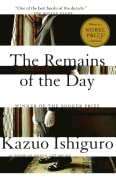
I had seen the movie based on the book long ago. It was made memorable by the performances of Anthony Hopkins and Emma Thompson in the two main roles and as I read the book, those were the faces that I saw in the characters of the butler James Stevens and the housekeeper Miss Kenton.
Stevens and Kenton had both served in the pre-World War II household of Lord Darlington at Darlington Hall, a stately home near Oxford. We learn that Lord Darlington was a Nazi sympathizer, a fact which Stevens is slow to admit. After the war and after the death of Lord Darlington, Darlington Hall is bought by a wealthy American, Mr. Farraday. The house has a seriously reduced staff by this time. Miss Kenton is long gone, having married and moved to Cornwall. She is now Mrs. Benn. She and Stevens had remained in touch in the years after she left service and when Mr. Farraday is going to be absent from Darlington Hall for a while and urges Stevens to borrow his car and go for a road trip vacation he decides to visit Mrs. Benn. He has some hopes of persuading her to return as housekeeper since it seems that her marriage is now on the rocks. The book details Stevens' first-person narration of his road trip and his reminiscences of the events of the 1920s and 1930s.
What becomes clear early on in the narration is that Stevens is unshakeably loyal to Lord Darlington and never questioned his hosting of lavish meetings between German sympathizers and English aristocrats in the years leading up to World War II in an effort to influence international affairs. What is also clear is that the guiding principle in Stevens' life is his reverence for dignity. That and his understanding of what it means to be a "great butler" are the most important concepts for him. They are even more important than his unacknowledged love for Miss Kenton. For he was in love with her and perhaps she was in love with him, but it would have gone against the "dignity" of his position to act on it and so it was tucked away in the most hidden corner of his heart. Their relationship never strayed from that of a professional friendship, even though it seems, based on his reminiscences, that Miss Kenton might have tried to draw closer to him.
As Stevens narrates his story for us, he seems to come to a realization, maybe for the first time, that Lord Darlington truly was a Nazi and was perhaps unworthy of his loyalty. He even seems to regret his lost opportunities with Miss Kenton. As he ponders "the remains of the day" and the remains of his life, he concludes that the evening is the best part of day and that it is best to enjoy the present of one's life rather than dwelling on the past.
This narrative was simply mesmerizing. The book received the Booker Prize for Fiction in 1989 and its author received the Nobel Prize for Literature in 2017, both richly deserved. In the announcement of his Nobel Prize, the committee stated that in Ishiguro's "novels of great emotional force, he has uncovered the abyss beneath our illusory sense of connection with the world." That seems the perfect description of The Remains of the Day and there is nothing more relevant that I could say about it.
My rating: 5 of 5 stars
That does sound like a really good one and a 5/5 is pretty darn impressive. Glad you enjoyed it!
ReplyDeleteIt is an impressive book. Ishiguro is a very impressive writer.
DeleteSomehow or another, I've never read this one or even seen the movie based on it. But it's one of those titles that have always stuck in my head, so after seeing how much you enjoyed it, I think I'm finally going to give it a try.
ReplyDeleteOh, please do, Sam! I think you'll like it as much as I did. One caveat: It starts rather slowly and takes a while to really get into, but it's worth the wait.
DeleteI've seen the movie and was pretty sure I read the book as well but, don't see a review so it was definitely prior to 2008. Glad you enjoyed it so much.
ReplyDeleteYes, the book was published in 1989 and I believe the movie came out in the early to mid-1990s. The story still feels very current even though it came out over thirty years ago.
DeleteI love both the movie and the book when it comes to this one! It's one of those quietly moving stories that sticks with you after you're done.
ReplyDeleteThe movie was memorable and the book is even more so.
DeleteI am wondering how I missed it too. Thank you so much for the post.
ReplyDeleteI'm just glad that I finally experienced the pleasure of reading this book.
DeleteThis has long been on my list of books I have wanted to read. Like you, I saw the movie first. I really liked it and made a note to try the book. From your review, it sounds like a must read. I am glad you enjoyed it.
ReplyDeleteAs in most cases, I enjoyed the book more than the movie, even though the movie was wonderful.
DeleteOh Yeah. This is a great novel & story -- very sad (as a love story missed) and I read it long ago but I still recall it well. I'm an Ishiguro fan but I have many more of his to read. I also liked Never Let Me Go and Klara & the Sun. Always a bit of sadness in his stories.
ReplyDeleteI read and love Klara and the Sun and I have Never Let Me Go in my reading queue. I'll be getting to it soon.
Delete