And now for something completely different...
Ogden Nash was one of those rare writers who was able to combine laugh-out-loud humor with poetry to good effect. His humor always had a point and usually had an essential truth well-camouflaged within it. He certainly hit the mark with this poem about birding.
You Can't Get There from Here
by Ogden Nash
Bird watchers top my honors list.
I aimed to be one, but I missed.
Since I'm both myopic and astigmatic,
My aim turned out to be erratic,
And I, bespectacled and binocular,
Exposed myself to comment jocular.
We don't need too much birdlore, do we,
To tell a flamingo from a towhee;
Yet I cannot, and never will,
Unless the silly birds stand still.
And there's no enlightenment in a tour
Of ornithological literature.
Is yon strange creature a common chickadee,
Or a migrant alouette from Picardy?
You can rush to consult your Nature guide
And inspect the gallery inside,
But a bird in the open never looks
Like its picture in the birdie books-
Or if it once did, it has changed its plumage,
And plunges you back into ignorant gloomage.
That is why I sit here growing old by inches,
Watching a clock instead of finches,
But I sometimes visualize in my gin
The Audubon that I audubin.
(Excerpted from "Up From the Egg: Confessions of a Nuthatch Avoider.")
~
"...But a bird in the open never looks
Like its picture in the birdie books-
Or if it once did, it has changed its plumage,
And plunges you back into ignorant gloomage..."
In those few words, Nash caught the essential frustration of the inexpert birder, of whom I am one of the most frustrated. The darn birds just never seem to look exactly like the drawings or the pictures in my field guides, and I'm left trying to match up the almost indiscernible marks on a creature that never, as Nash bemoans, "stands still."
Truly, if Ogden Nash was not a birder, he "audibin!"
Sunday, July 13, 2014
Saturday, July 12, 2014
This week in birds - #116
A roundup of the week's news of birds and the environment:
*~*~*~*
Scientists in Europe are analyzing the diet of the threatened Bonelli's Eagle to try to find ways to increase the Mediterranean area bird's chances for survival.
*~*~*~*
Scientists studying the Japanese Quail have identified a key photoreceptor cell deep inside the brain that helps to tell the bird when it is time to nest.
*~*~*~*
A discussion in "The Nature of Cities" addresses the problem of exotic species in urban areas and ways of managing or eradicating them.
*~*~*~*
Jochen of the "10,000 Birds" blog writes about the "Best. Crossbill. Encounter. Ever!" It was with Red Crossbills in the Black Forest area of Germany and he managed to get some fantastic pictures of the birds.
 |
| Juvenile birds, like this young male Northern Cardinal, are all over the backyard these days. Often they look very similar to adults and it may be difficult to distinguish that they are juveniles, but the cardinals make it easy. The young ones have dark bills. Only when they mature will they develop the distinctive red beaks of their species.
*~*~*~*
Environmental groups have been attempting to convince the U.S. Fish and Wildlife Service to change the status of the Lesser Prairie Chicken from threatened to endangered so that it can receive more vigorous protection. Persuasion has not worked so now three environmental organizations have filed suit against the agency to try to force the change.
*~*~*~*
Pesticides that get into the environment can have unintended and detrimental consequences. This is the case in the use of rat poisons in urban settings. Raptors and other predators that feed on the rats can have the poison passed on to them in the flesh of their prey and can be made sick or even killed.
*~*~*~*
Since the early 1990s, frogs around the world have been struck by a doomsday fungus which has looked as though it had the capacity to wipe that species off the face of the planet. Scientists have now found that some frogs have been able to develop immunity to the fungus, which offers at least a sliver of hope that our favorite amphibians might be saved.
*~*~*~*
Vampires are alive and well on Wolf Island in the Galapagos. Vampire finches that is. The well-named Sharp-beaked Ground Finch that lives there has learned to survive in its harsh environment by drawing blood from other birds and feasting on it. The bird pecks away at the tail feathers of its victim until it draws blood that it then slurps up. Interestingly, the victims which are generally much larger do not really resist this invasion of their bodily fluids.
*~*~*~*
Sociable Weavers from the savannahs of southern Africa are known for being cooperative nesters. A new study throws some light on just how and why the birds, as well as other cooperative species, may be willing to work together to achieve a goal.
*~*~*~*
Long-billed Curlews that nest and summer in places like Idaho and Montana will be tracked by The Nature Conservancy. Many of these curlews, which are our largest shorebird, spend their winters along the Gulf Coast, offering a treat for those of us who enjoy birding those coasts.

*~*~*~*
The U.S. Fish and Wildlife Service has caved to the objections of states where the last 300 wolverines in the country live and have decided not to list the animal as "threatened." In doing so, they have disregarded the conclusions of two independent panels which recommended the listing.
|
Scientists in Europe are analyzing the diet of the threatened Bonelli's Eagle to try to find ways to increase the Mediterranean area bird's chances for survival.
*~*~*~*
Scientists studying the Japanese Quail have identified a key photoreceptor cell deep inside the brain that helps to tell the bird when it is time to nest.
*~*~*~*
A discussion in "The Nature of Cities" addresses the problem of exotic species in urban areas and ways of managing or eradicating them.
*~*~*~*
Jochen of the "10,000 Birds" blog writes about the "Best. Crossbill. Encounter. Ever!" It was with Red Crossbills in the Black Forest area of Germany and he managed to get some fantastic pictures of the birds.
Friday, July 11, 2014
The Old Fox Deceiv'd by Martha Grimes: A review
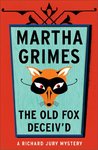 The Old Fox Deceiv'd by Martha Grimes
My rating: 3 of 5 stars
Twelfth Night in the tiny Yorkshire fishing village of Rackmoor. It is a typically chilly and very foggy night with a North Sea wind blowing. The perfect night for murder.
A young woman in costume apparently on her way to a Twelfth Night party at the local manor house is brutally murdered, her body left on steps on the way to the party. She was stabbed with some sort of two-pronged instrument. The police can't find the murder weapon or very many clues to what actually happened.
Days later, when the trail has already grown cold, New Scotland Yard is called in and Inspector Richard Jury, along with his sidekick Wiggins, is assigned to the case. He's soon joined by his unofficial sidekick, Melrose Plant, who just happens to be a guest in that aforementioned manor house.
There are many questions about the victim of the murder. First of all, her identity. Was she really Dillys March, the long-lost much-loved ward of Colonel Titus Crael, owner of the manor house? She certainly bore a remarkable resemblance to Dillys, but that wasn't the name she gave. Was she truly Gemma Temple, the name which she had used? What was she doing in Rackmoor? Was she involved in some kind of scam in which she was trying to convince the Colonel that she was his ward so that she could share in his fortune? And, most of all, who stood to gain by her death?
As Jury and his cohorts begin to pursue these questions, they uncover an unexpectedly tangled web that leads to other undiscovered murders. And, of course, it all has its roots in a decades-old maze of unrequited loves and unavenged wrongs in the village. The quiet, unassuming English village once again proves to be a very dangerous place.
As in Martha Grimes' first entry in her Inspector Richard Jury series, which I just read earlier this week, we find that Rackmoor has its full complement of eccentric residents, several of whom have potential motives for murder and all of whom seem to have strong opinions about the murdered woman, as well as some of the tragedies of earlier years which have possibly led up to this particular murder.
Two of the most sympathetic characters whom we meet in The Old Fox Deceiv'd are a young boy named Bertie and his dog Arnold. Both ultimately play a role in the unmasking of the murderer. Twelve-year-old Bertie has been left on his own by his mother who has gone off to London to pursue her dreams, which would only be impeded by the presence of an almost teenage son. Bertie and Arnold actually manage quite well without her. Bertie works part time and various people look in on him daily and make sure he has what he needs. The village takes care of its own. Who needs social services?
Rackmoor does indeed seem to have been an idyllic place before those pesky murders intruded. Things are never quite what they seem though, are they?
Again, Grimes has constructed a charming cozy mystery with quirky characters and plenty of gentle humor. Just the ticket for a summer day when it is too hot to do much of anything except sit in the shade with a cooling drink and read.
View all my reviews
Thursday, July 10, 2014
A photo op is not what is needed
It isn't so often that I find myself disagreeing with Joan Walsh of Salon.com, but this is one of those times.
Walsh wrote a column on Wednesday in which she agreed with all those politicians who are castigating the president because he did not plan to make a visit to the border while he is in Texas to see the thousands of immigrants detained there. Her argument was that such a visit would illustrate the complexity of the humanitarian and immigration crisis like nothing else. She's wrong.
We don't need the president in a photo op with desperate children to illustrate the complexity of the problem. All that would do would be to provide a media circus for the 24-hour news cycle. It would not get any closer to solving the problem.
The complexity of the problem is self-evident. It is a product of chaotic conditions in Central American countries, conditions in which the United States with its appetite for cocaine from the region is clearly complicit. And then, of course, there is the fact that this country actively contributed during the Reagan years to the destabilization of the region. So, we do bear some responsibility here. Even acknowledging that, however, really gets us no further along. We need to solve the immediate crisis and then we need to institute a humane and reasonable immigration policy.
The immediate problem is a need for decent, sanitary housing for these children and women - and they are mostly children and women - and sufficient adjudicators to hear their cases in a timely manner to determine whether they qualify for refugee status or they need to be returned to their countries of origin. And if they should be returned to their own countries, then we need a swift process for accomplishing that.
All of that, of course, requires money, and the only way that money can be provided is for Congress to appropriate it. But, frankly, Congress would rather yell at the president than get off its collective ass to do its job and help solve the problem.
Meanwhile, President Obama gets it from both sides. From advocates for immigrants, he gets criticism because he has deported more people than any president in history. (Not a fact that viewers of Fox News know, of course.) He has also increased numbers of Border Patrol agents to the highest level ever. Whenever I hear people complaining about the border not being secure, I wonder what border are they talking about? Anyone who has actually been to the border between Mexico and Texas in recent years, as I have, knows that it has more police per square foot than just about any place on the planet. If you are driving or walking anywhere near the border, you can't go ten minutes without encountering a Border Patrol agent. Still, all the right wingnuts scream about our "porous border" and a president who won't enforce the immigration laws. They don't know what they are talking about. They don't want to know.
So, the president is criticized from both the right and the left on this issue. One thing is clear. If he visited the border for a photo op, that would not stop the criticism. More importantly, it would not solve the problem. For that the president needs the cooperation of Congress. Unfortunately for us and for those desperate people waiting at our borders, I don't think he will get it.
Walsh wrote a column on Wednesday in which she agreed with all those politicians who are castigating the president because he did not plan to make a visit to the border while he is in Texas to see the thousands of immigrants detained there. Her argument was that such a visit would illustrate the complexity of the humanitarian and immigration crisis like nothing else. She's wrong.
We don't need the president in a photo op with desperate children to illustrate the complexity of the problem. All that would do would be to provide a media circus for the 24-hour news cycle. It would not get any closer to solving the problem.
The complexity of the problem is self-evident. It is a product of chaotic conditions in Central American countries, conditions in which the United States with its appetite for cocaine from the region is clearly complicit. And then, of course, there is the fact that this country actively contributed during the Reagan years to the destabilization of the region. So, we do bear some responsibility here. Even acknowledging that, however, really gets us no further along. We need to solve the immediate crisis and then we need to institute a humane and reasonable immigration policy.
The immediate problem is a need for decent, sanitary housing for these children and women - and they are mostly children and women - and sufficient adjudicators to hear their cases in a timely manner to determine whether they qualify for refugee status or they need to be returned to their countries of origin. And if they should be returned to their own countries, then we need a swift process for accomplishing that.
All of that, of course, requires money, and the only way that money can be provided is for Congress to appropriate it. But, frankly, Congress would rather yell at the president than get off its collective ass to do its job and help solve the problem.
Meanwhile, President Obama gets it from both sides. From advocates for immigrants, he gets criticism because he has deported more people than any president in history. (Not a fact that viewers of Fox News know, of course.) He has also increased numbers of Border Patrol agents to the highest level ever. Whenever I hear people complaining about the border not being secure, I wonder what border are they talking about? Anyone who has actually been to the border between Mexico and Texas in recent years, as I have, knows that it has more police per square foot than just about any place on the planet. If you are driving or walking anywhere near the border, you can't go ten minutes without encountering a Border Patrol agent. Still, all the right wingnuts scream about our "porous border" and a president who won't enforce the immigration laws. They don't know what they are talking about. They don't want to know.
So, the president is criticized from both the right and the left on this issue. One thing is clear. If he visited the border for a photo op, that would not stop the criticism. More importantly, it would not solve the problem. For that the president needs the cooperation of Congress. Unfortunately for us and for those desperate people waiting at our borders, I don't think he will get it.
Wednesday, July 9, 2014
Backyard Nature Wednesday: Leucophyllum frutescens
 |
| Leucophyllum frutescens in my backyard garden, July 8, 2014. |
Texas sage is the name it is most often known by in my area. It is a tough, tough plant, extremely tolerant of our triple-digit summer weather with its long dry spells but also able to survive fairly cold temperatures for extended periods. The frequent unusually cold spells which we experienced last winter, with temperatures down to 20 degrees F. or below, did not faze my plant at all.

One of the most interesting things about this plant is its bloom habit. The shrub produces abundant tubular flowers in response to high soil moisture or humidity. In summers during which we suffer drought, we don't see much out of the Texas sage. But this summer, our weather pattern has been hot days and not much cooler nights with a leavening of late afternoon showers. Recently, few days have passed when we didn't receive at least a sprinkle of rain and on Monday of this week we got 1.25 inches in a bit less than an hour. The Texas sage loved it and the next day all of these rose-lavender blossoms popped open.

The plant will bloom more or less continuously throughout the summer as long as there is enough moisture. With plenty of water, the plant tends to sprawl and grow taller and somewhat scraggly in appearance. One has to prune it in order to keep a pleasing rounded, fuller shape. Other than that, Texas sage doesn't really require any care. It's not a heavy feeder so fertilizing is not really required if it is in reasonably good soil. I never fertilize mine.

Moreover, the plant doesn't have any pests that I've encountered. According to horticulturists, it is even resistant to deer in areas where those herbivores are a problem. Probably the worst thing one could do to it is give it too much water, for it is essentially a desert plant.
A carefree native plant with pretty silver gray leaves and pink to purple tubular flowers that are attractive to a wide variety of pollinators - what more could one possibly ask? Leucophyllum frutescens may just be the perfect plant for Texas gardens.
Tuesday, July 8, 2014
The Man with a Load of Mischief by Martha Grimes: A review
 The Man with a Load of Mischief by Martha Grimes
My rating: 3 of 5 stars
I've decided to give myself a treat with my summer reading by indulging mostly in my guilty pleasures - that is to say mysteries. And in so doing, I plan to delve into some of the series which I haven't sampled before, starting with Martha Grimes' Inspector Richard Jury series.
This has been recommended to me at various times over the years, but, for some reason, I just never got into it. Maybe because I was busy reading several other series. But time to break new ground and meet some new characters.
One would think that a book featuring a New Scotland Yard detective inspector as its main character would be a police procedural type, but this, I think, falls more in the "cozy" category. While Inspector Jury may be the main character, the story is set in a small village and there are various eccentric villagers who "assist the police in their inquiries," and we see much of the story through their eyes.
The village is Long Piddleton - Long Pidd to the locals. It is a quaint little place that has recently been discovered by Londoners seeking a refuge from the hurly burly of city life. It is a village where nothing of note ever happens. And then the murders start.
First, the body of a stranger to the village is found with his head stuck in a barrel of beer in the cellar of one of the village pubs. But before he was put in the barrel, he was strangled with a wire. This all happened while the pub was busy with patrons, but nobody saw a thing.
Within twenty-four hours, another body is found at another village pub - this one stuck on a beam over the pub's name sign. And then the whole thing just gets silly. People are dropping like flies and there are few clues to indicate what is going on.
The thing is that all of the victims at first are supposedly unknown to the villagers and seem to have no connection to Long Pidd. But Jury is quite sure that there must be a connection if only he can find it.
One of Long Piddleton's own, Melrose Plant, a former lord who gave up his title, then finds another dead body. But this one breaks the pattern. It is a local girl, maid to the vicar, who had recently left town (she said) to visit her family. Plant becomes fascinated by the murders and turns into an amateur sleuth, helping Inspector Jury root out the source of evil in his village. Comic relief is provided by Plant's overbearing Aunt Agatha who fancies herself a modern-day Miss Marple.
In fact, one of the most fun things about this book was its gentle humor. Several of the characters are quirky to the point of peculiarity and they provide a lot of leavening for this essentially straightforward tale of greed gone wild.
I found The Man with a Load of Mischief to be a very light and pleasant read, almost perfect for a summer day. True, the last 15% or so of the book began to drag just a bit, after Jury had already solved the mystery and the culprit had been arrested, but, overall, I enjoyed it and I'm moving on to the second entry in the series. There are twenty-three Inspector Richard Jury books in total and I expect to continue reading my way through them in coming months and years. Fun times ahead!
View all my reviews
Monday, July 7, 2014
The Silkworm by Robert Galbraith: A review
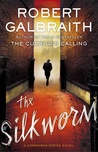 The Silkworm by Robert Galbraith
My rating: 4 of 5 stars
Readers of the Harry Potter series know very well what a master storyteller J.K. Rowling is. Even when she uses the pseudonym "Robert Galbraith" that talent shines through. She has written a second very entertaining entry in her Cormoran Strike detective series. The Silkworm holds the reader's interest from the first page to the last. It is quite simply delicious fun to read.
Part of what makes it such fun is the setting of this novel. Rowling/Galbraith has taken on the publishing industry, something about which she undoubtedly knows a very great deal and on which she must have very well-formed opinions. Coming from one of the most successful writers in history, those opinions certainly carry an extra dollop of interest as one speculates about the personalities of her characters.
The center of this story is novelist Owen Quine, who goes missing, not for the first time. His dowdy wife Leonora becomes alarmed when he doesn't return as usual and she doesn't hear from him and she contacts our hero, private detective Cormoran Strike, to find him. Strike has made a vow not to take on any clients who are not able to pay his fees, but something about the fiftyish wife stuck at home caring for a daughter with learning disabilities touches him and even though he's not sure he's going to be paid, he takes on the case and soon becomes obsessed by it.
Strike is still aided by his Girl Friday, Robin Ellacott. She came to him as a temp in the first novel The Cuckoo's Calling and now she is his indispensable assistant. Together, they follow up on leads concerning Quine's possible whereabouts and it soon becomes clear that this is not one of his usual disappearances.
Quine had just completed a manuscript which he thinks is the best thing he has ever done. Word leaks out that the book contains poison-pen portraits of many people in the book publishing business. If the manuscript that is bootlegged to many sources in the industry is actually published, it would have the capacity to ruin lives. That is motive enough for many of the targets of the poison pen to want to silence the one who wields it.
On a hunch, Strike decides to check a house which Quine owns jointly with another author but that has not been occupied or used in many years. There he finds the brutally murdered and butchered body of the missing novelist. He notifies the police, but he stays on the case, too. He feels an obligation to Leonora and her daughter and he has an ominous feeling that the wife may be accused of the murder. He knows instinctively that she didn't do it.
Soon his worst fears are realized when Leonora is arrested and charged with the sadistic crime, giving added urgency to his and Robin's investigation.
We get to know Cormoran and Robin a little better in this novel. Cormoran's ex-fiancee has become engaged to an upper class twit and she marries him but not before trying to provoke a response from Strike, possibly to get him to beg her not to marry. Meanwhile, Robin is engaged to be married to her own twit, but the wedding has to be postponed when the twit's mother dies suddenly. Cormoran and we can see that Matthew is all wrong for Robin, but will she realize it in time or is she destined to make a disastrous marriage?
Strike, who lost part of a leg to an IED in Afghanistan, struggles both physically and emotionally in The Silkworm, but his salvation is his job which he passionately loves. His passion is shared by Robin. They are obviously made for each other, but will they ever see it?
This book is very much in the mode of the traditional British crime novel, of which I am a big fan. We have the detective's connection with the police force in a friend whose life he saved in the war. There are the eccentric suspects and the indispensable assistant. (Think Holmes and Watson.) And most of all, there is a detective who is such good company that you really don't want the story to end, even when his theories have been proved true and he's solved the case. I'm already looking forward to Cormoran Strike's next case.
View all my reviews
Subscribe to:
Posts (Atom)