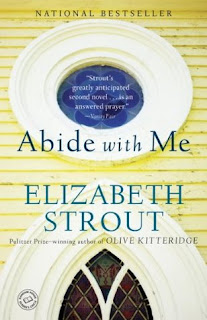
Abide With Me by Elizabeth Strout: A review


Elizabeth Strout's second novel, Abide with Me, was published in 2006. It tells the story of Tyler Caskey, a young minister in the fictional town of West Annett, Maine. His wife died about a year before, leaving him with two small daughters. The younger of the two, Jeannie who is still a baby, is being cared for by Tyler's mother in her home. The older child, Katherine, is around four years old when we meet her and lives with her father but has obviously been traumatized by her mother's death and is very antisocial both at school and at home. Tyler is thus dealing with his own grief and sense of loss as well as trying to be a responsible father to two daughters and meet his responsibilities at the church. In other words, he has his hands full.

As Tyler struggles, rumors spread in the community about Katherine's problems and of a suspected affair between Tyler and his housekeeper, Connie Hatch. It all starts in the church's Ladies' Aide Society which seems to have as its main purpose to serve as a clearance center for all the juicy gossip of the community. The members of the group hover over Tyler which only serves to increase the pressure on him. Soon enough his grief begins to turn to anger and his depression grows making it extremely problematic whether he can minister to his congregation and be the parent that his troubled daughter needs.

The time is the 1950s and the clouds of the Cold War hang over everything. Meanwhile, talk of Freud's theories about hidden sexual motivations driving human nature is all the latest rage. Amid these unsettled times in society and the challenges of his personal life, Tyler tries to cling to his faith and he takes comfort in the writing of Dietrich Bonhoeffer and his experiences of attempting to transform a faith community in Germany in World War II. 

Strout details in a straightforward way Tyler's attempts to rise above all the gossip and the petty concerns of his church board and congregation and to remain true to the calling that led him to become a minister in the first place. At times this becomes a thoroughly depressing story but ultimately there are breakthroughs both on the personal level and with the congregation that speak to the resilience of the human spirit and the ability to overcome adversity.

The writer's characterizations are completely believable. I think we have probably all known people like Tyler and indeed like some of the bitchier gossipers in his congregation. Tyler is on many levels endearing, if naive. In his own way, he strives to be perfect but falls short, as we all must.

The book's climax leaves the reader with some hope that things will eventually work out for the rebuilt Caskey family. But it is in no way a neat and tidy conclusion and we have to acknowledge that things could actually go either way from here. Tyler is a good guy and we hope for the best for him.

My rating: 4 of 5 stars

Comments

  1. Glad you had a chance to try this one. I enjoyed it as well.

    ReplyDelete
    Replies
    1. I believe it was your review that decided me to read it and it was definitely a worthwhile read.

      Delete
  2. I've recently read several reviews on this one. It sounds such a good book. Thank you for your post.

    ReplyDelete
    Replies
    1. It is a good book. The characterizations are particularly strong.

      Delete
  3. I'll add this one to my list. Oh, William was my first book by Strout, and I loved her writing.

    ReplyDelete
    Replies
    1. If you liked Oh, William you will most likely enjoy this one as well.

      Delete
  4. Strout is another author I'm hoping to finally read this year. So many of her books sound so good. :)

    ReplyDelete
    Replies
    1. I have enjoyed every book of hers that I have read, some more than others, of course. But this was an interesting one on many levels.

      Delete

Post a Comment

Popular posts from this blog

Poetry Sunday: Don't Hesitate by Mary Oliver

How about we share another Mary Oliver poem? After all, you can never have too many of those. In this one, the poet seems to acknowledge that it is often hard to simply live in and enjoy the moment, perhaps because we are afraid it can't last. She urges us to give in to that moment and fully experience the joy. Although "much can never be redeemed, still, life has some possibility left." Don't Hesitate by Mary Oliver If you suddenly and unexpectedly feel joy, don’t hesitate. Give in to it. There are plenty of lives and whole towns destroyed or about to be. We are not wise, and not very often kind. And much can never be redeemed. Still, life has some possibility left. Perhaps this is its way of fighting back, that sometimes something happens better than all the riches or power in the world. It could be anything, but very likely you notice it in the instant when love begins. Anyway, that’s often the case. Anyway, whatever it is, don’t be afraid of its plenty. Joy is no...

Poetry Sunday: Blackberry-Picking by Seamus Heaney

My mother was a farm wife and a prodigious canner. She canned fruit and vegetables from the garden, even occasionally meat. But the best thing that she canned, in my opinion, was blackberry jam. Even as I type those words my mouth waters!  Of course, before she could make that jam, somebody had to pick the blackberries. And that somebody was quite often named Dorothy. I think Seamus Heaney might have spent some time among the briars plucking those delicious black fruits as well, so he would have known that "Once off the bush the fruit fermented, the sweet flesh would turn sour." They don't keep; you have to get that jam made in a hurry! Blackberry-Picking by Seamus Heaney Late August, given heavy rain and sun For a full week, the blackberries would ripen. At first, just one, a glossy purple clot Among others, red, green, hard as a knot. You ate that first one and its flesh was sweet Like thickened wine: summer's blood was in it Leaving stains upon the tongue and lust ...

Poetry Sunday: Hymn for the Hurting by Amanda Gorman

You probably remember poet Amanda Gorman from her appearance at the inauguration of President Biden. She read her poem "The Hill We Climb" on that occasion. After the senseless slaughter in Uvalde this week, she was inspired to write another poem which was published in The New York Times. It seemed perfect for the occasion and so I stole it in order to feature it here, just in case you didn't get a chance to read it in the Times . Hymn for the Hurting by Amanda Gorman Everything hurts, Our hearts shadowed and strange, Minds made muddied and mute. We carry tragedy, terrifying and true. And yet none of it is new; We knew it as home, As horror, As heritage. Even our children Cannot be children, Cannot be. Everything hurts. It’s a hard time to be alive, And even harder to stay that way. We’re burdened to live out these days, While at the same time, blessed to outlive them. This alarm is how we know We must be altered — That we must differ or die, That we must triumph or try. ...