Translate

Friday, November 11, 2022

This week in birds - #526

 A roundup of the week's news of birds and the environment:

It's just about time for the return of the Sandhill Cranes. This picture was actually taken a few years ago. I haven't seen any of them yet this fall, although there probably are some around; I just haven't encountered them.

*~*~*~*

The U.N. Climate Change Conference was in session this week and a proposal was submitted that would tap private funds to provide assistance to developing countries for clean energy development.

*~*~*~*

This story documents some of the changes taking place on planet Earth because of climate change.

*~*~*~*

The world's four biggest emitters of greenhouse gases are primarily responsible for the planet falling short of its climate goals.

*~*~*~*

The intergovernmental body charged with protecting and conserving marine life in the Antarctic Ocean has ended its annual meeting with little progress made.

*~*~*~*

The "gloomy octopus" is the actual common name of a species and it lives up to that name by throwing things at other members of its species.

*~*~*~*

And then there is the argonaut octopus that produces a floating shell-like structure for the protection of its offspring.

*~*~*~*

How do seabirds survive typhoons? It turns out that many of them fly straight into the winds rather than risk being blown inland.

*~*~*~*

Some European countries at COP27 pledged money for a new loss and damage fund. The United States did not join them. 

*~*~*~*

Deep-sea divers have discovered a new ecosystem 1640 feet beneath the surface of the Indian Ocean. It is an ecosystem that is filled with sharks.

*~*~*~*

Here are some amazing photographs of wildlife visiting a man-made waterhole in Kenya.

*~*~*~*

Meanwhile, Jordan, one of the driest countries on Earth, is running out of water.

*~*~*~*

Ten African countries have accused the EU of jeopardizing the survival of the hippopotamus by failing to support a proposed commercial trade ban.

*~*~*~*

It is somewhat quail-like in appearance but it is, in fact, a rail. It is the Yellow Rail and its numbers are decreasing. It is the American Bird Conservancy's Bird of the Week.  

*~*~*~*

How do you rescue a whale, often frightened, angry, pehaps injured, and resisting, that is entangled in a fishing net?

*~*~*~*

Here is Book Riot's list of eight of the very best books about birding. 

*~*~*~*

Puerto Ricans know they will have to deal with hurricanes but they are determined to find ways not only to survive but to thrive with a new vision of agriculture.

*~*~*~*

The filming of the screen adaptation of The Lord of the Rings and all of its offshoots has had an environmental impact on New Zealand that is some cause for concern.

*~*~*~*

Naturalists fear that the proposed restart of crab harvesting in Delaware Bay poses a threat to shorebirds that frequent the bay.

*~*~*~*

Is the "wood-wide web" a thing? In other words, do trees actually talk to each other? Scientists disagree about it - it's what scientists do. But I am completely convinced that they do communicate.

*~*~*~*

Thanks to Mexican conservation efforts, that magnificent cat, the jaguar, is making a comeback in the Yucatan.

*~*~*~*

The springtail is an insect just about the size of a pinhead but it is capable of some truly amazing jumps.

*~*~*~*

The polar ice sheets are melting and that could cause catastrophic sea rise that could threaten coastal cities.

*~*~*~*

Brazil, Indonesia, and the Democratic Republic of the Congo are in talks to form a strategic alliance to protect their tropical rainforests. 

*~*~*~*

A perfectly placed trail cam in Minnesota has given us views of animals using a beaver dam as a highway.

*~*~*~*

A report from a project called Climate Trace states that oil and gas greenhouse emissions are about three times higher than their producers have claimed. 

*~*~*~*

A pristine marine preserve that serves as a sea turtle sanctuary in the Philippines is threatened by the effects of climate change.

*~*~*~*

Apparently, there are ordinary people out there buying emus "on a whim." Truly, the human race may be doomed by its own stupidity.

*~*~*~*

A nonprofit offered to lend Belize money to pay its creditors if the government would spend part of the savings produced to preserve its marine resources. And that's how Belize cut its debt by fighting global warming.

*~*~*~*

The 1200 indigenous Guna people of Gardi Sugdub Island in Panama will have to move to the mainland next year because their island is sinking into the sea.

*~*~*~*

Ponds don't necessarily get the love and respect they deserve but scientists tell us they have a key role in fighting climate change and aiding conservation. I know my life would be poorer without the little pond in my backyard.

*~*~*~*

A 3700-year-old ivory comb that was used to remove beard lice (according to the inscription on it) has been unearthed by archaeologists in Israel.

*~*~*~*

Finally, here's a video of two rescued baby beavers diligently building "dams" to keep their rivals out of their space.


The Thursday Murder Club by Richard Osman: A review


What an unadulterated pleasure this book was to read. Okay, it is not great literature, but then everything one reads doesn't have to be "great literature." Some reads are just for fun and The Thursday Murder Club was terrific fun.

The setting is England, always a great place for a murder and for eccentric retirees. In this case, there are four retirees who make up the core of the cast of characters. They meet each week to review cold murder cases. Joyce, Ron, Elizabeth, and Ibrahim are nearing their eighties, but their enthusiasm for life and their curiosity are undimmed.

The group of four live in the village of Cooper's Chase. It is a quiet retirement village and the residents are keen to keep it that way. 

The group's leader/organizer is Elizabeth who has a somewhat mysterious background as (possibly) a spy. She has a wide network of friends and acquaintances who are willing to do favors for her. She excels at getting things done.

Elizabeth has a friend named Penny who is an ex-detective. She is somewhat haunted by cases that she was never able to solve and it is the files of these cases that she passes on to the Thursday Murder Club.

Each member of the group of four has his or her own set of skills. Ron is a former union boss who is a champion of the underdog. Ibrahim is a retired psychiatrist with particular skills at reading and understanding human behavior. Joyce, who narrates the story, is a retired nurse, new to the community.

PC Donna de Freitas is rather bored with her job in this quiet village. She is called upon to deliver a boring speech about security to the Thursday Murder Club and is surprised when they ask her to join them in solving actual murders. She is intrigued and jumps at the chance to join the group.

Then, this quiet village is racked by news of two new murders and suddenly the Thursday Murder Club has current rather than historical murders to solve. They employ all of their various skills in identifying and exposing a modern-day murderer.

Richard Osman wrote this story with a very light touch and a generous splash of British humor. It is the first in a proposed series and I will certainly keep an eye out for the next entry. Great fun!  


Monday, November 7, 2022

A Heart Full of Headstones by Ian Rankin: A review

It seems that fate and all his bending of the rules over the years may finally have caught up with John Rebus. As this book opens, we find him on trial for some unnamed misdeed. Well, there are plenty of those in Inspector Rebus' past. Rebus has never let a minor point of law keep him from putting the bad guys away. But now, in retirement, he is finally being called to account. As he awaits his trial, we get some of the background that has led him to this point.

We find Rebus in a reflective mood. He muses about his career and about his relationship with the notorious "Big Ger" Cafferty. Both are older now and "Big Ger" is confined to a wheelchair, but he is still the head of his crime "family." Rebus and "Big Ger" always understood each other and managed to operate within their respective spheres without ever stepping on each other's toes.

But now it seems that "Big Ger" needs Rebus' help. A former employee of his has vanished and he asks Rebus to find him or to find out what happened to him. Cafferty insists that he has not had anything to do with the man's disappearance.

In a parallel plotline, it appears that the lid may be just about to blow on the corruption at the infamous Tynecastle Police Station. Rebus' protege, Siobhan Clarke is working the case that might expose it all and Malcolm Fox is there to keep an eye on things and hoping that he can contain the scandal and preserve the reputation of Police Scotland.

Added to all this, there is a new group of gangsters on the scene, evidently ready to move into any vacuum left as "Big Ger's" influence begins to fade.

Through it all, the retired Rebus and his faithful dog Brillo wander, just doing their thing. It all appears to be unconnected until it isn't. Eventually, the various plotlines do converge a bit. But this is evidently the first of a two-part series and we'll have to wait for the next installment for the ultimate denouement.

It may be that the old rascal Rebus is nearing his own denouement. His health is deteriorating and one wonders how much longer he can keep up the fight. One gets the sense that his own "headstone" may loom in the near future.

There are twenty-four books in the Rebus series. I've read them all beginning with Knots and Crosses back in the 1980s. Ian Rankin has kept the quality remarkably consistent over the years. Moreover, he has allowed his characters to age and grow in a believable manner, something which I think is often hard for writers to accomplish. In the beginning, Rebus was impatient for justice to be served and, as noted, he was perfectly willing to bend rules to see that his version of justice was served. As he now enters his "twilight years," he is just as irascible as ever but has perhaps gained a bit of patience and wisdom and might even occasionally be willing to consider another person's point of view. Nevertheless, he still maintains his passion for justice and his concern for the underdog. It's what makes Rebus Rebus.

Sunday, November 6, 2022

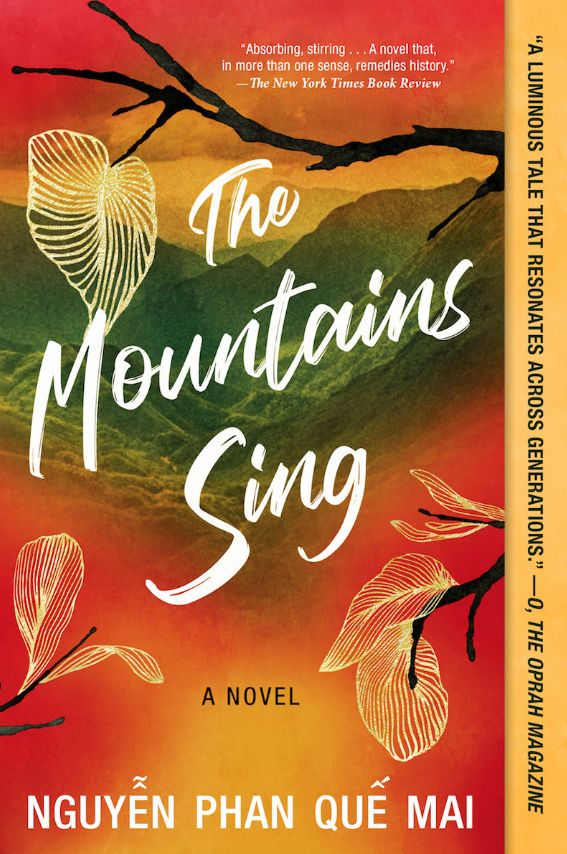
The Mountains Sing by Nguyễn Phan Quế Mai: A review

This is an account of Việt Nam’s twentieth-century history as experienced by one family, the Trần family, and as set, of course, against the background of war. 

Trần Diệu Lan was born in 1920 and she was forced to flee her family farm with her six children when the Communists came to power in the north and instituted their program of so-called "land reform." At mid-century in Hà Nội, her children head off down the Hồ Chí Minh Trail to fight first the French and then the Americans for control of their country. It was a conflict that tore her country and her family apart.

This is the first account I have read of that conflict from the point of view of the Vietnamese. It was really the defining conflict for my generation and it behooves us even now to try to understand what happened and how our country was drawn into it.

The multigenerational tale is told mostly from the point of view of women - grandmothers, mothers, and their children. The writer says that some of it is based on stories from her own family but that interviews with others who experienced these events as well as much reading of Vietnamese history also went into the writing of the book.

It is a brutal history with hardship, hunger, and death as constant companions in the lives of ordinary Vietnamese. Reading it gave me some understanding of the toughness of these people and their overwhelming sense of pride in their history and their customs and beliefs.

The Mountains Sing depicts an intimate family story spanning generations from the 1920s to the 1070s. I felt very connected to the narratives of the grandmother and granddaughter as they experienced the Great Hunger, Land Reform, and finally the War. Through them, we see the impact that all of these events had on ordinary people. At one point, the granddaughter says, “As the war continued, it was Grandma’s stories that kept me going and my hopes alive.”

The grandmother explained why she told the stories: “Do you understand why I’ve decided to tell you about our family? If our stories survive, we will not die, even when our bodies are no longer here on earth.”

I think it is the most any of us can hope for - that our stories survive so that we do not die. Nguyễn Phan Quế Mai has written a story that will, I think, survive.

Saturday, November 5, 2022

Poetry Sunday: At day-close in November by Thomas Hardy

When we moved to this house thirty-four years ago, the large yard, front and back, was bare except for the grass and a couple of small trees. We immediately got to work to change all that, planting trees and making beds for shrubs and perennials, and setting up a vegetable garden. The yard today would be unrecognizable to one who knew it only from thirty-five years ago. In the front yard, the tall live oaks and red oak spread their limbs in a protective canopy, and I'm sure that the children who walk by our house every day on their way to and from school cannot conceive that there was ever "a time when no tall trees grew here." But we set every tree in our "June time and now they obscure the sky."

At day-close in November

The ten hours’ light is abating,
And a late bird wings across,
Where the pines, like waltzers waiting,
Give their black heads a toss.
Beech leaves, that yellow the noontime,
Float past like specks in the eye;
I set every tree in my June time,
And now they obscure the sky.
And the children who ramble through here
Conceive that there never has been
A time when no tall trees grew here,
That none will in time be seen.

Friday, November 4, 2022

This week in birds - #525

 A roundup of the week's news of birds and the environment:

A common sight in Southeast Texas in the summer and fall - a pair of Cattle Egrets in a field.

*~*~*~*

Maui is leading the way! A new ordinance has been implemented there that will control outdoor illumination at night and will help keep migrating birds safe.

*~*~*~*

The prolonged drought has reduced the mighty Mississippi River to the status of a small stream in places and it has revealed shipwrecks, some of them from many decades ago. The shrinking of the river is having a serious impact in many places along its course. 

*~*~*~*

What is the cause of these "fairy circles" in the African desert? Many theories abound.

*~*~*~*

Environmentalists breathed a sigh of relief with the victory this week of Luiz Inacio Lula da Silva in the presidential election in Brazil. He has promised to protect the Amazon rainforest and restore Brazil's leadership in environmental matters.

*~*~*~*

Exposure to PFAS "forever chemicals" is widespread in this country. A study in North Carolina found nearly 100% of participants had been exposed to the chemicals. 

*~*~*~*

This is the Lesser Prairie-Chicken. It is the American Bird Conservancy's Bird of the Week. Like many birds of the prairie, its numbers are decreasing.

*~*~*~*

A Cop27 task force report this week warned that food companies and governments must come together to change agricultural practices or risk "destroying the planet."

*~*~*~*

The Mauna Loa volcano on the Big Island of Hawaii is giving indications that an eruption may be imminent.

*~*~*~*

Siberia is burning. The warming of the Arctic has led to extreme wildfire seasons in Siberia in recent years.

*~*~*~*

Wind energy could be the wave of the future for the Gulf South.

*~*~*~*

The last Chisos mountain oak, or lateleaf oak, was thought to have perished in 2011, but reports of its demise have proved premature. The tree has been found alive in Big Bend National Park.

*~*~*~*

Gabon, in Central Africa, is turning to its rainforest for revenue while also promising to preserve the forest.

*~*~*~*

Who are the biggest consumers of plastic on the planet? Why it is the blue whales who consume millions of particles of microplastic pollution every day. 

*~*~*~*

China is emitting more greenhouse gases because they are burning more coal. The country is seeking a viable alternative that will not pollute the environment. 

*~*~*~*

The National Park Service plans to rid one of Glacier National Park's coldest lakes of non-native trout in order to make it a refuge for a native variety. 

*~*~*~*

Nations are failing to meet their promises in regard to controlling harmful emissions and that could be a serious problem for the planet.

*~*~*~*

A Pinyon Jay enjoys a pinyon pine cone. These jays are decreasing in population throughout their range in the Southwest.

*~*~*~*

In a speech this week, President Biden accused oil and gas companies of 'war profiteering' off Russia's invasion of Ukraine.


*~*~*~*

Remember all the excitement a few years ago when there were reports that the Ivory-billed Woodpecker still lived in the swamps of Arkansas? There were never any verifiable sightings and eventually the excitement died. But there are still plenty of exciting species in those swamps and somewhere in there, there might even be an Ivory-billed.

*~*~*~*

This tiny butterfly is called the Fender's blue and there is good news about it. The good news is: It exists! Not only that but its numbers are increasing. All of that is particularly good news because a few years ago, the species was presumed to be extinct.

Wednesday, November 2, 2022

All Good People Here by Ashley Flowers: A review


Twenty years ago in Wakarusa, Indiana, six-year-old Margot Davies' friend and neighbor, January Jacobs, was kidnapped one night. Only hours after her parents awoke to find that she was gone, her dead body was found in a ditch. Her kidnapper/killer was never found and brought to justice.

Now, twenty-six-year-old Margot is a big-city journalist. Her life was scarred by the murder of her friend. She always had nightmares that it could have been her. 

Margot has returned to her hometown to care for her sick uncle and she finds that the town is just the same as she remembers with the same stifling atmosphere. Then history repeats itself.

In a neighboring town, five-year-old Natalie Clark has gone missing under circumstances eerily similar to the January Jacobs case. The similarity becomes even stronger when the child's body is found. 

Margot is consumed by her interest in the case and its similarities to that of her friend and she is determined to investigate and write a story that will make her job secure. Instead, her failure to deliver the story that her editors wanted on time results in her being terminated from her job. 

She is undeterred, however; she continues digging and working to discover the truth about both cases. She is convinced that the kidnapper/killer is the same person in both instances. She follows her journalistic instincts and training in working to uncover the truth.

This book was 336 pages long but it felt longer to me. The story developed slowly and the reading of it felt equally slow. This was the author's debut novel. Her background is that of a true crime podcast producer. This book may be a reflection of her inexperience in that there is a lack of character development and the plot does not adequately (in my opinion) flesh out the story about the similarities between the modern and historical murders of two little girls. And, my goodness, Ms. Flowers, give us an ending! Don't just leave everything hanging ambiguously.

In spite of my caveats, this was a creditable first novel and I would look for even better things from Flowers in the future.