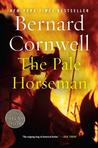
 The Pale Horseman by Bernard Cornwell
My rating: 4 of 5 stars
Uhtred Ragnarson is a divided man. He was a Saxon, born in 9th century Northumbria, at a time when England was regularly being raided by the viking Danes. He grew up in a time of warfare and learned to fight at his father's side, which is where he was when his father was killed by Danes in battle. Uhtred was still a child but he fought so savagely against his father's killers that he impressed Ragnar, their leader. Instead of killing him, Ragnar captured and eventually adopted him, and so the Saxon boy grew up as a Dane.
Uhtred was fully Dane in his culture. He admired the Danes and loved his adoptive family. He received his post-graduate course in fighting from them and so he learned both the Saxon way and the Danes' way of battle. It was to serve him well in later years.
We meet Uhtred here as a brash and arrogant twenty-year-old, cocksure of his own strength and his power to overcome all enemies. Not a pleasant bloke. Not the guy with whom you'd want to sit down and have a cup of tea.
In spite of the fact that he loves the Danes and considers himself one of them, Uhtred is still a Saxon and still hopes to reclaim his family lands in Northumbria. In his pursuit of that goal, he aligns himself with Alfred of Wessex. He gives Alfred his oath. He will fight against the Danes.
By the ninth century, the Saxons, Uhtred's people, had taken most of the territory of the future England from the Britons and the Welsh. They had, in fact, held most of the land for hundreds of years. It had been divided into seven different Saxon kingdoms, but by the 870s when the action of this novel takes place, all those kingdoms had fallen to the Danes one after the other until only Wessex and its king, Alfred, were left standing.
This Alfred is, of course, the one who will later be known to the English as "the Great" and in this book we catch glimpses of why he may have come to earn that name. Alfred is a sickly man, who suffers greatly from intestinal complaints. He is a Christian and he wants all of his kingdom to be Christian. His strongest character trait may be his stubbornness. He refuses to give up even when greatly outnumbered. He insists that God is on his side and so he cannot be defeated.
Uhtred has difficulty gaining and staying in Alfred's favor because he is not a Christian and has no desire to become one. He follows the gods of the Danes, carrying an amulet of Thor's hammer around his neck. Moreover, he has taken up with a pagan woman, a Briton, who some believe to be a witch. All this while he is still married to a Saxon woman with whom he has a son.
Cornwell spends a good bit of time in The Pale Horseman developing the relationships and the personalities of his characters, but he doesn't stint on the blood and guts when it comes to the descriptions of battles and of the hardships that Alfred and his few followers have to endure while they are stuck for a time in a swamp. He gives vivid descriptions of shield wall warfare - much of which my eyes glided right over, frankly - and he gives us balanced perspectives from both the Saxon and the Danish viewpoints.
What he doesn't give us is a feminine viewpoint, but then women had very little to do with Cornwell's tale. It makes one wonder where all those hardy men came from.
The Pale Horseman is a rousing good adventure tale of masculine derring-do for those who enjoy the genre. Plus, it has the advantage of being based on actual events. It gives us a window into the time when England as we know it today was just becoming a possibility. It was mostly because of the man called Alfred and perhaps of warriors not unlike Uhtred Ragnarson.
View all my reviews
Interesting reading. I would love to read it at some point to get a sense of how England came to be.
ReplyDeleteIt makes for an exciting read and is more or less true to historical events, I think.
DeletePleasurable thank you for sharing
ReplyDeleteThanks for stopping by, Martin.
Delete