Books, gardens, birds, the environment, politics, or whatever happens to be grabbing my attention today.
Thanks for Following
Tuesday, October 29, 2024
Pigs in Heaven by Barbara Kingsolver: A review
Saturday, October 26, 2024
Poetry Sunday: Why I Wake Early by Mary Oliver
Why I Wake Early
by Mary Oliver
Hello, sun in my face.
Hello, you who make the morning
and spread it over the fields
and into the faces of the tulips
and the nodding morning glories,
and into the windows of, even, the
miserable and crotchety–
best preacher that ever was,
dear star, that just happens
to be where you are in the universe
to keep us from ever-darkness,
to ease us with warm touching,
to hold us in the great hands of light–
good morning, good morning, good morning.
Watch, now, how I start the day
in happiness, in kindness.
Friday, October 25, 2024
This week in birds - #607
A roundup of the week's news of birds and the environment:
It's butterfly season in my backyard. The cohort is led by Cloudless Sulphurs like this one feasting on one of my Hamelia patens shrubs. These shrubs with their tubular blossoms are great favorites with butterflies and with the hummingbirds that are now passing through. In past years, there would be many Monarch butterflies among the cohort. Not this year. So far this October I've not seen a single Monarch.*~*~*~*
South America is experiencing a historic drought and the Amazon is drying up.
*~*~*~*
Some of the world's poorest nations are very rich in Nature. They need help protecting it. As the COP 16 conference meets in Colombia, delegates will push to ensure that protection. That need is urgent because the world's nations are lagging behind on their expressed goals.
*~*~*~*
New discoveries lead paleontologists to speculate that the origin of dinosaurs dates back much further than had been believed.
*~*~*~*
The Arctic National Wildlife Refuge is a very wild place but it needs protection to stay that way.
*~*~*~*
What species of birds are most likely to collide with windows during their migration and what can you do to help prevent it?
*~*~*~*
Mysterious white blobs have been washing up on Newfoundland's shores and their origin is still unknown.
*~*~*~*
Here's an article from a few months back about the connection between birds and insects. What's good for one is often good for the other.
*~*~*~*
If you want to rent a panda, China demands five things from you.
*~*~*~*
Pawpaws, the native American fruit, may be a popular fruit of the future in a world that is heating up.
*~*~*~*
Archaeologists say that new finds in the ancient city of Petra have been over-hyped.
*~*~*~*
The export of millions of critically endangered eels from the United Kingdom to Russia is being criticized as "bonkers" by some scientists and conservationists.
*~*~*~*
If you decorate for Halloween, make sure those decorations are bird-friendly.
*~*~*~*
This is the Common Poorwill, a resident of several western states and northern Mexico. It is the American Bird Conservancy's Bird of the Week.
*~*~*~*
Why would bumblebee queens choose to hibernate in soil that is full of pesticides and poisons? It's a mystery and the bumblebees aren't telling.
*~*~*~*
England is allowing some of its land to return to salt marshes in a radical approach to control flooding.
*~*~*~*
Here's an article from the past that explores how scientists track birds in migration.
*~*~*~*
The Atlantic meridional overturning circulation (AMOC) is a system of ocean currents that delivers heat to the northern Atlantic. Experts warn that it is in danger of breaking down.
*~*~*~*
The war in Ukraine is a threat to its unique red seaweed fields.
*~*~*~*
How do you teach rescued jaguars to be jaguars so that they can be returned to the wild?
*~*~*~*
Giant salmon carp, known as the "Mekong Ghost," had been feared to be extinct but they've now been rediscovered in Cambodia.
*~*~*~*
What will happen to Nature in Ukraine once the war there is over? Will it be allowed to revive?
*~*~*~*
Recent discoveries suggest that the ancient Silk Road trade routes were more complex than had previously been believed.
*~*~*~*
An adventurous dog climbed to the top of the Khafre Pyramid in Egypt and became an internet star!
Tuesday, October 22, 2024
We Solve Murders by Richard Osman: A review
Having previously read and enjoyed two Richard Osman mysteries - The Thursday Murder Club and The Last Devil to Die - I couldn't resist when I saw he had a new one out. So, once again, I abandoned my planned reading list and jumped right on it.
In We Solve Murders, Osman introduces us to some new characters:
Amy Wheeler is a private security guard who works at protecting VIPs. She is married to Adam, a man who she almost never sees. At the time that we meet them, they are on opposite side sides of the world. Strangely enough, it is a very happy marriage. (Or maybe that isn't so strange.) Her closest relationship seems to be with her father-in-law, Steve Wheeler.
Steve is a widower who is still grieving for his beloved wife and still talks to her every day, telling her about the events of that day. He is a retired cop and presently a private investigator. He is known at his local pub as a quiz and puzzle expert. He is a lover of cats, especially his own, named Trouble, and he can't resist a stray. And, of course, he is devoted to Amy.
Rosie D'Antonio is the VIP that Amy is presently charged with protecting. She is probably in her 80s, although her actual age is unknown, but she lives like a much younger person. Rosie is a successful and very famous writer. In her latest book, she has a character who seems a bit too close in description to a Russian oligarch named Vasiliy Karpin. That has earned her the unwanted attention of said oligarch and is the reason she needs protection.
Amy and Rosie, along with a former Navy Seal named Kevin who is now a chef, take refuge on a private South Carolina island. When an "influencer" named Andrew Fairbanks is found murdered on a yacht near the island, Amy realizes it is time to move on. She enlists Steve's help and together they drag Rosie with them as they embark on a heart-stopping adventure always just one step ahead of the hitmen who have been sent to eliminate Rosie.
And who is the person sending those hitmen? His name is François Loubet. He is a powerful money smuggler whose modus operandi is sending influencers on fake jobs and using them to move his money around the world. Will Amy and Steve be able to outsmart Loubet and elude his hitmen long enough to ensure Rosie's safety? You can probably guess the answer to that question.
Osman is adept at drawing each of these characters. We feel that we know them all very well and we certainly know who to root for and who to boo! The plot itself is carefully explicated with nothing left to guess at. And there is plenty of action to keep us turning the pages, making for a very enjoyable and quick read.
This, apparently, was the first in what Osman plans as a series. I'll be keeping an eye out for the next adventure featuring Amy and Steve.
Saturday, October 19, 2024
Poetry Sunday: Goldenrod by Mary Oliver
Let's have another Mary Oliver poem, shall we? One that celebrates the season and the plant much loved by bees. And me.
Goldenrod
Friday, October 18, 2024
This week in birds - #606
A roundup of the week's news of birds and the environment:
This is the American Bird Conservancy's Bird of the Week, the Upland Sandpiper, a bird of open grasslands, hayfields, and prairies. It is one species that seems to be doing well; its numbers are increasing.*~*~*~*
Is the carbon sink that keeps Nature in balance failing?
*~*~*~*
A botulism outbreak in California has caused mass bird deaths. More than 94,000 birds have died.
*~*~*~*
These thirty-four species are not "new" but they've only recently been discovered by humans.
*~*~*~*
A reforesting project is revitalizing Rio. And in Ireland, one landowner is rewilding his land in hopes of changing an area that had become an ecological desert.
*~*~*~*
Here's how scientists use a wind tunnel to study bird migration.
*~*~*~*
A new marine sanctuary has been created off the coast of California.
*~*~*~*
And halfway around the world, here are some of the creatures that call the Atlantic Ocean home.
*~*~*~*
And in the waters off the Galapagos Islands lives one of the strangest of creatures - the Red-lipped Batfish.
*~*~*~*
It seems that many countries are not doing well in achieving the goals they set for themselves for preserving Nature.
*~*~*~*
The Natural History Museum in London has designed a garden to trace 500 million years of geologic history.
*~*~*~*
In British East Africa in the 19th century, two man-eating lions were the cause of great terror in the region.
*~*~*~*
As a teenager, I loved reading stories in National Geographic about the Leakey family's discovery of fossils in the Olduvai Gorge in Tanzania. Discoveries are still being made there and they still fascinate me.
*~*~*~*
A dying sugar maple tree in Pennsylvania lives on in new forms.
*~*~*~*
Water shortages around the world are threatening our ability to produce food.
*~*~*~*
The boundary between the United States and Mexico is defined by the Rio Grande River. It doesn't need a wall to reinforce it.
*~*~*~*
Is it possible for scientists to recreate the Thylacine, the Tasmanian Tiger?
*~*~*~*
The National Zoo in Washington, D.C., is teaching people how to band birds.
*~*~*~*
What are these gooey white blobs that are washing up on Canada's beaches?
*~*~*~*
Can two Brazilian politicians unite to help save the Amazon?
*~*~*~*
Artificial nests are helping endangered penguins breed.
*~*~*~*
A research team has found microplastics in the breath of dolphins.
*~*~*~*
One woman learned the hard way that you shouldn't feed raccoons.
*~*~*~*
I am a fan of spiders so I was interested to see this story about three remarkable members of the species.
*~*~*~*
A molecular biologist who won the Nobel Prize thanked a worm in his acceptance speech.
*~*~*~*
The University of California at San Diego is requiring students to take a climate change course in order to graduate.
*~*~*~*
Southern killer whales are on the brink of extinction, but it is not because of a lack of food.
*~*~*~*
British Petroleum (BP) is retreating from its targets designed to make it a net zero energy company by 2050.
*~*~*~*
Researchers are collecting wolf howls in Yellowstone National Park as a means of estimating the population of the canids.
*~*~*~*
Another scientific study is looking into how humans evolved to eat starchy foods.
*~*~*~*
A high-rise development in Brooklyn threatens to put the Brooklyn Botanic Garden in its shade.
*~*~*~*
A comet last seen in the times of the Neanderthals will be visible from parts of the northern hemisphere this weekend.
*~*~*~*
And far out in space, the question of whether life exists on Europa, one of the moons of Jupiter, is still unanswered. NASA is planning to send a probe to investigate.
*~*~*~*
In her latest column, Margaret Renkl considers the changing of the seasons.
*~*~*~*
Trail cams in Alaska offer intimate looks at the lives of animals.
*~*~*~*
Finally, here's a look at some baby Gyrfalcons taking their momentous first flight.
Saturday, October 12, 2024
Poetry Sunday: Gathering Leaves by Robert Frost
Leaves are falling. Great heaps of them lie on the ground waiting to be removed to the compost bins. They are a rich harvest. Small animals will be glad for the heat of their decaying this winter and afterward garden beds will receive them. Nothing in Nature is wasted.
Gathering Leaves
by Robert Frost
Spades take up leavesNo better than spoons,
And bags full of leaves
Are light as balloons.
Friday, October 11, 2024
This week in birds - #605
A roundup of the week's news of birds and the environment:
Ruby-throated Hummingbirds continue passing through in migration, but I've still only seen immatures and females like this one - no adult males yet.*~*~*~*
Do you live in a "fun state"? (I note that Texas is #7 on the list.)
*~*~*~*
Wildlife populations are collapsing in many areas.
*~*~*~*
That collapse may be exacerbated by the fact that Earth's vital signs have reached record extremes.
*~*~*~*
Meanwhile, in the Sahara Desert, a rare deluge of rain has fallen.
*~*~*~*
Back in this country, the Supreme Court has refused to block new Biden administration efforts to address climate change and air pollution.
*~*~*~*
A UN biodiversity summit in Colombia will assess the progress made on countries' promises to help save the developing world's ecosystems.
*~*~*~*
The Northern Lights have put on quite a show this week.
*~*~*~*
The highest peak in the Great Smoky Mountains had been named after a Confederate general but will now be rechristened to reflect the name that it was previously called by the Cherokee.
*~*~*~*
And here is a story about the Japanese naturalist who helped to bring about the creation of the Great Smoky Mountains National Park.
*~*~*~*
Kleptoparasitism as practiced by "pirate seabirds" might be a vector for spreading avian flu.
*~*~*~*
One hundred bison from the North Rim of the Grand Canyon National Park have been successfully relocated to South Dakota in an effort to reduce the overpopulation of the animals at the park.
*~*~*~*
This little cutie is the Rock Wren, a bird of arid, rocky places and it is the American Bird Conservancy's Bird of the Week.*~*~*~*
A new study suggests that different species of birds deliberately team up during migration as they make their death-defying trips.
*~*~*~*
Old subway cars are being added to an artificial reef off the coast of Georgia to create more wildlife habitat.
*~*~*~*
In South Africa, human actions have pushed together an unlikely combination of predator and prey - the caracal and Cape Cormorants and African Penguins.
*~*~*~*
Protecting Iceland's Puffin chicks is the business of the "Puffling Patrol."
*~*~*~*
In a step toward rewilding parts of Great Britain, a herd of tauros (cattle-like animals) is to be released into the Scottish Highlands. It is an effort to recreate the ecological role of the extinct aurochs.
*~*~*~*
This is the Hoiho, a rare yellow-eyed penguin native to New Zealand and it is that country's Bird of the Year.*~*~*~*
The world's rivers are drying up at the fastest rate in thirty years.
*~*~*~*
Although 140 countries pledged three years ago to halt deforestation by the end of the decade, the destruction of the world's forests actually increased in 2023.
*~*~*~*
Avian flu is threatening the recovery of the Bald Eagle from its brink of near extinction.
*~*~*~*
Salmon numbers in England and Wales were the lowest on record in 2023.
*~*~*~*
But in the Klamath River in California and Oregon, salmon are now swimming freely after the removal of a dam.
Thursday, October 10, 2024
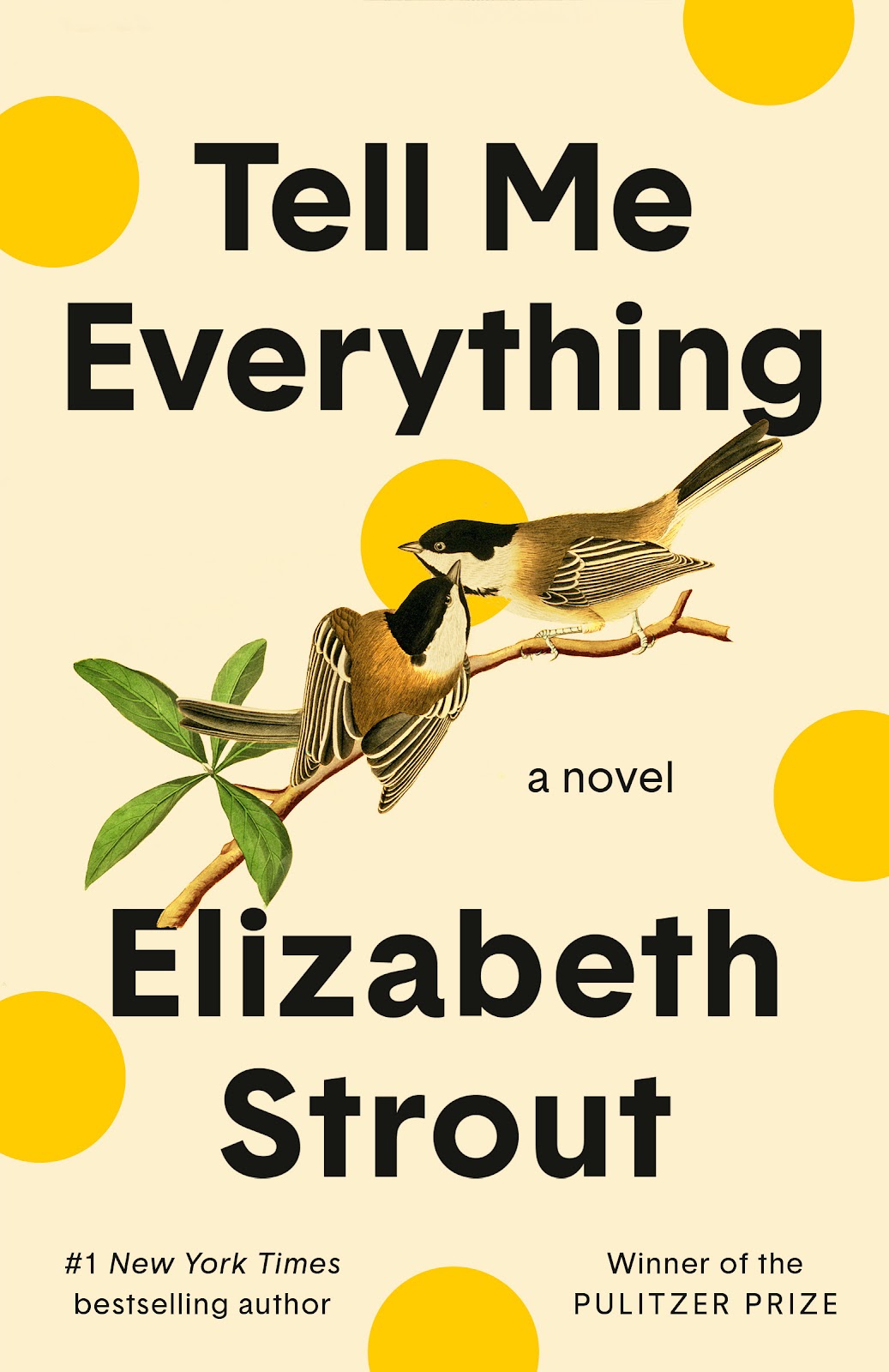
Tell Me Everything by Elizabeth Strout: A review
Bob is the town lawyer and he has the unenviable task of defending a lonely man who is accused of murdering his mother. It was a crime that shocked the community of Crosby, a community that seems to have already made up its mind that the man is guilty.
Meanwhile, Lucy has come to know Olive and she visits her each afternoon. The two of them tell each other stories about their lives and the "unrecorded lives" of people they have known. In the process, those people and their lives are given the respect and meaning that they deserve.
Elizabeth Strout writes about people who live ordinary lives, unremarkable in any way, and yet she shows us that those lives are indeed interesting. Each of us, no matter how ordinary, has a story to tell and has an impact for good or bad on the people and the world around us.
Thus, Strout has written a character-driven novel for which the plot (such as one exists) is secondary. Her theme seems to be that it is important to notice the little things in life, because it is those little things that, in the end, create the big picture of our lives. And that, I think, is an important message for all of us to take to heart. Perhaps it takes a brilliant writer like Strout to make that clear to us.
Nobel Prize for Literature
So Han Kang has won the Nobel Prize for Literature. I read her book, The Vegetarian, back in 2017 and gave it five stars. In 2019, I read The White Book by her. Also five stars! I very seldom have five-star reads so obviously I was impressed, just like the Nobel judges. I see she has a new book, We Do Not Part, that will be out in translation next January. I'm putting it on my read list now.
Monday, October 7, 2024
Death at the Sanatorium by Ragnar Jonasson: A review
This book has three timelines, 2012, 1983, and 1950, and the narrative goes back and forth among the three. The setting of the story is an old tuberculosis sanatorium in northern Iceland and it involves the murder of a nurse and the apparent suicide (or maybe it, too, was murder) of the chief physician in 1983.
In 2012, a student named Helgi who is a lover of whodunits, has returned to Iceland after finishing his studies in the United Kingdom. He begins work on his Master of Arts dissertation on criminology and takes as his subject the murder and suicide (or possibly second murder) that took place at the sanatorium back in 1983.
The murder was never actually solved. The detective assigned to the case, a man named Sverrir, was eager to close it as soon as possible and he arrested the facility's caretaker on the flimsiest of evidence. Detective Hulda Hermannsdóttir had misgivings about her superior's action but did not have the authority to prevent it. A few days later the chief physician died in a fall at the sanatorium and Sverrir called it the suicide of the nurse's murderer. Case closed.
In his pursuit of research for his dissertation, Helgi contacts people who worked at the sanatorium to learn their memories and opinions about what happened in 1983. He follows leads that were never investigated by Sverrir and he learns that the man is now married to the nurse who had discovered both the deaths. Coincidence? Not likely!
Helgi is considering an opportunity to join the Reykjavik police department as Hulda's successor. He proves his worthiness for that position when he actually solves the decades-old mystery.
This was an interesting and well-written mystery. I thought I had read books by Jonasson previously but it turns out I had him confused with another writer. He's now on my "read" list and I will likely return to him in the future.
Saturday, October 5, 2024
Poetry Sunday: October's Bright Blue Weather by Helen Hunt Jackson
October is usually one of the most pleasant months of the year for us here near the Gulf Coast and so it is (so far) this year. Beautiful blue skies, goldenrod, gold and scarlet fallen leaves, and temperatures that generally top out in the high eighties Fahrenheit. It is, indeed, the best of times.
October's Bright Blue Weather
by Helen Hunt Jackson
O suns and skies and clouds of June,Ye cannot rival for one hour
October's bright blue weather;
When loud the bumblebee makes haste,
Belated, thriftless vagrant,
And goldenrod is dying fast,
And lanes with grapes are fragrant;
When gentians roll their fingers tight
To save them for the morning,
And chestnuts fall from satin burrs
Without a sound of warning;
When on the ground red apples lie
In piles like jewels shining,
And redder still on old stone walls
Are leaves of woodbine twining;
When all the lovely wayside things
Their white-winged seeds are sowing,
And in the fields still green and fair,
Late aftermaths are growing;
When springs run low, and on the brooks,
In idle golden freighting,
Bright leaves sink noiseless in the hush
Of woods, for winter waiting;
When comrades seek sweet country haunts,
By twos and twos together,
And count like misers, hour by hour,
October's bright blue weather.
O sun and skies and flowers of June,
Count all your boasts together,
Love loveth best of all the year
October's bright blue weather.
Friday, October 4, 2024
This week in birds - #604
A roundup of the week's news of birds and the environment:
The Eastern Bluebird is an always welcome visitor to my yard.*~*~*~*
It's that time again - time for Project Feederwatch. Sign up to document the birds around your yard and contribute to the accumulation of knowledge about their ranges. The count begins on November 1.
*~*~*~*
Humanity has a finite carbon budget and wildfires around the world are burning right through it. In South America, huge tracts of land are being decimated by fire and the skies are shrouded by smoke.
*~*~*~*
Meanwhile, the southwestern United States is being scorched by an exceptional heat wave. Temperatures as high as 117 degrees F. have been recorded.
*~*~*~*
Rachel Carson's Silent Spring has had a profound effect on how the public views chemicals, creating, in some instances, an irrational fear of them.
*~*~*~*
Colombian environment minister Susana Muhamad has been called the "Frida Kahlo of environmental geopolitics."
*~*~*~*
Here's a good thing: In the Midwest, swaths of the prairie are being restored to reduce the nutrient runoff from croplands and to aid the birds and bees.
*~*~*~*
The idea of restoring meadows of wildflowers and native grasses is catching on in other places as well.
*~*~*~*
The pawpaw is a fruit tree native to the United States and it is resilient to climate change. Could its fruit become the new kiwi or mango?
*~*~*~*
Climate change is even changing borders between countries.
*~*~*~*
And in London, public parks are being allowed to go wild on purpose.
*~*~*~*
This is the Southern Lapwing, a member of the plover family found throughout the grasslands and wetlands of South America. It has recently expanded its range into Central America and southern Mexico. It is the American Bird Conservancy's Bird of the Week.*~*~*~*
On the sea turtle nesting grounds in Greece, there is very good news. There are a record number of nests this year.
*~*~*~*
October 2 was a momentous day for California's Klamath River; it marked the complete removal of four hydroelectric dams that will restore salmon and steelhead trout habitat in several miles of the river.
*~*~*~*
A new study has discovered the extent of Europe's once-massive oyster reefs, now exhausted.
*~*~*~*
The fight goes on to save the much-loved Monarch butterfly.*~*~*~*
In a first for the Endangered Species Act list, officials are proposing to add a firefly, the Bethany Beach firefly, to the list as a threatened species.
*~*~*~*
Magical, mystical mushrooms have uses that are only now being discovered and utilized.
*~*~*~*
Nibi the beaver was rescued from the side of a road when she was a baby. She's now grown up and could potentially be released into the wild but there's a lot of controversy about that and now a court will decide her fate.
*~*~*~*
On Navajo lands in Arizona, ancient practices are restoring the parched land.
*~*~*~*
It's tarantula mating season in Colorado and that is drawing arachnophiles from far and near to witness it.
*~*~*~*
Cuttlefish in the Mediterranean Sea are getting a helping hand from humans to boost their numbers.
*~*~*~*
A Lesser Flamingo chick is being cared for by two flamingo foster fathers at the San Diego Zoo Safari Park and it all seems to be working out quite well.
Wednesday, October 2, 2024
Weyward by Emilia Hart: A review
Weyward tells the stories of three women from three different centuries, women who are tied together by blood and by the common sanctuary that each of them found in a place called Weyward Cottage. We meet and get to know Kate from 2019, Violet from 1942, and Altha from 1619. Perhaps most importantly we get to know the cottage that is worlds away from the unhappiness and abuse that those three women experienced in their lives.
Kate had inherited the cottage in 2019 from a great-aunt whom she barely knew. The inheritance came at a fortuitous time as she needed to escape from an abusive relationship. As things became unbearable for her, she fled under cover of darkness to the cottage where she had never really spent any time previously. It felt to her like coming home.
In 1619, Altha was charged with witchcraft. She was accused of having murdered a local farmer by causing a stampede of his cattle that had trampled and killed him. Her mother had taught her knowledge of the natural world and such knowledge was considered dangerous by her neighbors who didn't possess or understand it. They could not appreciate that they, too, were a part of Nature.
We meet Violet in 1942 as World War II is raging. Violet wants to seek an education like her brother is receiving but social convention at the time forbids it and she is trapped on her family's estate. Violet owns a mysterious locket that came from her mother and is engraved with the letter "W." Moreover, on a baseboard in her bedroom, she finds the word "weyward" scratched. What does it all mean?
Emilia Hart weaves together the stories of these three women and of their sanctuary cottage. Their stories give testament to the resilience of women and to the power of the natural world to transform and heal.
The stories also make clear that not enough has changed regarding the status of women over more than four centuries. Even in the twenty-first century, women must often struggle to be considered equal to men in the rights they have and in their place in society.
Hart's first book was a remarkable accomplishment that won her the Goodreads Best Historical Fiction and Best Debut Novel awards in 2023. It is so well-written that it is actually difficult to believe that this was her first novel, although it should be noted that she had previously published considerable short fiction. I think she likely has a bright future as a novelist.