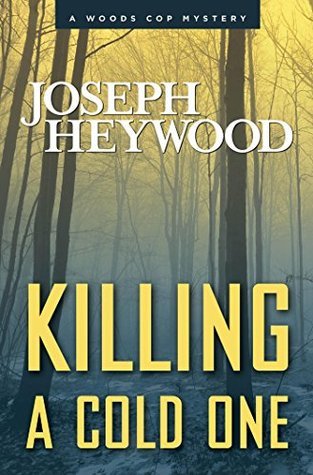
Killing a Cold One by Joseph Heywood: A review


In honor of my Michigan-born son-in-law, I decided to read another of these Woods Cop mysteries that are set in his home state. They feature "Woods Cop" Grady Service who patrols the Mosquito Wilderness area of that state. Though his official job is as a conservation officer, he always seems to get drawn into investigations of murders and that is the case once again in Killing a Cold One.

This one was a rather complicated story; moreover, there are a LOT of characters and I sometimes found it a bit difficult to keep them all straight. This was not made any easier by the author being inconsistent in the names that he used for them. Every character seemed to have at least three names and each of those names might be applied to him/her at different points in the narrative. Color me confused.

The story involved the violent killing and mutilation of two Native American girls. Their bodies were found in a tent in a remote area of the Huron Mountains and nearby there were strange, unidentified animal tracks. The governor of the state, nearing the end of her term in office, orders Grady to hunt down and kill the animal that made those tracks.

Is the creature a dogman? There are many in the area who believe that such an animal exists. There are also many who believe in Bigfoot, werewolves, vampires, and angels, but there haven't been any verified sightings of any of them either. Investigating what made the tracks and what might have killed the women takes Grady into some of the Upper Peninsula's harshest terrain. 

In this book, we get to know Tuesday Friday (yes, that's actually the name the author gave her) who is a coworker and potential romantic interest of Grady's and we spend a lot of time with woodsman Limpy Allerdyce who speaks in what I'm guessing is the patois of the area which sometimes gave me pause when trying to figure out what he was saying.  

It's interesting that I actually found Allerdyce a more likable and relatable character than Grady, who sometimes behaves like a bit of a jerk. But the two of them, along with Tuesday, do make a rather effective team and justice is served in the end.

Comments

  1. Tuesday Friday is really her name? Funny. It's an interesting premise. It's too bad Grady wasn't the more likable character.

    ReplyDelete
    Replies
    1. Yes, that was actually her name. One of the weirder things about the book.

      Delete
  2. Sounds like an interesting read. Keeping track of the various characters with various names sounds difficult... I started reading Anna Karenina last month, which I've paused reading at the moment, also has characters with multiple names (mainly nicknames) making it difficult to keep track of who is who sometimes.

    I recently finished reading Cari Mora by Thomas Harris and that novel had way too many characters.

    ReplyDelete
    Replies
    1. I remember reading "Anna Karenina" so many years ago when my brain was a lot younger and even then it was a lot to keep track of!

      Delete
  3. Lots of characters...multiple names for the same characters...a complicated plot...these are some of the problems I often have with mysteries. Violence in stories is difficult for me, too. Cozies seem to trivialize murder....all of these things keep me away from mysteries.

    ReplyDelete

Post a Comment

Popular posts from this blog

Poetry Sunday: Don't Hesitate by Mary Oliver

How about we share another Mary Oliver poem? After all, you can never have too many of those. In this one, the poet seems to acknowledge that it is often hard to simply live in and enjoy the moment, perhaps because we are afraid it can't last. She urges us to give in to that moment and fully experience the joy. Although "much can never be redeemed, still, life has some possibility left." Don't Hesitate by Mary Oliver If you suddenly and unexpectedly feel joy, don’t hesitate. Give in to it. There are plenty of lives and whole towns destroyed or about to be. We are not wise, and not very often kind. And much can never be redeemed. Still, life has some possibility left. Perhaps this is its way of fighting back, that sometimes something happens better than all the riches or power in the world. It could be anything, but very likely you notice it in the instant when love begins. Anyway, that’s often the case. Anyway, whatever it is, don’t be afraid of its plenty. Joy is no...

Poetry Sunday: Blackberry-Picking by Seamus Heaney

My mother was a farm wife and a prodigious canner. She canned fruit and vegetables from the garden, even occasionally meat. But the best thing that she canned, in my opinion, was blackberry jam. Even as I type those words my mouth waters!  Of course, before she could make that jam, somebody had to pick the blackberries. And that somebody was quite often named Dorothy. I think Seamus Heaney might have spent some time among the briars plucking those delicious black fruits as well, so he would have known that "Once off the bush the fruit fermented, the sweet flesh would turn sour." They don't keep; you have to get that jam made in a hurry! Blackberry-Picking by Seamus Heaney Late August, given heavy rain and sun For a full week, the blackberries would ripen. At first, just one, a glossy purple clot Among others, red, green, hard as a knot. You ate that first one and its flesh was sweet Like thickened wine: summer's blood was in it Leaving stains upon the tongue and lust ...

Poetry Sunday: Hymn for the Hurting by Amanda Gorman

You probably remember poet Amanda Gorman from her appearance at the inauguration of President Biden. She read her poem "The Hill We Climb" on that occasion. After the senseless slaughter in Uvalde this week, she was inspired to write another poem which was published in The New York Times. It seemed perfect for the occasion and so I stole it in order to feature it here, just in case you didn't get a chance to read it in the Times . Hymn for the Hurting by Amanda Gorman Everything hurts, Our hearts shadowed and strange, Minds made muddied and mute. We carry tragedy, terrifying and true. And yet none of it is new; We knew it as home, As horror, As heritage. Even our children Cannot be children, Cannot be. Everything hurts. It’s a hard time to be alive, And even harder to stay that way. We’re burdened to live out these days, While at the same time, blessed to outlive them. This alarm is how we know We must be altered — That we must differ or die, That we must triumph or try. ...