Thanks for Following

Saturday, March 29, 2025

Poetry Sunday: Spring and All: III [The farmer in deep thought] by William Carlos Williams

My father was a farmer. This poem makes me think of him. How often I  have seen him pacing his fields - "the artist figure of the farmer" - in early spring as, in his mind, he is composing and he sees the fields already planted...

Spring and All: III [The farmer in deep thought]

BY William Carlos Williams
The farmer in deep thought
is pacing through the rain
among his blank fields, with
hands in pockets,
in his head
the harvest already planted.
A cold wind ruffles the water
among the browned weeds.
On all sides
the world rolls coldly away :
black orchards
darkened by the March clouds —
leaving room for thought.
Down past the brushwood
bristling by
the rainsluiced wagonroad
looms the artist figure of
the farmer — composing
— antagonist.

Friday, March 28, 2025

This week in birds - #628

 A roundup of the week's news of birds and the environment:

A bird that nests in the salt and brackish marshes of the Atlantic and Gulf Coasts of the United States, the well-named Seaside Sparrow appears to be holding its own, with a stable population. Its range reaches all the way from southern New Hampshire to southern Texas, and that range is home to at least seven distinct subspecies of the bird. It is the American Bird Conservancy's Bird of the Week.

*~*~*~*

Measles is making a comeback in West Texas and is spreading to other communities. It's not a good time to be an anti-vaxxer.

*~*~*~*

Spring migration is well underway and Journey North has some reports from the field.

*~*~*~*

One of the byproducts of Russia's invasion of Ukraine has been a deadly spill of oil on the Black Sea. 

*~*~*~*

Hummingbirds are on their way and although I know they have reached my area I haven't seen any in my yard yet. But my feeders are stocked and waiting.

*~*~*~*

Off the South African coast, killer whales are hunting great white sharks.

*~*~*~*

Although they once opposed an oil pipeline in the Northeast, Democrats may now help to revive it.  

*~*~*~*

Oh, Canada, you are the best neighbor any country could have and we are so sorry! (And, yes, that apology goes out to Mexico, too.) 

*~*~*~*

Meteorologist James Spann is concerned about possible cuts to the budget for the National Weather Service. He is right to be concerned.

*~*~*~*

There's some exciting news from the world of Egyptology: A huge tomb of an unknown pharaoh has been discovered at the ancient city of Abydos. The tomb is estimated to be 3,600 years old.

*~*~*~*

Dozens of eggs and chicks of Double-crested Cormorants have been rescued from a collapsing eucalyptus tree in California.

*~*~*~*

Spiders don't have ears but it turns out that sound vibrations do affect them and they build webs to help protect themselves from noise pollution.

*~*~*~*

Eastern Bluebirds are once again checking out the nesting box outside my kitchen window. We'll see whether they or the Carolina Chickadees who have also been checking it out decide that it is a good place to raise a family this year. Here are six ways to attract bluebirds to your yard.

*~*~*~*

Here's why funding basic science is a smart thing for government to do and why DOGE cuts to agencies like the National Science Foundation, NOAA, and National Institutes of Health are incredibly stupid.

Saturday, March 22, 2025

Poetry Sunday: The Moment by Margaret Atwood

I love this poem by Margaret Atwood. It is a timely reminder that we truly "own" nothing here. We are visitors only and Earth will surely continue when we are gone. And it is incumbent on us to do what we can to preserve what is here for those who follow us.

The Moment

by Margaret Atwood

The moment when, after many years
of hard work and a long voyage
you stand in the centre of your room,
house, half-acre, square mile, island, country,
knowing at last how you got there,
and say, I own this,

is the same moment when the trees unloose
their soft arms from around you,
the birds take back their language,
the cliffs fissure and collapse,
the air moves back from you like a wave
and you can't breathe.

No, they whisper. You own nothing.
You were a visitor, time after time
climbing the hill, planting the flag, proclaiming.
We never belonged to you.
You never found us.
It was always the other way round.

This week in birds - #627

 A roundup of the week's news of birds and the environment:

This is the wonderful Whimbrel, a bird of the coasts of North, Central, and South American. It is a prodigious flyer that may travel as much as 2,500 miles in migration. I have frequently encountered it on autumn birding trips along the shores of the Gulf of Mexico. It is the American Bird Conservancy's Bird of the Week

*~*~*~*

When those NASA astronauts splashed down earlier this week, they had a special welcoming committee - a pod of curious dolphins

*~*~*~*

Unfortunately, much of the news of the environment this week emanates from Washington and the new administration there as it continues its slash and burn takeover of government agencies. One action was to plan the closure of the Global Monitoring Laboratory in Hilo, Hawaii, that collects data on global carbon dioxide levels. (Because who need that, right?) The team there had also been posting regular updates on the eruption of the Kilauea volcano

*~*~*~*

The man selected to head the Environmental Protection Agency seems intent on destroying it. The rollbacks at the EPA put people's lives at risk.

*~*~*~*

The new administration also appears to be revoking the status of certain national monuments, especially if they were designated as such by the previous administration.

*~*~*~*

Oil and gas producers will now be able to run rampant through millions of acres in Alaska that had previously been protected from their depredations.

*~*~*~*

The last ten years on Earth have been its hottest on record. Last year was actually THE hottest on record and it saw an unexpected rise in sea levels which was likely related to all those high temperatures.

*~*~*~*

As the U.S. government becomes more hostile to protections for the environment, other nations are looking to form alliances to counteract its policies.

*~*~*~*

Cosmologists have found evidence that the universe that has been expanding from time immemorial may not always continue to do so.

*~*~*~*

Plastic doesn't break down and that causes a very big problem for the environment.

*~*~*~*

The new Health and Human Services secretary seems unconcerned about the effects of mercury pollution, even though he once suffered from mercury poisoning.

*~*~*~*

An unexpected bright spot for the environment is China which has been a leader in water and soil conservation. As a result of those efforts, the birds have returned.

*~*~*~*

Racism has affected and continues to affect science in some strange ways, including the science of geology.

*~*~*~*

Some seeds found in bird seed mixes are just "fillers" and serve no useful purpose for birds.

*~*~*~*

Sturgeons as a species have survived for about 160 million years. Researchers are hoping to extend that record into the future.

*~*~*~*

Here's some good news from the world of the Monarch butterfly: Their eastern population has nearly doubled and they are now moving into Texas and the other Gulf states on their migration. I can confirm that, because I saw my first Monarch of the year in my backyard just this week. Hope is kindled.

*~*~*~*

Avian flu is making a return and those who provide feeders for the use of birds need to be aware of precautions they can take to limit its effects.

*~*~*~*

The cleanup of Agent Orange pollution in Vietnam has been halted by the new administration's cost-cutting.

*~*~*~*

Reestablishing a coral reef can be hindered by the eating habits of fish that feed on coral.

*~*~*~*

It turns out that animal poo can have some unique uses - including helping to save endangered species from extinction.

*~*~*~*

Switzerland can teach us a lot about cleaning up rivers.

*~*~*~*

The "cost-cutting" measures of the new administration could have catastrophic effects on the Great Lakes region. It also threatens the health and recovery of Chesapeake Bay.

*~*~*~*

This Eastern Bluebird emerging from a nest hole is one of the Audubon photo awards of past years.

*~*~*~*

Snow leopards are rarely ever seen as singletons in the wild but one lucky photographer recently saw FOUR together and managed to record the event for us.  

*~*~*~*

Deer are becoming urban residents in many places. It's not always a smooth transition.

*~*~*~*

It seems that an amazing variety of wildlife have lived their lives on the underside of icebergs.

*~*~*~*

New Zealand is home to some very strange critters but a sharktopus? And it furthers that reputation by celebrating the "world's ugliest animal" as its Fish of the Year.

*~*~*~*

It is hoped that a new agreement will protect colonies of endangered penguins off the coast of South Africa.

*~*~*~*

I didn't stay up to see the Blood Worm Moon total eclipse, but Margaret Renkl tells us about it

Saturday, March 15, 2025

Poetry Sunday: The Giving Tree by Shel Silverstein

When my kids were little, I read to them every night after putting them to bed. It's a ritual well-known to many parents of course. We had our favorites that we returned to time and time again. This was one of them.

The Giving Tree

by Shel Silverstein

Once there was a tree....
and she loved a little boy.
And everyday the boy would come
and he would gather her leaves

and make them into crowns
and play king of the forest.
He would climb up her trunk
and swing from her branches
and eat apples.
And they would play hide-and-go-seek.
And when he was tired,
he would sleep in her shade.
And the boy loved the tree....
very much.
And the tree was happy.
But time went by.
And the boy grew older.
And the tree was often alone.
Then one day the boy came to the tree
and the tree said, 'Come, Boy, come and
climb up my trunk and swing from my
branches and eat apples and play in my
shade and be happy.'
'I am too big to climb and play' said
the boy.
'I want to buy things and have fun.
I want some money?'
'I'm sorry,' said the tree, 'but I
have no money.
I have only leaves and apples.
Take my apples, Boy, and sell them in
the city. Then you will have money and
you will be happy.'
And so the boy climbed up the
tree and gathered her apples
and carried them away.
And the tree was happy.
But the boy stayed away for a long time....
and the tree was sad.
And then one day the boy came back
and the tree shook with joy
and she said, 'Come, Boy, climb up my trunk
and swing from my branches and be happy.'
'I am too busy to climb trees,' said the boy.
'I want a house to keep me warm,' he said.
'I want a wife and I want children,
and so I need a house.
Can you give me a house ?'
' I have no house,' said the tree.
'The forest is my house,
but you may cut off
my branches and build a
house. Then you will be happy.'

And so the boy cut off her branches
and carried them away
to build his house.
And the tree was happy.
But the boy stayed away for a long time.
And when he came back,
the tree was so happy
she could hardly speak.
'Come, Boy,' she whispered,
'come and play.'
'I am too old and sad to play,'
said the boy.
'I want a boat that will
take me far away from here.
Can you give me a boat?'
'Cut down my trunk
and make a boat,' said the tree.
'Then you can sail away...
and be happy.'
And so the boy cut down her trunk
and made a boat and sailed away.
And the tree was happy
... but not really.

And after a long time
the boy came back again.
'I am sorry, Boy,'
said the tree,' but I have nothing
left to give you -
My apples are gone.'
'My teeth are too weak
for apples,' said the boy.
'My branches are gone,'
said the tree. ' You
cannot swing on them - '
'I am too old to swing
on branches,' said the boy.
'My trunk is gone, ' said the tree.
'You cannot climb - '
'I am too tired to climb' said the boy.
'I am sorry,' sighed the tree.
'I wish that I could give you something....
but I have nothing left.
I am just an old stump.
I am sorry....'
'I don't need very much now,' said the boy.
'just a quiet place to sit and rest.
I am very tired.'
'Well,' said the tree, straightening
herself up as much as she could,
'well, an old stump is good for sitting and resting
Come, Boy, sit down. Sit down and rest.'
And the boy did.
And the tree was happy.

Friday, March 14, 2025

This week in birds - #626

 A roundup of the week's news of birds and the environment:

The American Bird Conservancy's Bird of the Week was one of my favorite birds when I was growing up. It is the beautiful Eastern Towhee, although when I was a child I knew it as the Rufous-sided Towhee. By any name, it is a remarkably beautiful bird with a sweet song.

*~*~*~*

Shall we celebrate "Gulf of Mexico Day" on March 18? 

*~*~*~*

The Environmental Protection Agency has become the Environmental Destruction Agency in the new administration. Apparently that administration believes that greenhouse gases are good for our health and there will be no resistance to climate change. And birds will die as a result.

*~*~*~*

In fact, the Fracker in Chief, otherwise called the Secretary of Energy, believes that the world needs more fossil fuels, not less.

*~*~*~*

A new study indicates that microplastics may already be affecting our food supply

*~*~*~*

Meanwhile, the fossil fuel lobby is campaigning for immunity from lawsuits.

*~*~*~*

Planting more trees is one partial solution to protecting against heat deaths.

*~*~*~*

Peregrine Falcons came close to being wiped out before DDT was banned in the United States in 1972. They've made a remarkable comeback but now they face new threats.

*~*~*~*

Cacti smuggling has become a big thing but sometimes the smugglers do get caught.

*~*~*~*

Monarch butterflies have been reported in my area but I've seen none in my yard yet.

*~*~*~*

Dana Milbank of The Washington Post has an appreciation of the spotted salamander.

*~*~*~*

As the current administration slashes foreign aid, including that for health care, it is having an effect around the world; e.g., tuberculosis is resurgent

*~*~*~*

But aren't Snowy Owls supposed to be...er..."snowy"?

*~*~*~*

The Supreme Court refused to hear arguments by Republicans that states cannot sue oil companies over their role in global warming.

*~*~*~*

Evidence of old wildfires can be found in the bark of ancient trees. 

*~*~*~*

Hawaii's endangered birds may be even further endangered by federal budget cuts.

*~*~*~*

The Galapagos Rail had not been seen on Floreana Island in the Galapagos since 1835 when it was seen by Charles Darwin. But now it has turned up again, sighted at three different locations on the island.

*~*~*~*

Sometimes moving animal species to new locations can be a good thing.

*~*~*~*

This Bullock's Oriole has been causing quite a stir in the Bethesda, Maryland, neighborhood where it has turned up. The birds are normally seen out West or in Mexico.

*~*~*~*

And in Washington, a Mallard Duck has been nesting at a busy intersection about a block from the White House.

*~*~*~*

Drones flying over the Canadian High Arctic have captured images of Narwhals playing with their food.

Saturday, March 8, 2025

Poetry Sunday: March by A.E. Housman

From "A Shropshire Lad" by A.E. Housman, here is his ode to March. 

MARCH

by A.E. Housman

The Sun at noon to higher air,
Unharnessing the silver Pair
That late before his chariot swam,
Rides on the gold wool of the Ram.

So braver notes the storm-cock sings
To start the rusted wheel of things,
And brutes in field and brutes in pen
Leap that the world goes round again.

The boys are up the woods with day
To fetch the daffodils away,
And home at noonday from the hills
They bring no dearth of daffodils.

Afield for palms the girls repair,
And sure enough the palms are there,
And each will find by hedge or pond
Her waving silver-tufted want.

In farm and field through all the shire
The eye beholds the heart’s desire;
Ah, let not only mine be vain,
For lovers should be loved again. 

Friday, March 7, 2025

This week in birds - #625

A roundup of the week's news of birds and the environment:

The American Bird Conservancy's Bird of the Week is a handsome shorebird, the Hudsonian Godwit. The "Hudwit" is a particularly well-traveled bird that breeds in Alaska but, after the breeding season is over, it may fly all the way to the tip of South America, ending up on Tierra del Fuego. 

*~*~*~*

The United States is burning. Literally. There are wildfires burning all across the country, many of them in Texas. Meanwhile, the federal government is cutting federal wildfire crews and the consequences of that could be dire indeed.

*~*~*~*

Global sea ice hit a record low in February, which was the third warmest February on record.

*~*~*~*

And then there is the El Niño/La Niña weather pattern in the Pacific that has its effect on global weather.

*~*~*~*

There are thirty-six companies that are responsible for at least half of the world's climate-altering emissions.

*~*~*~*

Here is a list of the worst villains who are damaging our public lands. Number one on the list is the Secretary of the Interior. I don't think that is what the creators of that position had in mind.

*~*~*~*

Europe is suffering an invasion of Asian hornets which prey on native insect species.

*~*~*~*

An executive order by the man whom a majority of those who voted in last year's election selected as our president has called for swathes of trees in national forests and on other public lands to be cut for timber.

*~*~*~*

Off the coasts of Seattle, killer whales have been hunting seabirds rather than their usual prey of sea mammals.

*~*~*~*

The Bald Eagle pair that nest at the National Arboretum in Washington is expecting chicks - possibly in early April.

*~*~*~*

Here's how to garden so that you welcome birds into that space.

*~*~*~*

A beautiful bird of the prairies - the Chestnut-collared Longspur.

*~*~*~*

The Biden administration had sued a chemical manufacturer to stop the release of a carcinogen from its Louisiana plant. The new administration in Washington has dropped the suit. Presumably the carcinogen will now be released into the environment.

*~*~*~*

In some good news for the environment, England will soon be releasing beavers into its waterways in an effort to help Nature recover. 

*~*~*~*

The funding cuts by the new administration will have the effect of putting elephants and rhinos at increased risk of poaching.

*~*~*~*

A new study shows that butterfly populations in the United States have shrunk by 22% over the last twenty years. See how the numbers are increasing or decreasing in your area.

*~*~*~*

Those who care about butterflies are stepping up to save the ones where they live. The Western Monarchs in particular have their champions.

*~*~*~*

In some areas, Monarch butterfly numbers are actually increasing.

*~*~*~*

Nutrias are an invasive species in some of this country's marshy areas. The U.S. Fish and Wildlife Service is encouraging people to help control the population by hunting and eating them.

*~*~*~*

Many things can influence birdsong, including age and migration status.

*~*~*~*

Unfortunately, this iteration of the Supreme Court does not seem to be a friend of the environment.

*~*~*~*

And, of course, national park facilities in many parts of the country are being targeted for closing. After all, Americans don't need or use those facilities, do they?

*~*~*~*

The scientists who are attempting to recreate the woolly mammoth have managed to create the...woolly mouse! Well, it's a start... 

*~*~*~*

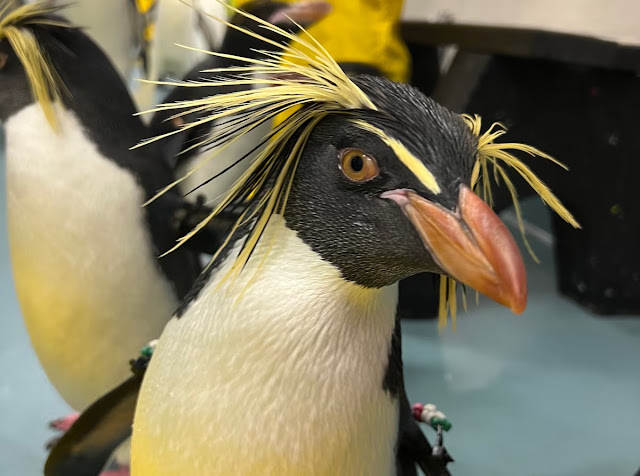
Marley, a Northern Rockhopper Penguin who lives at Moody Gardens in Houston, is quite the artist!

*~*~*~*

These days it often seems we are surrounded by nothing but lies, but the truth always matters.

*~*~*~*

An Ontario photographer captured a twenty-minute battle between a Canada Goose and a Bald Eagle when the eagle attacked the goose. Spoiler alert: The goose won!