This week in birds - #536

A roundup of the week's news of birds and the environment

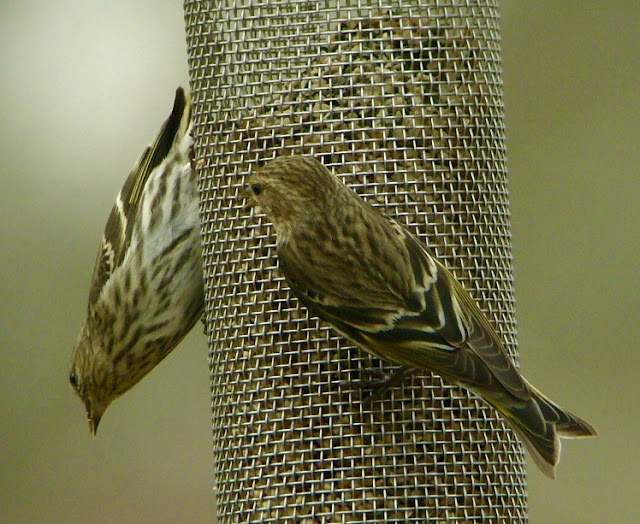
Pine Siskins are among my favorite winter visitors. 

*~*~*~*

Coal is economically outmatched by renewable sources of energy. It is more expensive to keep coal-fired power plants running than it is to build new wind or solar plants.

*~*~*~*

Six western states that rely on water from the Colorado River have agreed on a model to cut their use of water in the basin, but so far California is the one hold-out state that has not agreed.

*~*~*~*

It's a unique partnership: Bottlenose dolphins help Brazilian fishermen pull their catch in.

*~*~*~*

Why do bears rub against trees? It seems that there may be more to it than simply scratching an itch.

*~*~*~*

The EPA has blocked the Pebble mine project in Alaska, a move that will protect a valuable salmon fishery.

*~*~*~*

A black bear was apparently fascinated by a wildlife motion-activated camera near Boulder, Colorado, and ended up taking hundreds of "selfies." 

*~*~*~*

It's been an unusual winter in New York City. The city will set a record for its longest stretch in winter without measurable snowfall.

*~*~*~*

This beautiful shorebird, the American Avocet, is the American Bird Conservancy's Bird of the Week.

*~*~*~*

An extinct species of the elephant was a major source of calories for the Neanderthals.

*~*~*~*

The big news in the sky this week has been the passage of a green-hued comet past Earth and the sun for the first time in about 50,000 years.

*~*~*~*

Is it possible to bring back a species that has gone extinct? Some scientists think so and they want to try to do it with the Tasmanian tiger, a species that went extinct in the 1930s. 

*~*~*~*

Marshes in Iraq that have nourished communities since the dawn of civilization are drying up leading to further displacement of people in this region of conflict.

*~*~*~*

Sturgeons have survived in America's rivers for millions of years but now they are disappearing. Will humans be the death of this ancient species?

*~*~*~*

It's a rare partnership in Nature: The world's only black-furred bunnies distribute the seeds of a parasitic plant through their droppings.

*~*~*~*

"Microrewilding" in urban areas can provide a lifeline to Nature and enhance biodiversity.

*~*~*~*

A new conservancy in southeast British Columbia will protect a globally endangered rainforest with cedar trees. 

*~*~*~*

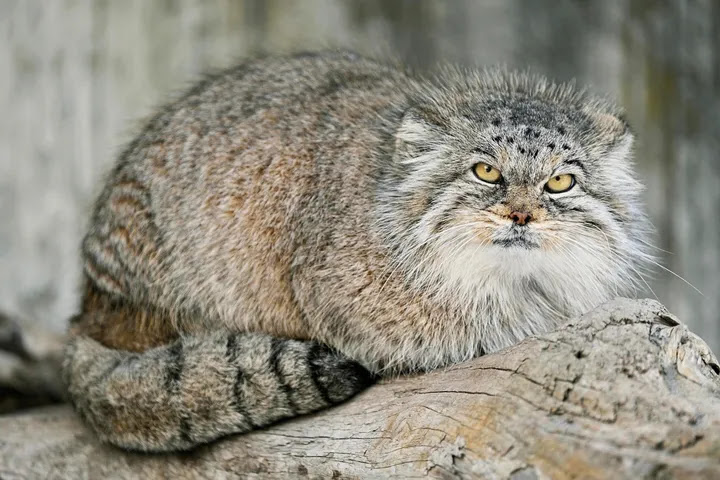
This grumpy-looking wildcat is a Pallas's cat, a rare and remarkable species that has been confirmed to be living on Mount Everest.

*~*~*~*

The thousands of Starlings that call Rome their home perform amazing aerial acrobatics that can mesmerize watchers, but what they leave behind at their night roosts is a lot less mesmerizing and a lot more problematic. 


Comments

  1. Good morning, Dorothy. I grabbed a coffee a while ago and settled in for the long read. Getting to your blog is akin to weekend therapy. Microrewilding is a trend I hope will catch on. Some years ago we totally naturalized our yard, front and back, and the native species we have planted have provided a little wildlife oasis. The diversity in a suburban backyard is quite remarkable. I have noticed a trend that homeowners are reducing the area occupied by lawns (green deserts) and that's a good sign. I have been reading of dire cold in Texas. I hope that you have not suffered. With my very best wishes - David.

    ReplyDelete
    Replies
    1. West Texas suffered some pretty cold temperatures this week, but here in Southeast Texas, our daytime temperatures have been in the 60-70 degree Fahrenheit range and nighttime in the 40s. (As you may have heard, it is a big state.)

      Delete
  2. Just yesterday I was finally able to differentiate between a Pine Warbler and a Goldfinch. I didn't realize that Pine Siskins are similar to Goldfinches, too.

    That American Avocet is magnificent. So much beauty in one bird!

    ReplyDelete
    Replies
    1. Pine Siskins and winter American Goldfinches are very similar indeed and often flock together. And I couldn't agree more about the American Avocet - truly one of the most beautiful of our shorebirds.

      Delete
  3. Lots to read, as usual. The highlights: (1) It doesn't surprise me one bit that California is the hold-out on the Colorado River water situation. (2) The selfie-loving bear made me laugh, and (3) The article on microrewilding really captured my interest. Thanks for bringing it to my attention.

    ReplyDelete

Post a Comment

Popular posts from this blog

Poetry Sunday: Don't Hesitate by Mary Oliver

How about we share another Mary Oliver poem? After all, you can never have too many of those. In this one, the poet seems to acknowledge that it is often hard to simply live in and enjoy the moment, perhaps because we are afraid it can't last. She urges us to give in to that moment and fully experience the joy. Although "much can never be redeemed, still, life has some possibility left." Don't Hesitate by Mary Oliver If you suddenly and unexpectedly feel joy, don’t hesitate. Give in to it. There are plenty of lives and whole towns destroyed or about to be. We are not wise, and not very often kind. And much can never be redeemed. Still, life has some possibility left. Perhaps this is its way of fighting back, that sometimes something happens better than all the riches or power in the world. It could be anything, but very likely you notice it in the instant when love begins. Anyway, that’s often the case. Anyway, whatever it is, don’t be afraid of its plenty. Joy is no...

Poetry Sunday: Blackberry-Picking by Seamus Heaney

My mother was a farm wife and a prodigious canner. She canned fruit and vegetables from the garden, even occasionally meat. But the best thing that she canned, in my opinion, was blackberry jam. Even as I type those words my mouth waters!  Of course, before she could make that jam, somebody had to pick the blackberries. And that somebody was quite often named Dorothy. I think Seamus Heaney might have spent some time among the briars plucking those delicious black fruits as well, so he would have known that "Once off the bush the fruit fermented, the sweet flesh would turn sour." They don't keep; you have to get that jam made in a hurry! Blackberry-Picking by Seamus Heaney Late August, given heavy rain and sun For a full week, the blackberries would ripen. At first, just one, a glossy purple clot Among others, red, green, hard as a knot. You ate that first one and its flesh was sweet Like thickened wine: summer's blood was in it Leaving stains upon the tongue and lust ...

Poetry Sunday: Hymn for the Hurting by Amanda Gorman

You probably remember poet Amanda Gorman from her appearance at the inauguration of President Biden. She read her poem "The Hill We Climb" on that occasion. After the senseless slaughter in Uvalde this week, she was inspired to write another poem which was published in The New York Times. It seemed perfect for the occasion and so I stole it in order to feature it here, just in case you didn't get a chance to read it in the Times . Hymn for the Hurting by Amanda Gorman Everything hurts, Our hearts shadowed and strange, Minds made muddied and mute. We carry tragedy, terrifying and true. And yet none of it is new; We knew it as home, As horror, As heritage. Even our children Cannot be children, Cannot be. Everything hurts. It’s a hard time to be alive, And even harder to stay that way. We’re burdened to live out these days, While at the same time, blessed to outlive them. This alarm is how we know We must be altered — That we must differ or die, That we must triumph or try. ...