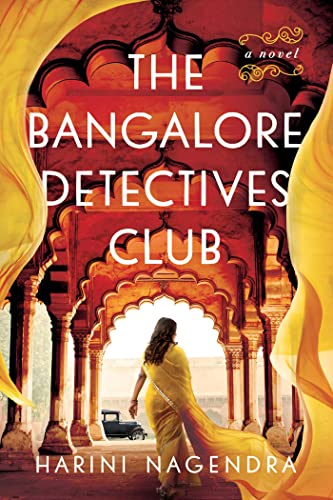
The Bangalore Detectives Club by Harini Nagendra


This is the first in a planned series of historical crime fiction books set in the 1920s in India. It is an India that is still under British rule, but protests against that rule are beginning to grow. This is very much the state of things during that period in the busy city of Bangalore in the state of Mysore. 

We see it all through the eyes of Kaveri, a young bride who has recently moved to Bangalore to be with her husband who is a doctor there. He is Dr. Ramu Murthy and he works at the Bowring Hospital run by Dr. Charles Roberts.

Kaveri is obsessed with mathematics and is apprehensive about how her interest will be perceived by her new husband, but fortunately, he is quite progressive and has an ego capable of withstanding his wife's other passions. Her mother-in-law is not nearly so progressive in her outlook and she demands that her daughter-in-law adhere to the strict societal expectations of women in that period, to forego education and center their lives around a man and the children that they have together.

As Kaveri becomes settled in her new life, she continues studying mathematics on her own and hopes to attend college and study formally. At the same time, she is establishing a circle of friends that cross all barriers of caste and class. This is a thing almost unheard of in an India that is strictly ruled socially by stringent adherence to caste.

Kaveri's insatiable curiosity and sense of community lead her to investigate the murder of a local pimp called Ponnuswamy. The murder occurred at a dinner that she attended at the local Century Club. She is certain that the wrong person is being accused of the murder and is determined to prove it. The police investigation is led by Detective Inspector Ismail who actually seems open to Kaveri's inquiries. Perhaps the two can work together to see that justice is served.

I very much liked the characters introduced in this book by Harini Nagendra. Kaveri, in particular, I found very relatable and someone that I might enjoy having as a friend. It's just that kind of feeling that one would want for the main character in a cozy mystery. Though this book definitely falls in the cozy mystery category, it also has quite a lot of information about that fraught period in Indian history. I suppose it might best be called "cozy historical fiction."  


Comments

  1. Kaveri does sound like a very fun character; I love that she's obsessed with mathematics. And the cover of this book is amazing! Another one to add to my crowded TBR list. :D

    ReplyDelete
    Replies
    1. Kaveri is definitely an appealing character. It will be interesting to see how she develops in future entries in this series.

      Delete
  2. I haven't heard of this one. But 1920s India seems a ripe setting for mysteries right?

    ReplyDelete
    Replies
    1. 1920s India was a place in flux and that offers plenty of material for mysteries.

      Delete
  3. I really enjoyed reading this first book and can't wait to dive into the next one.

    ReplyDelete
  4. I enjoy cozy mysteries and historical fiction!! I'll add this book to my reading wishlist.

    ReplyDelete
    Replies
    1. I think you might enjoy this one. Kaveri is a wonderful character.

      Delete

Post a Comment

Popular posts from this blog

Poetry Sunday: Don't Hesitate by Mary Oliver

How about we share another Mary Oliver poem? After all, you can never have too many of those. In this one, the poet seems to acknowledge that it is often hard to simply live in and enjoy the moment, perhaps because we are afraid it can't last. She urges us to give in to that moment and fully experience the joy. Although "much can never be redeemed, still, life has some possibility left." Don't Hesitate by Mary Oliver If you suddenly and unexpectedly feel joy, don’t hesitate. Give in to it. There are plenty of lives and whole towns destroyed or about to be. We are not wise, and not very often kind. And much can never be redeemed. Still, life has some possibility left. Perhaps this is its way of fighting back, that sometimes something happens better than all the riches or power in the world. It could be anything, but very likely you notice it in the instant when love begins. Anyway, that’s often the case. Anyway, whatever it is, don’t be afraid of its plenty. Joy is no...

Poetry Sunday: Hymn for the Hurting by Amanda Gorman

You probably remember poet Amanda Gorman from her appearance at the inauguration of President Biden. She read her poem "The Hill We Climb" on that occasion. After the senseless slaughter in Uvalde this week, she was inspired to write another poem which was published in The New York Times. It seemed perfect for the occasion and so I stole it in order to feature it here, just in case you didn't get a chance to read it in the Times . Hymn for the Hurting by Amanda Gorman Everything hurts, Our hearts shadowed and strange, Minds made muddied and mute. We carry tragedy, terrifying and true. And yet none of it is new; We knew it as home, As horror, As heritage. Even our children Cannot be children, Cannot be. Everything hurts. It’s a hard time to be alive, And even harder to stay that way. We’re burdened to live out these days, While at the same time, blessed to outlive them. This alarm is how we know We must be altered — That we must differ or die, That we must triumph or try. ...

Poetry Sunday: Blackberry-Picking by Seamus Heaney

My mother was a farm wife and a prodigious canner. She canned fruit and vegetables from the garden, even occasionally meat. But the best thing that she canned, in my opinion, was blackberry jam. Even as I type those words my mouth waters!  Of course, before she could make that jam, somebody had to pick the blackberries. And that somebody was quite often named Dorothy. I think Seamus Heaney might have spent some time among the briars plucking those delicious black fruits as well, so he would have known that "Once off the bush the fruit fermented, the sweet flesh would turn sour." They don't keep; you have to get that jam made in a hurry! Blackberry-Picking by Seamus Heaney Late August, given heavy rain and sun For a full week, the blackberries would ripen. At first, just one, a glossy purple clot Among others, red, green, hard as a knot. You ate that first one and its flesh was sweet Like thickened wine: summer's blood was in it Leaving stains upon the tongue and lust ...