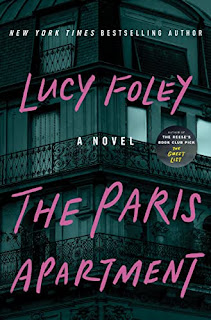
The Paris Apartment by Lucy Foley: A review


The apartment in the title is the home of Ben Daniels, a British journalist. Ben receives a text from his half-sister Jess Hadley asking if she can stay with him for a while. Jess, who lives in Brighton, has recently lost her job and is now homeless and virtually penniless. She and Ben don't know each other well. They lost their parents when they were quite young and their paths diverged. Ben was adopted by a wealthy family who gave him all the advantages of that wealth. Jess was long shunted around in foster care and never really had a place she could call home. But when she contacts Ben asking for help, he invites her to come stay with him. When she arrives in Paris with all her worldly goods and makes it to Ben's apartment, there is no Ben there. No note, nothing to explain his absence, and his neighbors are, to put it mildly, not helpful.

The apartment is quite palatial and Jess doesn't understand how her brother could have afforded it on a journalist's salary, but then she learns that he got the apartment through Nick Miller, a friend of his from Cambridge, who has an apartment in the same building. Nick seems like a nice guy but claims not to know where Ben is; however, he offers to help Jess find him. The other residents of the building seem unaccountably hostile to her.

Jess begins asking questions about her brother and about his life and getting very few answers. As determined as she is, she is facing a web of secrets and intrigue where it seems that everyone she meets is wearing a mask of some kind. The question is why. What have they got to hide and what do they know about the unexplained absence of Ben? There doesn't seem to be anyone Jess can trust, maybe not even Nick.

Jess has had a hard-knock life but she is a survivor and she is undeterred by the air of menace that seems thick enough to be cut with a knife. Her character was really the strongest part of this narrative. The narrative itself is presented to the reader through the viewpoints of several different characters, all residents of the apartment building. The differing voices of the characters lent even more mystery to the action. They are essentially all unreliable narrators and the reader quickly learns to take each of them not just with a grain but with a large block of salt.

I found the book suspenseful up to a point, but more than halfway through the action really began to drag for me. It seemed that it was going nowhere and I began to find Jess more than a little irritating. Moreover, the plot began to feel a bit claustrophobic as virtually all the action was in that apartment building. As far as it being a Paris apartment, it might as well have been in Podunk because we really didn't see much of Paris.

Two years ago, I read Lucy Foley's book The Guest List and liked it quite a lot. For that reason, I was excited to be able to read this book, so I was disappointed that I didn't like it nearly as well. The plot felt contrived and the action really began to feel forced and ponderous after a while. It wasn't a bad book; it just wasn't nearly as good as I was hoping for.

My rating: 3 of 5 stars


Comments

  1. Thank you for an honest review.

    ReplyDelete
    Replies
    1. I try to be fair in my reviews but I have to give my honest reaction.

      Delete
  2. I guess I wasn't alone with my issues about this book. Yes, it was hard visualize Paris as the whole story basically took place in that building.

    ReplyDelete
    Replies
    1. Maybe it should have been called The Apartment Building!

      Delete
  3. It's always irritating to me to read a book where it seems that the author's closest contact to the setting is a tattered Rand McNally road map. Loved the Podunk reference.

    ReplyDelete
    Replies
    1. Exactly. Why set your story in a very specific and well-known place unless you intend to give a view of that place and the action somehow relates to it?

      Delete
  4. Half the draw of this book is that it's set in Paris! It's too bad the author didn't make more use of the city in her story.

    ReplyDelete
  5. So much for Paris, right? I've heard others as well say this book dragged a bit for them too. I think I might take a pass. Too bad.

    ReplyDelete
  6. How disappointing. It doesn't help when a MC becomes irritating.

    ReplyDelete
    Replies
    1. If the character is intended to be irritating that's another matter, but in this case, she clearly wasn't

      Delete
  7. Oh no! That's what I was scared about when it came to this novel. I enjoyed her other one so much that I felt this couldn't live up to the hype. I really hope I still enjoy it. Thank you for your honest review.

    ReplyDelete
  8. Oh thank goodness! Honestly, I was so bored that I was tempted to quit, but since I loved The Guest List so much, I made myself push through to the end. Maybe I also overhyped it in my head, but I don't think it was nearly as good as her previous work.

    ReplyDelete
    Replies
    1. I definitely thought it was inferior to The Guest List.

      Delete

Post a Comment

Popular posts from this blog

Poetry Sunday: Don't Hesitate by Mary Oliver

How about we share another Mary Oliver poem? After all, you can never have too many of those. In this one, the poet seems to acknowledge that it is often hard to simply live in and enjoy the moment, perhaps because we are afraid it can't last. She urges us to give in to that moment and fully experience the joy. Although "much can never be redeemed, still, life has some possibility left." Don't Hesitate by Mary Oliver If you suddenly and unexpectedly feel joy, don’t hesitate. Give in to it. There are plenty of lives and whole towns destroyed or about to be. We are not wise, and not very often kind. And much can never be redeemed. Still, life has some possibility left. Perhaps this is its way of fighting back, that sometimes something happens better than all the riches or power in the world. It could be anything, but very likely you notice it in the instant when love begins. Anyway, that’s often the case. Anyway, whatever it is, don’t be afraid of its plenty. Joy is no...

Poetry Sunday: Blackberry-Picking by Seamus Heaney

My mother was a farm wife and a prodigious canner. She canned fruit and vegetables from the garden, even occasionally meat. But the best thing that she canned, in my opinion, was blackberry jam. Even as I type those words my mouth waters!  Of course, before she could make that jam, somebody had to pick the blackberries. And that somebody was quite often named Dorothy. I think Seamus Heaney might have spent some time among the briars plucking those delicious black fruits as well, so he would have known that "Once off the bush the fruit fermented, the sweet flesh would turn sour." They don't keep; you have to get that jam made in a hurry! Blackberry-Picking by Seamus Heaney Late August, given heavy rain and sun For a full week, the blackberries would ripen. At first, just one, a glossy purple clot Among others, red, green, hard as a knot. You ate that first one and its flesh was sweet Like thickened wine: summer's blood was in it Leaving stains upon the tongue and lust ...

Poetry Sunday: Hymn for the Hurting by Amanda Gorman

You probably remember poet Amanda Gorman from her appearance at the inauguration of President Biden. She read her poem "The Hill We Climb" on that occasion. After the senseless slaughter in Uvalde this week, she was inspired to write another poem which was published in The New York Times. It seemed perfect for the occasion and so I stole it in order to feature it here, just in case you didn't get a chance to read it in the Times . Hymn for the Hurting by Amanda Gorman Everything hurts, Our hearts shadowed and strange, Minds made muddied and mute. We carry tragedy, terrifying and true. And yet none of it is new; We knew it as home, As horror, As heritage. Even our children Cannot be children, Cannot be. Everything hurts. It’s a hard time to be alive, And even harder to stay that way. We’re burdened to live out these days, While at the same time, blessed to outlive them. This alarm is how we know We must be altered — That we must differ or die, That we must triumph or try. ...