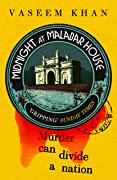
Parsee Inspector Wadia is based at Malabar House in Bombay which is where the police hierarchy places its misfits and those whose careers have gone awry for some reason. She has only been on the job for a few months and is still learning her way around. She is both idealistic and determined and she has a considerable amount of anger stirring inside her in response to the inequities of society. Her boss, Superintendent of Police Roshan Seth, tries in his own way to support her while at the same time wishing that she would just go away, go home, find a man, and start producing children. In this last wish, he has an ally in Persis' Aunt Nussie. She has a candidate in mind for Persis' potential marriage partner, but Persis is uncooperative. Getting married would mean that she would have to leave the police and she's not about to do that.
Persis lives with her father in the apartment above the bookstore that the father owns. He is still grieving the death, several months prior, of his beloved wife, Sanaz. The circumstances of her death are a bit of a mystery at first.
Persis is on duty at Malabar House when a call comes in from the aide of an important British diplomat named Sir James Herriot. Sir James was hosting a New Year's Eve party at his residence while dressed as Mephistopheles. But now his dead body has been discovered. He has been murdered and is seated at his desk but his trousers are missing. Persis has a very big case and perhaps a scandal on her hands. She quickly learns that Herriot was not really the upstanding citizen that he was portrayed to be and there seems to be no lack of potential suspects. But how to untangle the lies from uncooperative witnesses and finally get at the truth of what happened? Who really had the strongest motive for wanting Sir James dead? In searching for the answers to those questions, Persis has an ally in British criminologist Archimedes 'Archie' Blackfinch and there are hints that this alliance could become more than just professional.
This book, while fiction, is firmly based on actual Indian history during its chaotic transformation. Gandhi, the architect of the new country, is dead having been shot in 1948 by a militant Hindu nationalist. The politicians left to carry on struggle to achieve the unity that is needed. To do so they have to clear away the detritus left by British colonial history in India and Pakistan. The effects of that struggle filter all the way down to local police procedures and the work of Parsee Inspector Persis Wadia. This was quite an interesting look at this fraught period but one must admit that the execution of the plot left a bit to be desired. The writing seemed curiously without passion. The story was simply told as one might give a weather report. In other words, it was flat and featureless. Still, I did like the character of Persis and I liked the concept. There's quite a lot to build on there.
My rating: 3 of 5 stars
I don't think this is a book for me, so it's rare, but I'm NOT adding this one to the TBR! Since it's already so long.....
ReplyDeleteOne can't read all the books published and probably shouldn't try.
DeleteThe havoc, carnage and injustice created by partition continues to this day.
ReplyDeleteMan's inhumanity remains unabated.
DeleteI've read all of Khan's books, and his Baby Ganesh Detective Agency series set in modern Mumbai, while giving an often fascinating look at India, tends to be more lighthearted than his Persis Wadia series. Of course, the time period of the second series is anything but lighthearted. This Wadia series is such a departure from Khan's original series that I think it's taking him a bit of time to feel comfortable with it, but i still enjoy reading it.
ReplyDeleteThis is the first one that I've read but I expect to read more.
DeleteSounds like an interesting read. I've only read one book I can remember set during this time period in India, but I totally loved it. It's called Partitions by Amit Majmudar. Have you ever read that one?
ReplyDeleteI have not read it, but it is a period of history that provides plenty of material for a writer.
DeleteYeah the India setting and time period seem really ripe for reading. Too bad the writing wasn't more involved!
ReplyDeleteThis was the first in a series, so it's possible the writing will get more assured in the next one.
DeleteI love learning about a country through reading fiction, then checking into the history. I enjoy this series, but I do like Sujata Massey's Perveen Mistry series even better!
ReplyDeleteI do plan to read more of this series because the setting is so interesting and I do like the main character. I'll also check out the Mistry series.
Delete