Translate

Saturday, October 30, 2021

Poetry Sunday: The Raven by Edgar Allan Poe

How about something a bit spooky for Halloween? Something from that king of spookiness, Edgar Allan Poe. Like many of you, I suspect, I first encountered his poem "The Raven" in high school. I loved it! I loved the structure, the rhyme, and the rhythm of it that made it easy to remember, so unlike some of the other poetry we studied. Moreover, it told a story, again unlike some of the other poems in our literature book. So, it was an early favorite of mine. I love it still. I hope you do, too.

The Raven

by Edgar Allan Poe 

Once upon a midnight dreary, while I pondered, weak and weary,
Over many a quaint and curious volume of forgotten lore—
While I nodded, nearly napping, suddenly there came a tapping,
As of some one gently rapping, rapping at my chamber door.
“’Tis some visitor,” I muttered, “tapping at my chamber door—
Only this and nothing more.”

Ah, distinctly I remember it was in the bleak December;
And each separate dying ember wrought its ghost upon the floor.
Eagerly I wished the morrow;—vainly I had sought to borrow
From my books surcease of sorrow—sorrow for the lost Lenore—
For the rare and radiant maiden whom the angels name Lenore—
Nameless here for evermore.

And the silken, sad, uncertain rustling of each purple curtain
Thrilled me—filled me with fantastic terrors never felt before;
So that now, to still the beating of my heart, I stood repeating
“’Tis some visitor entreating entrance at my chamber door—
Some late visitor entreating entrance at my chamber door;—
This it is and nothing more.”

Presently my soul grew stronger; hesitating then no longer,
“Sir,” said I, “or Madam, truly your forgiveness I implore;
But the fact is I was napping, and so gently you came rapping,
And so faintly you came tapping, tapping at my chamber door,
That I scarce was sure I heard you”—here I opened wide the door;—
Darkness there and nothing more.

Deep into that darkness peering, long I stood there wondering, fearing,
Doubting, dreaming dreams no mortal ever dared to dream before;
But the silence was unbroken, and the stillness gave no token,
And the only word there spoken was the whispered word, “Lenore?”
This I whispered, and an echo murmured back the word, “Lenore!”—
Merely this and nothing more.

Back into the chamber turning, all my soul within me burning,
Soon again I heard a tapping somewhat louder than before.
“Surely,” said I, “surely that is something at my window lattice;
Let me see, then, what thereat is, and this mystery explore—
Let my heart be still a moment and this mystery explore;—
’Tis the wind and nothing more!”

Open here I flung the shutter, when, with many a flirt and flutter,
In there stepped a stately Raven of the saintly days of yore;
Not the least obeisance made he; not a minute stopped or stayed he;
But, with mien of lord or lady, perched above my chamber door—
Perched upon a bust of Pallas just above my chamber door—
Perched, and sat, and nothing more.

Then this ebony bird beguiling my sad fancy into smiling,
By the grave and stern decorum of the countenance it wore,
“Though thy crest be shorn and shaven, thou,” I said, “art sure no craven,
Ghastly grim and ancient Raven wandering from the Nightly shore—
Tell me what thy lordly name is on the Night’s Plutonian shore!”
Quoth the Raven “Nevermore.”

Much I marvelled this ungainly fowl to hear discourse so plainly,
Though its answer little meaning—little relevancy bore;
For we cannot help agreeing that no living human being
Ever yet was blessed with seeing bird above his chamber door—
Bird or beast upon the sculptured bust above his chamber door,
With such name as “Nevermore.”

But the Raven, sitting lonely on the placid bust, spoke only
That one word, as if his soul in that one word he did outpour.
Nothing farther then he uttered—not a feather then he fluttered—
Till I scarcely more than muttered “Other friends have flown before—
On the morrow he will leave me, as my Hopes have flown before.”
Then the bird said “Nevermore.”

Startled at the stillness broken by reply so aptly spoken,
“Doubtless,” said I, “what it utters is its only stock and store
Caught from some unhappy master whom unmerciful Disaster
Followed fast and followed faster till his songs one burden bore—
Till the dirges of his Hope that melancholy burden bore
Of ‘Never—nevermore’.”

But the Raven still beguiling all my fancy into smiling,
Straight I wheeled a cushioned seat in front of bird, and bust and door;
Then, upon the velvet sinking, I betook myself to linking
Fancy unto fancy, thinking what this ominous bird of yore—
What this grim, ungainly, ghastly, gaunt, and ominous bird of yore
Meant in croaking “Nevermore.”

This I sat engaged in guessing, but no syllable expressing
To the fowl whose fiery eyes now burned into my bosom’s core;
This and more I sat divining, with my head at ease reclining
On the cushion’s velvet lining that the lamp-light gloated o’er,
But whose velvet-violet lining with the lamp-light gloating o’er,
She shall press, ah, nevermore!

Then, methought, the air grew denser, perfumed from an unseen censer
Swung by Seraphim whose foot-falls tinkled on the tufted floor.
“Wretch,” I cried, “thy God hath lent thee—by these angels he hath sent thee
Respite—respite and nepenthe from thy memories of Lenore;
Quaff, oh quaff this kind nepenthe and forget this lost Lenore!”
Quoth the Raven “Nevermore.”

“Prophet!” said I, “thing of evil!—prophet still, if bird or devil!—
Whether Tempter sent, or whether tempest tossed thee here ashore,
Desolate yet all undaunted, on this desert land enchanted—
On this home by Horror haunted—tell me truly, I implore—
Is there—is there balm in Gilead?—tell me—tell me, I implore!”
Quoth the Raven “Nevermore.”

“Prophet!” said I, “thing of evil!—prophet still, if bird or devil!
By that Heaven that bends above us—by that God we both adore—
Tell this soul with sorrow laden if, within the distant Aidenn,
It shall clasp a sainted maiden whom the angels name Lenore—
Clasp a rare and radiant maiden whom the angels name Lenore.”
Quoth the Raven “Nevermore.”

“Be that word our sign of parting, bird or fiend!” I shrieked, upstarting—
“Get thee back into the tempest and the Night’s Plutonian shore!
Leave no black plume as a token of that lie thy soul hath spoken!
Leave my loneliness unbroken!—quit the bust above my door!
Take thy beak from out my heart, and take thy form from off my door!”
Quoth the Raven “Nevermore.”

And the Raven, never flitting, still is sitting, still is sitting
On the pallid bust of Pallas just above my chamber door;
And his eyes have all the seeming of a demon’s that is dreaming,
And the lamp-light o’er him streaming throws his shadow on the floor;
And my soul from out that shadow that lies floating on the floor
Shall be lifted—nevermore!


Friday, October 29, 2021

This week in birds - #474

 A roundup of the week's news of birds and the environment:

The yard has been unusually quiet of bird activity this week, but we have had a lot of silent visitors. Monarch butterflies have been passing through on migration. Every time I've been outside this week I've seen them. This one is sipping from some tropical milkweed.

*~*~*~*

The good news is there has been progress on arresting climate change since the Paris accord of 2014. The bad news is it's not enough

*~*~*~*

As nations prepared for the major climate summit in Glasgow, many vowed to do more to curb their warming, but even if these plans are put into effect, the world would still be on a path to dangerous warming

*~*~*~*

The Biden administration this week announced plans to rescind two environmental rollbacks that took effect under the previous administration. This will have the effect of restoring habitat protections for endangered plants and wildlife.

*~*~*~*

In Malawi, a center of international illegal wildlife trade, a judge has sentenced a Chinese citizen to as much as 14 years for charges related to illegal wildlife trade of which he had been found guilty. After he serves his sentences, he will be deported to China. This represents a major victory for those seeking to put a stop to this trade. 

*~*~*~*

California's historic drought has been interrupted by a historic downpour that extinguished some still smoldering wildfires but also created some flooding. Welcome though the rains were, however, what the state really needs is a wet winter to break the drought. Whether it will get such a winter is problematic.

*~*~*~*

The town of Bunn, North Carolina has a vulture problem. Turkey and Black Vultures have found the town to their liking for some reason, but their droppings and vomit are creating actual damage. Efforts to move the birds have not been successful. Both species are protected so lethal methods cannot be used.

*~*~*~*

Did you ever wonder how animals like elephants got their tusks? And why? Often they are not actually used for fighting, so, in such cases, what purpose do they serve? Evolution has an answer, of course. 

*~*~*~*

Evolution also, it seems, produced another previously unknown species in the human line. Researchers have announced the naming of the species. It is called Homo bodoensis and it lived in Africa 500,000 years ago during the Middle Pleistocene Age. According to scientists, it is a direct ancestor of modern humans.

*~*~*~*

The pikas living on the tops of the Cascade Mountains are in a precarious position and could disappear altogether. That would be one more link in the chain of life lost.

*~*~*~*

Like many other groups reassessing their names, the Audubon Naturalist Society has decided to drop Audubon from its name because the man was a slaveholder. The National Audubon Society, the largest group still holding his name, has not to this point announced any change.

*~*~*~*

The effects of climate change are obviously no longer an abstraction, something that will happen in the future. It's happening now and throughout the world, we are seeing not only intense heat waves but also an increase in raging wildfires and in deadly destructive rainfalls.

*~*~*~*

All of that is made worse by China's race to extract more coal to meet its electricity shortage. In doing so, it ignores the risks to miners' safety, the environment, and the economy.  

*~*~*~*

Meanwhile, the Arctic is literally melting and the thawing of permafrost threatens to release powerful greenhouse gases that have been trapped there for thousands of years. That could cause irreversible damage to the environment.

*~*~*~*

The Environmental Protection Agency has released an "action plan" which is intended to seek solutions to the many barriers that Native American communities have in securing running water and wastewater services.

*~*~*~*

A group of scientists and ocean life advocates has reported that the population of the North Atlantic right whale fell by 10 percent in the last year. In 2019, there were 366 of the whales left alive. In 2020, that dropped to 336, the lowest number in nearly twenty years. 

*~*~*~*

Last year, the Hawaii state legislature passed a law that blocks new utility contracts for coal power. The purpose of the Act is to eliminate the use of coal for producing electricity. Moreover, a 2015 law mandates that all power in the state be 100 percent renewable by 2045.

*~*~*~*

Hi-tech is being brought into the battle to save honeybees from destruction. An array of methods is being used to help manage and protect beehive colonies from collapse. Those methods include artificial intelligence programs that can game out the future health of colonies and make adjustments to keep them healthy.

*~*~*~*

Nuclear reactors are part of France's plan for carbon-neutral goals at the cheapest cost. A new report says that it must build fourteen new reactors alongside a surge in renewables investment if they are to meet their goals by 2050.

*~*~*~*

When you think of New York City, you probably don't think of it as teeming with wildlife, but apparently, you would be wrong. There is actually an amazingly diverse population of wildlife from eagles, beavers, and sea turtles to bats, coyotes, bobcats, and mink. 

Thursday, October 28, 2021

Beloved by Toni Morrison: A review

I first read Beloved thirteen years ago. I hated it. It had, of course, been a highly acclaimed novel, thought by many critics to be Morrison's masterpiece and it had won the Pulitzer Prize for Fiction in 1988. Morrison went on to win the Nobel Prize for Literature in 1993 based on her body of work. Some would say that Beloved was the heart of that body. I always felt that I had probably shortchanged the book in my reading and I made it part of my goals for the year to read it again. I finished rereading it a week ago. Who could have known that by then it would be in the news again, making racists uncomfortable? Banning it seems to be the latest right wing cause celebre.

The novel is set after the end of the  Civil War during the Reconstruction period. It was not a peaceful time. Even though slavery had been officially ended in the country, those who had been given their freedom or who had bought their freedom earlier were still victims of a lot of random violence. That was a constant cloud hanging over the freed Blacks. Among those living under that cloud were a woman in her mid-thirties named Sethe and her family. Sethe lived in Ohio with her daughter, Denver, and her mother-in-law, Baby Suggs, in a home found by abolitionists for Baby after she was freed. But there is another presence in the house. It is the ghost of Sethe's other daughter who died under horrific circumstances eighteen years earlier. After her death, Sethe wanted to get a headstone for her grave. She traded ten minutes of sex with the tombstone engraver to get it. She wanted Dearly Beloved engraved on the stone but she only had enough strength for the one word. Beloved it was.

The ghost of Beloved is an angry, sad, and malevolent spirit who often breaks and smashes things in the house. She had driven away Sethe's two young sons. Denver, though, seeks the company of the spirit because her family is ostracized and she has no other friends. As the novel opens, Baby Suggs, after a lifetime spent in slavery and then time in freedom after her son, Sethe's husband, purchased her freedom with his labor, dies leaving Sethe and Denver alone in the house with the spirit.

The action of the novel takes place in this Reconstruction time period but there are flashbacks to an earlier time which reveal the backstories of the characters and their time in slavery. They had been slaves on a Kentucky plantation that was named, quite ironically, Sweet Home. But, in fact, it was not as bad as many plantations. It was owned by a Mr. Garner who was relatively benevolent and treated his "property" well. But then Mr. Garner died and his widow brought in one of her male relatives to help run the place. He was called "the schoolteacher" and his viciousness knew no bounds. Soon the slaves were trying to escape. Some were murdered and some went crazy. Sethe takes a nightmarish trek to freedom. This all happened eighteen years before the time during which the current action of the novel occurs.  

It is through these flashbacks that we learn of the hideous and gruesome existence of slaves caught in this awful system. Their families are viciously ripped apart. They are deprived of their mates and their children and their kin. Family members vanish and are never seen again, sold away, or victims of an even crueler fate. Their bodies were not their own but merely units of commerce. Any evil could be visited upon them or their loved ones by their owners and there was nothing they could do about it. Can you begin to imagine what that does to a person?

Back in the present time of the novel, a man from Sethe's past at Sweet Home shows up in Ohio. His name is Paul D. and he, too, escaped from the plantation but has endured harrowing, nauseating experiences along the way, including time on a Georgia chain gang. Paul D. and Sethe attempt to set up a "real" family and when the baby ghost acts up, he drives it out. 

But then a young woman turns up. She seems to be about twenty years old but she talks like a child and can't remember where she came from. She is intensely interested in Sethe. She says her name is Beloved. Sethe believes that this young woman is her long-dead daughter and she becomes a catalyst for other revelations and memories.

The supernatural is an integral part of this layered story. All the characters believe in ghosts and the "ghosts" are reported in a matter-of-fact manner as are all the other events. At one point, Sethe wishes that her memories could be erased, that she could "go crazy" like some of the slaves and forget. But it was not to be. Her brain absorbed it all and loaded her down with the past, leaving no room to plan for the future.

There are so many different stories and voices in this novel that it becomes difficult at times to keep them all straight. Toni Morrison's versatility and technical skill in telling her stories cannot even be fully comprehended by an ordinary reader like myself. The stories are truly horrifying and appalling which explains why I hated them when I first read the book. I still hate them. Only a monster could "enjoy" this book. But I don't think Morrison intended it to be enjoyed. It was intended to explicate an almost inexplicable human experience and make it real for people living comfortable modern lives, and she succeeded with skill and an astounding emotional range. On my second reading, I think I have gained a better appreciation of that skill and emotional range. I honestly don't think a person in my position can ever truly comprehend the slave's experience but at least I have a more complete understanding of what it is I can't understand. The amazing Toni Morrison did that for me.

My rating: 5 of 5 stars 

Tuesday, October 26, 2021

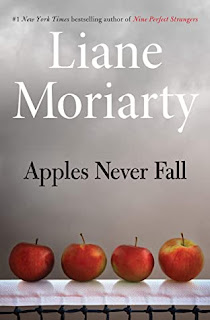
Apples Never Fall by Liane Moriarty: A review


I had never read Liane Moriarty before, but if this book is any indication, her reputation for writing engrossing cliffhangers is well-earned.

Apples Never Fall gives us the Delaney family, Stan and Joy Delaney and their four grown children: Amy, the oldest and artsy one; Troy, a highflying businessman very proud of his wealth and losing no opportunity to flaunt it; Brooke, the youngest, a businesswoman who has not had much success in the romance department; and Logan, the disheveled teacher with a heart of gold. This is, in fact, a family saga that turns into a mystery and a bit of a thriller before the end.

Moriarty is very adept at giving us an in-depth portrait of each of these family members. That, I felt, was one of the book's strengths and something that I really liked about it. She describes each of their backstories of experiences along with their struggles and mistakes along the way. In spite of their weaknesses and mistakes, the reader gains a real empathy for each of them. One feels that one knows them. They might be our neighbors. They might even be our family.

The Delaneys are famous in the tennis world. Both Joy and Stan are former Australian tennis stars and after their playing career ended, they started a tennis academy where they instructed young players, including their own children, for years. They had hopes that one or more of their children might someday play at Wimbledon, but they were disappointed in that. Although talented, none of them had sufficient talent or desire to be such a star.

Their real prodigy was Harry Haddad who went on to become a Grand Slam champion. As a student at the academy, he was a rival of the younger Delaneys, both as a player and for their father's affection. But Harry eventually broke Stan's heart. At seventeen, he left Harry as a coach and signed on with someone else. It was that coach who got him all the way to the Grand Slam. 

Now it is several years later and Harry had retired from tennis, but he's decided to try for a comeback and he is about to release his memoir. Meanwhile, Joy and Stan are retired after selling their tennis academy. Joy will soon turn seventy, and Stan is already in his seventies. They are both a bit bored and at loose ends since retirement. Then something happens to change all that. A young woman turns up on their doorstep.

Her name (she says) is Savannah and she's supposedly running from an abusive boyfriend and she does have some physical injuries to support her story. Open-hearted Joy takes her in, gives her one of her children's old rooms, and she becomes a guest of the family. This guest though certainly earns her way. It seems she is an excellent cook and soon Joy and Stan are eating better than ever before.

Of course, this idyllic situation doesn't last. The Delaneys learn something about Savannah's background that makes them suspicious of her. Stan and Joy have a serious argument and shortly afterward, Joy disappears. Has Stan done away with her? That seems to be the consensus opinion. Or has Savannah done away with her? Were Savannah and Stan having an affair?

There are no apparent clues and as the disappearance lengthens into weeks, everyone fears the worst. Red herrings abound. Still, no body has been found. Even so, the two detectives investigating the case prepare to arrest Stan for murder. Moriarty builds the suspense layer upon layer until we are sure that some truly horrible fate has befallen Joy. And then we learn... But, no, you'll have to read the book to find out!

I enjoyed this book from the first page to the last. I particularly liked the character of Joy and found it easy to identify with her. And the lessons of the book seem to be that, yes, we all make mistakes, and sometimes we betray those we love, either intentionally or unintentionally. Love is not always easy but it is built on upon our willingness to accept mistakes and to forgive. To forgive others and to forgive ourselves. That's not a bad thing for a novel to demonstrate.

My rating: 5 of 5 stars 


Saturday, October 23, 2021

Poetry Sunday: Future Plans by Kate Barnes

When I read Kate Barnes' poem last week, I laughed out loud with a feeling of recognition. I know the woman in her poem. In fact, I see her in the mirror every day.

Future Plans

by Kate Barnes

When I am an old, old woman I may very well be
living all alone like many another before me
and I rather look forward to the day when I shall have
a tumbledown house on a hill top and behave
just as I wish to. No more need to be proud—
at the tag end of life one is at last allowed
to be answerable to no one. Then I shall wear
a shapeless felt hat clapped on over my white hair,
sneakers with holes for the toes, and a ragged dress.
My house shall be always in a deep-drifted mess,
my overgrown garden a jungle. I shall keep a crew
of cats and dogs, with perhaps a goat or two
for my agate-eyed familiars. And what delight
I shall take in the vagaries of day and night,
in the wind in the branches, in the rain on the roof!
I shall toss like an old leaf, weather-mad, without reproof.
I’ll wake when I please, and when I please I shall doze;
whatever I think, I shall say; and I suppose
that with such a habit of speech I’ll be let well alone
to mumble plain truth like an old dog with a bare bone.

Friday, October 22, 2021

This week in birds - #473

 A roundup of the week's news of birds and the environment

The Red-bellied Woodpecker is one of the most common woodpeckers in our area. He is a permanent resident here. Common he may be but it is always a pleasure to see him in the yard.

*~*~*~*

Three reports released by the Biden administration this week warn of conflicts fueled by the climate crisis. It is likely to aggravate conflicts over water and migration and to cause instability which can threaten global security.

*~*~*~*

Another aspect of the climate crisis is its potential to provide an "emerging threat" to the financial system of this country and to upend global markets and economies.

*~*~*~*

The weather pattern known as La Niña is likely to further prolong the severe drought in the western U.S. this winter but it may bring some relief to Northern California and the Pacific Northwest.

*~*~*~*

Just what are El Niño and La Niña weather patterns anyway and why are weather forecasters always referring to them? Here's an explanation.

*~*~*~*

Factory farms are obviously not environmentally friendly, and they are incubators of disease. They could well be the source of the next pandemic which could be even more deadly than the one we are currently experiencing.

*~*~*~*

The family of chemicals known as "forever chemicals", or PFAS, are found in everything from drinking water to furniture. They have been linked to cancer. The E.P.A. administrator has set regulating those chemicals as one of his priorities.

*~*~*~*

Global heating is hitting wildlife hard right around the world. It is causing problems with fertility, immunity, and behavior with the potential for lethal results. 

*~*~*~*

In order to assess the status of a species, it is necessary to know their numbers and how widespread they are. And the only way to really determine that is to count. That's what counting bees is all about.

*~*~*~*

The hippos introduced to Colombia by drug lord Pablo Escobar as a part of his private zoo have more than doubled in numbers since 2012. They have no natural predators to keep them in check. So the country's wildlife services department is engaged in a project to sterilize them in order to control the potentially destructive invasive species. 

*~*~*~*

By 2030, the plastics industry in the United States will be releasing more greenhouse gases into the atmosphere than coal-powered electricity generating plants. This is according to a new report released on Thursday.

*~*~*~*

Honestly, it is difficult not to despair at times when one contemplates the damage we have done to our planet and the inadequacy of our response to the problem. But Jane Goodall refuses to despair. She has written a new book, a hopeful guide for the survival of our species.

*~*~*~*

And sometimes when despair for our present circumstances threatens to overwhelm us, it is useful to consider where we have come from, humanity's long history. This is quite a long read, an adaptation from a new history of the species, but if you are interested in our prehistory, it is well worth it and quite fascinating. 

*~*~*~*

Discover the wonders of the East African coral reefs with this link.

*~*~*~*

One of the two last living northern white rhinos, both females, has been dropped from the breeding project which hopes to use preserved sperm from dead males to create an embryo that would then be implanted in a more abundant species of rhino.

*~*~*~*

Remember the tragic story of the young family and their dog who mysteriously died from unknown causes while hiking in Sierra National Forest? It has taken several weeks but post mortem examinations have finally determined that their deaths were caused by heat exposure and possible dehydration. Temperatures on the trail they were hiking had reached 107 to 109 degrees Fahrenheit on the day of their deaths.

*~*~*~*

Northern peatlands are a carbon sink that helps to cool the planet, but the heating climate may be turning them into a carbon bomb which will make global warming even worse.

*~*~*~*

The World Meteorological Organization, along with other agencies, released a report this week stating that climate change threatens to destroy Africa's rare glaciers within the next two decades. The continent that contributes the least to global warming will likely suffer from it the most.

*~*~*~*

The Stads K'un is a genetically unique subspecies of the Northern Goshawk that is one of the most endangered species on the planet. The search is on in British Columbia to locate habitats of the bird so that they can be protected from logging and habitat loss.

*~*~*~*

The Environmental Protection Agency has located more than 120,000 locations around the country where people may be exposed to the toxic "forever chemicals." Colorado tops the list with an estimated 21,400 such facilities.

*~*~*~*

Russia is allowing massive leaks of methane, as shown by satellites, to the planet's peril.

*~*~*~*

Environmental themes seem to be very popular with novelists this year. Here is a list of twelve such novels that have been released this year.

*~*~*~*

There has long been justifiable concern about the decreasing numbers of western Monarch butterflies, but here's some good news on that score: This week thousands of the butterflies returned to a sanctuary in California.

Thursday, October 21, 2021

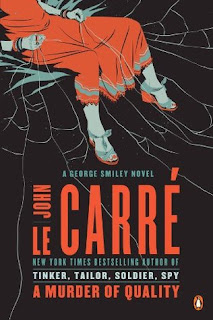
A Murder of Quality by John le Carré: A review


One of my reading goals for this year was to reread all of John le CarrĂ©'s George Smiley books. I read the first one, Call for the Dead, back in January, and now here it is October and I'm finally getting around to the second one. Yes, I did get a bit distracted along the way.

This second one references boarding schools which, in a foreword, the author states that he was sent to from age five to sixteen. He hated them and something of that sentiment comes through in the book which finds Smiley being prevailed upon to help investigate what turns out to be a murder of the wife of an instructor at such a school, a sort of posh prep school. He becomes involved when he receives a request from a former wartime colleague. The woman, Ailsa Brimley, is now the editor of a publication called the "Christian Voice" and she has received a note from one of her long-time and valued subscribers who tells her that she is afraid her husband is going to kill her. Unwilling to go to the police with such sketchy information, Miss Brimley calls Smiley, and since he is at loose ends he accedes to her request and travels to the city of Carne. Unfortunately, he arrives too late. The woman had been killed the night before.

Since he arrived too late, Smiley feels an obligation to find out what happened and secure justice for the murdered woman. Thus, in this book, we get not Smiley, the spy, but Smiley, the investigator. He teams with the police to try to discover the murderer. It develops that there is no shortage of suspects. Could it be a jealous wife, one of the tutors at the private school, or a possessed lady? Or maybe it really was the husband.

As an investigator, Smiley gets to use some of the same skills that he employed as a spy. He is a careful observer, a student of human nature, and he is not easily fooled. The author leads us through the process that Smiley takes to solve this heinous crime and the reader, along with Smiley, soon begins to get an idea of just who the killer is. Even though I felt pretty confident early on just who that killer was, it was fascinating to watch Smiley work as he followed the clues to their inevitable conclusion.

Reading John le CarrĂ© is such a pleasure. Each individual sentence has such crispness and it seems that not one could be removed from the book without changing its meaning. Here, for example, is a description of Smiley which left me feeling that I understood his soul: “It was a peculiarity of Smiley's character that throughout the whole of his clandestine work he had never managed to reconcile the means to the end. A stringent critic of his own motives, he had discovered after long observation that he tended to be less a creature of intellect than his tastes and habits might suggest; once in the war he had been described by his superiors as possessing the cunning of Satan and the conscience of a virgin, which seemed to him not wholly unjust.” 

And then there is Smiley's assertion that one must take the facts just as they are without embellishing them: “A fact, once logically arrived at, should not be extended beyond its natural significance.” That's advice from which we all might benefit.

The characters, the plot, and the pacing in this book are just about perfect. Le CarrĂ© really was one of the best writers of the twentieth and early twenty-first centuries of not just genre espionage novels but novels period. How lucky we readers are to have had him.

My rating: 5 of 5 stars

Monday, October 18, 2021

Matrix by Lauren Groff: A review


This is the fourth Lauren Groff book I've read and I've loved them all. I love the subtlety of her writing, the way that she builds her characters, and the feminist vibe of the writing. In her acclaimed Fates and Furies, she gave us a dissection of a modern marriage as seen from the two points of view of those in the marriage. In this new book, she delineates the life of a 12th-century poet named Marie de France about whose actual life very little is known. This leaves the writer free to imagine it without worrying about historical accuracy. The result makes for fascinating reading.

The Marie that she gives us is, in 1158, a member of the court of Queen Eleanor, history's Eleanor of Aquitaine who in her life was the queen of both France and then England. Marie was an awkward and unwelcome member of the court. She was extremely tall and had a giant bony body. She was too unattractive to ever be considered for a marriage, so what to do with her? She was educated and had had to fend for herself since she was twelve years old and her mother died, so she was resourceful and well able to manage an estate. Eleanor reasoned that if she could manage an estate, she could just as easily run a nunnery and as it happened she had just such a place in mind.

The particular nunnery that needed someone to take it in hand was a "dark and strange and piteous place, a place to inspire fear." Marie was seventeen years old and had already discarded the religion in which she was raised. She could not accept the paternalism of that religion. She did not wish to leave the court because she harbored an unrequited love for Eleanor and could not bear the thought of being separated from her, but she wasn't given a choice. So off to the nunnery she goes.

What she finds there would be enough to make anyone quail. It was a community of sick and starving women who had no resources to feed or cure themselves. Marie used some of her own money to buy food and then to buy animals who would later provide more food. She organized the women who were able to do so to plant and care for gardens that would provide food as well as medicinal herbs. Gradually, she was able to transform the failing community into a sprawling and successful complex tucked away in the Arthurian forest. She had been filled with self-pity when she first came to the nunnery but she soon began to realize that she had a unique opportunity with the real estate and the women who could be organized to work the land. She could make this into a successful enterprise.

She created a scriptorium to provide copying services at a fraction of what the monasteries charged, and the nunnery began to flourish. Through the long years of Marie's life, it achieves ever greater success and renown as she continues to ignore the paternalism of the church and to pursue her own feminist philosophy. This sometimes causes concern for the nuns as Marie takes on priestly functions an action which some of them deem blasphemous, but she manages to override those concerns more or less through the force of her personality. Female ambition and power are the themes of the novel as Marie continues to refuse to acknowledge an inferior position for women in the church. 

This narrative is essentially without men except as incidental characters. It focuses tightly on the grand life of one remarkable woman. She started as an orphan who was entrusted with the lives of others and through the force of her will, she molded them from a group of weak and dying women into a strong and resourceful community. We follow Marie year after year as she completes this work and through all those years up until the time of Eleanor's death she continues to love her from afar and to hope that she will some day retire to the nunnery that she has transformed. Alas, it is not to be. It is one of the few but defining disappointments of her life.

Marie is not always an entirely lovable character but one always has to admire her strength and the fact that she remains true to her vision throughout. It makes for a compelling and entertaining story.

My rating: 5 of 5 stars

Saturday, October 16, 2021

Poetry Sunday: Autumn Rain by D.H. Lawrence

I had never actually realized that D.H. Lawrence wrote poetry. I think of him as a novelist and short-story writer. But in fact, he did write quite a bit of poetry. I read that he was a fan of Walt Whitman and his poetry was influenced by him. His favorite form seems to have been free verse.

I learned about Lawrence, the poet, as I was looking for poetry about autumn during the past week and I happened upon this one. It seems to speak with intensity and vigor of the poet's understanding of and empathy for the natural world. The poem was published in 1917 near the end of World War I and one feels that he must have been influenced by that conflagration. Perhaps that is what he refers to when he writes of "sheaves of pain" and "sheaves of dead men that are slain."


Autumn Rain

by D.H. Lawrence

The plane leaves
fall black and wet
on the lawn;

the cloud sheaves
in heaven’s fields set
droop and are drawn

in falling seeds of rain;
the seed of heaven
on my face

falling — I hear again
like echoes even
that softly pace

heaven’s muffled floor,
the winds that tread
out all the grain

of tears, the store
harvested
in the sheaves of pain

caught up aloft:
the sheaves of dead
men that are slain

now winnowed soft
on the floor of heaven;
manna invisible

of all the pain
here to us given;
finely divisible
falling as rain.

Friday, October 15, 2021

This week in birds - #472

 A roundup of the week's news of birds and the environment:

What kind of bird is this, you ask? I thought I would give you something completely different this week in honor of the season. This is my friend who lives just outside my office window these days. She is a golden garden spider, Argiope aurantia. Golden garden spiders, in fact most spiders, are our friends and allies. They have a voracious appetite for insects and are very efficient predators. They are able to subdue and eat prey twice their size. These spiders are sometimes called the "writing spiders" because of the squiggles they put in their webs. It was such a spider that was the inspiration for E.B. White's Charlotte's Web. If you are lucky enough to have one around your yard - and they are most often seen in the fall - please be kind and don't disturb her. She's doing important work. My friend's name is Charlotte, of course.

*~*~*~*

The United Nations biodiversity conference, meeting in China this week, has not received much notice in the press but it represents an important effort by countries to stop the biodiversity collapse which scientists warn could equal climate change as an existential crisis.

*~*~*~*

The Biden administration wants to establish wind farms along almost the entire coastline of the United States. Interior Secretary Deb Haaland has announced that her agency will begin the process of identifying federal waters where the wind farms can be leased.

*~*~*~*

According to research published this week, at least 85% of the world's population has already begun to be affected by climate change. 

*~*~*~*

A new kind of perennial grain called Kernza could be what environmentally-friendly farming could look like in the future and it could represent a recipe for fighting climate change and for feeding a hungry world.

*~*~*~*

This is a Bar-tailed Godwit in flight wearing a tracking device. These amazing shorebirds can fly more than 7,000 miles non-stop. A research project that has tagged twenty of the birds is now tracking them in real-time

*~*~*~*

Hawaii which possesses an exceptional richness of unique species is also, unfortunately, the extinction capital of the world. In order to fight against and stop the extinctions, it is necessary to restore biocultural diversity, which is elements of both the natural environment and of native Hawaiian culture. 

*~*~*~*

Feral hogs are capable of causing enormous damage to the environment and now they have been confirmed to be in one of Canada's national parks. Hunting them is often counterproductive as firearms can spook the animals. Trapping is generally considered the best option for controlling them.

*~*~*~*

It may seem counterintuitive but apparently, sea otters who uproot sea grass in their search for clams may actually be doing the grass a favor by encouraging it to flower.

*~*~*~*

Thanks in part to a project to restore beaches in the southwestern corner of Louisiana, Black Skimmers like this one have successfully nested on the state's mainland for the first time in ten years.

*~*~*~*

The Revelator's species spotlight this week is on the greater hog badger, a small, fearless Asian carnivore that looks a lot like a miniature bear except that it has a piglike snout. 

*~*~*~*

After days of high winds increased evaporation rates, the water levels in drought devastated Lake Tahoe fell to the basin's natural rim for the first time since 2017, the end of the state's last drought.

*~*~*~*

There has been a boom in the market for avocados and in Colombia that has led to avocado plants replacing coffee crops in many rural areas. Environmental scientists warn, however, that the switch may have unintended consequences for some local wildlife.  

*~*~*~*

A bill that would provide for a coordinated scientific effort to inform effective management and conservation of Saline Lake habitats in the West has been introduced in the U.S. House of Representatives by a Republican and a Democratic House member.

*~*~*~*

Among all the other negative impacts of a loss of biodiversity on the planet, it could be jeopardizing the future discovery of useful drugs.

*~*~*~*

Sawfishes are weird-looking animals, but like all things in Nature their weirdness serves a purpose. But they are vanishing from habitats everywhere. Their extinction would have serious consequences for the environment.

*~*~*~*

Tracking grizzlies as therapy? The activity is actually helping some Canadian veterans recover from the trauma of battle.

*~*~*~*

Communal irrigation systems called acequias have sustained communities, cultures, and birdlife for centuries through recurring droughts in the Southwest, but the current devastating drought is causing them to begin to run dry.

*~*~*~*

A new grant from the National Oceanic and Atmospheric Administration will fund a partnership with stakeholders around the Gulf of Mexico to measure and refine the effectiveness of coastal stewardship to protect birds from human disturbance. It should give birds that breed or overwinter along the Gulf a better chance for survival. 

*~*~*~*

Plans to cut down 2,000 acres of beautiful hardwood forest in Tennessee to provide habitat for the endangered Bobwhite Quail is generating opposition from a wide variety of interests across the political spectrum. It seems there may be better options; for example, cutting down nearby state-owned tracts of pine.

*~*~*~*

Finally, enjoy this video of a giant leatherback sea turtle that became stranded on a beach in Cape Cod and was successfully rescued by a group of volunteers.

Garden Bloggers' Bloom Day - October 2021

Welcome to my October garden. I do actually have a few blooms to show you this month, although if you have visited my garden before, you've probably seen them in the past. I haven't really added anything new this fall yet, but I hope to soon. Here in zone 9a near Houston, as in many parts of the country and world, we have endured an unusual year of weather. It has not been kind to the garden and my plants show that. So please understand if a number of my plants do not appear at their best.


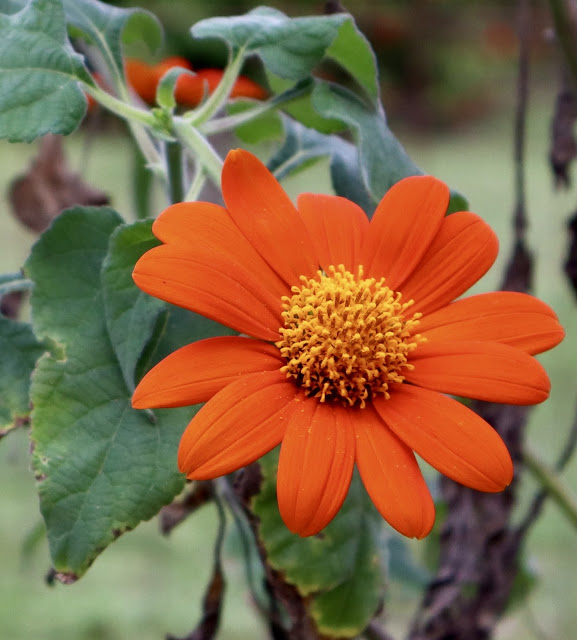
My tithonia plants are in a part of the garden that is not easy to water and they show that they have been deprived of moisture. Still, they bloom on, undaunted.


The cosmos bloomed in the summer and reseeded itself and now it blooms in autumn.


These crinums still put out a few blooms from time to time.


Do you ever forget that you've planted something? That happened to me with these yellow lycoris plants. I had completely forgotten that I had them until a few popped up to remind me.


This is the more common lycoris and I hadn't forgotten about it.

Duranta erecta, aka golden dewdrops.
 
The Cape honeysuckle is full of blooms.

'Cashmere Bouquet' Clerodendrum, aka Mexican hydrangea.

The cooler autumn weather has triggered the start of blooms in the purple oxalis.

Blue plumbago.

Pentas.

And more pentas.

Tropical milkweed, a gangly, somewhat unlovely plant but butterflies do like it.

The buddleias are still going strong, although the blooms are smaller now. (Yes, I do know I need to deadhead!)

And more buddleias.

Firespike, Odontonema strictum.

The muscadine grapes have been hurt by the year's weather but they still managed to produce some fruit that the wildlife will be glad to get.

The beautyberries seem impervious to weather. All of my several plants are fully loaded with berries.

This lantana was attacked by insects a few weeks ago but it is recovering and beginning to bloom again.

Peaches and cream lantana.

Purple trailing lantana, a favorite of butterflies.

The blooms of the almond verbena are not very noticeable to the eye, but if you have a sense of smell you can't miss them. Their scent is heavenly. Those are the neighbor's huge pine trees in the background.

Turk's cap, 'Big Mama.'

Justicia 'Orange flame.'
 
Cestrum.

Autumn sage.

While out taking pictures of flowers, I came upon this little guy resting on a fallen red oak leaf. I'm not 100% sure but I think it is a Tiger Swallowtail caterpillar. Please correct me if you know better.

The roses are responding to the cooler weather with blooms. This is pink Knockout.

'Peggy Martin.'
'Julia Child.' The blooms fade as they age. The one at the top is several days older than the bottom one.

 
'Caldwell Pink,' an antique polyantha.

'Belinda's Dream.'

'Lady of Shallott.'

I can always depend on the "blooms" of the bottle tree next to the Texas sage. You may be able to see a few of the fuchsia blooms remaining on the sage and there is one of those loaded beautyberry shrubs in the background.

I hope you and your garden are both doing well this October. I look forward to visiting you. Happy Bloom Day!

(Linking to Carol of May Dreams Gardens, our host.)