This book features a story within a story which made it (sometimes) confusing for me to follow.
Books, gardens, birds, the environment, politics, or whatever happens to be grabbing my attention today.
Translate
Thursday, June 30, 2022
The Woman in the Library by Sulari Gentill: A review
Monday, June 27, 2022
Bayou Book Thief by Ellen Byron: A review
Saturday, June 25, 2022
Poetry Sunday: The Breezes of June by Paul Hamilton Hayne
The soft breezes of a late June afternoon are much appreciated as I sit in the swing on my patio at the end of the day. It's the best time of day to venture out just now. Then, or else the early morning. Only a very foolish person would spend much time outside in the mid-day heat. Either a foolish person or one whose job requires him/her to endure the triple-digit temperatures. Those who must earn their living under this brutal June sky have my sympathy and concern.
If we make it through the heat of the day, those late afternoon "sweet and soft" breezes that whisper through the leaves of the trees are our reward. But if June comes, can July and August be far behind? It doesn't bear thinking about!
The Breezes of June
by Paul Hamilton Hayne
On! sweet and soft,
Returning oft,
As oft they pass benignly,
The warm June breezes come and go,
Through golden rounds of murmurous flow,
At length to sigh,
Wax faint and die,
Far down the panting primrose sky,
Divinely!
Though soft and low
These breezes blow,
Their voice is passion's wholly;
And ah! our hearts go forth to meet
The burden of their music sweet,
Ere yet it sighs,
Faints, falters, dies
Down the rich path of sunset skies—
Half glad, half melancholy!
Bend, bend thine ear!
Oh! hark and hear
What vows each blithe new-comer!
Each warm June breeze that comes goes,
Is whispering to the royal rose,
And star-pale lily, trembling nigh,
Ere yet in subtlest harmony
Its murmurs die,
Wax faint and die
On thy flushed bosom, passionate sky,
Of youthful summer!
Friday, June 24, 2022
This week in birds - #506
A roundup of the week's news of birds and the environment:
My beautyberries are a favorite with American Robins as well as many other birds that visit my yard.Thursday, June 23, 2022
Love and Saffron by Kim Fay: A review
Twenty-seven-year-old Joan Bergstrom lives in Los Angeles and has just started writing for the food section of the newspaper there. Imogene Fortier is fifty-nine years old and lives on Camano Island outside of Seattle. She writes a monthly column for a Pacific Northwest magazine. Joan is a fan of Imogene's columns and she writes her a fan letter, enclosing a gift of saffron. Their friendship blossoms through their exchange of letters in the 1960s, as they discuss world events like the Cuban missile crisis and the assassination of President Kennedy in addition to the everyday events of their own lives.
This is a short novel, only about 200 pages. I listened to it as an audiobook during a recent road trip. It was a quick read and kept us entertained for a couple of hours.
Imogene (Immy) writes a humor column about her daily life on Camano Island. Joan's special interest is discovering and writing about foods from other cultures, particularly Mexican. Her guide in learning about Mexican food and culture is a man from that country. Their relationship deepens as they share their interest in and love of good food.Both Joan and Immy enjoy exploring foods that are new to them and they share that love in their letters. They also reveal their inner lives and feelings in their letters, things that are unknown to others who are a part of their daily lives.
The 1960s were a time of growing interest in food, an interest that was spawned in large part by the success of Julia Child's television show, "The French Chef." It was hard to resist Julia's enthusiasm for good food. The show is referenced in the book. Both Joan and Immy are fans.
I found the book's narrative interesting, if not compelling. The narrator did a commendable job of presenting the story. None of the characters really "grabbed" me but the story was good and if you happen to be going on a road trip, I can recommend it as an audiobook that will definitely keep you entertained.
My rating: 3 of 5 stars
Wednesday, June 22, 2022
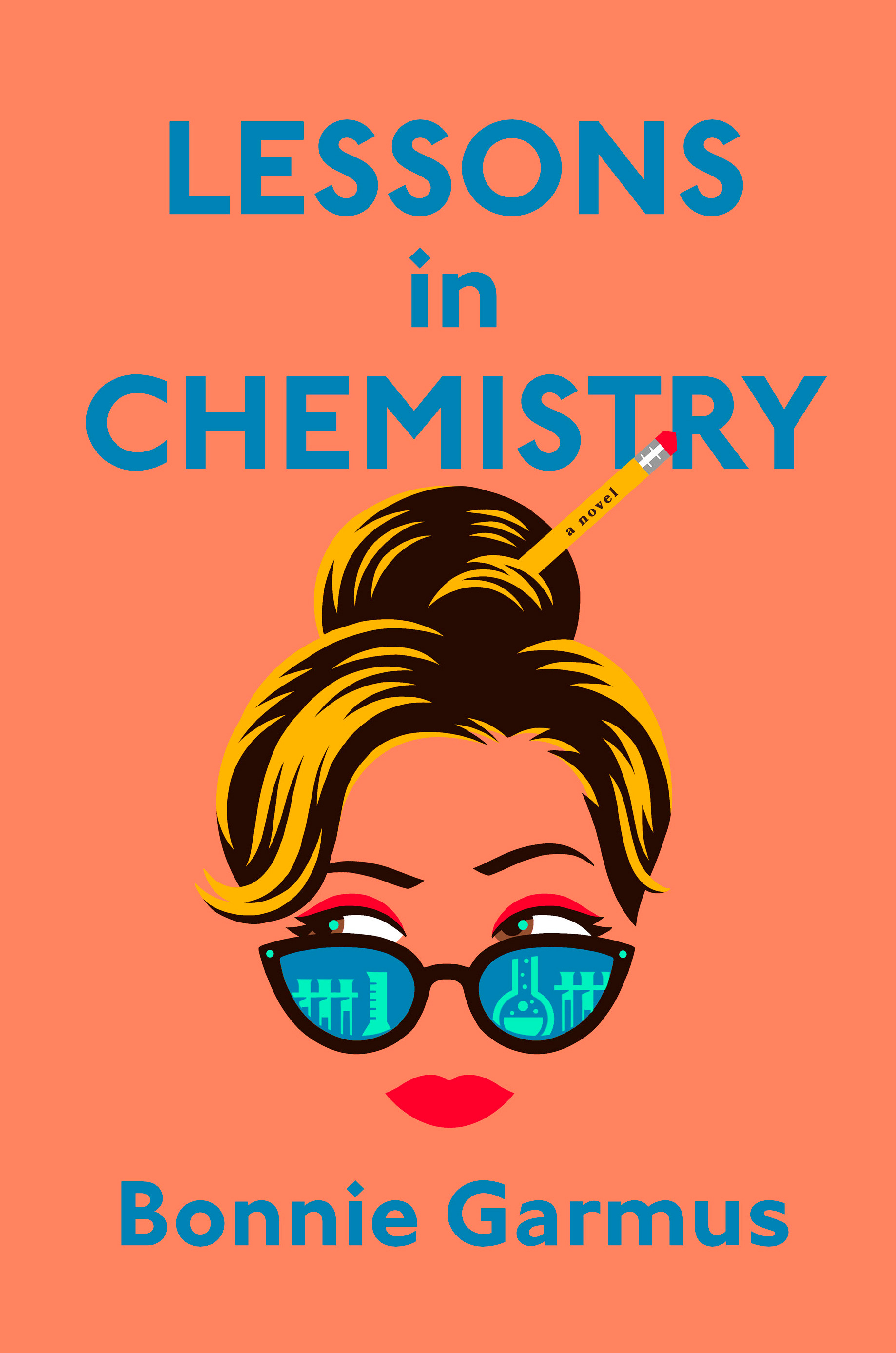
Lessons in Chemistry by Bonnie Garmus: A review
Abiogenesis. It's a word that describes a theory that life arose from simplistic, non-life forms. The heroine of Lessons in Chemistry is an expert on the subject.
A Botanist's Guide to Parties and Poisons by Kate Khavari: A review
First off, I must confess that I finished reading this book several days before I left town on my recent trip and so much has happened since then that I really find it hard to recall a lot about the plot. You might gather from that that it didn't make a lasting impression on me and you would be right in that conclusion. At the time that I finished it, I rated it as a three-star read which means that it was not terrible but not great. It was basically mediocre.
I read somewhere that this was the writer's second novel, but I can only find this one listed under her name, so I'm assuming that it was, in fact, her first. She is a Texas writer, living in the Dallas-Fort Worth area.
The time is 1923 and the place is London. Our protagonist, Saffron Erleigh, is a botanist at University College London. In this position, she is following in the footsteps of her late father. She is an assistant to Dr. Maxwell who is very supportive of her career ambitions. It's important that she has his support because she doesn't have that of her family from whom she is alienated.
The head of the botany department is Dr. Berking who is not a nice guy. He is a sexual harasser and Saffron does her best to steer clear of him whenever possible.
At a party for donors, faculty, and their spouses, Saffron meets a dishy and accomplished microbiologist named Alexander Ashton and we can sense immediately that this may develop into a romantic relationship. But also at the party, Saffron overhears a conversation detailing the many affairs of one of the professors, Dr. Henry. Soon after, she watches in horror as Mrs. Henry collapses and dies. Poison is suspected and soon confirmed.
A few days earlier, Dr. Maxwell had had an explosive argument with Dr. Henry and now he becomes the chief suspect in what is determined to have been murder. Maxwell had been scheduled to lead a large research expedition to the Amazon, but now he finds himself arrested and charged with murder. His plucky assistant, Saffron, is determined to prove his innocence and realizes she will have to do it on her own. She does however get a helping hand from that dashing microbiologist that she met earlier.
So what we have here is a romance/mystery with the emphasis a bit more on the romance side featuring a spunky and impetuous heroine. It was a quick read with a likable main character. It held my interest and certainly did not tax my brain cells; in other words, it was a nearly perfect summer read. The chapters were short and the action moved along at a steady clip. But the characters were all pretty one-dimensional and frankly, I can't even recall most of them. I know there were others besides Saffron, Dr. Maxwell, Alexander, and the Henrys, but they are only a blur to me now.
Still, not every book is Pulitzer-worthy but they can still be entertaining for a short while, if not particularly memorable in the long run. This one met those criteria.
My rating: 3 of 5 stars
Tuesday, June 14, 2022
Mini reviews
I'm going to be on the road for the next several days but before I leave I thought I would give you mini-reviews of a couple of books that I've recently read because who knows what I'll be able to remember about them by the time that I return!
*~*~*~*
Sea of Tranquility
by Emily St. John MandelThis is a science fiction book that has action taking place over a couple of centuries beginning in 1912. In that year, Edwin St. Andrew has been exiled from polite society in England because he had the audacity to make some ill-considered remarks at a dinner party. Edwin was eighteen years old at the time and likely had no understanding of the possible consequences of such remarks in the society in which he lived.
The family's solution to this embarrassment was to send him to Canada. He travels by steamship but when he arrives in the Canadian wilderness, he unaccountably hears a violin playing in an airship terminal! What could this possibly mean? Why, Edwin, it appears you have become a time traveler and have arrived in a different era altogether!
That violin player makes repeated appearances in different circumstances over a couple of hundred years. For example, two centuries later he turns up as a character in a book by famous writer Olive Llewellyn. Llewellyn lives in a colony on the Moon but she has written a book about a pandemic on Earth that includes a passage about a man playing a violin in an air terminal.
Finally, we meet Gaspery-Jacques Roberts, a detective in Night City, who is hired to investigate an anomaly in the North American wilderness and he uncovers all of these lives that have been turned upside down by some strange phenomenon.
I find it really difficult to describe the plot of this book in any sensible way, but it was an enjoyable read. Time travel has never been made to seem so ordinary and commonplace.
My rating: 3 of 5 stars
*~*~*~*
The School For Good Mothers
by Jessamine Chan
This book is based on every mother's nightmare - a moment of inattention, one bad decision that could ruin her and her child's life forever. Such a moment of inattention by Frida Liu landed her in the "School for Good Mothers," a place no mother in her right mind would ever want to be.Saturday, June 11, 2022
Poetry Sunday: June Thunder by Louis MacNeice
How I long to hear June thunder and see the catharsis of a cleansing downpour. But it is dry, dry, dry here. We haven't had rain in weeks and there is none in the offing that I can see. Nevertheless, a person can dream...
June Thunder
by Louis MacNeice
The Junes were free and full, driving through tiny
Roads, the mudguards brushing the cowparsley,
Through fields of mustard and under boldly embattled
Mays and chestnuts
Or between beeches verdurous and voluptuous
Or where broom and gorse beflagged the chalkland--
All the flare and gusto of the unenduring
Joys of a season
Now returned but I note as more appropriate
To the maturer mood impending thunder
With an indigo sky and the garden hushed except for
The treetops moving.
Then the curtains in my room blow suddenly inward,
The shrubbery rustles, birds fly heavily homeward,
The white flowers fade to nothing on the trees and rain comes
Down like a dropscene.
Now there comes catharsis, the cleansing downpour
Breaking the blossoms of our overdated fancies
Our old sentimentality and whimsicality
Loves of the morning.
Blackness at half-past eight, the night's precursor,
Clouds like falling masonry and lightning's lavish
Annunciation, the sword of the mad archangel
Flashed from the scabbard.
If only you would come and dare the crystal
Rampart of the rain and the bottomless moat of thunder,
If only now you would come I should be happy
Now if now only.
Friday, June 10, 2022
This week in birds - #505
A roundup of the week's news of birds and the environment:
An American Robin cools off from the 100-degree heat in our birdbath.Thursday, June 9, 2022
The Investigator by John Sandford: A review
I have read a few of John Sandford's books in the Prey series featuring Lucas Davenport. This book is a literal offspring of that series. It's the first in a series featuring Davenport's adopted daughter Letty Davenport.
Monday, June 6, 2022
The Gold Bug Variations by Richard Powers: A review
I have read and enjoyed other books by Richard Powers, most recently Bewilderment which I read late last year. So it was with some confidence that I would like it that I picked this early book of his to read. What the experience taught me is that one can't always depend on recreating one's enjoyment of a writer's later works with his earlier efforts. This book was published in 1991 and I hated it.
The first thing to be said about the book is that it is long, nearly 700 pages, and, in my opinion, if an unsparing editor had cut it to half that length, it might have been a better book. Powers seemed determined to never use only one word if ten could be employed to convey the same meaning. Moreover, he seemed equally determined to use some of the most obscure words in the language. (I'm sorry I didn't write any of them down to give you an example of what I mean; I was just too exasperated.)
I take a back seat to no one in my appreciation of our language. I'm even currently slogging my way through a nonfiction book about its history and rise to dominance on the world stage today (The Rise of English: Global Politics and the Power of Language by Rosemary C. Salomone), but surely the first test of being a good writer is to use cogent and accessible language and not exasperate your reader by making her have to pick up a dictionary every five minutes. Powers failed that test for me with this particular book.
But about the plot...
There are two tracks to the plot. The first occurs in 1957/58 and the second takes place in 1983. The two stories are intertwined. In the earlier track, scientists, including Dr. Stuart Ressler, are attempting to decode the message of the DNA spiral. In the 1983 story, we learn that Dr. Ressler is working at a commercial data processing center and art historian Frank Todd has just started working there and is curious as to why Ressler abandoned research that might have won him the Nobel Prize. Todd gets a young research librarian named Jan O'Deigh to investigate Ressler's background. Soon after the effort begins, Ressler dies of cancer, so there is never an opportunity to ask him about his reasons.
In the 1958 narrative, we learn that Ressler had an affair with another scientist with whom he worked, Dr. Jeanette Koss. Dr. Koss had given Ressler a vinyl record featuring Glenn Gould playing Bach's "Goldberg Variations." Ressler plays the record constantly and it becomes a kind of metaphor for their search for the message in DNA.
The 1983 narrative is essentially Jan O'Deigh's field notebook. From it we learn information about DNA and Ressler's and Koss's research. She is attempting to educate herself on the subject and, as we read, she educates us as well.
The construct of metaphor is essential to the novel's plot. In fact, it seems that the author may have meant it as an analogy between "The Goldberg Variations" and the DNA code, and I think the truth is that I may just not be smart enough to understand all that. To do so might require a firmer grounding in philosophy and science than I have. It is a complex and difficult plot that demands a lot of the reader and there were many references that are probably lost on the unprepared reader. I am quite sure there were many that were lost on me.
I've often felt that the time that one reads a particular book has much to do with one's enjoyment or lack of enjoyment of it, so perhaps I just picked this one up at the wrong time of my life. In looking at reader reviews of the book on Goodreads, I was struck by the fact that most of them were glowing. Those readers really, really liked this book! So, once again I am the rebel, the outlier. I can live with that.
My rating: 1 of 5 stars
Saturday, June 4, 2022
Poetry Sunday: June by James Russell Lowell
The June that James Russell Lowell describes in his poem does indeed sound like the perfect month, a time when "The flush of life may well be seen..." Wherever you are, I hope you are experiencing that "perfect" month.
June
by James Russell Lowell
What is so rare as a day in June?
Then, if ever, come perfect days;
Then Heaven tries the earth if it be in tune,
And over it softly her warm ear lays:
Whether we look, or whether we listen,
We hear life murmur, or see it glisten;
Every clod feels a stir of might,
An instinct within it that reaches and towers,
And, groping blindly above it for light,
Climbs to a soul in grass and flowers;
The flush of life may well be seen
Thrilling back over hills and valleys;
The cowslip startles in meadows green.
The buttercup catches the sun in its chalice,
And there's never a leaf nor a blade too mean
To be some happy creature's palace;
The little bird sits at his door in the sun,
Atilt like a blossom among the leaves,
And lets his illumined being o'errun
With the deluge of summer it receives;
His mate feels the eggs beneath her wings,
And the heart in her dumb breast flutters and sings;
He sings to the wide world, and she to her nest,—
In the nice ear of Nature which song is the best?
Friday, June 3, 2022
This week in birds - #504
A roundup of the week's news of birds and the environment:
Pied-billed Grebes are definitely one of my favorite - and I think one of the cutest - of the water birds.