Translate

Saturday, May 28, 2022

Poetry Sunday: Hymn for the Hurting by Amanda Gorman

You probably remember poet Amanda Gorman from her appearance at the inauguration of President Biden. She read her poem "The Hill We Climb" on that occasion. After the senseless slaughter in Uvalde this week, she was inspired to write another poem which was published in The New York Times. It seemed perfect for the occasion and so I stole it in order to feature it here, just in case you didn't get a chance to read it in the Times.

Hymn for the Hurting

by Amanda Gorman

Everything hurts,
Our hearts shadowed and strange,
Minds made muddied and mute.
We carry tragedy, terrifying and true.
And yet none of it is new;
We knew it as home,
As horror,
As heritage.
Even our children
Cannot be children,
Cannot be.

Everything hurts.
It’s a hard time to be alive,
And even harder to stay that way.
We’re burdened to live out these days,
While at the same time, blessed to outlive them.

This alarm is how we know
We must be altered —
That we must differ or die,
That we must triumph or try.
Thus while hate cannot be terminated,
It can be transformed
Into a love that lets us live.

May we not just grieve, but give:
May we not just ache, but act;
May our signed right to bear arms
Never blind our sight from shared harm;
May we choose our children over chaos.
May another innocent never be lost.

Friday, May 27, 2022

This week in birds: #503

 A roundup of the week's news of birds and the environment:

(Yellow-billed Cuckoo photo from eBird.)

The dominant voice around my yard this week has been the bird that I knew as the "Rain Crow" when I was growing up. It was only later that I learned that the bird's proper name was Yellow-billed Cuckoo. A secretive bird that skulks among the leaves of the trees and shrubs its frequents, it is more often heard than seen, so it is difficult for the amateur to get a good picture of it. But at this time of year, even if we can't see it, its call leaves us no doubt that it is present.

*~*~*~*

The heatwave that has been scorching India and Pakistan has been made thirty times more like by climate change, according to scientists. The subcontinent has had extreme temperatures and low rainfall since mid-March and that has caused widespread suffering in the area.

*~*~*~*

Scientists are also warning that focusing on carbon dioxide alone will not be enough to keep temperatures within a livable range. It is also necessary to sharply cut methane levels in the atmosphere they say.

*~*~*~*

Among the 2022 winners of the world's preeminent environmental award, the Goldman Prize, are Indigenous activists and lawyers who took on transnational corporations and their own governments to force climate action.

*~*~*~*

This is not the news that those of us who live near the Gulf of Mexico want to hear: Conditions in the Gulf are now similar to 2005, the year that produced deadly Katrina as well as six other major storms.

*~*~*~*

An unprecedented wave of sandstorms has recently struck parts of the Middle East and experts say they are at least partly the result of climate change. They also blame the failure of governments to regulate appropriately.

*~*~*~*

It was sixty years ago that Rachel Carson's Silent Spring was published and engendered the modern environmental movement. It was thanks to that book that DDT was banned in America but still today birds face extreme threats to their existence, largely because they migrate through every habitat on Earth.

*~*~*~*

As heat surges and drought worsens across already dry California, tensions are rising in the state as governments seek ways to deal with the crisis.

*~*~*~*

States are looking at ways to extract critical elements from waterways that have been polluted by coal as a means of offsetting the high cost of cleanup.

*~*~*~*

If you go outside and look up at the sky on Monday night, you might be able to see a very special shower of meteors. Or not. But if everything lines up just right there could be as many as 1,000 shooting stars per hour which would make for a spectacular show. 

*~*~*~*

Scotland's Bass Rock in the Firth of Forth is home to the world's largest colony of Northern Gannets, some of which you see here. The island is literally for the birds.

*~*~*~*

After more than a century of federal management and nearly two decades of negotiations, the lands of the Northern Bison Range in Montana have been reclaimed by the Confederated Salish and Kootenai Tribes.

*~*~*~*

This is Trillium grandiflorum, a native wildflower in the eastern part of the continent. It is seriously endangered due to human development, predation, and competition from invasive plants and it may disappear.

*~*~*~*

At the World Economic Forum in Davos, Switzerland this week, more than fifty corporations pledged to "buy green" by getting the commodities they need in their production from processes that emit little or no carbon. 

*~*~*~*

Ninety-seven-year-old Jimmy Carter has joined the fight to stop the construction of a gravel road that would cut through a federal wildlife refuge in Alaska. The battle over the road endangers an environmental law which Carter called one of his highest achievements.

*~*~*~*

Also in Alaska, the Biden administration this week took action that will likely block the controversial Pebble Mine project there. 

*~*~*~*

When cave explorers descended into a massive sinkhole in China's Guangxi region that had never before been explored, they discovered a hidden forest that could be home to previously unidentified plant and animal species.

*~*~*~*

Langkawi Archipelago in Malaysia is a cluster of 109 tropical islands that form an important area for marine mammals. It is threatened by development in the area that could cause severe damage to its ecosystem and wildlife.

*~*~*~*

A nest of the endangered Kemp's ridley sea turtle was discovered in the dunes of Galveston Island State Park on Thursday. The nest contained 107 eggs which were taken to an incubation facility where they can be protected. The nest was the first to be discovered in the park since 2012 and since this is the most critically endangered sea turtle in the world, every egg is precious. 

*~*~*~*

A lithium mining project in North Carolina promised a reliable source of clean energy but neighbors have now turned against the project.

*~*~*~*

While some species suffer because of the warming climate, at least one creature is perfectly happy with higher temperatures. Pacific rattlesnake populations in a heated up California are thriving.

*~*~*~*

Christian Cooper, the Black birder who became famous after he was accosted by a White woman in Central Park, will soon be hosting a birdwatching show called "Extraordinary Birder" on National Geographic TV.

*~*~*~*

One victim of the heatwave on the Indian subcontinent has been the mango. The blistering temperatures have devastated crops of the fruit.

*~*~*~*

The tiny Clear Lake hitch is an endangered fish that currently swims in the waters in California, but for how much longer?

*~*~*~*

Here are some pictures of the beautiful Swainson's Hawk from the Flint Hills of Kansas.

*~*~*~*

Wandering salamanders that parachute out of trees? Yes, they exist! Nature never ceases to amaze us. 


Tuesday, May 24, 2022

When We Were Orphans by Kazuo Ishiguro: A review


This book was published in 2000 and all the reading world except for me probably read it then. I'm only twenty-two years late to the party, but never mind; the story still seems fresh and "of the moment" even though it begins in 1923.

This is a sort of detective story that isn't really a detective story. It starts in the early twentieth century with a mystery, the suspicious disappearance from their home in the International Settlement of Shanghai of Christopher Banks' parents. First his father and then his mother disappear and nine-year-old Christopher is left an orphan. Christopher is then sent "home" to an aunt in England. It is a home he had never seen. He's never been to England before.

His parents never turn up and he grows up in his aunt's home and becomes - perhaps not surprisingly - a detective. His urge to learn what happened to his parents is sublimated in his work of finding missing persons and solving crimes. He becomes a detective of some renown as he solves several big cases.

Still, the disappearance of his parents remains a mystery that haunts him. Christopher's mother had been an outspoken critic of the opium trade in Shanghai and Christopher had always believed that her criticism was somehow responsible for their disappearance. The grown-up Christopher sees his career as a detective as preparation to follow the trail of their disappearance and try to find out what happened to them. But by the time he is ready to begin searching in his early 30s, the Sino-Japanese War breaks out in 1937.

Christopher comes to believe that his parents' disappearance and the beginning of the war are somehow related. He believes that they had been trapped in Shanghai for all the years of their absence and that their situation is the cause of the struggle. It is both a risible and a tragic delusion, but he determines to look for them in the landscape of war. 

This story is told to us by Christopher in a straightforward and detached narrative. For someone whose career has demanded an ability to rigorously examine details and to objectively analyze them, his psychological state seems to hinge on his ability to maintain his self-deception that his parents' disappearance is a factor in the beginning of the war.

His search takes him through some of the worst of the fighting. There are scenes of horror. But then in the midst of the horror, Christopher chances to meet an old friend from his childhood. His Japanese friend is now involved in the war. Their meeting seems entirely implausible but a necessary component of the arc of the story.

Once again we have to deal with an unreliable narrator in Christopher. How much of his narrative is the truth and how much is his wishful thinking? Ishiguro continues with his favorite theme of memory and how it relates to our sense of self. How well, after all, do we really know ourselves? How clearly are we able to see and judge events around us? Are our life experiences and their sometimes traumatic effect not always the prism through which we will view the world? And does that prism inevitably skew our understanding of events? Are we not all, in Ishiguro's telling, "orphans" whose lives can never truly be our own? It is a bleak view of the world but not necessarily a wrong one.

My rating: 3 of 5 stars

Monday, May 23, 2022

Homegoing by Yaa Gyasi: A review


Homegoing was Yaa Gyasi's debut novel, published in 2016. It is an ambitious work that covers almost three hundred years of history from the Gold Coast of Africa (later to be called Ghana, where, incidentally, the author was born) to life in America. Through eight generations of one family, it explores the history and the legacy of slavery.

The story begins with "Effia the Beauty" and her half-sister Esi. It is the eighteenth century on the Gold Coast where England holds sway. Effia is married off to a wealthy Englishman named James Collins who is responsible for overseeing operations at Cape Coast Castle which is the headquarters of the British slave trade. Esi is the daughter of Asante warrior. She is captured by slave traders and sold to the British and, unknown to Effia, she ends up in the dungeons underneath the Castle before ultimately being shipped off to America.

Esi has a daughter named Ness. In 1796, her daughter is taken from her and sold. In order to survive such horrors, Esi has hardened her heart and her daughter learned to associate real love with a hardened heart. Ness would always miss "the gray rock of her mother's heart."

In her new home, Ness met and was married to Sam, another slave, and they had a son called Kojo. Ness and Sam risked their lives in a bid for freedom so that Kojo could grow up free.

The descendants of both Esi and Effia make efforts to break free from the past and to live in freedom. Throughout the generations of the family, the stories of these efforts are passed on, but in time, the oral tradition fades. A modern-day descendant named Marcus works on his doctorate in sociology at Stanford. Through diligent research and study and finally a trip to Ghana, Marcus pieces together the history of his family.

There is so much history covered in this book that it is hard to do it justice in a summation. Gyasi methodically relates the continuous chronological record of three centuries and there is a lot there. But her story is most relatable and most understandable when she focuses on individual stories and relationships. It is through these individuals that we can come to understand, even a little bit, what the slave trade has done to families throughout the centuries. The horrors of slavery are brought home to us on an intimate, personal level. I have daughters. To imagine those daughters being sold like any piece of merchandise is more than I can bear. I can fully understand why Esi had to "harden her heart" in order to survive. 

In her ambitious debut, Gyasi showed her instinctive gift for storytelling. Through her writing, she has given us a deep-rooted and emotional understanding of the savage realities of the slave trade and the damage that continues even today to those whose ancestors were sold like cattle. She also gives us an appreciation of human resilience that has endured such savagery and managed to overcome it. To overcome it but never to forget. As one character says, "When someone does wrong, whether it is you or me, whether it is mother or father, whether it is the Gold Coast man or the white man, it is like a fisherman casting a net into the water. He keeps only one or two fish that he needs to feed himself and puts the rest in the water, thinking that their lives will go back to normal. No one forgets that they were once captive, even if they are now free."

My rating: 4 of 5 stars 


Saturday, May 21, 2022

Poetry Sunday: Late Spring by Judith Wright

I met a new poet this week. Her name was Judith Wright. She is no longer with us, having died almost two years ago, but her poetry lives on. She was an Australian and a devoted environmentalist and social activist who campaigned for Aboriginal land rights.

Her poems that I read were replete with references to the environment, revealing her familiarity and concern for issues affecting it. I particularly liked the following poem which gives us images of a pear tree that had fallen in a storm but still sends out its blossoms as "obstinate tokens" of life in spring. I hope you like it, too.   

Late Spring

by Judith Wright

The moon drained white by day
lifts from the hill
where the old pear-tree fallen in storm
springs up in blossom still.
Women believe in the moon:
this branch I hold
is not more white and still than she
whose flower is ages old,
and so I carry home
flowers from the pear
that makes such obstinate tokens still
for fruit it cannot bear.

Friday, May 20, 2022

This week in birds - #502

 A roundup of the week's news of birds and the environment:

White Pelicans enjoying a day by the bay.

*~*~*~*

The National Oceanic and Atmospheric Administration has issued its monthly report and the bottom line is that we should prepare ourselves for a real scorcher of a summer.

*~*~*~*

And in more potentially bad weather news, conditions in the Gulf are looking much like they did when Hurricane Katrina was produced.

*~*~*~*

According to United Nations climate reports, climate change indicators all set new record highs in 2021.

*~*~*~*

If you missed the lunar eclipse earlier this week, here are pictures of the event.

*~*~*~*

Unsurprisingly, policies that offer solutions to check the potential ongoing extinction of species also have benefits for fighting climate change.

*~*~*~*

This is a giant stingray, measuring 13 feet long and weighing 400 pounds, that was rescued and released into the Mekong River in Cambodia earlier this month.

*~*~*~*

Meanwhile, in Italy, its longest river, the Po, is drying up.

*~*~*~*

This is an artist's depiction of a forest skink that used to thrive on Christmas Island. Apparently, it only exists now in artists' depictions for it is believed to be extinct.

*~*~*~*

Rosy-faced Lovebirds have learned to use their head as a third limb to help them walk over rocks. Other species may also have learned the technique.

*~*~*~*

Some rare good news for narwhals: A proposed expansion of an Arctic mine has been rejected by Canadian authorities. Its approval could have meant extirpation for the narwhal.

*~*~*~*

A detailed map of potential exposure to wildfires across the country shows that 1 in 6 Americans live in areas that have a significant risk of wildfires. 

*~*~*~*

A photographer who was trying to take a picture of a Great Gray Owl got more than she bargained for when the big bird perched on her camera.

*~*~*~*

The herb silphium was a particular favorite in ancient Rome. It had many uses. But then it became extinct, possibly the first victim of human-caused climate change.

*~*~*~*

A wave of lethal bird flu is killing millions of birds right now. Experts say that previous experiences with this disease should have taught us how to avoid these outbreaks. Evidently, we have not learned the necessary lesson. 

*~*~*~*

A tooth from an ancient Denisovan girl that was found in a cave in Laos is offering clues for solving the mystery of these hominins that are among the ancestors of people alive today in Australia and the Pacific region.

*~*~*~*

A Global Big Day revealed a number of bird species in the Flint Hills of Kansas.

*~*~*~*

Kayakers on the Minnesota River at first thought they might have found part of the skull of a murder victim, but if it was then the victim was murdered 8,000 years ago.

*~*~*~*

This is the American Bird Conservancy's "Bird of the Week," the beautiful little Magnolia Warbler.

*~*~*~*

A study found that over a five-year period one in six of all deaths of humans were caused by pollution.

*~*~*~*

How bad is the drought in the West? It is the worst that the area has experienced since 800 A.D.

*~*~*~*

An aggressive male Wild Turkey has taken to attacking people on the Anacostia Riverwalk Trail that straddles Washington, D.C. and the Maryland state line.

*~*~*~*

And in other poultry news, feral chickens have become a fixture on  Oahu and Kauai in the Hawaiian Islands. They are creating some difficulties for the islands and the governing entities are discussing how to handle the problem.

*~*~*~*

The Colorado River which serves people in seven states and Mexico is in crisis and in danger of drying up

*~*~*~*

South Africa has experienced deadly flooding and scientists say the problem has been exacerbated by climate change.

*~*~*~*

The secret ingredient in wine may be sheep droppings. Well, not literally, of course, but the animals' droppings do enrich the vineyard and increase the production of grapes. 

*~*~*~*

Margaret Renkl says that one way to help the environment is to let our yards be a little more wild.

Tuesday, May 17, 2022

The Candy House by Jennifer Egan: A review


Jennifer Egan's latest is billed as a sequel to A Visit From the Good Squad which I read way back in 2013. A lot of books have flowed over the rocks of my brain since then, so I don't remember the specifics of that book as well as I might, but I do remember that I liked it. In fact, I've never read a book by Egan that I didn't like. And that includes The Candy House

This one is a bit difficult to describe. It is all about memory and the desire for privacy in a world where so much of our lives is open to the public. We can come to feel that our lives are no longer our own but are part of the shared memories of everyone around us. As I say, a bit difficult to describe or wrap our heads around.

The time is 2010 and Bix Bouton is a successful tech entrepreneur on the lookout for the next big thing. A conversation with some Columbia professors puts him on the track of an idea for downloading or externalizing memory. The technology that he creates to make that germ of an idea a reality allows an individual access to every memory he or she has ever had as well as the ability to share those memories and the memories of others. Thus, "Own Your Unconscious" is born.

The technology becomes wildly popular with the public. Egan then shows us the potential consequences of the system through the lives of many disparate characters over decades. She does this in a number of different styles throughout the various chapters. One chapter, for example, is comprised of nothing but tweets! It's certainly a creative, imaginative way of developing a theme and telling the story. 

Through this imagined technology, one is able to access and remember the memories of others: one's forebears, for example. What could possibly go wrong with that? Furthermore, she imagines a system of "counters" who track and exploit the desires of others as they are identified in memories. In her world, there are also "eluders," those who understand the price of becoming involved in "Own Your Unconscious" and refuse to participate. 

The world that she imagines has social media and technology as an integral part of the living environment. One review of the book that I remember described it as the "soundtrack" of our lives and that seems particularly apt. And what if one doesn't want one's memories to become a part of this global consciousness? Can one refuse to participate? Can one disown one's consciousness and one's memories? As much as an exploration of the possibilities of reliving the memories of others, Egan's book seems to be a warning of the dangers of such sharing. In the end, although we long for connection with others, we also cherish our privacy. It is, after all, the essence of what makes us us.

My rating: 4 of 5 stars  

Sunday, May 15, 2022

Garden Bloggers' Bloom Day - May 2022

Can it really be May Bloom Day already? Carol Michel says so and I must believe her since she is the original instigator of this monthly post.

So, here goes. We've had a dry spring so far and it is looking like a dry summer but many of my tough old plants don't seem to notice.


This red salvia for example.


The 'Hot Lips' salvia started blooming earlier and is almost finished with its first blooms now.


I love these hot orange blossoms of the pomegranate.


Not quite in full bloom yet but this buddleia will soon get there.


This sweet-smelling vine is by my back porch.


These ancient cannas haven't done much for me so far, but they'll get going soon and bloom throughout the summer.

Blue plumbago doing its thing.

And yellow cestrum doing its.

'Darcy Bussell' rose almost finished with its first cycle of bloom.

'Julia Child' rose.

'Lady of Shallott' rose just a bit past its prime.

I have lost the label for these blooming plants and have racked my brain trying to remember their name. My brain is not cooperating. Perhaps you recognize them.

These little violas came up as "volunteers" in one of my pots, so I dug them out and gave them their own little pot. They have bloomed and bloomed for me for a couple of months, but they are beginning to fade a bit now.

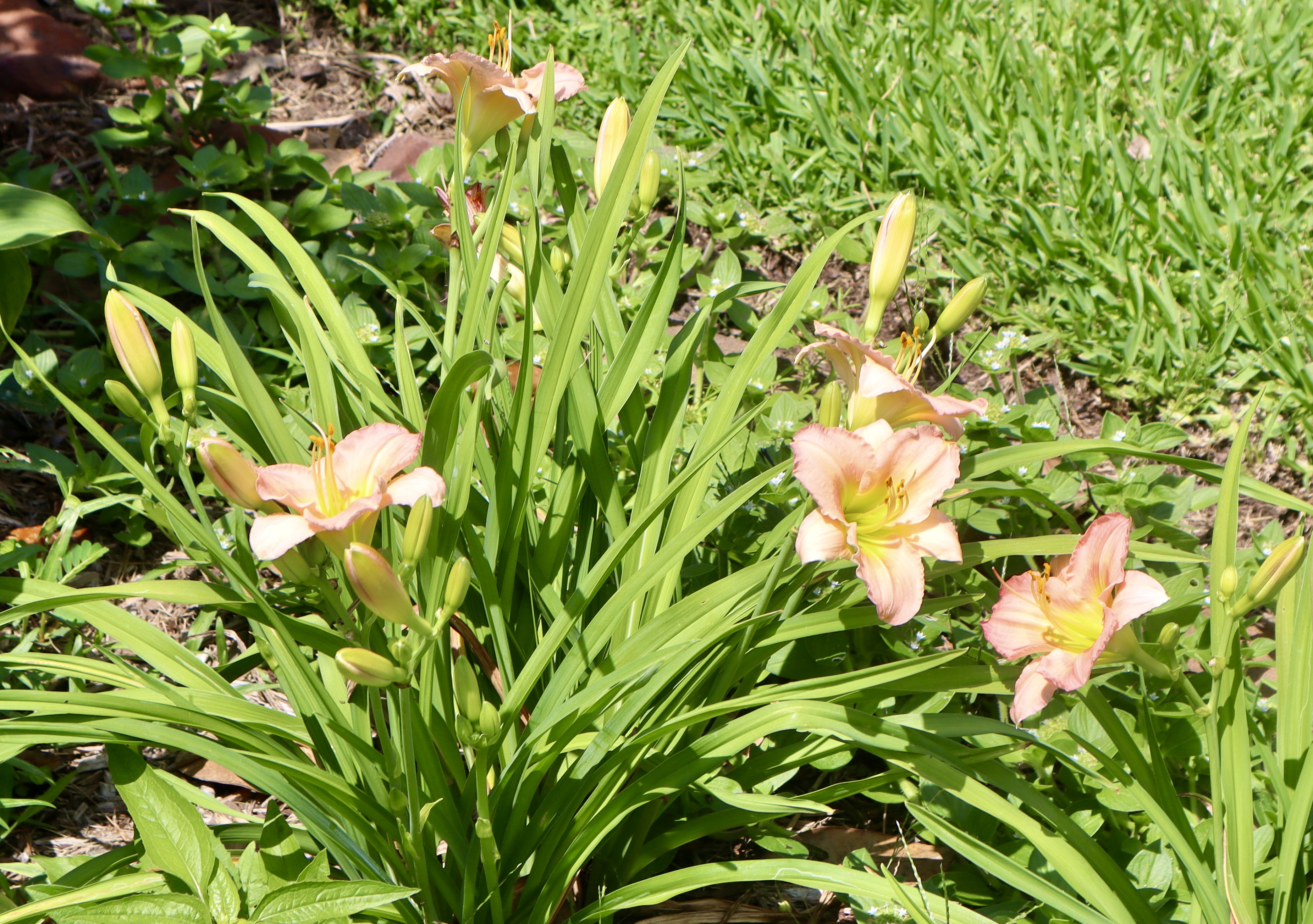
If it's May, there must be daylilies of course.

I'm especially fond of this one.

Some of my blooms are late this year. We did have a winter that lingered a bit. This coreopsis is just beginning to get going.

Tropical milkweed.

Justicia 'Orange Flame.'

This larkspur has bloomed profusely for me but it is almost done now.

The pots by my patio have petunias, salvia, and yellow cockscomb. It looks like the cockscomb is getting crowded out.

Purple echinacea.

Rudbeckias are among my most dependable bloomers.

The yarrow by the little goldfish pond continues to bloom.

Four o'clocks or, in this case maybe six o'clocks.

The pansies in the pot on my patio table have bloomed all winter and now spring and they are just about finished but still gamely sending out a few blooms.

The clematis has put on quite a show recently.

And, of course, what would be May without at least one sunflower. The birds plant them all around my yard and I mostly let them grow unless they are interfering with one of my intentional plantings. 

I hope you and your garden are enjoying a productive and stress-free spring. Happy Bloom Day!

Saturday, May 14, 2022

Poetry Sunday: A Book by Emily Dickinson

This one is short and sweet and to the point. Emily Dickinson did not mince words!

A Book

by Emily Dickinson

There is no frigate like a book
To take us lands away,
Nor any coursers like a page
Of prancing poetry.
This traverse may the poorest take
Without oppress of toll;
How frugal is the chariot
That bears a human soul!

(Note to readers: My Bloom Day post will be published later today.)

Friday, May 13, 2022

This week in birds - #501

 A roundup of the week's news of birds and the environment

This, I believe, is a female Black-Throated Green Warbler who stopped in my backyard for a visit on her way north. 

*~*~*~*

Wildfires continued to ravage parts of New Mexico this week. There has been an early beginning to the wildfire season in the West fed by a combination of high winds and extremely dry vegetation due to drought.

*~*~*~*

On the good news for the environment side of the ledger this week, the Interior Department confirmed this week that it will not be holding three oil and gas lease sales for the Gulf of Mexico and off the coast of Alaska that had been expected to take place, removing millions of acres from the auction block.

*~*~*~*

But on the other side of that ledger, the global average temperature rise of 1.5 degrees centigrade is likely to be reached at some point in the next five years. That is the point at which climate impacts will become increasingly harmful for humans and for the planet as a whole.

*~*~*~*

PFAS-tainted sewage sludge has historically been used as a fertilizer in fields and now those chemicals may have polluted as much as 20 million acres of U.S. cropland, according to a recent study.

*~*~*~*

Leaders of the world's major religions have joined with United Nations officials in urging financial institutions to stop bankrolling activities that drive climate change, including ending support for new fossil fuel projects. 

*~*~*~*

More effort is needed to investigate and prosecute environmental crimes. For this, we need eco-detectives who can identify and uncover those crimes.

*~*~*~*

The American Bird Conservancy's "Bird of the Week" is the beautiful and musical Northern Parula.

*~*~*~*

The International Energy Agency's chief warned this week that climate chaos is inevitable if we continue to invest in large new oil and gas developments. Such projects would have little impact on the current energy crisis but could spell devastation for the planet.

*~*~*~*

A heatwave that has shattered records in parts of Texas is destined to spread through much of the central United States causing records to fall as it goes.

*~*~*~*

Margaret Renkl writes about endangered rivers and specifically about the Mobile River which is the third most endangered waterway in the United States thanks to the threat from coal ash pollution. 

*~*~*~*

The beautiful San Gabriel Mountains in California are a very birdy place.

*~*~*~*

The soil beneath our feet comprises an astonishing ecosystem on which the future of the planet and of human beings on that planet depends.

*~*~*~*

This weird creature is a highfin dragonfish that has been spotted off the coast of northern California. It is only the fourth time in nearly thirty years of deep-sea research that one has been seen.

*~*~*~*

The Revelator has a featured story on the shrinking tidal flat habitats in eastern China that are critical stopover sites for migrating birds.

*~*~*~*

The deforestation of Brazil's Amazon continues unabated. In fact, it surged to new levels for the month of April, nearly doubling the area of forest that had been removed in April of the previous year.

*~*~*~*

A mysterious process called horizontal gene transfer accounts for how some fungi became toxic.

*~*~*~*

It's not exactly a part of our earthly environment but it is a part of our galactic neighborhood; it's a supermassive black hole that sits at the center of the Milky Way and astronomers have taken a picture of it!

*~*~*~*

Cassava is a shrubby root that is grown in Africa and it works well as a substitute for wheat. It could even help to wean the world off that crop.

*~*~*~*

Some bats have learned to make a noise like buzzing hornets in order to scare off predators that might eat them. It would take a hearty or foolhardy predator indeed to face down a swarm of angry hornets. 

*~*~*~*

When it comes to climate change, we (i.e., all of life on Earth) are in this together and it behooves humans as the species primarily responsible for the changes to get involved in helping other species survive

*~*~*~*

In Kenya's Kipsigis community, Chepalunga Forest is at the heart of their culture. When indigenous trees were being lost, the local villagers decided to replant their forest and that is how 90,000 trees brought a forest back to life.


Thursday, May 12, 2022

Ocean State by Stewart O'Nan: A review


The setting of Ocean State is the small working-class town of Ashaway, Rhode Island. The narrator is named Marie and she takes us back to the autumn of 2009 when her older sister Angel killed a girl named Birdy. 

This isn't a murder mystery then. There is no mystery because we know from the very first paragraph of the book what happened.

Angel and Birdy had been in love with the same teenage boy. Or at least with all the intense single-mindedness of teenagehood, they thought they were in love. Angel's solution to this "love" triangle was to knock off one of its sides. 

Angel's and Marie's mom, Carol, struggles to raise her two girls and to encourage them to make lives for themselves somewhere away from Ashaway. She just wants to get them through high school and to help them as much as she can with college. Her dreams did not work out and that has left her with the feeling that their lives are a matter of chance and are basically beyond their control. Things are bound to go awry even if they do everything right. 

And then of course things do go badly awry when her older daughter commits murder.

Stewart O'Nan tells his story through the alternating perspectives of these four women. Thus, we spend time with and get to know both the victim and the murderer. But we also get to know the murderer's mother and get some sense of where she came from. And we see it all through the eyes of the murderer's younger sister who loved, admired, and perhaps envied her beautiful older sister. None of these perspectives that we are privy to are without their biases.

It's interesting that the teenage boy who is at the center of all this drama, Myles, is largely ignored. And yet he was an accomplice with Angel in the murder of Birdy and he was arrested, convicted, and served time for it. Was he the manipulator or the manipulated in the commission of the crime? Was he thrilled with the knowledge that he was the object of desire for two girls? What happened to him after he served his time? O'Nan doesn't give us a clue. One gets the feeling that he wasn't very interested in Myles.

As for our narrator, Marie, her sister's crime disrupted her life as well and she seems to have been something of a Sad Sack as a child and teenager. How could she have been otherwise, given the circumstances? Her telling of the story is presented as a way to get all of that out of her system and perhaps move on with her life. As the most sympathetic character in the story, the reader can hope that that worked for her.

The book is short, less than 300 pages, and it makes for propulsive reading. I was hooked from the first paragraph and found the book hard to put down. O'Nan does a good job of detailing the life in this small town and the characters are all interesting and well-drawn. One could hardly ask more of a writer.

My rating: 4 of 5 stars 


Tuesday, May 10, 2022

The Necklace by Matt Witten: A review


I finished reading this book more than two weeks ago (Yes, I am seriously behind with my reviews!), and when I sat down to write a review today, I could not remember anything about it. You might conclude from that that it didn't make much of an impression on me and you would be right in that assumption. 

Not that it was a terrible book. That would have made an impression and I probably would have remembered it, but it was just kind of blah. Not really terrible and not really that good. 

The writing was okay. Matt Witten is mostly a writer for television and has had considerable success with that. He has also written other mystery novels, but this is the first one of his that I have read. In the end, I resorted to the summary of it on Goodreads to refresh my memory.

One of the problems that I had with the book was that I just didn't like the protagonist that much. She should have evoked my sympathy. After all, her young daughter had been murdered twenty years before. A man had been arrested and charged with the murder. He was tried and convicted and when we come in on the story he is about to be put to death by the state of North Dakota. Our protagonist, the child's mother Susan Lentigo, is driving to North Dakota to witness the execution. She lives in upstate New York so has a long drive ahead.

On the way, she encounters her ex-husband. Their marriage broke apart after the murder of their daughter and her ex is now remarried and has another young daughter. 

Not to disclose any spoilers, I will just say that Susan discovers something on her long trip that leads her to believe that the man who is about to be put to death is actually innocent and that someone else who is still free is, in fact, the murderer. She tries to get the FBI to listen to her and investigate, but they are having none of it. 

Finally, she manages to reach the retired cop who made the original arrest and gets him to listen to her story and her reasoning. With his help and the help of a cynical but smart teenage girl, she races to try to find the proof that will win a stay of the execution and put the real murderer behind bars. 

Susan is a very unself-aware character who is quick to blame everyone but herself. Her conversation relies heavily on profanity and while that doesn't normally bother me - I have been known to use profanity myself - it just felt stilted in this instance. I could not feel any real connection to this character even though her life story should have elicited my sympathy. All in all, it was a relief to turn the last page of the book and move on to something else.

My rating: 2 of 5 stars  

Saturday, May 7, 2022

Poetry Sunday: The Last Resort by Don Henley and Glenn Lewis Frey

I sometimes suffer from the disease of nostalgia. This past week it has been nostalgia for the music of "The Eagles." I've listened to it at every opportunity that I've had. 

There are several of their songs that are personally meaningful to me, but the one that I return to most often is probably the one called "The Last Resort." That's its official name but I always think of it as "Paradise." The story that the lyrics tell seems to be particularly relevant just now and the two stanzas that always stand out in my mind are these:

Who will provide the grand design?
What is yours and what is mine?
'Cause there is no more new frontier
We have got to make it here
We satisfy our endless needs
And justify our bloody deeds
In the name of destiny
And in the name of God
And here are the complete lyrics:
The Last Resort
by Don Henley and Glenn Lewis Frey
She came from Providence
One in Rhode Island
Where the old world shadows hang
Heavy in the air
She packed her hopes and dreams
Like a refugee
Just as her father came across the sea
She heard about a place
People were smilin'
They spoke about the red man's way
And how they loved the land
And they came from everywhere
To the Great Divide
Seeking a place to stand
Or a place to hide
Down in the crowded bars
Out for a good time
Can't wait to tell you all
What it's like up there
And they called it paradise
I don't know why
Somebody laid the mountains low
While the town got high
Then the chilly winds blew down
Across the desert
Through the canyons of the coast
To the Malibu
Where the pretty people play
Hungry for power
To light their neon way
Give them things to do
Some rich men came and raped the land
Nobody caught 'em
Put up a bunch of ugly boxes
And Jesus people bought 'em
And they called it paradise
The place to be
They watched the hazy sun
Sinking in the sea
You can leave it all behind
Sail to Lahaina
Just like the missionaries did
So many years ago
They even brought a neon sign
"Jesus is coming"
Brought the white man's burden down
Brought the white man's reign
Who will provide the grand design?
What is yours and what is mine?
'Cause there is no more new frontier
We have got to make it here
We satisfy our endless needs
And justify our bloody deeds
In the name of destiny
And in the name of God
And you can see them there
On Sunday morning
Stand up and sing about
What it's like up there
They call it paradise
I don't know why
You call someplace paradise
Kiss it goodbye

Friday, May 6, 2022

This week in birds -#500

 A roundup of the week's news of birds and the environment:

A Sora searches among the reeds for its dinner.

*~*~*~*

New Mexico is burning. A wildfire fueled by the drought has consumed thousands of acres and the governor of the state has asked the president to declare a disaster area in order to free up more funds to fight the catastrophic blaze. 

*~*~*~*

A global review has found that birds are disappearing at an alarming rate. Half of the approximately 11,000 avian species on Earth are losing population while only 6% are increasing. 

*~*~*~*

But there is hope. Just look at the California Condor, once nearly extinct and now flying over California's redwoods for the first time in a century.

*~*~*~*

India and Pakistan are suffering through a brutal heatwave which has exacerbated massive energy shortages on the subcontinent.

*~*~*~*

It's pollen season and the native pollinators are busy out there collecting it. One way to help protect native pollinators is to plant native wildflowers that will provide pollen and nectar for insects such as bees, ants, and butterflies.

*~*~*~*

Modern technology is helping to find and preserve ancient Native American cave art.

*~*~*~*

Nature will find a way to deal with just about anything that we humans throw at her. Even the Great Pacific Garbage Patch which we have learned is being colonized by tiny creatures.

*~*~*~*

In Zimbabwe, where the drought has brought intensified competition for food and water, there is conflict not just between animals but between animals and humans.

*~*~*~*

The transitional fossil fish called Tiktaalik roseae flopped out of the water and onto land some 375 million years ago and some would argue that we've been flopping ever since! 

*~*~*~*

A recent paper by a national group of biologists and zoologists laid out a pathway for museums and zoos to work together to protect the planet's biodiversity. 

*~*~*~*

Here's a visit to a Great Blue Heron nest in Milford, Michigan. 

*~*~*~*

A tribe living at the southern tip of South America was thought to be extinct, but it seems that their descendants are still living in Chile and that the government there will soon legally recognize them.

*~*~*~*

This is an illustration of the Hawaiian Po'ouli which is now considered to be extinct. The last one died in our lifetimes. Here is the species' obituary.

*~*~*~*

Oyster harvesting was occurring in Australia and North America for at least 10,000 years prior to colonization, helping to sustain the indigenous communities there.

*~*~*~*

Colonial Jamestown, the 400-year-old site in Virginia, is facing disaster because of climate change. Chronic flooding has landed the site on the endangered list.

*~*~*~*

Time-lapse photography by a NOAA satellite documents twin disasters, showing smoke from the wildfire in New Mexico and a dust storm stirred up by violent winds in Colorado.

*~*~*~*

Did you ever wonder how trilobites made babies? Well, perhaps not, but rest assured that even before there were birds and bees there was sex. Proof? Here we are!

*~*~*~*

A spate of attacks on human residents by wild boar in Rome has caused several neighborhoods in the north of the city to impose curfews. It seems that the wild boar have been sharing the city with humans for many years. 

*~*~*~*

Single-use plastic products are being sold and distributed in America's national parks which certainly seems like a contradiction to the whole philosophy behind the national park system which the writer Wallace Stegner famously termed "America's best idea."

*~*~*~*

Exterminating wolves, on the other hand, is arguably one of America's very worst ideas. Will we never learn? 

*~*~*~*

It turns out that graveyards, peaceful, unpolluted, and often left untouched for centuries, are some of our wildest Nature sites.

*~*~*~*

The U.N.'s latest climate change report details positive steps that the world can take to halt the cycle of disaster.

*~*~*~*

This is a bit of a milestone for me. This is the 500th of these roundups of bird and environmental news that I have done, going all the way back to my earlier blog, Backyard Birder, in December 2011. There have been many times over the years when I have considered giving it up. Does it really do any good? And yet I keep plugging away at it because somehow I just can't quit. We all have to do whatever bit we can to try to increase awareness of the peril we face and this is my little bit. Thank you for taking the time to read it.