A roundup of the week's news of birds and the environment:
*~*~*~*
This year's Farm Bill could actually help some grassland species like the Bobolink that are in danger of disappearing from America's prairies.
*~*~*~*
The famous California mountain lion called P-22 was given a tribal burial this week in the mountains where he once roamed.
*~*~*~*
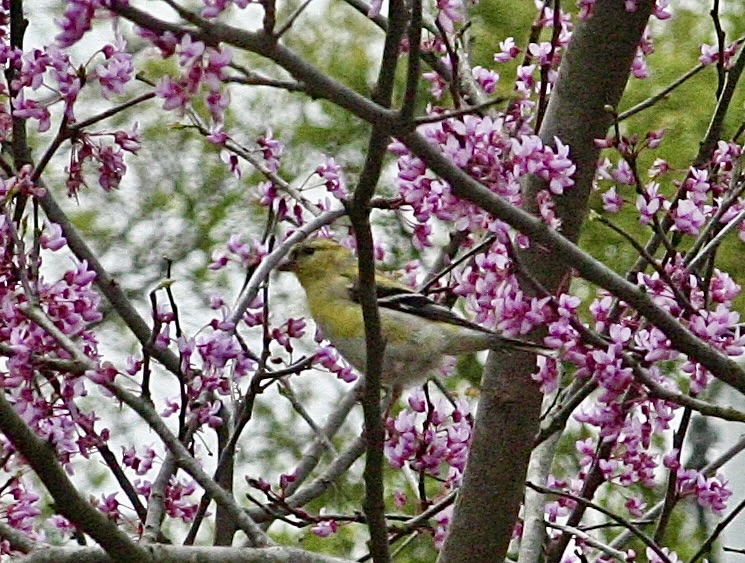
Spring is arriving about three weeks early throughout the continent. Trees, like my redbud, are already sprouting leaves and blooming.
*~*~*~*
A toxic algae bloom called the "red tide" is killing tons of fish along Florida's west coast.
*~*~*~*

*~*~*~*
Have they been looking for life in all the wrong places? A European probe that launches next month will be scanning the moons of Jupiter for potential signs of life.
*~*~*~*
This winter in the northern hemisphere has featured some significantly weird weather. Is it all because of climate change or is there something else afoot?
*~*~*~*
It's not news of this planet but NASA's Mars rover, Curiosity, is sending back some very interesting pictures.
*~*~*~*
Here are our five grassland species of birds that are most in danger of disappearing.
*~*~*~*
Conservation organizations are dropping the name of John James Audubon in response to information about his white supremacist beliefs.
*~*~*~*
The python invasion of Florida no longer affects only the Everglades but extends into nearly all of the southern part of the state.
*~*~*~*
Antarctica's sea ice is melting and that is bad news for Earth's land masses.
*~*~*~*

*~*~*~*
To save Earth, we need to save Earth's seas. A new treaty may help to do that.
*~*~*~*
How we can best protect butterfly species becomes a legal question.
*~*~*~*
An explosion of seaweed growth in the Great Atlantic Sargassum Belt is visible from space.
*~*~*~*
What animal species are most in danger of going extinct? Scientists believe they know.
*~*~*~*
The city of Pompeii was destroyed by a volcanic eruption in 79 A.D. and yet it lives on through the excavations of it. More and more is being revealed about life in the city.
*~*~*~*
A coalition of groups is urging the Environmental Protection Agency to, in fact, protect the environment by reforming dangerous neonicotinoid pesticides.
*~*~*~*
A majority of members of the United Nations have agreed on language for a treaty that would protect ocean biodiversity.
*~*~*~*
A technique known as proteomics is used to analyze ancient human protein and it could unlock secrets of our species' evolution.
*~*~*~*
A U.S. Forest Service logging plan that targets mature trees is angering residents in Kentucky.
*~*~*~*
Recent DNA discoveries reveal more of the history of the early hunter-gatherers who lived in Europe.
*~*~*~*
The plan for restoring bison to America's prairies focuses on expanding herds on Native American lands.
*~*~*~*
A creature called the sunflower sea star has been enlisted in the effort to control sea urchins in the kelp forests off the Pacific Coast of the continent.
*~*~*~*
One of the world's rarest populations of lions is in Senegal, but that population recently increased by three when a cat named Florence gave birth to three healthy cubs.
Good morning, Dorothy, and thank you for the weekly roundup. It has become a bit of a ritual in our house that when Miriam gets up (I am always up first) she will say, "What's Dorothy reporting on today?" and so the discussion continues. Often this triggers a visit to the bookshelves and the conversation continues on and off all day. Just about everything caught my eye this morning, but the story of the mountain lion's internment in Los Angeles resonated somewhat. I was puzzled by it, since I am sure that mountain lions were not routinely buried in ceremonial fashion by indigenous people, but it did emphasize that we need to have an enhanced level of respect for all life on earth and if the burial of one lion in California helps to achieve that, I am grateful. Thank you again for this noteworthy and wonderful service you provide each Saturday morning. With my very best wishes - David
ReplyDeleteP-22 was such a special animal, in that he was (unknown to him, of course) a bit of an ambassador for the wildlife of his mountains. He touched the consciousness of many through his life so it was appropriate that he be given that last measure of respect.
DeleteI, also, look forward to your most informative and interesting postings. Thank you, Dorothy!
ReplyDeleteAnd thank you for your kind comment.
DeleteI was especially interested in reading about the research which is leading scientists to be able to predict which species will be most likely to go extinct. I would like to know more about the evolution of animals on islands.
ReplyDeleteYes, spring has arrived early here. But I have been told we will have a little cold front next week.
I believe it's supposed to get cool again at the end of the week. Our last chance to enjoy coolness for about six months!
DeleteThis is the second year in a row that my sweet acacia tree has started blooming two months early.
ReplyDeleteI was reading about the wild buffalo herd up at the North Rim of the Grand Canyon. They thinned it quite a bit by sending many to tribal lands in-- if I remember correctly-- South Dakota. I think it's a good plan to have Native Americans be in charge of this.
Absolutely!
DeleteAbsolutely with all that is going on with Pompeii. Wasn't there also a different algae beside this red one that had been killing wildlife around Florida in recent years? I am like 50% certain I read about it in one of these posts.
ReplyDeleteThere have been repeated instances of excessive algae growth creating "red tides" in recent years. They have been mentioned in my roundups on different occasions.
Delete