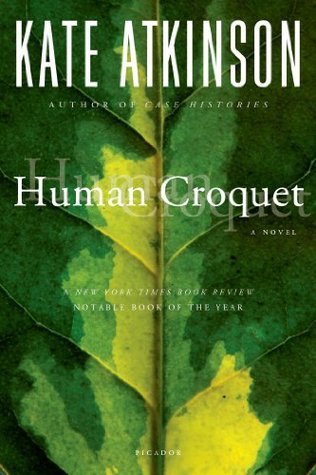
Human Croquet by Kate Atkinson: A review

Human Croquet is actually one of Kate Atkinson's early books. It was published in 1997. As such, I would rank it perhaps in the middle of her works as far as the quality of the plot and the writing. So, not one of her best but certainly not bad and well worth a read. (I don't think Kate Atkinson has ever written a bad book.) 

The book is set in a typical 1960s British suburb called Lythe. Lythe's claim to fame is that it was once the heart of an Elizabethan estate and was the home of a young writer/tutor named William Shakespeare. In the 1960s it was the home of a young girl named Isobel Fairfax. Human Croquet tells her story.

Isobel lives in a home with her quite dysfunctional family that includes a brother who is obsessed with alien abductions and an aunt who lives with many cats in her bedroom. Isobel's mother, Eliza, went missing when Isobel and her brother Charles were only children and they have never really recovered from this loss. Isobel's and Charles' father has remarried but the kids are not too keen on the new wife and Isobel, in particular, still harbors hope that her mother will someday return. 

Isobel is the narrator of the story and she has a wonderful voice. She is intelligent and witty but quite lonely and she had a profound longing for her mother which is central in her life. Isobel also has a very big crush, as only a teenager can, on a boy called Malcolm.

The mystery of Eliza's disappearance and Isobel's longing for her return dominate the story. We also get a good bit of Fairfax family history, along with Shakespearean references. And that would be my one complaint about the book; namely, that there is so much going on that it detracts somewhat from the main story. Nevertheless, Atkinson's depth of characterization and attention to detail are fully present and make for a book that is hard to put down and that the reader is sorry to see end.  


Comments

  1. I don't think Atkinson has ever written a bad book either, Dorothy.

    ReplyDelete
  2. I love the sound of Isobel!

    ReplyDelete
  3. This is an early one - that I don't know of, so thanks for educating me. It has a unique title too, which conjures an image.

    ReplyDelete
    Replies
    1. Yes, that title is very evocative of the story inside.

      Delete
  4. Sounds like a splendid read to me. I can't say as I've read anything by Kate Atkinson, but I've seen plenty of her book titles around. People seem to really enjoy her books.

    ReplyDelete
  5. I write this in 2025. I have enjoyed several of Ms. Atkinson's Jackson Brodie books--a lot!--; and greatly enjoyed "Transcription", or however that's titled. Starting with those more fact-based novels, of course 'Human Croquet' has been a challenge. I thought, "Here Ms. Atkinson lets her inner Ali Smith run free", before getting clear that this, and possibly her inner Ali Smith, preceded the more conventional material.
    Anyway: my experience was "Plodding for the first half and more. Sort of redeemed by the final third. Beautifully imaginative, but doe not completely cohere/come together. Still worth the trip".

    ReplyDelete

Post a Comment

Popular posts from this blog

Poetry Sunday: Don't Hesitate by Mary Oliver

How about we share another Mary Oliver poem? After all, you can never have too many of those. In this one, the poet seems to acknowledge that it is often hard to simply live in and enjoy the moment, perhaps because we are afraid it can't last. She urges us to give in to that moment and fully experience the joy. Although "much can never be redeemed, still, life has some possibility left." Don't Hesitate by Mary Oliver If you suddenly and unexpectedly feel joy, don’t hesitate. Give in to it. There are plenty of lives and whole towns destroyed or about to be. We are not wise, and not very often kind. And much can never be redeemed. Still, life has some possibility left. Perhaps this is its way of fighting back, that sometimes something happens better than all the riches or power in the world. It could be anything, but very likely you notice it in the instant when love begins. Anyway, that’s often the case. Anyway, whatever it is, don’t be afraid of its plenty. Joy is no...

Poetry Sunday: Blackberry-Picking by Seamus Heaney

My mother was a farm wife and a prodigious canner. She canned fruit and vegetables from the garden, even occasionally meat. But the best thing that she canned, in my opinion, was blackberry jam. Even as I type those words my mouth waters!  Of course, before she could make that jam, somebody had to pick the blackberries. And that somebody was quite often named Dorothy. I think Seamus Heaney might have spent some time among the briars plucking those delicious black fruits as well, so he would have known that "Once off the bush the fruit fermented, the sweet flesh would turn sour." They don't keep; you have to get that jam made in a hurry! Blackberry-Picking by Seamus Heaney Late August, given heavy rain and sun For a full week, the blackberries would ripen. At first, just one, a glossy purple clot Among others, red, green, hard as a knot. You ate that first one and its flesh was sweet Like thickened wine: summer's blood was in it Leaving stains upon the tongue and lust ...

Poetry Sunday: Hymn for the Hurting by Amanda Gorman

You probably remember poet Amanda Gorman from her appearance at the inauguration of President Biden. She read her poem "The Hill We Climb" on that occasion. After the senseless slaughter in Uvalde this week, she was inspired to write another poem which was published in The New York Times. It seemed perfect for the occasion and so I stole it in order to feature it here, just in case you didn't get a chance to read it in the Times . Hymn for the Hurting by Amanda Gorman Everything hurts, Our hearts shadowed and strange, Minds made muddied and mute. We carry tragedy, terrifying and true. And yet none of it is new; We knew it as home, As horror, As heritage. Even our children Cannot be children, Cannot be. Everything hurts. It’s a hard time to be alive, And even harder to stay that way. We’re burdened to live out these days, While at the same time, blessed to outlive them. This alarm is how we know We must be altered — That we must differ or die, That we must triumph or try. ...