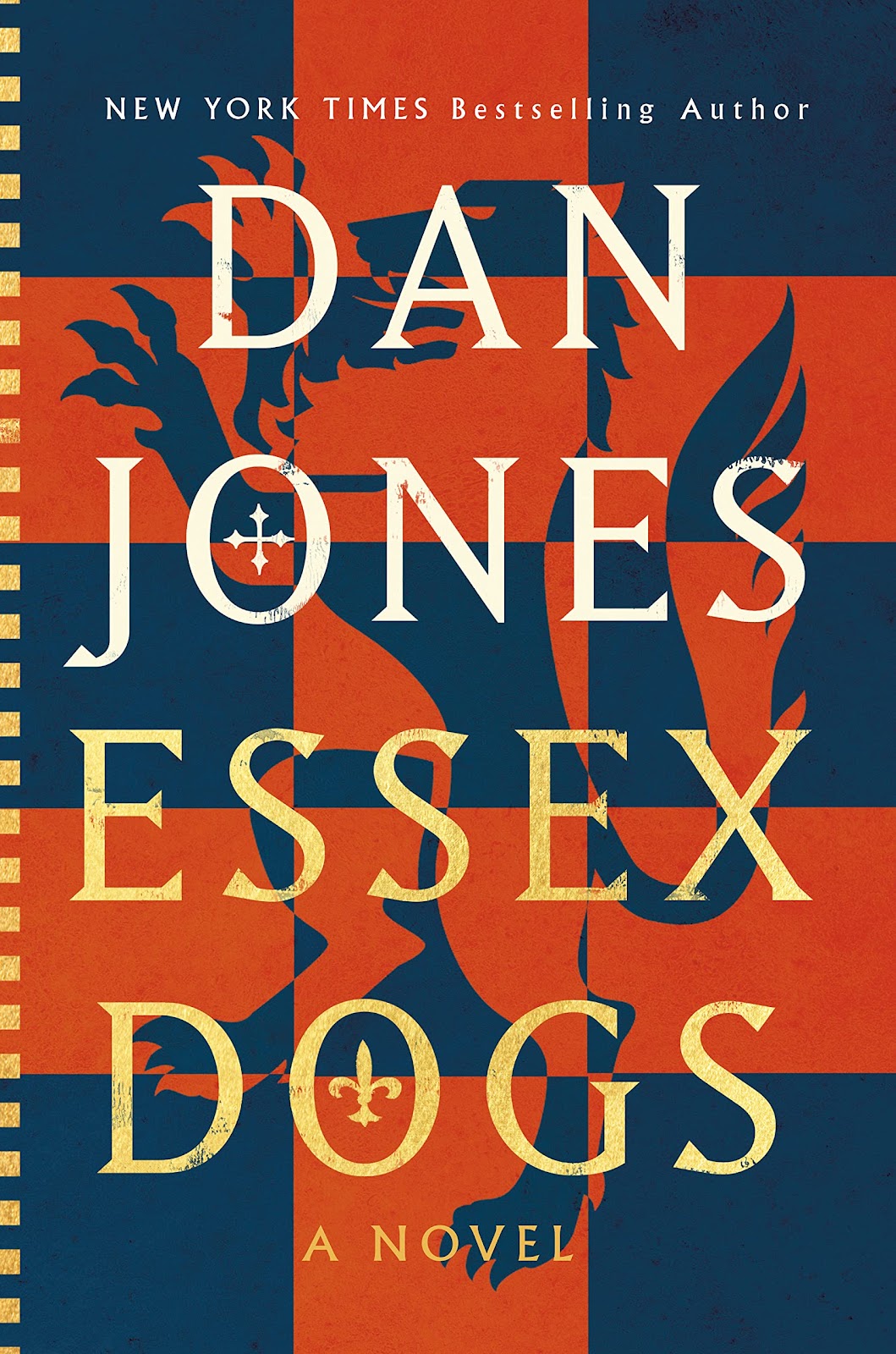
I should state right up front that Essex Dogs is really not my cup of tea. It is a war story and I generally try to avoid stories that take place in a war setting. But I have read and enjoyed books by Dan Jones in the past and so when the title came up I added it to my TBR list. And now I can cross it off that list!
The Essex Dogs of the title are a small group of men-at-arms and archers who fought in the Hundred Years War between England and France as a part of King Edward III's forces. This book, I understand, is the first in a trilogy about the war that is planned by Dan Jones.
The book follows the Essex Dogs during their involvement in the 1346 Crécy campaign. In addition to viewing the conflict through their eyes, we also get the perspectives of renegade priests, the ever-scheming aristocrats and merchants, and the ordinary people who are caught in the conflict mostly against their will. As always, it is these ordinary people caught in the middle who bear the brunt of the abuse resulting from the fighting.
The plot is very much character-driven. The Essex Dogs are a colorful group and probably the thing I enjoyed most about the novel was reading their conversations and banter as they attempt to rally and support each other and keep their spirits up. Although this is the fourteenth century, their interactions seem very modern. Perhaps those who are called on to fight their country's wars never quite change in their responses to the peril in which they find themselves.
Of course one of the ways humans defend themselves in such situations is through humor and that is very much a part of this narrative. We see it especially in the Dogs' dealings with the noblemen who lead them, particularly people like Warwick and Northampton. The humor is a blessed relief to the descriptions of the brutal everyday grind of their slog through the countryside as they endure shredded feet because of split boots and terrible digestive problems. There are some vivid descriptions of agonizing bowel movements as a result of the terrible food they had to eat.
No, being a soldier during a fourteenth-century war definitely was no bed of roses, except for the thorns. There were plenty of thorns. In that regard, I guess not much has changed in almost 700 years.
I like to imagine what it would be like to live long, long ago, so I read the occasional historical fiction. I am certain that had I been a soldier during a fourteenth-century war I'd have been the first killed!
ReplyDeleteWhen I'm reading a book, I tend to imagine myself among the characters. Admittedly, it's a bit difficult to see myself as a fourteenth century soldier, who, as Jones describes it, spent an awful lot of time sitting around waiting for things to happen.
DeleteI don't read a lot of war stories, too. Though the time period of this one is interesting. And I do like more character-driven books.
ReplyDeleteI am SO GLAD you liked it!! Wolves of Winter comes out in October!! I am so excited for it.
ReplyDeleteAlso not my ususal cup of tea but I enjoyed it - very well written. Cheers
ReplyDeleteDo you think you'll read the rest of the trilogy or stop there? I must admit I'm not driven to it.
ReplyDeletePossibly. My reading decisions are often spur of the moment, whatever appeals to me in that moment things. So, we'll see...
Deletethecuecard beat me to the question I was going to ask you! I will skip on reading, Essex Dogs. It sounds like a good read, but like yourself, I'm not big on war stories.
ReplyDelete