A roundup of the week's news of birds and the environment:
*~*~*~*
The Tonga volcanic eruption and its aftermath are still making news. The eruption itself was captured by satellite imagery and could be seen from space. Meanwhile, scientists are trying to understand the global implications of the eruption. Their conclusion is that it may affect global weather, at least in the short term.
*~*~*~*
Ecuador has announced that it is extending protections for the Galapagos Islands to more than 20,000 square miles of ocean to the northeast of the archipelago. No fishing will be allowed in half the area and longline fishing will be banned in the rest.
*~*~*~*
The Cornell Lab of Ornithology has announced a new online course entitled "Feeder Birds: Identification and Behavior." It is designed for backyard birders to learn more about identifying and understanding those birds. And it is all just in time for the Great Backyard Bird Count that takes place annually on Presidents' Day weekend, this year February 18-21.
*~*~*~*
Here's a reminder that the warming ocean is likely to create substantial changes in marine ecosystems.
*~*~*~*
A small pristine seven-acre island that sits in the Prairies River between Montreal and Laval in Quebec has been donated by its 93-year-old owner to the Nature Conservancy of Canada. He had owned the island since the 1960s and had rebuffed many offers over the years from developers to buy the land.
*~*~*~*
The California city of Sunnyvale has been overrun by thousands of American Crows. The streets are "riddled with crow poo" and city officials are planning to use lasers to try to chase the birds away.
*~*~*~*
It is a massacre. The slaughter of gray wolves in the states of Montana, Idaho, and Wyoming has no precedent within the last century.
*~*~*~*
In what is the first known incident of a human-engineered hybridization of species, DNA studies have shown that a female donkey and a male Syrian wild ass were crossed to create the kunga in ancient Mesopotamia 4,500 years ago.
*~*~*~*
Koalas are getting harder to find in the wild, but scientists in Australia are searching for what may be a hidden population of the charismatic animals.
*~*~*~*
Illinois has recently passed the Climate and Equitable Jobs Act which offers a model for other states to build coalitions to help communities and the planet.
*~*~*~*
The cocktail of chemical pollution that pervades the planet threatens the stability of the global ecosystems upon which humanity and, indeed, all life depends. It is past time for drastic action to contain the production and release of those pollutants.
*~*~*~*
And in the Northeast U.S. lead ammunition is hampering the recovery of the Bald Eagle. Ingesting the ammo is killing large numbers of eagles every year, according to a new study.
*~*~*~*
French researchers have discovered one of the world's largest previously unknown healthy coral reefs off the coast of Tahiti. The discovery raises hopes that other such finds may be waiting for explorers.
*~*~*~*
Global climate warming is turning the Arctic green and that is not a good thing.
*~*~*~*
The debate about Pluto's status continues. Is it a planet or isn't it? Well, as far as I'm concerned, that debate is long settled; Pluto always has been and will be a planet!
*~*~*~*

*~*~*~*
The Olympic Cougar Project is a partnership between Native American tribes, a renowned cougar expert, and biologists with the Washington Department of Transportation. Studying the animals means tracking them which depends on fitting them with collars that have batteries. What happens when those batteries have to be changed?
*~*~*~*
The summer heat torturing the southern hemisphere continues. On January 13, Australia tied the record high temperature for the southern hemisphere at 123.3 degrees F. That record had held since 1060.
*~*~*~*
A rare Hawaiian plant sometimes referred to as a "cabbage on a stick," was declared extinct in the wild in 2020, but it persists thanks to the efforts of dedicated biologists.
*~*~*~*
The Biden administration is expanding efforts to stave off catastrophic wildfires in the West. The plan is to more aggressively thin forests around "hot spots" where Nature and neighborhoods collide. The plan is set to cost $50 billion.
*~*~*~*
The iconic Joshua trees of the Mohave Desert are facing several threats to their survival including climate change and human development. But a dedicated band of volunteers is planting Joshua seedings to try to replenish the ravaged forest.
Thank you for the roundup, Dorothy. I am tickled with the story of the fellow in Québec donating his island to the Nature Conservancy, but I am absolutely dismayed at the unwarranted, barbaric slaughter of grey wolves in those sparsely populated western states. It is activities such as this that reinforce the nation that we are unable to learn from our past errors, and bloodlust is still a dominating force for many. It also confounds me that lead shot is still being used after the evidence for years and years that lead is a serious killer for birds, especially waterfowl and birds of prey that consume them. Plus ça change plus c'est la même chose.
ReplyDeleteIt is astounding that, as a supposedly intelligent species, we seem to have so much trouble learning from our mistakes.
Deletelogging companies salivate at "thinning": they get paid for both the trees and the effort... kudos to Ecuador!
ReplyDeleteEcuador has been a model of ecological responsibility.
DeleteI've had a soft spot for wolves ever since I read Nate Blakeslee's book, American Wolf. I cannot understand how the slaughter of wolves has been allowed to be resumed.
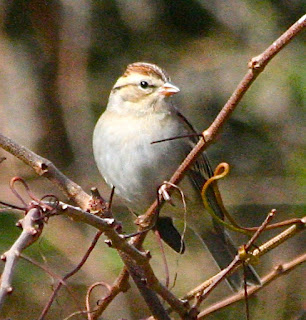
ReplyDeleteWe've not had any sparrows yet this year. We are being overwhelmed with American Goldfinches right now.
The goldfinches are dominating my feeders just now, too. We went from seeing only a few a couple of weeks ago to them being omnipresent in large numbers now.
DeleteI've been reading about those crows in Sunnyvale. I hope the "fixers" are taking into account that crows are extremely intelligent. (I'm also getting a flashback or two to Hitchcock's The Birds...)
ReplyDeleteNot so easy to get the best of crows because of that intelligence, but I guess a town covered in their poo is a great incentive to try!
DeleteCabbage on a stick lol. I love the name and am so glad it's persisting! I can't even believe that Australia got that hot and broke that record!!!
ReplyDeleteIt is incredible to think of temperatures that hot, but we may not have to imagine them in the very near future.
Delete