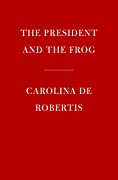
It is a short book at only around 220 pages so one could almost read it in one sitting if one had nothing else to do. Carolina De Robertis packs quite a lot into those few pages. She gives us the story of an 82-year-old man who is the former president of a South American country that is never actually named but is assumed to be Uruguay. He is about to be interviewed by a television journalist from Norway and as he waits for her he reflects on his life and on the part of it that he does not want to reveal to anyone. That secret part is his relationship with a frog.
As a much younger man, the former president had taken part in an attempted revolution against the autocratic government that was then in power. The attempt was unsuccessful and many of the revolutionaries, including him, were captured and imprisoned in solitary confinement for years. His cell for the first four years was a hole in the ground with a grate covering part of the top through which food was lowered to him each day and through which he was extracted from time to time for "questioning," i.e., torture. His only light came through that grate and his only companions at first were the spiders and bugs that found their way into his hole, but finally, another creature joined him there: a frog.
This was no ordinary frog. For one thing, he could talk. He was, in fact, a philosopher frog, a snarky and prescient frog, and he and the future president had many long conversations about life and its meaning. They talked about the quest for justice and dignity and what it means to love a country. Those conversations are full of irony and satire as they reflect on politics, on the disparities endemic in society, and the systemic racism that seems so hard to root out. Their conversations are sometimes funny, sometimes moving, but always insightful. And they are a secret that the ex-president has carried with him for more than forty years.
The interview with the journalist takes place in 2016 after the presidential election in the United States and that, too, comes up in the conversation. The ex-president marvels at the idea that a country could freely elect such an ignoramus to be its leader.
This is the third of De Robertis' books that I have read after The Gods of Tango and Cantoras and I think it may be my favorite. It is very different from the other two books but it has in common with them her brilliant insights into what it is to be human. It is part historical fiction and part fable and she ties all of that together beautifully with masterful writing. The technique she employs is to flash back and forth through time as we witness the interactions with the frog who urges the man to dig deep and find "the One Thing" and the conversation with the interviewer who expresses concern about the ramifications of climate change and of the American election. The result of comparing and contrasting the two conversations is to give us a sense of the indomitable human spirit that finds hope and optimism even in the face of the grimmest reality.
It's difficult to adequately describe this novel. There isn't much of a plot and one can't really say it is character-driven. The "action" takes place entirely in the head of the main character, as we are privy to his thoughts and memories. It's not a book that everyone would enjoy, but I loved it and I'm just glad I finally got to it at the end of the year.
My rating: 5 of 5 stars
it's wonderful to find a book that inspires like that... increasingly rare as one ages, tho, i've found anyhow...
ReplyDeleteIt is oddly inspiring. That was one very wise frog!
DeleteThis sounds great. I've never heard of the author. Thanks!
ReplyDeleteShe has written several books of which I've now read three and she's quite talented.
DeleteA philosopher frog! That's awesome. And what a unique premise for a story. :)
ReplyDeleteIt was unique.
DeleteI'm curious as to whether or not the author actually uses a talking frog, or if it is a way for the main character to hold conversations with himself and work out things in his head during his imprisonment. Does she make it clear one way or the other?
ReplyDeleteThe frog is real to him - a creature that he can touch and hold. But is he an actual frog or an invention of his imagination? That's something the reader would have to decide.
DeleteSuch an interesting sounding book. I've read a couple of stories where most of the plot is revealed through internal thoughts of the thoughts and reflections of the main character. This is a style that worked well for me - Mrs March, by Virginia Feito was such a book.
ReplyDeleteIt can be a very effective technique, as it definitely was with this book.
Delete