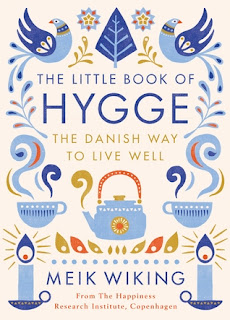
The Little Book of Hygge by Meik Wiking: A review


I chose this book as my final read of 2021. It turned out not to be that because I managed to squeeze another in, but this one was chosen as a comfort read. It is literally about comfort. Coziness, happiness, being comfortable in your own skin and appreciating the life you have. Doesn't that sound like a positive note on which to end the year?

The author of the book, Meik Wiking, is the CEO of the Happiness Research Institute in Copenhagen. (Yes, apparently there is such a thing!) Whenever there are polls about which country is the happiest, Denmark inevitably ends up at or near the top so it is appropriate, I guess, that the Happiness Research Institute is located there. 

And what are the things that Danes associate with this feeling of happiness? Wiking lists them from most to least important as follows: hot drinks, candles, fireplaces, Christmas, board games, music, holiday, sweets and cakes, cooking, and books. I find it interesting that at least half those things are related to light or food. I also find it interesting that books are last. Oh, well, at least they made the list.

Danes spend a disproportionate amount of their income on lighting and some of their most popular designers are designers of lamps or other lighting. They are also the world's highest consumers of candles. They light them daily to create a mood throughout much of the year.

They love indulging their sweet tooth. For example, they consume twice the amount of sweets as other Europeans. And they love cooking. Their pleasure comes from the process of preparing food and if it is complicated and takes a long time, so much the better!

They prefer casualness in their dress and in their home furnishings. Their clothing tends to rely on soft natural fabrics like wool. Danish furniture is simple in style and uses a lot of wood in its designs. Tactility is very important to them.  

Hygge, in short, is a word that implies indulging all the senses. It's what makes us feel cozy. Now, all of that could be said in one short sentence, but Meik Wiking does go on and on about it. Not that the book is that long at less than 300 pages, but after a while, it started to feel like War and Peace to me. Except that War and Peace is not endlessly repetitive. The writer basically states the same idea over and over again in as many different ways as he could come up with. And I pretty quickly lost patience with him. I ended up skimming most of the book, seeing if there was any new idea there that I needed to concentrate on. There wasn't. 

My rating: 2 of 5 stars


Comments

  1. LOL, i love the idea but i can see that it could be wearing... i asked Ms. M if she'd heard of the Happiness Institute and she quoted chapter and verse at me, haha... i wish i was Danish....

    ReplyDelete
    Replies
    1. Apparently, they are a very happy people and I guess they do have a lot to be happy about.

      Delete
  2. From what you say about this one's repetitiveness, I don't think I would have made it to the end. Your are obviously tougher than me.

    ReplyDelete
    Replies
    1. The first third or so of the book was pretty interesting. The last two-thirds went fast because I didn't linger over any of it.

      Delete
  3. I wouldn't make it through this book, though I do love the idea of creating more coziness and happiness in your life. :)

    ReplyDelete
    Replies
    1. It is an attractive idea and the author dealt pretty adequately with it in the first one hundred pages.

      Delete
  4. This sounded interesting and the cover is cute but I'm going to pass for sure.

    ReplyDelete
  5. Ha. Sounds like happiness took a back seat to repetitiveness. Still I'd like to go to Denmark for a trip and cozy next to the fireplace with some hot cocoa.

    ReplyDelete
    Replies
    1. Oh, absolutely! It must be a wonderful place to be home to some of the happiest people on the planet.

      Delete

Post a Comment

Popular posts from this blog

Poetry Sunday: Don't Hesitate by Mary Oliver

How about we share another Mary Oliver poem? After all, you can never have too many of those. In this one, the poet seems to acknowledge that it is often hard to simply live in and enjoy the moment, perhaps because we are afraid it can't last. She urges us to give in to that moment and fully experience the joy. Although "much can never be redeemed, still, life has some possibility left." Don't Hesitate by Mary Oliver If you suddenly and unexpectedly feel joy, don’t hesitate. Give in to it. There are plenty of lives and whole towns destroyed or about to be. We are not wise, and not very often kind. And much can never be redeemed. Still, life has some possibility left. Perhaps this is its way of fighting back, that sometimes something happens better than all the riches or power in the world. It could be anything, but very likely you notice it in the instant when love begins. Anyway, that’s often the case. Anyway, whatever it is, don’t be afraid of its plenty. Joy is no...

Poetry Sunday: Blackberry-Picking by Seamus Heaney

My mother was a farm wife and a prodigious canner. She canned fruit and vegetables from the garden, even occasionally meat. But the best thing that she canned, in my opinion, was blackberry jam. Even as I type those words my mouth waters!  Of course, before she could make that jam, somebody had to pick the blackberries. And that somebody was quite often named Dorothy. I think Seamus Heaney might have spent some time among the briars plucking those delicious black fruits as well, so he would have known that "Once off the bush the fruit fermented, the sweet flesh would turn sour." They don't keep; you have to get that jam made in a hurry! Blackberry-Picking by Seamus Heaney Late August, given heavy rain and sun For a full week, the blackberries would ripen. At first, just one, a glossy purple clot Among others, red, green, hard as a knot. You ate that first one and its flesh was sweet Like thickened wine: summer's blood was in it Leaving stains upon the tongue and lust ...

Poetry Sunday: Hymn for the Hurting by Amanda Gorman

You probably remember poet Amanda Gorman from her appearance at the inauguration of President Biden. She read her poem "The Hill We Climb" on that occasion. After the senseless slaughter in Uvalde this week, she was inspired to write another poem which was published in The New York Times. It seemed perfect for the occasion and so I stole it in order to feature it here, just in case you didn't get a chance to read it in the Times . Hymn for the Hurting by Amanda Gorman Everything hurts, Our hearts shadowed and strange, Minds made muddied and mute. We carry tragedy, terrifying and true. And yet none of it is new; We knew it as home, As horror, As heritage. Even our children Cannot be children, Cannot be. Everything hurts. It’s a hard time to be alive, And even harder to stay that way. We’re burdened to live out these days, While at the same time, blessed to outlive them. This alarm is how we know We must be altered — That we must differ or die, That we must triumph or try. ...