A roundup of the week's news of birds and the environment:
*~*~*~*
And here's an ecologist who believes that. He says that fighting climate change and protecting biodiversity starts at home. One way to start is to get rid of the lawn.
*~*~*~*
California has plans to launch a system for ranking heat waves. The idea is that categorizing the weather events will help communities to better plan for reducing heat-related fatalities.
*~*~*~*
In the largest single translocation of its kind, thirty white rhinos have been flown from South Africa to Rwanda in a bid to secure the future of this endangered species. They have been rehomed in Akagera National Park in that country.
*~*~*~*
The stock market helping preserve coral reefs? So it would seem. A Nobel-winning economic theory is being used to select 50 reefs as the ones most likely to survive climate change and help reestablish reefs elsewhere.
*~*~*~*
The fragile ecosystem of Antarctica is being threatened by climate change, invasive species, and human activity.
*~*~*~*
A federal grant program from the Department of Transportation that had been primarily used for highways in the past is now being directed toward more car-free means of getting around.
*~*~*~*
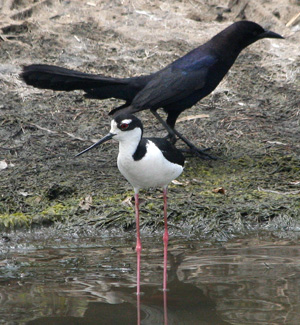
Data analysis has revealed which birds are the biggest jerks at the bird feeders. The researchers ranked the American Crow as the worst with Common Grackles closely following. I don't get crows at my feeders and only occasionally grackles. I can say unequivocally that the biggest bullies here are Northern Mockingbirds and Red-bellied Woodpeckers.
*~*~*~*
The social-spending bill that is currently before Congress would place limits on offshore oil and gas drilling. In fact, it would outlaw most such drilling.
*~*~*~*
The worst offender in producing the plastic waste that is inundating the planet is the United States. We produce about 42 million metric tons of plastic waste each year which is more than all of the E.U. countries combined.
*~*~*~*
How can we design policies and strategies for adaptation to climate change into the future? Ancient cities that survived over centuries have a lot to teach us about that.
*~*~*~*
Portugal has created the largest marine sanctuary in the North Atlantic. The reserve spans 12 nautical miles around the Selvagens Islands off the northwestern African coast. It covers 1,034 square miles.
*~*~*~*
Shockingly, a new report found that one-third of the world's sharks and their relatives are threatened with extinction.
*~*~*~*
Another new study reveals, not surprisingly, that Atlantic hurricanes are increasing in their number and ferocity. They are the most costly weather disasters for this country which would seem to be an incentive to try to do something to prevent them.
*~*~*~*
The northeastern part of Brazil is slowly becoming a desert. The area has long been a victim of droughts but climate change is causing them to become more intense, leaving the land barren.
*~*~*~*
As the Arctic is being transformed by climate change, it is receiving more rain and less snow. The change does not just affect the Arctic but the whole planet because "What happens in the Arctic doesn't stay in the Arctic."
*~*~*~*
Thacker Pass in Nevada is rich in lithium deposits but it is on land that is sacred to the Paiute people. They are fighting to preserve their land from a lithium mining operation.
*~*~*~*
Ten years ago, some of the world's biggest companies pledged to change their practices in order to help end deforestation by 2020. How successful has that pledge been?
*~*~*~*
Guyana, at least, offers a bright spot in the preservation of the rainforest. Trees cover 90 percent of its land and the country has been remarkably successful in protecting it.
Than you, Dorothy, for the Saturday roundup, the great contribution you make to the blogging world each week. The biggest challenge to science is coming from religious fundamentalists based on what I have seen and read. They deny even the obvious. I wonder if they think science had any hand in the modern, computer-directed car they drive, or do they claim that their version of god is now making fuel-injection systems? The figures on plastic waste produced by the United States are both staggering and shameful. But I guess somebody's god made that too!
ReplyDeleteI will never really understand those who completely deny science and yet live with all the conveniences it has given us every day of their lives.
DeleteI especially like the link to the article that lists thirty-one things an individual can do to fight climate change. I intend to start by collecting books that offer suggestions for ways children do fight climate change for my Little Free Library. I just put one book out there.
ReplyDeleteIt feels good to do something.
Yes, I was quite happy to see that article also. It's good to be able to actually do something positive and not just complain.
Deletei wish some Guyaninians would move here. logging is turning the NW into a monoculture, with many species dying out... to say nothing re the adverse effect on climate change...
ReplyDeleteThey have an admirable record of protecting their forests. If they can't move here, one wishes they could at least export that ethos.
DeleteWe have a LFL a short walk from our house! One huge contributing factor to landfills is the tons of Christmas wrapping paper that can't even be recycled. For several years, I've made fabric bags and used furoshiki fabric wrapping that can be reused. My SIL always returns his fabric if he gets a furoshiki wrapped gift. :)
ReplyDeleteWhat an excellent idea!
DeleteIt's neat to think of white rhinos on a 747 airplane. Wow. What an undertaking. Interesting story.
ReplyDeleteI agree that 30 rhinos on a plane is quite a picture.
Delete1/3 of all the sharks.... that's insane. Such a huge number. I would've never guessed. But on a positive note.... go Portugal!
ReplyDeleteIt is surprising - or maybe not so - that so many sharks are in trouble.
DeleteThanks for posting the "possible for individuals to take positive actions" article, Dorothy!
ReplyDeleteI remember me commenting something about it feeling so pointless sometimes. I'm definitely going to read this article and see what I can do!
It is good to feel that there are at least some positive actions that we as individuals can take.
Delete