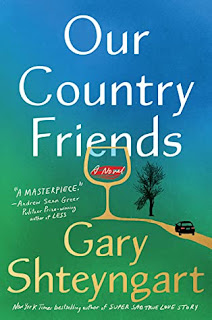
At a country house surrounded by four one-bedroom bungalows in upstate New York owned by the Levin-Senderowskys, a Russian-born novelist and his Russian-born psychiatrist wife, five friends gather. There is a woman who is an extremely successful Korean American app developer; a man who is a struggling Indian American writer; a woman essayist from the South who specializes in provocative pieces; a man who is a world traveler with several passports; and finally, an actor who is never named but who may appear in a television show written by the novelist. The five join the Levin-Senderowskys and their precocious adopted Asian pre-teen daughter who is obsessed with K-pop. They will be together at the estate for the next several months as they try to wait out the pandemic.
Sasha Senderowsky is the Russian-born novelist. His main purpose in inviting these people to stay in his bungalows seems to be to convince the actor to work with him on the film that he wants to make. His wife is Masha and her main concern is enforcing social distancing and mask-wearing among this group. They come to think of her as the pandemic nazi. Their daughter, Natasha called Nat, appears to have special needs, perhaps being on the autism spectrum. She is a delight and the most sympathetic character in this group of fairly self-absorbed people.
The obsessions of these adults seem to be depressingly stereotypically American: money, sex, and booze. None of them appear to have any real self-awareness or a full appreciation of what is happening in the world. It goes without saying perhaps that their sense of their own importance in that world is extremely inflated.
Shteyngart no doubt intended this to be witty and satirical and at times he achieves that purpose. There are bits that are quite funny. Most of them involve the antics of Nat. But satirizing a situation in which millions have died, many of them needlessly, requires an extremely deft touch and I felt that this writer was not quite up to the task. Moreover, the characters are essentially stereotypes, and that, I guess, is supposed to serve as "character development" but again, it didn't quite do the trick for me.
This novel has been highly praised and I looked forward to reading it as I had thoroughly enjoyed Shteyngart's Super Sad True Love Story and I did enjoy parts of it. It was entertaining up to a point but the story became repetitive and less than a hundred pages from the end, it just sort of petered out. The ending itself felt like an afterthought, something tacked on for dramatic value.
I debated about what rating I should give this book and I have to acknowledge that my reaction to it may be as much a reflection of our current situation as it is a true assessment of the writing. It may be that if I read it for the first time a few years hence, I might find it more amusing. But I read it now amid all the baggage of December 2021 and it is what it is.
My rating: 3 of 5 stars
Thought-provoking review, Dorothy. I will probably give this one a miss. I've had a run of reading about self-absorbed people, and I can only take so much before I want to run screaming into the night. :-)
ReplyDeleteI know that feeling well, Cathy. The book that I read just after this one had a bit of the same problem and I'm more than ready for something else!
DeleteIt's very difficult for me to read books about the pandemic right now, and reading about self-absorbed people during the pandemic sounds even less appealing. Thanks for sharing your thoughts. I'll give this one a pass.
ReplyDeleteWriting about the pandemic must be an incredible challenge for a novelist at the moment. I guess I have to give Shteyngart props for attempting it even if I felt it was less than successful
DeleteI have this one but, I'm a tad bit less interested now so I'll probably back-burner it for now. Sorry it wasn't a winner.
ReplyDeleteMy opinion is definitely in the minority here. You might be more in agreement with the majority.
Deletei'm not at all familiar with books like this... that is to say, written after about 1960 or so... i suppose there's a case to be made for egoistic trauma as a literary trope, but i confess to not having much interest in it...
ReplyDeleteWell, not all books written after 1960 are based on egoistic trauma, but this one is certainly full of egoistic characters.
DeleteGreat review, Dorothy. It's an interesting point that you make about the contrast between reading this novel while then pandemic is still ravaging our lives and reading it when we can look back on it. As you say,one might view it differently given the perspective of time.
ReplyDeleteYes, time and experience certainly give us added perspectives.
DeleteOh that's a fair assessment. I like your thoughts about this one ... it is hard to read satire right now about the pandemic. And when things get repetitive then it's tough to muddle on. Still it's okay to like Gary.
ReplyDeleteI have always enjoyed Shteyngart before. This one was just a little disappointing.
Delete